
Critical Thinking and other Higher-Order Thinking Skills
Critical thinking is a higher-order thinking skill. Higher-order thinking skills go beyond basic observation of facts and memorization. They are what we are talking about when we want our students to be evaluative, creative and innovative.
When most people think of critical thinking, they think that their words (or the words of others) are supposed to get “criticized” and torn apart in argument, when in fact all it means is that they are criteria-based. These criteria require that we distinguish fact from fiction; synthesize and evaluate information; and clearly communicate, solve problems and discover truths.
Why is Critical Thinking important in teaching?
According to Paul and Elder (2007), “Much of our thinking, left to itself, is biased, distorted, partial, uninformed or down-right prejudiced. Yet the quality of our life and that of which we produce, make, or build depends precisely on the quality of our thought.” Critical thinking is therefore the foundation of a strong education.
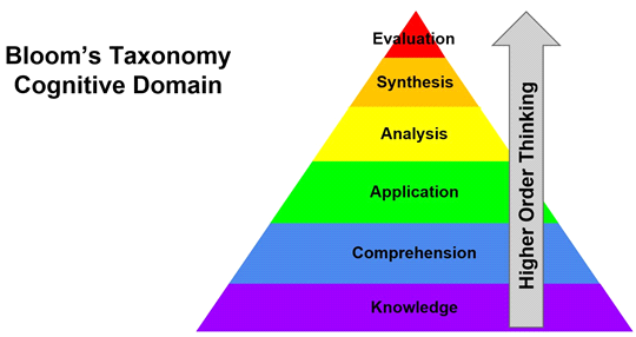
Using Bloom’s Taxonomy of thinking skills, the goal is to move students from lower- to higher-order thinking:
from knowledge (information gathering) to comprehension (confirming)
from application (making use of knowledge) to analysis (taking information apart)
from evaluation (judging the outcome) to synthesis (putting information together) and creative generation
This provides students with the skills and motivation to become innovative producers of goods, services, and ideas. This does not have to be a linear process but can move back and forth, and skip steps.

