
目录

  • 1 Introduction about the Course
    • 1.1 Teaching Guidelines for Undergraduate English Majors
    • 1.2 Chinese English Proficiency Level Scale
    • 1.3 本课程成绩评定方式
    • 1.4 Critical Thinking and other Higher-Order Thinking Skills
      • 1.4.1 critical thinking in everyday life
    • 1.5 Classical articles about reading
      • 1.5.1 Of studies(Francis Bacon)
      • 1.5.2 Nicolas Shump's experience on reading
      • 1.5.3 three articles in Chinese
    • 1.6 Reading skill:skimming and scanning
    • 1.7 Steve Jobs at Stanford University
  • 2 To Youth
    • 2.1 pre-reading
      • 2.1.1 Lawrence scientific school
    • 2.2 In-reading
      • 2.2.1 How to paraphrase sources
      • 2.2.2 a video on paraphrasing
      • 2.2.3 Comment on Look at Your Fish
      • 2.2.4 The power of storytelling
      • 2.2.5 Wei's Speech
    • 2.3 after-reading
      • 2.3.1 The Freedom of Thought or "A Pencil is the Best of Eyes"
      • 2.3.2 The main idea of another version of Look at your fish
      • 2.3.3 River Baptism By Garth Gilchrist
      • 2.3.4 TED: the power of observation
    • 2.4 Reading skills: undertanding topics
  • 3 Language Diversity
    • 3.1 pre-reading
      • 3.1.1 Genesis
      • 3.1.2 latest news
      • 3.1.3 Mother tongue课文音频
      • 3.1.4 video on how to make prediction
    • 3.2 In-reading
      • 3.2.1 The story of the Tower of Babel
      • 3.2.2 Chomsky's universal grammar
      • 3.2.3 rain的中英文表达
      • 3.2.4 language diversity
    • 3.3 after-reading
      • 3.3.1 the connection of habit、inhabit、cohabit等词的关联
      • 3.3.2 Video1: Amy Tan's speech in White House
      • 3.3.3 Video2: Meet Amy Tan
    • 3.4 Yuelu Proclamation
      • 3.4.1 岳麓宣言
    • 3.5 Reading skills:finding the main idea
  • 4 Beauty, Love and Sacrifice
    • 4.1 pre-reading
      • 4.1.1 the Happy Prince
      • 4.1.2 aesthetic movement
    • 4.2 in-reading
      • 4.2.1 connote VS denote
      • 4.2.2 statue, status, statute, stature
      • 4.2.3 Further reading on Aestheticism art movement
    • 4.3 after-reading
      • 4.3.1 Irony in the Gift of Magi
      • 4.3.2 Life reads life a poem by Lin yutang
      • 4.3.3 seven stages by Shakespear
      • 4.3.4 Redefine beauty-TED: how to define yourself
  • 5 To lie or not to lie
    • 5.1 pre-reading
      • 5.1.1 on the decay of the art of lying中文
    • 5.2 In-reading
      • 5.2.1 Meeting of the Historical and Antiquarian Club
      • 5.2.2 The three Graces
      • 5.2.3 The nine Muses
    • 5.3 after-reading
      • 5.3.1 hand和way搭配
      • 5.3.2 Movie clip of Twelve Anry Men
    • 5.4 Reading skills: recognizing  the implied main idea
    • 5.5 video on to be or not to be
  • 6 The Use of Humanities
    • 6.1 pre-reading
      • 6.1.1 brief introduction to Shakespeare
      • 6.1.2 brief introduction toJohn Milton
    • 6.2 in-reading
      • 6.2.1 English idiom:tongue-in-cheek
    • 6.3 after-reading
      • 6.3.1 reading skills: inferring
    • 6.4 video of  online class on unit 6
  • 7 Conflicts in Public and Private Space
    • 7.1 pre-reading
      • 7.1.1 a video about Einstein
  • 8 Education
    • 8.1 The Ron Clark Story(热血教师)
    • 8.2 The Washiongton Post reading
    • 8.3 Hogwarts-inspired middle school in the heart of Atlanta
    • 8.4 视频:that is why I choose Yale
    • 8.5 stand-up comedy
  • 9 Environmental Protection
    • 9.1 death watch for the Amazon
    • 9.2 the earth song
    • 9.3 video clip of the Day after Tomorrow
    • 9.4 official trailor of Carbon bomb
    • 9.5 the debate over climate
    • 9.6 Congo’s enormous rainforest is getting smaller
    • 9.7 Reading and translation
  • 10 Number Games in China
    • 10.1 TED Video: the ugliest woman
    • 10.2 Students borrowing money for cosmetic surgery
    • 10.3 Cosmetic surgery on the rise in China
  • 11 Britain Today
    • 11.1 Brexit after May
    • 11.2 video
    • 11.3 UK
  • 12 The changing American Culture
    • 12.1 Reading: I have a dream
    • 12.2 Newyork Times:Is American dream real?
    • 12.3 TED living the American Dream
  • 13 Communication and Interpersonal Skills
    • 13.1 Men are from Mars, Women are from Venus
    • 13.2 Quotes
    • 13.3 An essay on what is communication
    • 13.4 how to be a good communicator
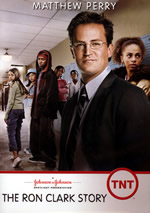
The Ron Clark Story(热血教师)

The Ron Clark Story

By J. Byron Dean


Air Date: August 13, 2006 on TNT

TV Rating: TV-PG-L 
Staring: Matthew Perry, Hannah Hodson, Brandon Smith, Ernie Hudson, Bren Eastcott
Genre: Drama with comedic moments, True story

Recommended Age: 8+

Sex: green

Language: green

Violence: yellow

Overall PTC Rating: green 


The Ron Clark Story tells the real-life saga of a North Carolina grade school teacher with an amazing record of success with students; his unique teaching style brings out the best in even the worst students and he tests his mettle in one of the toughest classrooms in America. An exceptionally inspiring movie, The Ron Clark Story is suitable for family viewing and for children 8-years old and up.


In the title role, Matthew Perry steps away from his comfortable, and much loved, image of Chandler Bing from Friends to bring us into the world of a gifted teacher, Ron Clark. Having achieved great success with students in his local school system, Ron believes that he can do much more good outside of his small home town, so he moves to New York City, hoping to teach underprivileged kids in the inner city.  But being Caucasian is a drawback in Harlem and none of the New York City public schools will hire him.  Here Clark exhibits one of his strongest traits: he never gives up, not on his students and not on getting hired.  He knows he can make a difference if given the chance. Destiny intervenes one day when he observes a teacher getting rough with a student who is trying to leave campus.  The teacher fights with the school's principal and quits, giving Clark the opportunity to let his availability be known.  At first he is ignored but finally the principal decides to give him a chance.  He is given a class that includes what everyone considers to be the "losers," the worst students in the school.  They have the lowest grades, are the most unruly, and the least achieving.  But Ron Clark sees potential in every child and will not give up on them. 


The steps he takes, the approaches he makes, the energy he extends and the devotion he shows produce a wonderful outcome.  He reaches the children that everyone, including their parents, had written off.  He successfully brings out their strengths: the artist, the scientist, the math wiz.  Best of all he makes each of them aware of their own self-worth.  He gives them more than an education and a desire to keep on learning; he gives each one the knowledge that they do matter, and that when they put their hearts and minds to it, they can achieve anything.


There is very little offensive content in this movie. The only swear words are "lazy ass" and "damn," each said only once. There is one moment of violence involving a foster father beating his foster son, though the actions are off screen.   In the following scene Clark finds the boy, with blood on his face, in an alley.  Later the boy is shown with a cast on his arm.


In all The Ron Clark Story is full of redeeming, positive messages and values. The PTC gives this film an over-all green rating.