-
1 导学
-
2 视频
阅读文章:
What Is Disruptive Innovation?
Disruptive innovation, a term of art coined by Clayton Christensen, describes a process by which a product or service takes root initially in simple applications at the bottom of a market and then relentlessly moves up market, eventually displacing established competitors.
Harvard Business School professor Clayton M. Christensen most famously described his Disruptive Innovation Model in his worldwide bestseller, The Innovator’s Dilemma (1997). The model identifies three critical elements of disruption.

First, in every market, there’s a rate of improvement that customers can utilize or absorb, represented by the dotted line slopping gently upward across the chart. To simplify the chart, customers’ ability to utilize improvement is depicted as a single line; in reality, there’s a distribution of customers around this median—a range indicated by the distribution curve at the right. Customers in the highest or most demanding tiers may never be satisfied with the best that’s available and those in the lowest or least demanding tiers can be oversatisfied with very little. The dotted line represents technology that’s ‘good enough’ to serve customers’ needs.
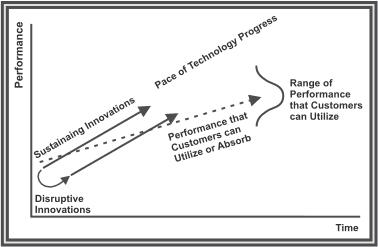
Second, in every market there’s a distinctly different trajectory of improvement that companies provide as they introduce new and improved products. This pace of technological progress almost always outstrips the ability of customers in any given tier of the market to use it, as the more steeply sloping lines in the chart suggest. Accordingly, a company whose products are squarely positioned on mainstream customers’ current needs today will probably overshoot what those same customers are able to utilize in the future. This happens because companies keep striving to make better products that they can sell for higher profit margins to not-yet-satisfied customers in more demanding tiers of the market.
The third critical element of the model is the distinction between sustaining and disruptive innovation. A sustaining innovation targets demanding, high-end customers with better performance than what was previously available. Some sustaining innovations are the incremental year-by-year improvements that all good companies produce. Other sustaining innovations are breakthrough, leapfrog-beyond-the-competition products. It doesn’t matter how technologically difficult the innovation is, however: The established competitors almost always win the battles of sustaining technology. Because this strategy entails making a better product that they can sell for higher profit margins to their best customers, the established competitors have powerful motivations—and the resources—to fight and win sustaining battles.
Disruptive innovations, in contrast, don’t attempt to bring better products to established customers in existing markets; rather, they disrupt and redefine that trajectory by introducing products and services that are not as good as currently available products. But disruptive technologies offer other benefits—typically, they are simpler, more convenient and less expensive products that appeal to new or less-demanding customers.
Once the disruptive product gains a foothold in new or low-end markets, the improvement cycle begins. And because the pace of technological progress outstrips customers’ abilities to use it, the previously not-good-enough technology eventually improves enough to intersect with the needs of more demanding customers. When that happens, the disruptors are on their way to defeating the incumbents. This distinction is important for innovators seeking to create new-growth businesses. According to Christensen’s model, whereas current leaders of the industry almost always triumph in battles of sustaining innovation, successful disruptions have been launched most often by entrant companies.
As companies tend to innovate faster than their customers’ needs evolve, most organizations eventually end up producing products or services that are actually too sophisticated, too expensive, and too complicated for many customers in their market.
However, by doing so, companies unwittingly open the door to “disruptive innovations” at the bottom of the market. An innovation that is disruptive allows a whole new population of consumers at the bottom of a market access to a product or service that was historically only accessible to consumers with a lot of money or a lot of skill.
Characteristics of disruptive businesses, at least in their initial stages, can include: lower gross margins, smaller target markets, and simpler products and services that may not appear as attractive as existing solutions when compared against traditional performance metrics. Because these lower tiers of the market offer lower gross margins, they are unattractive to other firms moving upward in the market, creating space at the bottom of the market for new disruptive competitors to emerge.
完成测试:
参与讨论:

