I Basic situation of the course
(1)Course overview
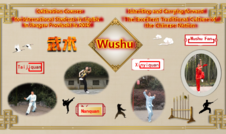
Wushu is a traditional national sport based on Chinese traditional culture, which pays attention to both internal and external training and lays equal stress on skills and morality. As a characteristic event of Chinese traditional culture, it is an essential part of spreading Chinese culture. It is a business card of Chinese culture, which brings not only movement elements in routine, but also Wushu spirit in Chinese culture and traditional virtues.
Wushu originates in China and belongs to the world.
In recent years, with the improvement of China's comprehensive national strength, more and more international students come to China to study or exchange. Most of them come to China to learn Chinese and professional skills they are interested in. And also, they have a strong interest in Chinese traditional culture, as well as Chinese Wushu. Therefore, it can not only enrich their spare time, but also enable them to better understand Chinese traditional culture to set up Wushu courses among international students.
Nanjing Tech University, as one of the Target Universities of Overseas Studying in Jiangsu Province, has nearly 400 international students from 36 countries, such as UK, Italy, Russia, Kazakhstan, Bangladesh, Pakistan, South Korea, etc. Since 2016, Wushu course taught in English has been offered for undergraduate international students, which is a non-degree course, and a compulsory credit course for undergraduate international students in our university. The course time is divided into autumn semester (September to next January) and spring semester (March to June), there are two rounds for a academic year, and the average teaching scale is 60 students per class with 100% proportion of international students.
Course leaders mobilized all teachers to compile the syllabus on Wushu, which fully absorbed the latest achievements of the development of modern Wushu and the experience of Wushu curriculum reform in sister colleges. Now, there formed a relatively complete system of Wushu syllabus for international students, and the methods of teaching have also developed to modern multimedia teaching and make full use of online resources for teaching, from simple means of teaching, as greatly improved the quality of teaching.
(2)Course Type: non-degree course
(3)Course Time: autumn semester (September to next January) ;
spring semester (March to June)
(4)Course Round: 2 rounds per academic year
(5)Course Object: international students
II Teaching content
This course is a traditional Chinese physical education course, which consists of theory and practice. On the premise of fully considering the background of international students and the requirement of talents' needs, the teaching contents are arranged in a multi-faceted, three-dimensional way, which fully reflects the modern educational thoughts and conforms to the rules of science, advancement and education and teaching. Through the study of the course, the aim is to let the international students feel and understand the Chinese traditional culture more deeply, and make them have a strong interest in Chinese traditional culture.
Table 1 Teaching Content
Parts Teaching Content
Theory Introduction of Wushu Brief History of Wushu; Concept, Characteristics and Function of Wushu ; Content and Classification of Wushu ; Wushu Culture; of Wushu Spirit Education
Basic skills of Chinese Boxing and Instrument of Wushu Instrument Chinese Boxing Skills;Instrument Skills
Organization and Judgment of Wushu (Routine) Competition Organization of Wushu Competition; Rules and Judgment of Wushu Competition
Multimedia Teaching Appreciation on Wushu; Teaching Video of Xingyiquan; Teaching Video of Taijiquan; Teaching Video of Bajiquan; Teaching Video of Ku Fu Fun; Live Video of Wushu Competition (international)
Practice Taijiquan Basic Footwork, Basic Hand Style, Eight-method and Five-step Routine of Taijiquan
Xingyiquan Basic Footwork, Basic Hand Style and Five-element Lianhuanquan In Xingyiquan
Bajiquan Basic Skills, Stage Two Routine
Ku Fu Fan Basic Skills, Ku Fu Fun Routine
Table 2 Knowledge Module and Corresponding Hours
Unit : hour
Parts Teaching Content Hours Allocation
1st term 2nd term 3rd term 4th term
Theory Introduction of Wushu 2
Basic skills of Chinese Boxing and Instrument of Wushu Instrument 2
Organization and Judgment of Wushu (Routine) Competition 2
Appreciation on Wushu 2
Wushu Culture 2
Skill Basic skills, basic movements 4 4 4 4
Eeight-method and Five-step Routine of Taijiquan 22
Xingyiquan 20
Bajiquan 22
Ku Fu Fan 18
Check Theory Examination 2 2
Skills Test 2 2 2 2
Total 30 30 30 30
Teaching key and difficult points:
(1)Key points:
Through the teaching of cultural communication and action technology, students should develop a correct understanding and master the Wushu cultural connotation, Wushu fitness methods, and learn certain appreciating and judging skills.
(2)Difficult points:
To translate Chinese culture-specific vocabulary and connotation into English teaching.
III Teaching mold
(1)Lectures
Teach by means of narration, questioning and classroom discussion, etc.
(2)Practice Courses
Teach through explanation and demonstration, imitation, repetition, correction of wrong movements, single movement exercises, multiple combination exercises and teaching competitions, etc.
(3)Network and Multimedia Teaching Courses
The course website is carried out standardization and scientific management of all links of teaching to enable students to have sufficient time and materials to preview and review the course content, which can enhance the management of learning progress, improve teaching efficiency, and strengthen information communication and feedback, so as to effectively improve the effect of teaching and learning.
IV、Examination Method and Evaluation Standard
Table 3 Content and Percentage of Course Examinations
1st semester
Content Percentage Evaluation standard
Basic skills of Wushu I 20% skills testing
Taijiquan 50% skills testing
Class Performance 30% usual exam
Note: class performance includes attendance, learning attitude and initiative, etc. Truancy deducts 5 ‘ for one time; come late or leave early deducts 1’ for one time(three times equals one truancy); sickness or leave deducts 2’ for one time; there is no examination qualification if absence of more than 1/3, truancy of more than 1/4 (need to restart).
Level /Grade Excellent Good Medium Pass Fail
Content 90~100 80~89 70~79 60~69 60-
Xingyiquan
Bajiquan Accurately and consistently complete the whole set of movements; full of spirit, good movement specifications, clear rhythm, show the style characteristics of Changquan; familiar with the name of a single movement; Accurately and coherently complete the whole set of movements ; full of spirit, good movement specifications, clear rhythm; familiar with the name of a single movement; Accurately and coherently complete the whole set of movements ; the movement specifications are general, the rhythm is not obvious; familiar with the name of a single movement
Independently complete the whole set of actions; the movement specifications are general, the rhythm is not obvious; familiar with the name of a single movement Posture is basically correct, but can not independently complete routines or miss the complete sets of movements for more than five times
Taijiquan Accurately and coherently complete the whole set of movements; look at ease, move generously, rhythm evenly slow, body center of gravity does not fluctuate, can show the style characteristics of Taijiquan; familiar with the name of a single movement Accurately and coherently complete the whole set of movements; look at ease, move generously, body center of gravity does not fluctuate obviously; familiar with the name of a single movement Accurately and coherently complete the whole set of movements ; the movements are stiff, the continuity is poor, the center of gravity fluctuates greatly; Familiar with the name of a single action Complete the whole set of movements independently; stiff movements, obvious pauses between movements; familiar with the name of a single movement Posture is basically correct, but can not independently complete routines or miss the complete sets of movements for more than five times
Basic skills Correct Posture, standard movement, straight body, heel over shoulder Correct Posture, standard movement, straight body, heel over chest, not up to shoulder Correct Posture, standard movement, straight body, heel over waist, not up to chest Correct Posture, standard movement, straight body,, heel over knee, not up to waist Correct Posture, standard movement, straight body,heel not up to knee
Note: Miss refers to a pause in the routine exercise process, but the following actions can be completed within 10 seconds. If the students' miss time exceeds 10 seconds, they should be considered as unable to complete the routine (allowing for the second examination within the prescribed examination time). In the routine exercise process, 5 points are deducted for each pause exceeding 10 seconds.
V Teaching Team
1)knowledge structure and age structure of teaching team
This course includes three associate professors, one lecturer and one assistant, with the master's degree of five person. The knowledge structure of the teaching staff covers all related fields of competitive Wushu, traditional Wushu and physical education, and the teaching researchers and leaders of the Ministry of Physical Education guide and support the teaching reform.
The teachers are a group people with strong vitality, high teaching level, academic level and special attention to teaching reform, among whom, there are 2 teachers under 40 years old and 3 teachers of 40 and 50 years old.
2)Structure of Graduation School
The head of the course is graduated from Beijing Sport University with the major of Traditional Ethnic Sports, and other teachers are graduated from College of Wushu of Shanghai University of Sport, Department of Wushu of Beijing Sport University, Department of Economics and Management of Nanjing Tech University, Department of Physical Education of Yangzhou Normal University. The academic structure of such a multi-school and multi-type University enables the teaching team to master the specialty of muti-disciplinary and muti-dimensional education with diverse teaching characteristics and reasonable structure of learning edge.
3)Distribution of Teachers
In recent years, there is an increasing trend that the annual enrollment of undergraduate students in overseas education colleges. It is expected that the teacher-student ratio will be kept within 1:35 for a long time, which is in line with the small-class teaching of physical education course. This course is staffed with course research and development personnel, who are responsible for the research of course requirements, the construction of course content system, teaching design, the research of theoretical framework construction of cultural resources course, course evaluation, teaching resources construction and the organization and implementation of course activities; and the teaching implementation and management personnel, who are responsible for the implementation of the whole process of course teaching, and the preparation of teaching plans and courseware, and explore various teaching methods, teaching and cultivating, as well as teaching monitoring.