-
1 Task2 AliExp...
-
2 课程思政
-
3 拓展阅读
-
4 章节测试
-
5 教案
Task2 AliExpress (B2C)
1. Learning Goals
(1)Acquire basic knowledge about AliExpress.
(2)Know the platform rules on AliExpress。
2. Introduction
Bob placed an order and chose it to be shipped by China Post to Lebanon, but the seller shipped it by AliExpress standard Shipping and he said it was faster than China Post. What is AliExpress standard Shipping ?
3.Learning Tasks
4. Learning Points
学习视频:Aliexpress
(1) The differences between AliExpress and other platforms
AliExpress is an online retail service based in China that is owned by Alibaba. Launched in 2010, it is made up of small businesses in China and elsewhere, such as Singapore, that offer products to international onlinebuyers. It is the most visited e-commerce website in Russia and was the 10th most popular website in Brazil. It facilitates small businesses to sell to customers all over theworld, and one can find almost anything for sale. It is more accuratelycompared to eBay, as sellers are independent, using AliExpress as a host to sell to consumers and other businesses.
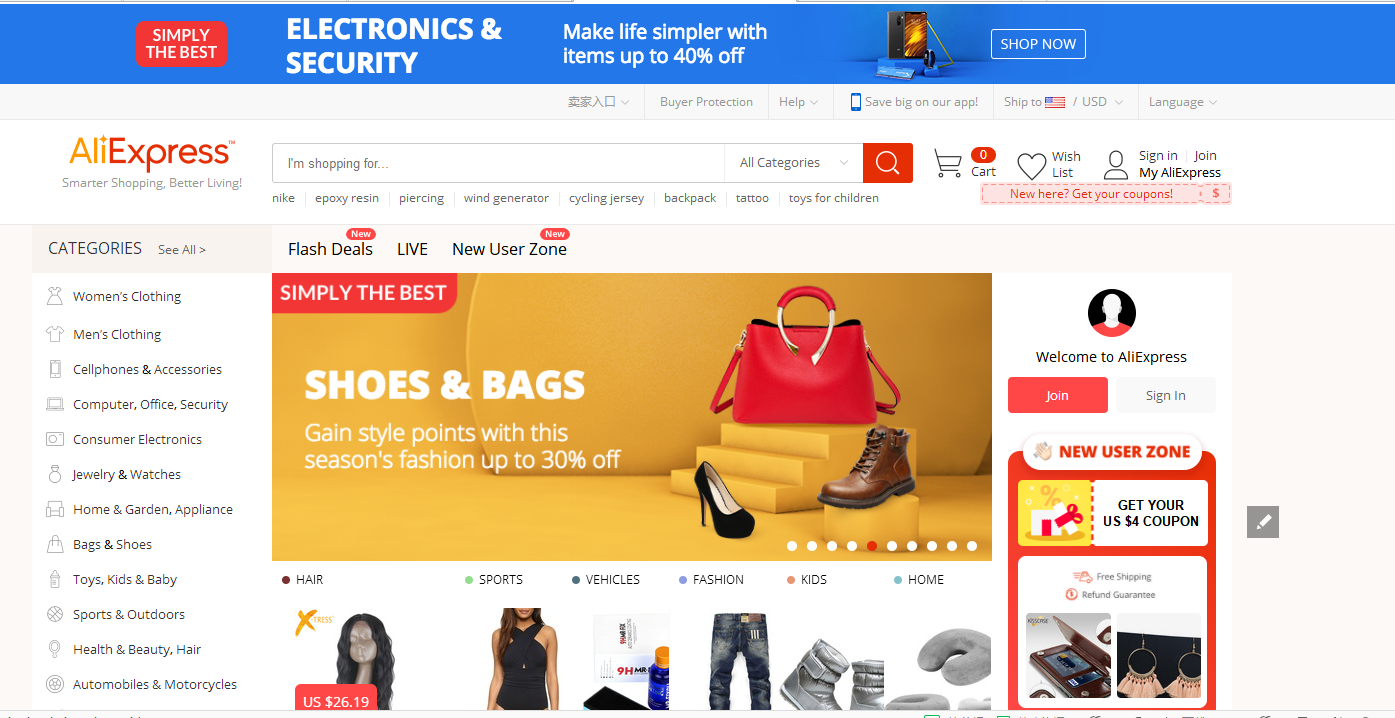
Sellers on AliExpress can be either companies or individuals. Aliexpress is different from Amazon because it acts only as an e-commerce platform anddoesn’t sell products directly to consumers. It directly connects Chinesebusinesses with buyers. The main difference from the Chinese shoppingsite Taobao is that AliExpress is aimed primarily at international buyers mostly in the UnitedStates, Russia, Brazil and Spain. Alibaba is using AliExpress to expand its reach outside of Asia and challenge online giants like Amazon and eBay. AliExpress is using affiliate marketing tofind new consumers.
AliExpress started as a business-to-business buying and selling portal. It has since expanded to business-to-consumer, consumer-to-consumer, cloud computing, and payment services, as well. AliExpress is currently in the languages English, Spanish, Dutch, French, Italian, Polish, Portuguese and Russian. Customersoutside of the country boundaries for these languages are automatically served the English version of the service.
(2) The advantages of Aliexpress
The emergence ofinternet and cross-border e-commerce platform has loweredinternational tradebarriers. There are significant changes in international tradeparticipants,goods and structure. Both create favorable conditions for inclusive trade development.
▶ Change in participants
Cross-bordere-commerce platform provides equitable opportunities for MSMEs (Micro, Small andMedium Enterprises) and individuals to participate in international trade. With the role of MSMEs and individuals gradually strengthening, international trade landscape is becoming more diversified and active. China accommodates nearly 40 million MSMEs, of which 5 million engage in international trade and contribute approximately 60% of China’s total export and import volume.
▶ Change in goods
Traditional international trade is in large volume and delivered through container shipment. Internet has improved information exchange efficiency among trade participants. Considering inventory cost and dynamic consumer demands, the new trend is to order in small quantity and with high frequency.
▶ Change in formats
Inclusive tradesignificantly weakens the role of intermediaries. The distance between consumersand producers shortens. Under some special circumstances, producers directly reach consumers, collecting feedbacks and improving its production, design, innovation,etc.
(3) Aliexpress -order wherever with internet access
Cross-bordere-commerce empowers small businesses to engage in globalization in the age of big data. In 2015 Singles’ Day Shopping Festival, consumers from 214 countriesand regions placed orders on Aliexpress; then 21.24 million parcels were sent over the world within 24 hours, including:
• 155 ordersfrom Greenland, the most northern island of the earth;
• 415,479 ordersfrom Chile, the most southern country of the earth;
• 608 ordersfrom Fiji, where 180° meridian runs through;
• 356 ordersfrom Seychelles, an island country on the Indian Ocean;
• 30 orders fromLesotho, a country in southern Africa with the world’s highest averageelevation;
• 15 orders fromVatican, the smallest country in the world;
• 18 orders fromchaotic Syria.
5. Learning Resources
全球速卖通开店指南 (https://sell.aliexpress.com/zh/__pc/NewSellerGuidelines.htm?spm=5261.11333555.100.3.47f12fe0UWFXZn)

