第八章 跨文化交际能力的培养
现代科技的发展、商业的世界化蔓延、全球交通网络的形成以及大范围的移民潮等共同促成了全球化的到来,也迫使我们越来越深刻地认识到人与人之间、文化与文化之间的碰撞、冲突与交融的不可避免与重要性,从而促使人们不断思索怎样在地球村中拥有一种和谐共融的心态,怎样形成一套不同文化的人都能够认同的交往方式,以及用什么样的方法和途径来达到交流的最佳绩效。也即是说,如何实现跨文化交际的最有效化?毋庸置疑,只有通过跨文化交际能力的不断培养和提升,才有望达成。首先我们需要了解什么是交际能力?什么是跨文化交际能力?
第一节 交际能力与跨文化交际能力
交际能力是人类与他者交流和沟通的基本能力,也是跨文化交际能力的基础和前提,而跨文化交际能力则要求交际者除了具备人类基本的交际能力外,还应该具有外语能力和跨文化敏觉力等。
一、交际能力
“交际能力”这一概念最初来源于社会学,后来延伸到语言学。美国学者海姆斯(Hymes,1966)在“论交际能力”中第一次提出“交际能力”。海姆斯在提出这一概念时侧重语言的得体性,也就是在使用语言的时候应该更注意符合具体社会环境的要求,即时间地点、交际对象、内容、以及谈话方式等。他认为交际能力应包含四个方面的内容:(1)语法的正确性,即语言形式要正确。(2)语言的可行性,即交际对象在心理上的接受度。(3)语言的得体性,即交谈时要根据具体环境和对象选择得体的语言。(4)语言的现实性,指语言实现其交际功能并产生相应的影响。随着“交际能力”概念的提出,语言学家们对交际能力发表了各自不同的看法。其中最具影响力和代表性的是美国的卡纳尔(M.Canale)、斯温(M.Swain)和欧洲的范艾克(Van Ek)。在卡纳尔和斯温(1980:p.1-47)的研究里,他们认为交际能力包括语言能力、社会语言能力、篇章能力和交际策略四个方面。这个观点已经被大多数业界人士认可。范艾克认为交际能力所涵盖的范围应该更大,更全面。他认为外语交际能力应该包括:(1)语言能力;(2)社会语言能力;(3)篇章能力;(4)交际策略;(5)社会文化能力;(6)社会能力。范艾克与卡纳尔和斯温的不同之处在于增加了社会能力和文化能力。这两项能力正是范艾克交际能力研究的精彩之处,精彩在于它道出了交际能力的本质。随着心理学的发展,十年后,巴克曼(Backman)和帕尔默(Palmer)将交际能力重新划分为语言能力、策略能力和生理心理机制等三个部分。语言能力包括组织能力和语用能力两部分。策略能力是运用语言知识的心理能力,是语言能力与现实世界沟通的桥梁。生理心理机制是语言交际能力的生理心理基础,是语言交际能力赖以存在和发展的前提。我们要培养学生的交际能力必须考虑学生的生理和心理机制特点。显然,巴克曼和帕尔默的理论把前辈们关于交际能力的理论往前推进了一步。在陈国明(2009:p.219)的研究中,“交际能力”被称为沟通能力或胜任度(communication competence),而“有效性”(effectiveness)与“适当性”(appropriateness)则构成了交际能力的主要内涵,有效性意指个人在互动过程中用以产生某种意欲结果的能力;适当性,则泛指互动者达到沟通情境的脉络需求(contextual requirements)的能力。
二、跨文化交际能力
跨文化交际是指具有不同文化背景的人从事交际活动的过程。至于交际的效能如何,主要取决于交际双方的跨文化敏感度、沟通技巧和交际行为的灵活性等,即取决于交际者的跨文化交际能力(intercultural communication competence)。金(Kim)曾经对跨文化交际能力作过比较具体的界定:跨文化交际能力是个体所具有的内在能力,能够处理跨文化交际中的关键性问题,如文化差异、文化陌生感、本文化群体内部的态度,以及随之而来的心理压力等。这种能力并非与生俱来或一蹴而就,必须经由一段教育与学习的过程才能慢慢习得。正如一些学者指出,在全球化到来的今天,“当我们面对日增无已的文化多元互动时,详加探讨跨文化交际能力的意义与内涵,便日趋重要。唯有经由跨文化交际能力,我们才能在全球化社会里,与来自不同文化背景的人们,有效与适当地沟通。”(Chen&Staraosta,1996)由此可见,跨文化交际能力培养的基本因素和途径,是跨文化交际学者和第二语言教师应该关注的重点。根据陈国明(2009:p.220)的论述,“跨文化沟通能力是沟通能力的延伸。两者的定义大同小异,唯一的区别在于,跨文化沟通能力特别强调情境脉络的重要性。这种对情境脉络的强调,除了重视人与人之间互动的有效性与适当性外,也很注意人与沟通环境之间的互动与双方的文化认同。因此跨文化沟通能力可以定义为‘互动者谈判文化意义(culturalmeanings)与适当地在一个特殊环境下使用有效的沟通行为,以便确认双方多重认同(multiple identities)的能力’”。
第二节 跨文化交际能力的基本要素
跨文化交际是一个多学科交叉、跨越性很强的新兴学科,这种跨越性决定了跨文化交际能力的立体性。跨文化交际能力是20世纪90年代针对跨文化交际人才培养提出的一种能力范式,它强调交际者跨文化敏觉力、跨文化意识和处理文化差异的技巧和灵活性。这三个部分不是孤立存在的,它们之间有着紧密的联系和层级关系,即跨文化敏感性处于最低层,处理文化差异灵活性处于最高层,跨文化意识则处于两者之间。换句话说,只有当交际者对各类文化差异萌生了敏锐的意识,才可能产生宽容的文化态度和交际的兴趣,面对不同的跨文化情景进行积极地自我调适,跨文化意识也渐次增强,进而采取灵活自如的处理方式,由此达到很高的跨文化交际效能,据此我们可以看出跨文化能力的培养是由低到高、循序渐进的过程。
一、跨文化敏觉力
跨文化敏觉力是跨文化交际能力基本要素的第一个要素。有学者指出,跨文化敏觉力(intercultural sensitivity)代表跨文化沟通能力的情感面向,它代表一个人在某种特殊的情境或与不同文化的人们互动时情绪或情感的变化(Triandis,1977)。跨文化沟通的情感面向特别指出,具有跨文化沟通能力的人,能够在互动之前、之中和之后,投射与接收正面的情感反应(positive emotional responses)。这种正面的情感反应,最终会把当事人带到认可与接受文化差异的境界。这个过程正是发展跨文化敏觉力的过程。贝内特(Bennett)(1981)认为跨文化敏觉力是个发展的过程。一个人能够在认知、情感以及行为层次,把自己从我族中心(ethnocentric)的阶段转化到我族相对(ethnorelative)的阶段。这个转化的过程包括六个阶段:(1)否认文化差异的存在。(2)对抗认知到的威胁以试着保护自己世界观的核心。(3)试图把差异藏匿在文化相似性的伞下,以保护自己的世界观。(4)开始接受文化与行为上的差异。(5)开始发展对文化差异的移情能力并成为双重或多重文化人。(6)能够把我族相对主义用到自己认同之上,而且体验到差异其实是人生很重要与值得愉悦的一部分。
文化差异的敏感性,不仅是对文化表层,更是强调对文化深层差异的识别能力。文化表层的差异显而易见,不需要特别的训练就可以识别,而文化深层的差异通常隐含在人们的行为和思想中,不易直接观察到。如西方人习惯的低情景交际和东方人采用的高情景交际是不易直观看到的,因此有意识地培养对文化深层差异的敏感性就显得尤为重要,这必须依赖于对不同文化的比较及对文化差异相关知识和经验的积累。
跨文化敏觉力是一个内涵丰富的能力概念,它包含了交际者的自信心、自适力、开明度、中立的态度以及社交的从容等相互联系的几个层面。
作为一个面对全新异文化的交际者,首先对自己的文化和自身素养要有很强的自信心,这种自信心使交际者在面临各种交际情景时采取乐观积极的态度,从而更易于接受他人和他文化,也较易于被对方交际者理解和接受。同时,自信心让交际者在跨文化交际中遇到挫折、误解或疏离时,能够相对自如地应对这些交际逆境,更快走出交际困境。
跨文化交际的开明度意味着交际者要有多元文化心态,对异质文化应采取宽容理解并尽量去接纳的态度,而不是以自我文化为中心,以自己的文化价值观去衡量和评价对方交际者的言行。同时,开明度还包含交际者愿意适当解释对方不易理解和接受的自己的语言和行为,也乐于倾听对方在交际过程中的解释。其实,跨文化交际的开明度即是阿德勒在1977年提出的“多重文化人”。多重文化人能够接受不同于他们自己的生活形态,更能在心理和社交方面掌握住实体的多重性(multiplicity of realties)。换言之,跨文化敏觉力强的人,不仅能够了解一个观念,可以用多种不同的形式来加以表达,并且对世界具有一个内化与广阔的概念。这些都是开放心灵的表征,促使一个人愿意认可(recognize)、感激(appreciate),甚至接受(accept)不同的观点。这种处处为他人设想与承受别人需求的特性,在跨文化交流中,就是相互确认(mutual validation)与认可彼此文化认同的发挥。”(陈国明,2009:p.232)
自适力是指在跨文化交际中,交际者根据交际情景和交际时间不断地进行自我调节适应并进行有效交际的能力。据研究表明,自适力强的交际者对周遭的环境和对方交际者的行动更敏感,能够迅速捕捉到交际中的可用信息以及交际中适时的变化并调整自己的言行,以尽可能完成交际任务,达到交际目标。
中立的态度主要指交际者在真诚倾听对方交际者的言语时,能够主动摆脱自己文化带来的思维模式的定式,积极倾听对方的语言和意识,理解对方语言中的文化密码和交际意图。在对话过程中,尽量采用描述性而非评价性和判断性语言和态度,不以自己的文化价值为标准和依据去评论别人的行为,否则会产生文化偏见而导致民族中心主义。在倾听过程中,尽量不打断对方,必要时以点头或者眼神等身体语言与对话者示意,最后让对方感到心理愉悦和满足。
社交的从容是指在跨文化交际中不显露焦虑情绪的能力。在跨文化交际中,难免会遇到各种各样的交际困境和交际压力,交际者应具有良好的心理素质,不慌乱、不焦躁,能够摆脱交际困境带来的各种焦虑症状,如流汗、颤抖以及言语不畅等,以比较泰然的心态面对各种交际难题。交际的从容也利于交际者利用以往的交际经验和生活经验,在困境中发挥潜力而急中生智,战胜交际障碍,达成交际共融。
跨文化敏觉力较强的人在与来自不同文化背景的人交流时能更快地适应陌生环境,更有自信心,更能够以客观的态度看待文化冲突,并认真专注地倾听交际对象的交际意图,从而更快速地调整自己去处理交际中出现的挫折,更从容地应对跨文化交际过程中出现的各种障碍,确保交际的顺利进行。
二、跨文化认知能力
国内知名学者戴晓东在其论著《跨文化交际理论》中,把跨文化交际的第二个层面概括为认知过程,即跨文化意识。他认为跨文化能力的认知过程主要涵盖自我意识和文化意识两个方面。自我意识是指交际者自我监控或对自己作为特定文化成员即文化身份的感悟,文化意识是指对影响人们如何思考与交际的文化规约的理解。所谓“跨文化意识”,是指对不同民族国家之间的文化现象、文化规约和文化模式等的洞察和理解,对文化之间关系的领悟,并根据所领悟的对方文化特点来调整自己的语言和思维,以及据此产生的跨文化自觉性。跨文化意识的基础和前提是跨语言能力,而跨文化意识是跨语言能力的深度体现和非言语呈示。交际者跨文化意识的形成意味着交际者完成从单一文化认同身份到多重文化认同身份的转变(Chen&Starosta,1996),交际者站在第三文化的高处观照世界各种文化,这样才能在千变万化的文化现象和千差万别的文化语境中应对自如而立于不败之地。
跨文化交际中的认知能力主要涵盖两个方面的内容,即语言能力和文化能力。其实用另外一种表述是,言语交际能力和非言语交际能力(这两种交际方式在本书的第四和第五章都有比较详尽的讲解)。这是因为在跨文化交际中,运用的交际方式包括言语和非言语两种,其中言语交际正是语言能力的体现,非言语交际能力的高低则建立在交际者对双方文化背景的深刻洞察和理解上,非言语交际中的体态语、环境语、客体语以及副语言等无不包含着丰富的文化信息,交际者只有具备良好的跨文化背景知识,才能很好地处理这些非言语信息,从而进行有效交际。另外,言语交际中的盲区和误解常常存在,这些正是不同文化背景和文化内部系统迥异所致,非言语交际恰好补充了言语交际的这种有限性和不足,两者相辅相成,使跨文化交际得以顺利进行,最后达到双方需要的交际效能。
三、跨文化行为能力
跨文化交际能力的第三个基本要素是跨文化行为能力,即跨文化交际的灵巧性,是强调交际者进行有效交际的技巧和能力。根据戴晓东(2011:p.290)的论述,跨文化交际的灵巧性是指交际者实施交际行为、完成交际目标的能力。跨文化交际的灵巧性涉及言语和非言语信息,它包括信息的传达、自我表露、行为的灵活性、互动的管理以及社交技巧等方面。交际灵巧性是交际能力的一种体现,它反映出交际者怎样调动有限的语言知识进行交际的水平。在跨文化交际中,如果交际者能够灵活有效地运用交际技巧,就会克服语言水平和文化水平的限制,从而达到交际目的。
传递信息的技巧是指交际者根据自己掌握的语言和文化知识,运用合适的交际策略和技巧,熟练地传达交际对方可理解的信息的能力。它要求交际者不仅具有熟练的语言功底和深厚的双文化底蕴,还要求在以往的交际经验中练就良好的信息传达技巧,这样才能尽量避免产生由信息误读和文化误解而导致的交际障碍,保证交际的顺利进行。信息传递的效率与自我表露技巧的高低有着紧密的关系。自我表露就是交际者在面对交际对象时,以恰当的方式向对方坦露自我心意和自我情态。这种表露在特殊的跨文化交际场合流露和表达出来,具有很强的导向性,而非普通好友或亲人之间的随意表露,因此要谨慎表露、恰当示意,表露方式要显得贴切自然、不做作,要考虑到对方的文化背景和语言水平,否则容易引起对方交际者的漠视或反感,甚至形成对交际者不利的刻板印象。同时,自我表露和信息传达的准确与否直接影响交际的有效性。得体的自我表露和准确恰当的信息传达也体现了交际者行为的灵活性。
交际行为的灵活性体现了交际者在各种交际场合中根据交际对象和交际时间不同而随机应变应对交际事务的能力,也体现了交际者交际策略选择的准确与迅速,同时交际灵活性也是交际敏觉力在行动上的体现和延展。有学者指出,高超的交际者能够运用灵活的言语提示,敏锐地捕捉对方的身份,并且适时做出调整,较快与对话者建立起良好的互动关系。(戴晓东,2011:p.290)
互动的管理是指交际者在交际中对互动局面的把握和控制,即在交际过程中,交际者适当控制交际节奏、说话顺序和交谈主题,适时地启动和结束对话。具有良好互动管理能力的交际者,能够调动交际场景中的各个交际对象,把握好会话结构,根据自己和其他交际者的交际需求粗略设计和转换会话主题,不轻易打断别人,并认真倾听他者,最后实现交际者的交际意图,达到交际目标。
社交技巧包含移情和身份的维护两个层面。“移情”(empathy)作为美学概念,是德国学者罗伯特·费肖尔1873年在《视觉形象感》中首先提出的。日本语言学家库诺第一个把移情从美学领域借用到语言学领域,随后,移情这一概念逐渐被用到跨文化交际学领域。跨文化交际中的移情是指交际主体自觉地转换文化立场,在交际中有意识地超越本土文化的俗套和思维模式,摆脱自身文化带来的束缚,转换身份到另一种文化模式中,切身感悟和理解另一种文化。移情在跨文化交际中是连接交际者之间的情感和文化的桥梁,是进行有效沟通的重要能力。据陈国明(2009:p.232)所言,移情就是把自己投射到互动对方的位置,暂时地想对方所想,感对方所感的过程,它把我们带入了别人的心灵世界。跨文化交际中的移情主要表现在两个方面,一个方面是指听话人从说话人的角度准确领会话语的交际意图;另一个方面是指交际双方要设身处地地尊重对方的文化背景、风俗习惯和价值取向。整个过程包括:承认差异—认识自我—调适自我—准备移情—体验对方,进而克服民族中心主义,增强对别人的需求和跨文化敏觉力。文化移情要求交际者与时俱进地不断学习并具有开明的文化价值观。文化移情能力决定了交际者能否摆脱自身文化积淀所形成的思维定势的影响,从而自觉地避免因文化取向、价值观念、宗教信仰、伦理规范、思维方式、生活方式等差异引起的文化冲突,保证跨文化交际的顺利进行。在跨文化交际中,移情是为了有效沟通,但在移情的同时,也不能忘了对身份的维护。身份的维护应该包括对交际者自己个人和民族身份的维护以及对交际中他者身份的维护。交际行为的灵活性不能离开身份的维护,没有尊严的交际不是平等的交际,也不是我们追求的理想交际状态。因此,在交际中,优秀的跨文化交际者既能够根据对方传达的信息快速有效地判断对方的身份,并对之进行有效维护,又能够准确定位自己在交际场景中的身份和代表的民族身份,以维护它为交际的原则之一。
第三节 跨文化交际能力培养的途径
根据我们前面对跨文化交际能力基本要素的区别和分析,可以看出跨文化交际能力的培养分为三个层面。第一个层面是在接触和了解他国语言和文化时,不断加强交际者的语言功夫,丰富其文化积累,克服交际过程中易出现的两大障碍,培养交际者的文化敏感性,以提高跨文化交际敏觉力。第二个层面强调对语言和文化的深层认知,增强对他国语言以及背后的隐性文化和价值观的理解,如西方文化价值观中的个性自由和独立竞争等,这些方面的理解和感悟有助于交际者在交际中策略的选择,针对对方文化的异质性以及个人特性,做到有的放矢。第三个层面是培养交际者灵活运用所学语言、文化知识应对和处理跨文化交际中出现的各种交集情景以及突发事件等,这是跨文化交际能力培养的最高层面和最终目标。要达到这一目标,必须培养交际者学以致用的能力,培养他们根据过去对外国相关文化的认知,积极参与跨文化交际实践,锻炼他们处理文化冲突的灵活性。由此可见,从跨文化敏觉力的培养到对语言和文化的深层认知再到跨文化交际实践行为的训练,这三个层面既有一定的递进关系,又相互融会贯通,相辅相成。
一、培养跨文化敏觉力
关于交际者跨文化敏觉力的培养,首先要做的就是克服两大障碍。因为在跨文化交际的初期总是存在一些交际障碍。主要障碍之一是刻板印象。这些印象和看法可能是正面的,也可能是负面的。尽管大家都知道刻板印象不可取,但要做到完全避免却不容易。刻板印象忽视个体区别,一旦形成便不易改变。它僵化了交际者的头脑,使得交际者不能客观地对待另一种文化,失去交际应有的敏觉力。在观察他国文化时只注意与自己的刻板印象相符合的现象,而忽略其他更重要的差异信息。它妨碍交际者与不同文化背景的人相处,不利于顺利开展跨文化交际。因此,必须尽量克服由于刻板印象带来的负能量。对教师来说,在文化课上应尽量避免用带有刻板印象的话语,并提醒学生注意普遍文化概念下的个性差别。因为在跨文化交际中交际者首先面对的是交际个体,然后才是其背后的民族文化。不能因为对整个民族的刻板印象而影响了交际者对具体交际对象的判断和决策。跨文化交际中的障碍之二是民族中心主义,即习惯以自己民族的价值观衡量其他文化,从自己的文化角度出发,以自己的评判标准评价对方交际者。一旦发现与自己的预期不同,就会对对方产生敌对情绪而引起文化冲突。有学者认为,所谓民族中心主义就是按照本族文化的观念和标准去理解和衡量他族文化中的一切,包括人们的行为举止、交际方式、社会习俗、管理模式以及价值观念等(胡文仲,1999:p.191)。社会中的每个人都无法避开民族中心主义,尽管我们努力克服隐藏在内心深处的民族中心主义,但是,我们都成长在一定的文化环境中,文化早已融化进我们的心灵,指导着我们的行动,造成人们在观察别种文化时会不自觉地以自己的是非标准为依据,对于异质文化事物常会做出有失客观的判断。胡文仲认为,各个国家的地图都是把本国放在中心。美国人看中国出版的世界地图感到生疏,因为他们习惯看到的是把美国放在中心的地图。我们看美国的世界地图也觉得奇怪,因为突然发现中国在地图的一侧。这都是把自己国家作为中心的最好证明。在历史课上,往往也是这种情形。谈到对世界文明的贡献,一般总是突出自己国家的成就,而对于其他国家的成就估计不足(1999:p.191)。这些正是民族中心主义在作祟,要完全摆脱我们在社会化过程中获得的观念和看法是一个长期艰巨的任务,也是培养跨文化交际敏觉力的重要方向。
文化对比教学法是课堂上克服刻板印象和民族中心主义的主要手段,通过对比了解自己和他者各自的特性。文化对比教学法的实施要求交际者摆脱自身文化的约束,避免简单化的定式思维,将自己置于他文化模式中,在理性、平等的立场中感受、领悟和理解另一种文化。当然,对比教学法首先要求教师理解他国文化并选取典型文本解释其中的文化元素,帮助学生更充分地理解文本的语言信息和渗透其中的非语言信息,并与自己本土文化中的相应文化元素进行对照讲解,引导学生在解读过程中有意识地去寻找文化差异。比如教师讲解关于狗的文本资料时,由于狗在中西方文化中所代表的意义相差很大,如果不明白这一文化密码,交际中很容易产生误会。教师可以举例子:一个英国人对自己才接触不久的中国朋友说“you are a lucky dog”。中国朋友很可能会认为这位英国人在侮辱他。因为“狗”在汉语里是一种卑微的动物,狗的贬义形象在中国人心中已生根,人们常常用狗来形容不好的事物,如“狼心狗肺”等。但是在英国,狗却有很高的地位,英国人认为狗是忠实的朋友。英国人常常用狗来比喻人。如Every dog has his day(凡人皆有得意日),You are a lucky dog(你是一个幸运狗)等。这样的教学既形象又生动,还能增强学生的跨文化敏觉力。
交际参与度是跨文化敏感度的最佳指示变量,意味着要想通过跨文化敏感度来提高跨文化交际能力,最有效的是加强交际参与度,从而对跨文化交际能力产生影响。(白雪,2010:p.4)因此,除了课堂上的对比教学法以外,教师还要鼓励学生积极参与具体的跨文化交际训练和实践,并努力为他们创造跨文化交际的机会,这是培养他们克服刻板印象和民族中心主义的最好途径。因为在具体的训练和实践中,他们能真切地感受到文化的多样性和同一文化不同个体的差异,逐渐形成多元文化观和开明的交际态度,从而尽量主动克服因刻板印象和民族中心主义而导致的交际障碍,形成良好的跨文化敏觉力。比如可以设计多个与中国人的思想和性格迥异的文化模式,由不同的人扮演,让他们分别与中国人交往。从这个活动中,受训者会体会到自身文化的某些特点和他国文化的一些特性,从而提高自己的文化敏觉力。在条件允许的情况下,带领学生或鼓励他们多参加各种小型国际会议、国际论坛以及跨文化聚会是一种更为直接的训练和培养他们跨文化敏觉力的高效方式。一位西班牙的女学生,来中国留学以前是空姐,来中国几个月后她说她好几个朋友也准备来中国学习了。在她没来中国学习以前,她和她的朋友们都以为中国还没有通电,没有电话、电视机,甚至住的还是古旧的土房子,更别说电脑这样的高科技了,所以他们觉得来了会非常不方便。这些都是由于刻板印象而造成的,阻碍了他们来中国学习和交流的机会,但是由于那位西班牙空姐学生亲身体验了中国的现代化以及中国文化带来的乐趣,所以扭转了她和朋友们对中国的刻板印象。
综上所述,无论是为了克服刻板印象和民族中心主义带来的两大交际障碍,还是旨在培养交际者对语言背后文化的解读和参悟,形成较强的跨文化交际敏觉力,都需要课堂上教师有意识地进行文化对比教学和其他形式的文化拓展讲解法,更需要尽量给学生创造跨文化交际训练和实践的机会,这样才能让他们树立良好的自信心,能够在具体的交际情境中调适自我,从容地应对交际中出现的各种复杂状况,最后顺利实现交际目标。
二、培养跨文化认知能力
跨文化认知是指交际者对他国具有独特风格和内涵的文化要素及文化特质等方面的认识和了解,其本质就是学习与把握异国文化。文化认知过程随年龄的增长会不断变化。培养跨文化认知能力不但包括培养交际者跨语言交际能力,还包括培养交际者的跨文化交际能力。语言交际与文化交际是不可分割的,语言交际是文化交际的一部分,它为文化交际服务并反映着文化交际。跨语言功夫和跨文化功夫也是相辅相成的。跨语言功夫除了包括对目的国语言的巧妙选择和熟练运用外,更重要的是对语言背后文化的解读和参悟,也就是在语言教学中渗透文化分析,培养学生逐渐深谙他国语言背后与自身语言不同的文化密码,以利于交际语言的选择和交际的顺畅。培养跨文化认知能力首先要加强交际者的语言功夫,在教学中要使语言教学与文化教学齐头并进,在输入语言基础知识的同时,也不忘相关文化知识的输入,从而加强学生对文化差异的熟识、理解和评判,以提高学生对文化差异的敏感性和跨文化意识。语言功夫主要体现在用词、句子陈述与主题选择的适当性上。
在跨文化交际语言能力的培养上,首先应该重视的是词汇层面。词汇是语言的基石,也是很多学生学习语言的难点。每种语言的词汇中都蕴含着丰富的文化信息,是该语言中最活跃的成分,也是文化最精密的汇聚点。词汇本身的新陈代谢映射了相关文化的发展信息。因此,教师在单词讲授的过程中,穿插一些跨文化交际知识,既利于培养学生的跨文化交际意识,又让枯燥的词汇学习变得生动有趣。讲解词汇时利用相关的谚语、典故、名句等融入课堂就不失为一种有效的方法。比如在高级班汉语课上讨论“朋友”主题时,可以引入“有难同当,有福同享”“患难之中见真情”以及“在家靠父母,出门靠朋友”等中国著名的谚语和名句,也可以顺势讲解《三国演义》中桃园三结义的故事。这些谚语、名句和历史典故反映了中国“义”文化,既能够增加学生对汉语的兴趣,又可以延伸词汇后面的文化知识,同时也能够促进留学生反观自己文化中“朋友”的含义及其与汉语的差异,这样的词汇教学自然会提高学生的跨文化意识。
除了词汇教学以外,句子陈述的跨文化培养也很值得重视,老师在课堂上讲解句子的时候,不但要讲解此种句子的语体风格适合在什么场合下使用,还要分析这种句子适合用在什么身份的交际对象上。句子的语气也是举足轻重的,比如请求语气的句子适合于与长辈说话或者请教别人帮忙时,而命令语气的句子则是用在命令下属或者孩子,如果没有掌握两种句子的区别而把语气用反了,在跨文化交际中很容易引起不必要的文化冲突。
另外,句子通顺与否、语法是否正确等也是教学中需要注意和训练学生的部分。在语法学习中领悟他国文化。在语法学习过程中,要注意比较外语语法与汉语语法的异同点,不要受汉语思维特点的制约,同时,在学习语法结构时,要强调其文化和交际功能。如“Lovely day,isn’t it?”只是英美人发起话题的常见语句,实无疑问。“Would you please turn off the light?”不表问而是表请求。西方人提出的请求常用问句,以示礼貌,但若长辈对晚辈或熟人之间可用祈使句。最后,谈话中主题选择的适当性同样不容忽视,这也是对语言应用能力的一个综合性考验。在拥有了词汇层面和句子陈述等方面的跨文化交际基本能力后,交际中的谈话主题是否得当,是否符合交际双方共同的交际需求,是否能引起交际双方的共鸣,是否需要继续深入谈下去还是转换为更有价值的主题,这些都需要学习。应在教学中通过具体的教学情景的设置、相关教学视频的播放,教师适时训练、引导和鼓励学生在跨文化对话中对谈话主题进行恰当选择和适时转换。
培养跨文化认知能力除了要培养交际者的跨语言认知能力外,还要培养其跨文化认知能力,即跨文化意识。培养跨文化意识第一步就是要让交际者从观念上消除偏见和歧视,认识到文化没有优劣之分,以平等的心态对待各个民族的文化和人。培养跨文化意识的第二步就是拓展交际者跨文化知识和眼界,树立多元文化心态和宽容的文化态度。培养跨文化意识可以通过以下途径来实现:(1)在语言学习的听说读写各种技能训练中。首先通过阅读外文资料感悟外国文化,在阅读中,多了解他国的科技、地理、历史和风俗等,熟悉他们的表达方式和风格,消除因文化知识不足而导致的理解障碍。其次,在外语听力中领悟他国文化。听力材料一般都是模拟的真实对话情景,因而听力训练过程就是一个跨文化意识培养的过程。要让学生知道交际中哪些话题应该避免,比如年龄、婚姻、薪水以及家庭住址等私人话题不应该作为话题。第三,在听的基础上要积极发言,主动参与到跨文化交际活动中,以提高自己在跨文化交际中的表达能力。最后,通过写作提升外国文化知识的内化和运用。在写作中,要充分意识到中外文化的差异,让人体会到流畅、地道、连贯的外语文章,从根本上提升跨文化交际的综合能力。(2)在外语活动中体验外国文化,主动结交各国朋友。例如,组织外语角、学唱外文歌、看影视材料以及编演外语剧等。在这些活动中,学生身临其境地体验真实的外国文化,了解他们的风俗文化和民族禁忌。同时,教师应帮助学生分析自己文化中哪些方面对自己有利,哪些不利,然后再分析目的语文化,分析其中哪些方面我族容易适应,哪些不易适应却易引起文化冲突,从而有意识地改变自己的行为模式,以利于跨文化交际目标的实现。(3)在各种旅行活动中,主动积极地营造跨文化交际的机会。总之,我们对文化差异了解越多,体验越多,越容易对他国文化采取接受和宽容的态度;同时,移情也有利于培养对文化差异的宽容性,我们一旦能从对方的角度考虑问题,就已经具有很强的跨文化意识了。
三、培养跨文化行为能力
其实,无论对跨文化敏觉力的培养,还是对跨文化认知能力的培养,最终都是为了使交际者在跨文化交际中能够进行灵活交际,也即是跨文化行为的灵活性,这三者不是彼此截然分开的,而是互相依存的关系。跨文化敏觉力的培养包含跨文化认知能力和跨文化行为能力,而跨文化认知能力的培养中也融入了跨文化行为能力,而跨文化行为能力的培养势必以跨文化敏觉力和认知能力的培养为基础,并且是对这两种能力的一种巩固和融合。
跨文化行为能力即跨文化行为的灵活性,是跨文化交际能力的核心要素。它首先包括交际者能够根据交际双方的文化背景和个性特点,灵活地调整自己的交际策略和行为,尽量向对方的交际规则靠近(以不违反自己交际原则为前提),减少差距,营造和谐交际氛围,同时,灵活处理因文化差异而引起的文化冲突,在处理冲突时,交际者要善于运用恰当的语言阐明自己的文化困惑,介绍本族文化行为规范,弄清对方的文化习俗,找出冲突的解决途径,达成共识,完成交际任务。根据美国学者陈国明在《跨文化交际学》中所述,跨文化行为能力包括信息传达技巧、自我表露技巧、行为的灵活性、互动管理以及认同维护技巧等五个方面。当学生学习了跨文化行为能力的五个要素之后,教师分阶段、有层次地组织跨文化实践是培养学生跨文化交际行为能力最有效的途径。
(一)跨文化交际角色扮演
首先,角色扮演是教师在条件有限的情况下采取的一种跨文化虚拟实践,角色扮演可以分成两人组角色扮演及多人组角色扮演。两人组角色扮演要求两人分别扮演不同文化国的两个具有一定职业身份(或者学生身份)的交际者,模拟一个实际生活或工作场景,基本设定交际流程主线,留出适度自由发挥的空间,完成一定的交际任务。多人组角色扮演除了在交际者人数上有所增加外,还可以分为两个文化国或多个文化国之间的跨文化交际。多个文化国交际背景相对复杂些,因此多人组角色扮演应该在两人组角色扮演训练到一定程度的时候开展,学生能阶段性地增强跨文化行为能力。角色扮演的目的,在于让学生经由模拟的过程,面对并尝试解决跨文化交际中可能碰上的问题和障碍,通过信息传递、自我表露、互动管理以及移情等行为的训练,提高跨文化交际行为的技巧,增强跨文化行为能力。这个方法的优点在于把学生从旁观者变成参与者,使他们能够在模拟的跨文化环境里,亲身体验另一种或多种跨文化交际。
(二)跨文化交际互动实践
组织本校留学生和被训中国学生进行实际的跨文化交流,布置一定的交际任务,根据交际任务需求提供交际场所,并提醒中国学生注意跨文化交际能力五个方面的技巧,通过见面、认识、交流过程,老师观察学生在交际中的困惑、问题、冲突以及解决问题时学生表现出的焦虑或灵活行为。同时可以在学生不知晓的情况下把他们的交际行为摄录下来,在课堂上回放,有些交际失误学生会在观看中意识到,有些需要老师点出后给学生讲解,这样一个学期组织几次交际实习,每次针对不同的重点交际问题进行现场交际,学生的实际交际行为能力自然会得到提升,交际行为更加灵活,交际效能更高。在互动过程中尽量使用描述性、支持性的讯息。描述性的讯息指使用不妄加判断的态度,给对方明确、具体的回馈,支持性的讯息指沟通时同意或支持对方的看法并以点头、注视等动作技巧奖赏对方论点的能力。互动实践的优点是来自异国的交际者比本国角色扮演者能够带来更真实完整的异国文化讯息和行为形态。
中国与世界的跨文化交际日益频繁,除了和本校留学生进行一定的跨文化交际实践外,教师和学校还应该多鼓励学生积极参加国际会议或跨国活动,尽可能提供学生相关方面的信息和机会,以增加学生跨文化交际实践的机会,让学生在实践中去体验和认知文化差异,进一步有效提高自身处理文化差异的灵活性。这些建议的实施必然能促成学生的跨文化交际能力和综合文化素质的实质性提升。
跨文化交际能力的形成有其阶段性、层次性,因此跨文化交际能力的培养也不是一蹴而就的,而是由表及里,由浅入深,不断发展、深化的过程。教师要针对不同层次设计不同的教学方法和侧重点。
第四节 跨文化交际学科的发展前景
任何学科的发展都离不开一定的时代背景。在全球化的今天,世界大部分民族都以开放的态势与世界其他民族进行积极对话,在对话交流中求发展,全球文化呈现出多元文化共融共存的局面,这些不断推动着跨文化交际的产生、发展和变化。作为一门学科,跨文化交际的历史很短,但作为一种现象,它却一直伴随着人类。人们习惯把霍尔(1959)“无声的语言”视为跨文化交际学的开端。随后,社会学、人类学、语言学及心理学等都开始对跨文化交际中出现的文化冲突现象进行研究并作出不同角度的分析。最开始人们减少跨文化交际冲突的方法主要是介绍异国文化习俗和两国之间的文化差异。后来,人们逐渐认识到:仅介绍两国文化差异对减少跨文化交际中的文化冲突的作用不大,而对交际对方价值观的了解和宽容是影响跨文化交际的重要因素,同时人们也开始研究影响跨文化交际能力的诸因素,进而对这些因素进行一定的跨文化训练,以增强交际者在跨文化行为中的灵活技巧,从而不断提高交际者的跨文化交际能力。学者们对跨文化交际认知、行为和训练的研究加深了人们对跨文化交际的了解,促进了跨文化交际学的发展。目前,“跨文化交际”作为一门学科,它的发展机遇和前景怎样?以下我们分三个方面进行论述:
一、“跨文化”相关学科的增加推动跨文化交际的学科建设
在现代科学研究中,无论是社会科学还是自然科学研究都呈现出不断分化和高度综合并向的趋势。不断分化意味着学科内部研究的深入,专业分得越来越细。不断综合意味着不同学科之间的互补性和渗透性等内在联系越来越紧密。以“跨文化”命名的学科不断产生,跨文化交际学便是其中之一。从本质看,它与以“跨文化”命名的系列学科具有差异性和一致性。以“跨文化”命名的系列学科越发展,跨文化交际越能从中吸收有用的成果,从而推动跨文化交际学科的发展和完善。这些学科对跨文化交际学科建设起着直接或间接的推动作用。例如,“跨文化心理学和跨文化教育学,对跨文化交际学的发展有着直接的促进作用。因为跨文化交际的过程,实质上就是跨文化心理调适和互动的过程,同时也是跨文化学习和教育的过程。不同民族的文化都与不同民族的心理紧密联系在一起。而不同的民族心理都由不同民族的教育方式、教育内容、教育环境等决定。对于不同的民族心理和民族教育的深入研究,有助于为跨文化交际研究提供大量的实证经验材料,推动跨文化交际研究的深入进行。”(高永晨,2008)这些以“跨文化”命名的学科的产生、发展及成果不断丰富跨文化交际学的学科内涵,推动着跨文化交际学的学科前进。
二、多国跨文化交际合作研究促进跨文化交际的学科发展
跨文化交际学的研究对象和学科特点决定了它在一定程度上受多国跨文化交际合作研究的广度和深度的影响。多国合作研究的广度和深度与跨文化交际学科发展水平有紧密的联系。在广度上,多国合作研究促进多元文化的交流、整合与优化,帮助交际者克服民族文化中心主义和文化偏见,最后达到双赢,使跨文化交际研究的视野更加开阔,领域得到进一步拓展。在深度上,多国跨文化交际合作研究有助于学科本身一些命题的深入探讨,同时由于多国思想碰撞而产生的灵感火花有益于突破和解决跨文化交际学科的难点,所以,在跨文化交际的学科建设过程中,经常开展跨国间的专项课题合作研究,有助于推动跨文化交际学科建设的发展。多国跨文化交际合作研究,是我国对外汉语界、外语界以及一些企事业单位的需要,也是世界各国经济和文化发展的必然需求。跨文化交际研究领域是全球性的,随着多国交流合作研究的进一步发展,跨文化交际的科研机构也将遍布全球。我国近几年关于这方面的多国合作成绩卓著,既有校际之间的合作交流,又有省级和州级以及国家之间的合作交流。国内外举行的国际跨文化交际研讨会的定期召开,推动着宏观研究与微观研究、综合研究以及专题研究的不断深入。可以预想,在跨文化交际方面,多国合作研究的趋势在全世界范围内会越来越强。
三、全球新现象、新事物扩大跨文化交际研究范围
文化全球化既是跨文化交际的产物,又推动着跨文化交际的纵深发展。目前的跨文化研究课题多数都是传统命题,如跨文化意识、言语交际和非言语交际等,而直接针对文化全球化带来的新问题展开跨文化交际研究的新成果还很少。事实上,在全球化时代,存在着需要跨文化交际学深入研究的新课题还很多。概括起来,主要有以下几方面的课题有待研究:(1)全球化给跨文化交际带来的机遇和挑战的综合研究。(2)全球化进程对多元文化合作与交流影响的研究。(3)关于虚拟世界的跨文化交际研究。互联网带来了以网络文化为主体的虚拟世界,跨文化交际从真实延伸到虚拟。跨文化交际在虚拟世界的表现有哪些?虚拟世界与真实世界的跨文化交际的异同比较?虚拟世界跨文化交际的制度和准则怎样完善?虚拟世界跨文化交际对全球文化发展的影响怎样?怎样规避虚拟世界跨文化交际的风险等这些问题都需要进行研究。(4)关于全球化时代强势文化与弱势文化关系的研究。如:弱势文化在文化全球化时代如何保持自己的民族文化特质?弱势文化如何在跨文化交际中扬长避短?(5)对跨文化交际学与其他以“跨文化”命名的学科之间关系的研究。(6)受全球化影响各国语言和非语言交际变异以及变异的表现形式、基本特征以及发展趋势的研究。此外,“在跨文化交际研究中如何进行研究方法的变革,如何将宏观研究与微观研究结合起来,如何将定性分析与定量分析结合起来,如何将理论研究与实际运用结合起来,如何推进跨文化交际学科建设等问题,都是跨文化交际学研究的重大课题。”(高永晨,2008)
从跨文化交际学科建设的角度看,在全球化时代的地球村,跨文化交际学的研究空间需要不断拓展,研究对象层出不穷,研究方法和途径需要更加丰富,理论与实践有待结合得更加紧密,理论研究深入进行的任务还很艰巨,研究队伍需要加强和充实。跨文化交际的学科前景有待当代的有志之士去描绘,去开拓。
◎参考文献
[1]白雪.跨文化敏感度对跨文化交际能力的影响[D].大连理工大学硕士学位论文,2010.
[2]陈国明.跨文化交际学[M].上海:华东师范大学出版社,2009.
[3]戴晓东,跨文化交际理论[M].上海:上海外语教育出版社,2011.
[4]胡文仲.跨文化交际学概论[M].北京:外语教学与研究出版社,1999.
[5]贾玉新.跨文化交际学[M].上海:上海外语教育出版社.1997.
[6]高永晨.文化全球化与跨文化交际学科发展:动力、趋势和展望[J].外语与外语教学,2008(1).
[7]A.K.Pugh et al.Language and Language Use.London:The Open University Press.1972.Chen,G.M.&W.J.Starosta.Intercultural competence:a synthesis.Communication Yearbook 19,1996.
[8]L.A.Samovar and R.E.Porter(eds.)Intercultural Communication:AReader.Belmont:Wadsworth Publishing Company.1994.
[9]Triandis,Harry C.Interpersonal behaviour.Monterey,Calif:Brooks/Cole.1977.
[10]Van Ek,J.A.Objectives for foreign language learning.Strasbourg:Council of Europe.1986.
[11]Widdowson,H.G.Teaching language as communication.UK:Oxford University Press.1979.
[12]Wiseman,R.L.&Koester,J.Intercultural communication competence.CA:Sage Publications.1993.
【原典阅读】
1.Intercultural Communication Competence:A Synthesis(Excerpt)
Molefi Kete Asante,Yoshitaka Miike,and Jing Yin.
Aswe grow increasingly aware of the global interdependence of people and cultures,we confront ever shifting cultural,ecological,economic,and technological realities that define the shrinking world of the twenty-first century.The development of new ways of living in the world together is pivotal to further human progress;wemust learn how to see things through the eyes of others and add their knowledge to our personal repertories.Such a globalmind-set can result only from competent communication among peoples from diverse cultures.
Intercultural Communication Competence:W hy?
The citizens of the twenty-first century must learn to see through the eyes,hearts,and minds of people from cultures other than their own.Several important trends of the late twentieth century have transformed the world into a global village:technology development,globalization of the economy,widespread population migrations,the development of multiculturalism,and the demise of the nation-state in favor of sub-and supranational identifications.In order to live meaningfully and productively in this world,individuals must develop their intercultural communication competence.Technology development
The development of communication and transportation technology linking every part of the world has served to interconnect almost every aspect of life at the onset of the twenty-first century(Frederick,1003;Porter&Samovar,1994).Today the flow of ideas and information increasingly transcends national boundaries.People can also travel to anywhere in the world much more quickly than ever before.The faster travel speeds wrought by transportation technology have introduced increasing face-to-face communication among people from different cultures.
Globalization and economy
The progress of communication and transportation technology has rendered globalmarkets more accessible and the business world more interrelated and international than in the past.Regional trade alliances have become the“new world order”.The trend toward a global economy is bringing people from different cultures together.It requires representatives from multinational corporations to communicate with those in other parts of the world to retain a competitive space in the global economic arena.The interdependence among international economies reflects the important role that intercultural communication plays now and will play increasingly in the next century.The development of greater intercultural understanding has become an essential element of global business(Adler,1991;Mead,1990).Widespread population migrations
As cultural interconnectedness has increased as a result of technology advancement,we have alsowitnessed remarkable populationmigrations across national borders.The United States especially has felt the impacts of this trend.In 1990,the U.S.Census revealed that the first generation foreign-born population in the United Sates had reached almost 20 million.About 8.7 million immigrants entered the United States between 1980 and 1990.At least 32 million persons residing in the United State speak a first language other than English,and 14million of these do not speak English fluently.These figures indicate that the increasing numbers of immigrants have restructured the fabric of American society.The United States has become much more culturally diverse than it has been in the past.
This multiethnic structure makes intercultural contact among co-cultures inevitable.Members of the various co-cultures and ethic groups residing in the United Statesmust learn to adjust to one another’s identities.This trend demands that individuals learn to communicate in ways that are effective in such a diversifying society(Nieto,1992).
The development ofmulticulturalism
The changing demographics described above stand to affect every aspect of life in the United States.Johnston and Packer(1987),for example,predict that the increasing diversity of workplace and social life in the United States will dramatically affect organizational life in the twenty first century.The new workforce will comprise personswho are diverse in race,culture,age,gender,and language.Cultural diversity,or multiculturalism,will become the norm rather the exception in American life.Thus,intercultural communication scholars need to address those issues thatwill help people learn towork and live together without being deterred by the differences they may bring to their encounters.The development of greater intercultural understanding and intercultural communication competence is an essential partof human life in the contemporary age.
De-Emphasis on the nation-state
As new immigrants arrive and co-culturesmake headway in achieving fuller participation in U.S.society,the very idea of national identity will surely change.Increasingly,the United States is pulled into regional alliances,such as NATO or NAFTA,that are larger than the nation.In addition,we see the reassertion of ethnic and gender differences within the nation;for instance,women have begun to talk as women,African Americans as African Americans,and Native Americans as Native Americans.The ability to negotiate themeanings and priorities of diverse identities has become a prerequisite of attaining interpersonal competence inmodern society(Collier&Thomas,1988).
The five trends described above combine to provide a foundation for the indispensability of intercultural communication competence in our increasingly global society.The world has become more interdependent and interconnected,and the nation-state has become more culturally heterogeneous.These developments foster within individuals multiple,simultaneous identities in terms of culture,ethnicity,race,religion,nationality,and gender(Belay,1993).Intercultural communication competence therefore functions to nourish a human personality in which people are aware of their multiple identities and are able to maintain a multicultural coexistence in order to develop a“global civic culture”(Boulding,1988).In other words, intercultural communication competence transforms a monocultural person into a multicultural person.This transformation is achieved through symmetrical interdependence that enables persons to demonstrate“tolerance for differences and mutual respectamong cultures as amark of enlightened national and global citizenship”in individual,social,business,and political institutions levels(Belay,1993).
Based on this theoretical foundation,the following discussion of intercultural communication competence is divided into five sections.These address,in turn,the nature of communication competence,approaches to the study of intercultural communication competence,amodel of intercultural communication competence,a critique and directions for future research,and a summary and conclusion.
The Nature of Communication Com petence
Although 50 years of conceptualizing have provided a theoretical and practical foundation for intercultural communication,it remains a fresh field.The study of intercultural communication dates back to the works of political scientists and anthropologists in the 1940s and 1950s.Whereas linguist Edward Sapirwrote about this topic in the 1920s,it took Benjamin Whorf to frame hiswork more fully as a communication question.As sociologists,linguists,and communication scholars have developed an interest in intercultural communication,two separate schools of thought—cultural dialogue and cultural criticism—now inform research in intercultural communication(Asante,Newmark,&Blake,1979).Both schools have spawned significant research in intercultural communication.One of the main topics studied by the two groups is intercultural communication competence,or the effectivemeans whereby individuals can understand cultural commonalities and move beyond cultural differences in order to reach the ideal goals advocated by cultural dialogists and cultural critics.But,we ask,What is communication competence?
Definition of communication competence
Two concepts have long been applied in discussions of communication competence:effectiveness and appropriateness.Effectiveness refers to an individual’s ability to produce intended effects through interaction with the environment.This ability is treated either as a basic human skill that is obtained through learning and socializing processes(Weinstein,1969;White,1959)or as an acquired ability that is related neither to personal intellect nor to education(Foote&Cottrell,1955;Holland&Baird,1968).In either case,the ability is understood to increase as the individual’s awareness of relevant factors increases(Argyris,1965a,1965b).In addition,ideally,competent communicators should be able to control and manipulate their environments to attain personal goals.In order to maximize such goals,individualsmust be able to identify them,get relevant information about them,accurately predict others’responses,select communication strategies,implement those communication strategies,and accurately access the interaction results(Parks,1985,1994).
A more systematic view of effectiveness in communication relates the concept to both interactants.To be competent in communication,a person must not only feel competent,but his or her ability should be observed and confirmed by the people with whom he or she interacts.Thus,communication competence should be judged based on individuals’abilities to formulate and achieve objectives,to collaborate effectively with others,and to adapt to situational variations(Bochner&Kelly,1974).Rubin(1983)has further considered communication competence to be a kind of impression based on the individual’s perception,an impression the individual forms of both his and her own and others’behaviors.Through this impression,a person makes guesses about the internal states of those with whom he or she is interacting.
Finally,Wiemann(1977)synthesizes the concept of communication competence from the perspective of effectiveness.He conceptualizes communication competence as“the ability of an interactant to choose among available communicative behaviors in order that he may successfully accomplish his own interpersonal goals during an encounter whilemaintaining the face and line of his fellow interactants within the constraints of the situation”(p.198).This definition argues simultaneously that competent communication is other oriented and that communicators have to accomplish their own goals.
Whereas some scholars conceive of communication competence as a function of perceived effectiveness,others look at it from the viewpoint of appropriateness.Wiemann and Backlund (1980)explain appropriateness in the communication process as follows:
Appropriateness generally refers to the ability of an interactant to meet the basic contextual requirements of the situation—to be effective in general sense...These contextual requirements include:(1)The verbal context,that is,making sense in terms of wording,of statement,and of topic;(2)the relationship context,that is,the structuring,type and style of messages so that they are consonant with the particular relationship at hand;and(3)the environmental context,that is,the consideration of constraints imposed on messagemaking by the symbolic and physical environments.
(p.191)
The“appropriateness of behavior”thus implicates three kinds of ability.First is the ability to recognize how context constrains communication,so that one acts and speaks appropriately by combining capabilities and social knowledge to recognize that different situations give rise to different sets of rules(Lee,1979;Trenholm&Rose,1981).Second is the ability to avoid inappropriate responses.An inappropriate response is defined as“one which unnecessarily abrasive,intense,or bizarre.It is also likely to result in negative consequences that could have been averted,without sacrifice of the goal,by the more appropriate actions”(Getter&Nowinski,1981,p.303).Third is the ability to fulfill appropriately such communication functions as controlling,sharing feelings,informing,ritualizing,and imagining(Allen&Wood,1978).We extend Grice’s(1975)recommendations concerning appropriateness in interaction to include the following:
1.Say just enough—not too little or toomuch.
2.Do not say something that is false—or speak about something for which you lack evidence.
3.Relate your contribution to the topic and situation.
4.Be clear aboutwhat you are saying,and say itwith dispatch.
These guidelines specify the four elements of appropriate communication:quantity,quality,relevance,and manner ofmessage sending.
To summarize,communication competences requires appropriateness,and“the fundamental criteria of appropriateness are that the interactants perceive that they understand the content of the encounter and have not had their norms and rules violated too extensively”(Spitzberg&Cupach,1984,p.101).
Definition of intercultural communication competence
The literature treats intercultural communication competence in much the same way as it does communication competence in general(Hammer,1988;Lustig&Koester,1993;Martin,1989;Ruben,1989;Spitzberg,1988,1989;Wiseman&Koester,1993).The only difference is,in addition to looking at communication competence as effective and appropriate interaction,intercultural communication scholars place more emphasis on contextual factors.They conceive of communication competence not only as effective and appropriate interaction between people,but as effective and appropriate interaction between people who identify with particular physical and symbolic environments.This orientation resembles that of communication scholars who emphasize competence as a context-specific behavior(Spitzberg &Cupach,1984).
Although researchers conceive of communication competence as the ability to interact effectively and appropriately with others,their definitions betray greater or lesser degrees of ambiguity,confusion,and imprecision.For example,from Wiemann’s(1977)synthesized definition,the question arises,What constitute“available communicative behaviors”and “constraints of the situation”?These concepts are not clear,and require definition.To alleviate the problem in defining communication competence and to apply the concept to intercultural settings,intercultural communication competence can be conceived of as the ability to negotiate cultural meanings and to execute appropriately effective communication behaviors that recognize the interactants’multiple identities in a specific environment.This definition emphasizes that competent persons must know not only how to interact effectively and appropriately with people and environment,but also how to fulfill their own communication goals by respecting and affirming the multilevel cultural identities of those with whom they interact.
Types ofcompetence
How do individuals interact across multiple cultural identities?Spitzberg and Cupach (1984)propose seven generic types of competence:fundamental competence,social competence,social skills,interpersonal competence,linguistic competence,communicative competence,and relational competence.Fundamental competence involves the general ability to adapt effectively to a new environment in order to achieve goals.In this sense,fundamental competence comprises the cognitive capacities that individual communicators need to be effective crosssituationally.Social competence involves specific,rather than general,abilities.Spitzberg and Cupach include within social competence the skills of empathy,role taking,cognitive complexity,and interaction management.Interpersonal competence is the ability to accomplish tasks and achieve goals through successful communication.Even though interpersonal competence is part of both fundamental competence and social competence,it is especially related to how individuals execute certain skills to control their environments in order to achieve goals in particular communication situations.Linguistic competence and communicative competence both relate to language and messages in the interaction process.Linguistic competence(a concept that stems from the work of Chomsky,1965)is specifically the ability to use language properly.Communicative competence entails not only the knowledge of how to use language,but also knowledge about how to execute one’s language knowledge appropriately.To be communicatively competent,a person must be able to convey messages appropriately in a given context of interaction.Finally,relational competence comprisesmany of the other six kinds of competence,but independent and reciprocal processes of interactions are among itsmost important aspects.An individualmust establish certain degrees of relationships with others before he or she can interact effectively with them and achieve his or her goals.Such relationships crossmultiple dimensions of language,profession,ethnicity,and nation.
Spitzberg and Cupach’s view of competence suggests that individuals have unitary and unchanging cultural identities.By contrast,we view cultures as a set of preferences and possibilities that inform,rather than determine,given interactions.Communicators both shape and are shaped by these familiar meanings.Especially as individuals draw from multiple identities,interactionsmay not perfectly resemble any one cultural expectation.
Approaches to the Study of Intercultural Communication Com petence
To understand the mutual negotiation of cultural meanings in intercultural communication,Dinges(1983)and Collier(1989)have classified the study of intercultural communication competence into different approaches.Dinges(1983)identifies six approaches to the study of intercultural communication competence:“overseasmanship,”subjective culture,multicultural person,social behaviorism,topology,and intercultural communicator.The overseasmanship approach,first presented by Cleveland,Mangone,and Adams(1960),identifies common factors in effective performances among sojourners,or individuals on extended,nonpermanent stays in cultures other than their own.To be considered competentaccording to this approach,a sojournermust show the ability to convert lessons from a variety of foreign experiences into effective job-related skills.
The subjective culture(isomorphic attribution)approach requires individuals to have the ability to understand the causes of interactants’behaviors and reward them appropriately,and tomodify their own behaviors suitably according to the demands of the setting(Triandis,1976,1977).This ability to understand the reasons that members of other cultures give for their behaviorsmust be based on accurate cognition of the differences in cognitive structure between cultures.
Themulticultural person approach emphasizes that a competence person must be able to adapt to exceedingly difficult circumstances by transcending his or her usual adaptive limits (Alder,1975,1982).The individualmust learn to move in and out of different contexts,to maintain coherence in different situations,and to be dynamic.
The social behaviorism(culture learning)approach emphasizes that successful intercultural coping strategies depend more on the individual’s predeparture experiences,such as training and sojourning in another country,than on inherent characteristics or personality (Guthrie,1975).That is,to be competent in intercultural interaction,a person must learn discriminative stimuli to obtain social rewards and to avoid punishments that will create hardship(David,1972).
The typology approach develops different models of intercultural communication competence.Most of themodels place sojourners’behavioral styles on a continuum from most to least effective.For example,Brislin(1981)proposes that a successful intercultural interaction must be based on the sojourner’s attitudes,traits,and social skills.He asserts that nonethnocentrism and nonprejudicial judgments are the most valuable attitudes for effective intercultural interaction.Ethnocentrism is the judgment of an unfamiliar practice by the standards and norms familiar to one’s own group or culture.Themajor adaptive personal traits Brislin mentions include personality strength,intelligence,tolerance,social relations skills,recognition of the potential for benefit,and task orientation.Important social skills are knowledge of subject and language,positive orientation to opportunities,effective communication skills,and the ability to use personal traits to complete tasks.
Finally,the intercultural communicator approach emphasizes that successful intercultural interaction centers on communication processes among people from different cultures.In other words,to be interculturally competent,an individual must be able to establish interpersonal relationships by understanding others through the effective exchange of verbal and nonverbal behaviors(Hall,1959,1966,1976).
Collier(1989)identifies four categories of approaches to intercultural communication competence:ethnography of speaking,cross-cultural attitude,behavioral skills,and cultural identity.The ethnography of speaking approach assumes thatmeaning,conduct,and cultural membership are interdependent,thus,competencemust be contextually defined(Geertz,1973;Hymes,1971,1972).In order to achieve communication goals,an individual must correctly perceive,select,and interpret the specific features of the code in interaction and integrate these with other cultural knowledge and communication skills(Saville-Troike,1982).The cross-cultural attitude approach assumes that understanding the culture of those with whom one is communicating and developing a positive attitude toward that culture are the keys to attaining communication competence across cultures.Studies by Chen(1989),Abe and Wiseman (1983),Gudykunst,Wiseman,and Hammer(1977),and Wiseman and Abe(1984)have examined the concept from this perspective.The behavioral skills approach assumes that “humans are goal directed and choicemaking beings,and thathumans can distinguish between skillswhich will be effective and skills which will not be effective”in interaction(Collier,1989,p.294).Thus,competent persons are able to identify and adopt those effective skills in intercultural interaction(Chen,1992;Hammer,1989;Ruben,1976,1977;Ruben&Kealey,1979).Finally,the cultural identity approach assumes that communication competence is a dynamic and emergent process in which interactants are able to improve the quality of their experience by recognizing the existence of each other’s cultural identities(Collier,1989,1994;Cupach&Imahori,1993).Thus,interculturally competent persons must know how to negotiate and respectmeanings of cultural symbols and norms that are changing during their interactions(Collier&Thomas,1988;Y.Y.Kim,1994a).In addition,Ward and Searle (1991)have found that cultural identity significantly affects adaptation to a new culture.
Although the approaches described above provide useful perspectives from which to study intercultural communication competence,they fail to give a holistic picture that can reflect the global civic culture in which people can mutually negotiate their multiple identities.In the following section we attempt to synthesize these approaches into a model of intercultural communication competence.
(The global intercultural communication reader.Taylor&Francis e-Library.2007.)
2.Becoming More Intercultural
Everett M.Rogers,Thomas M.Steinfatt.
It really does little good to talk or lecture to people about prejudice.Tolerance has to be lived.
Edward T.Hall(1948)
This chapter provides guidelines for the individual who wishes to become more interculturally competent in a communication sense.How does one become more capable in intercultural communication?Does intimate contact with another culture lead to better intercultural communication?How can one overcome the obstacles that prevent effective intercultural communication?
Intercultural Competence
Intercultural competence is the degree to which an individual is able to exchange information effectively and appropriately with individuals who are culturally dissimilar.Individuals vary widely in their ability to communicate with culturally unalike others.AB we noted in previous chapters,there is much evidence that intercultural communication is a difficult process.
The stated or implied purpose ofmost research,training,and teaching in the field of intercultural communication is to improve the intercultural competence of individuals.This objective has been apparent since the beginnings of the field<if intercultural communication at the Foreign Service Institute in the 1950s.One of the most important skills for cultural competence is the ability to suspend our assumptions about what is“right”.The greater the range of alternatives to which we are exposed,the more choices we have for deciding what makes sense for us.“Knowing another culture gives you a place to stand while you take a good look at the one you were born into”(Bohannan&van der Elst,1998,p.6).Anthropologists are taught to be nonjudgmental about cultural differences.Even though they may study a culture that has sexual practices considered bizarre by European North American standards,anthropologists seek to understand the functions fulfilled by these sexual practices from the point of view of the culture in which they occur.Hall and his anthropological colleagues who founded intercultural communication were nonjudgmental,and the new field took on this attitude.
We live in a world that is increasingly diverse in a cultural sense.Large U.S.cities,for example,have populations that are extremely diverse.Improved communication technologies and transportation make intercultural contact increasingly common(see Chapter 9).This trend will continue in the future;the“global village”becomesmore real every day.If individuals could attain a higher degree of intercultural competence,they would presumably become better citizens,students,teachers,business people,and so forth.Society would bemore peaceful,more productive,and become a generallymore attractive place in which to live.Individualswould be better able to understand others who are unlike themselves.Through such improved understanding,a great deal of conflict could be avoided;the world would be a better place.Most North Americans want to become more interculturally experienced.College students,for example,want to learn about individuals unlike themselves.They often attend religious services of religions other than the one in which they were raised.They make friends with individuals from nations other than their own.Theymay date someone from another ethnic group,attracted to someone who does not think exactly as they do.Many students take vacations in other nations,go on student exchanges,and/or study at foreign universities.Heterophilous contacts with culturally different people provide an opportunity to become more interculturally competent,but they do not guarantee it.Our ability to learn from other individuals depends on our ability to overcome the barriers of culture.
Willingness to expand one’s skills to include intercultural communication is an essential first step in overcoming barriers to intercultural communication.However,despite good intentions,we should bemindful of possible negative outcomes.Intercultural contact in many cases leads an individual to become more ethnocentric,prejudiced,and discriminatory.Even when we are aware of the barriers that make intercultural communication particularly difficult,wemaymistakenly attribute problems to other people rather than examining our own skills or lack of them.Misunderstandings are as likely to result from intercultural contact as are understandings.How do we develop sufficient intercultural communication competence to ensure more successes than failures?The following sections revisit major barriers to intercultural communication and suggestways to improve one’s skills.
Overcom ing Ethnocentrism
One of the most important barriers to intercultural competence is ethnocentrism,the degree to which other cultures are judged as inferior to one’s own culture.lIB explained in Chapter 2,ethnocentrism can lead to racism and sexism.lIB defined previously,racism categorizes individuals on the basis of their external physical traits,such as skin color,hair,facial structure,and eye shape,leading to prejudice and discrimination.Sexism is the assignment of characteristics to individuals on the basis of their sex,such that the genders are treated unequally.In many cultures,the female gender is treated as inferior and subjected to prejudice and discrimination.
How can ethnocentrism,and its attendant racism and sexism,be decreased or eliminated?Decreasing ethnocentrism is usually not just amatter of increased information but rather one of bringing about an emotional change on the part of the individuals involved.Greater contact between unalike individualsmay be one means to lessen ethnocentrism,as Gordon Allport’s (1954/1979)contact hypothesis suggests(see Chapter 2).Many individuals study other national cultures or travel to visit them because they think that closer contact will help them toward better understanding of an unalike culture.However,the nature of such intercultural contact is an important determinantofwhether such travel decreases or increases ethnocentrism toward the culture that is visited.Many touristswho visitanother culture for a brief period,often without knowing the language,become more ethnocentric toward that culture.Touristic sojourning often does little to decrease ethnocentrism toward a national culture.Language competence,contact over a lengthy period of time,and a more intense relationship with members of the foreign culture(such as through close personal friendships)can help decrease ethnocentrism.The key is that only positive contacts produce positive feelings about another culture.
The various elements of a culture are integrated so that each element generally makes sense in light of the other elements.When a stranger encountel’s only one cultural element,independently of the other elements,it may seem exotic,unusual,or weird.Only when the outside observer experiences and understands all of the cultural elements,does that culture make sense.This level of cultural understanding can be achievedmore fully if an individual has fluency in the language that is spoken and has had extended personal contact.Only then can the stranger perceive all of the elements of an unfamiliar culture and understand that the totality is coherent.
The nature of contact also applies to the case of ethnocentrism toward another religion,race,or any outgroup within one’s own society.Just asmost individuals have only limited,and socially distant,contactwith foreigners,so domost North Americans communicate mainly with others who are ethnically much like themselves.The degree of interpersonal contact with heterophilous others is infrequent,butwhen interpersonal relationships occur,they have a rich potential for behavior change.Direct,personal(one-on-one)contact with an unalike other can decrease ethnocentrism.
More individuals today have the opportunity to meet people from another culture.Frequently the reasons for increased contact are related to studying or working abroad,Sojourning can be an effective type of intercultural communication in decreasing ethnocentrism,especially if the stay is long enough.The special cultural patterns created,shared,and learned by individualswho have lived in a culture other than their own have been termed“third culture”(Useem&others,1963).Even though the sojourning individualsmay have a different first culture(the culture intowhich they were born and reared)and a different second culture(the culture in which they sojourned),they learn to share a world-encompassing perspective(the third culture).Someone who was born in the United States and then lived in India has a third culture experience in common with another individual who was born in Japan and then sojourned in Mexico.
Most people learn the third culture as adultswhen they sojourn abroad.Their childrenmay learn the third culture by accompanying their parents on the sojourning experience.Third culture young people havemuch in common and,in fact,often marry each other.Third culture individuals are unusually tolerantand understanding of cultural differences.They are less likely to think in terms of borders between ingroups and outgroups.
Some individuals have a third culture from birth.Biracial children,for example,can often operate effectively within each of their parents’cultures and can connect the two.Biracial people,who never leave their home nation,have a third culture.In the United States,the number of interracialmarriages is increasing,as is the number ofmultiracial children.Today there are more than two million people of mixed racial ancestry in the United States;this numbermay be a substantial underestimate.
Experiential Training
Ethnocentric attitudes are firmly entrenched in cultural norms and thus are extremely difficult to change.Change is not,however,impossible.One means of decreasing ethnocentrism is intervention through training.There are courses designed to help individuals understand the nature of their ethnocentric beliefs.One example of an ethnocentrism intervention is a two-week training course in India that is designed to decrease the sexism ofmale government employees. ThisWomen’s Awareness Training puts the male trainees in the daily role of an Indian woman.The trainees carry water from a distant well,wash their clothes and dishes,cook,and clean their living quarters.The male trainees are not allowed to go outside of their residences without permission of a female trainer.Nor are the trainees permitted to drive a vehicle.Thus,the Indian men are taught to empathize with the subservient role of Indian women.Individuals who have completed this training say that it has a powerful effect on their sexist attitudes and,more generally,in decreasing their ethnocentrism.The training is intended to increase empathy not just with women but with all heterophilous others,including lower-caste individuals and others considered inferior.
Intercultural communication training must be highly experiential in order for it to increase intercultural competence.Thus intercultural communication courses often use simulation games,exercises,videos,and other types of learning in which another culture can be experienced by the learner.In otherwords,if intercultural communication training is to have an effect on individuals’behavior,the unalike culturemust be experienced.One cannot just talk about intercultural communication.One has to do it.
Cultural Relativism
As defined in Chapter 2,cultural relativism is the degree to which an individual judges another culture by its context.One can then understand the behavior of another individual in the context of the other’s culture.Thus cultural relativism is in a sense the opposite of ethnocentrism.Rather than picking out a specific cultural element as unusual or odd,the individualwho is culturally relativistic considers that element in light of the total culture of which it is a part.When judged from the viewpoint of the entire culture,the cultural element usually can be understood for the functions that it serves.
For example,the Hindu value on sacred cows seems bizarre tomany visitors to India.In a land wheremillions of individuals go hungry,cows roam the streets oflarge cities,causing traffic problems,but cannot be slaughtered formeat.ToWesternerswho are accustomed to an entirely different culture,one that stresses eating steak and hamburgers,the beliefs about cows seem illogical.But the sacred cows are very functional for Indian society.Their manure is gathered and used for fuel and fertilizer.Sacred cows are milked to provide an important source of protein for the human diet in a largely vegetarian society Hindu religion,which believes in reincarnation,preaches that the cowsmay represent a former(or a future)form of human life.So the idea of sacred cows makes sense in light of the total culture of India,including its dominant religion,its vegetarianism,and the need for protein in the diet.
Differences surface in routine activities.For example,a European American may greet another person simply by saying,“Hi,my name is Sam Hill”.In contrast,a Navajo living in Window Rock,Arizona,may respond by stating,“Iam Tom Begay,by the Two-Who-Came-to-the-Water Clan[hismother’s clan],for the One-Walks-Around Clan[his father’s clan]”.Many non-Navajos find such a lengthy introduction unnecessary and irrelevant.A culturally relativistic individual,however,would note that the identification of a Navajo’s parental clans is functional in a society in which incest(marriage or intercourse with an individual perceived to be a relative)is a very strong taboo.The lengthy personal introduction establishes,from the initial contact between Navajo strangers,the ground rules for any future relationships.
The Navajo approach to housing is another example of a behavior serving a germane function within a culture,Tom Begay lives in a hogan.We learned in Chapter 6 that the door faces east because the Navajo feel a spiritual closeness with the sun,The hogan belongs to Tom’swife;the Navajo arematrilocal,whichmeans thatwhen theymarry the husband goes to live in the wife’s mother’s hogan.All of these elements of Navajo culture makesense to a culturally relativistic individual who understands this culture and who appreciates its coherence,Cultural relativism means thatwe understand a culture from the inside and thatwe look at the behavior of people from their point of view.Further,we respect the differences that contrastwith our own culture.
From Ethnocentrism to Ethnorelativism
The variable of ethnocentrism versus ethnorelativism(that is,cultural relativism)is marked by a series of stages through which an individualmay pass(Bennett,1986):
1.A parochial denial of cultural differences,in which there is little contact with unalike others.For example,when Edward Hall(1957)was training diplomats and technicians at the Foreign Service Institute,many of the trainees initially insisted that all people are alike,once you get to know them.
2.An evaluative defense against understanding cultural differences,because they may be threatening to one’s view of the world.An individualmay say,“I don’t want to understand what those people think.They are so different from us.”
3.A minimization of cultural differences,through which cultural similarities are stressed.Edward Hall found that themid-career agricultural technicians that he was training at the FSI frequently stated:“I have worked extensively with U.S.farmers in the past,and I expect that Latin American farmerswill be about the same.”
4.The acceptance of cultural differences,which are acknowledged and understood.Here a trainee in a cultural diversity workshop might say,“Okay,people in India do not use their left hand for eating,and Iunderstand why.”
5.The adaptation of one’s thinking and behavior to cultural differences.A trainee might state:“Now Iunderstand why women in the United States feel they are underpaid for doing the same work as aman.”
6.The integration of cultural differences into one’s own worldview,so that one’s identity is both a part of,but apart from,the different culture,and a new“third culture”perspective replaces the native culture perspective.A returned Peace Corps volunteer from Nigeria explained that she now felt she viewed North American culture from a different perspective than before her sojourn in Africa.
Training can move an individual through these six stages toward a greater degree of cultural relativism.
Pluralism is the degree to which an individual is open to others’points of view.Such broadmindedness is closely related to cultural relativism butmay be even wider in scope.For example,one could be pluralistic regarding another individual’s point of view on some issue like abortion.An ethnnorelativistic individualwould accept a viewpoint if itwere coherentwith the rest of the culture of which it is part.
Societies,aswell as individuals,can be pluralistic.Often a system that is characterized by diversity(defined as the degree to which a system is composed of a variety of individualswith different cultures)is also pluralistic.In Chapter 7,we reviewed how the United States is becoming increasingly diverse.Diversity can encourage tolerance for other points of view.Of course,diversity can also lead ethnocentric individuals to think in terms of ingroups and outgroups.
Overcoming Stereotypes
In order for individuals to become more interculturally conscious,they must learn to question stereotypes,the building blocks of prejudice,and to break through the arbitrary borders that have been taught to separate people from one another.The interculturally competent communicator judges each individual on a person-to-person basis,rather than categorizing people into stereotypes.
Derivation of Stereotypes
What is the origin of the word“stereotype”?In the early history of U.S.newspapers,more than 100 years ago,cartoons were extremely popular.Photography was not yet well developed,and newspapers were eager to publish illustrative material.The works of famous cartoonistswere syndicated in a number of newspapers.The cartoonist’s daily cartoon was distributed by sending a papiermachemirror image of the cartoon through the postal service.A stereotype wasmade of the cartoon by converting the cartoon to lead type,and the cartoon was published in the local newspaper.The cartoons often featured exaggerated images of Uncle Sam,John Bull,the cunning Asian,bloated politicians,and other social figures.Gradually,these cartoon images came to be called“stereotypes”.
As explained in Chapter 2,a stereotype is a generalization about some group of people that oversimplifies their culture.Many stereotypes are completely incorrect and others greatly distort reality.For example,many North Americans have a stereotype of the collegeathlete as an individual who is not a serious student.The authors of this book have taught hundreds of athletes,many of whom were outstanding students.The stereotype was generalized from well-known examples.While theremay be some truth in the stereotype(some athletes,like all other students,may not be exceptional scholars),it is greatly exaggerated.Astereotype is often self-fulfilling.If we accept a stereotype as an accurate description,we tend to see only evidence that supports it and to overlook the frequent exceptions to it.
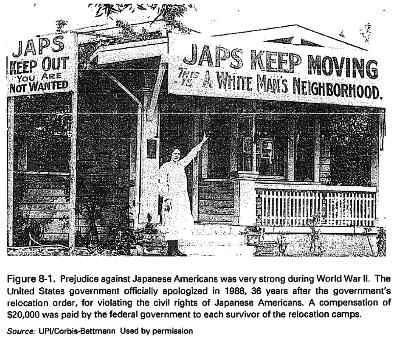
In public opinion,Walter Lippmann(1922)spoke of“the pictures in our heads,”and the role of themassmedia in forming such stereotypes.One of the most shameful episodes in U.S.history resulted from the stereotypes depicting the enemy during World WarⅡ.Anti-Japanese propaganda convinced many people in the United States that the Japanese were cunning,tricky,and willing to fight to the death to win.The negative stereotype was mainly formed by news accounts carried by themedia aboutwarfare in the Pacific theater,by cartoons and posters,and by interpersonal communication influenced by the predominant beliefs of the time.Attitudes help us determine appropriate behavior.Nationalistic sentiments protecting one’s country by uniting against an enemy that threatens its national security are essential during a war.However,those stereotypes created an atmosphere in 1942 in which U.S.citizens did nothing while the federal government put 110,000 citizens of Japanese ancestry in internment camps.Japanese-Americans were forced to leave their homes,their businesses,and their possessions behind because the stereotype portrayed them as threats to their own country (Figure 8-1).
Stereotypes as Codes
What is a code?A code is a classification used by individuals to categorize their experience and to communicate it to others.A code is a kind of shorthand that enables an individual to convey a range of phenomena in a single word.For example,ducks,geese,and swans are three variations ofwaterbirds.Adults are generally familiar with the general category and the three subcategories.A child may learn one of the subcategories and apply it to the other two,calling all birds paddling in a lake“ducks”,for example.
A stereotype is a special kind of code.The term stereotype evolved from the printing process of repeatedly casting the same image often exaggerated and usually negative.It is easier to communicate if we don’t need to describe every nuance of difference.Rather than exerting themental effort to evaluate all incoming information carefully and critically,we often resort to categorizing certain information into familiar patterns.Stereotypes are one of these patterns,and they can be positive or negative.For example,many people in the United States think that Asians have a gift formathematics and science.Another stereotype is that Germans build the finest automobiles;the French have the best chefs;the Italians the finest opera singers.
We learn stereotypes as one part of our culture.Standardized mental pictures held in common bymembers of a groupmake it easier to decidewhatbehavior is appropriate and what behavior to expect.The problem with such an oversimplified approach is that it distorts the reality of what we are perceiving.During initial contact with someone of a certain race or lifestyle,you may have reacted toward the stranger in a way determined by the stereotype that you held.The stereotype may have prevented you from ever getting to know the other individual.On the other hand,if you got to know the individual better,you might first believe that the stereotype did not apply to him or her and,eventually,that the stereotype incorrectly categorized allmembers of the group.We should recognize that within any stereotyped set of individuals,there iswide variation.
Forming codes and thinking in terms of these categories is a necessary aspect of human communication.Culturally sensitive individuals guard against the dangers of thinking in stereotypes;they remain flexible in changing these classifications.Culturally competent people use stereotypes as tools with limited functions.Cultural relativism is one means of questioning existing stereotypes.If we learn the codes of other cultures,we can evaluate our own more critically.
Overcom ing Prejudice and Discrim ination
Certain countries like the United States have a national policy objective to lessen discrimination.The CivilWar of the 1860s,the Civil Rightsmovement of the 1950s and 1960s,and the equal opportunity legislation of recent decades are important landmarks in this historicalmovement toward lessened discrimination.Butmaking discrimination illegal does not make it disappear.In order to decrease discrimination,individuals and systems must change.Such a shift in attitudes(prejudice)and in overt behavior(discrimination)ultimately can be encouraged by intercultural communication.
Prejudice
As explained in previous chapters,prejudice is an unfounded attitude toward an outgroup based on a comparison with one’s ingroup.Prejudice is usually expressed through communication.For example,an African-American student attending amainly White university stated:“In my freshman year,at a university student parade,there was a group of us standing there not knowing that thiswas an event that not a lot of Black people went to.Our dorm was going,and...wewere students too!...A group ofWhite fraternity boys-I remember the Southern flag-and one of them pointed and said,‘Look at that bunch of niggers!’I remember thinking,‘Surely he’s not talking to us!’...Iwanted to cry”(quoted in Feagin,1992).
After several such unpleasant experiences,an individual develops an expectation of experiencing prejudice in similar situations.Another African American student attending a predominantly White university explained:“I still find myself uncomfortable if Iwalk into a strange environmentwhere there are only Whites and I’m the only Black.And unfortunately,usually someone,at least one person in that environment or in that situation,will say or do something that’s negative,if it’s nomore than just ignore you.So,if you come in defensive...your fear is reinforced”(quoted in Feagin,1992).
There aremany types of prejudice in the United States,but one of the most obvious is prejudice by European Americans toward African Americans.In the 1940s Gunnar Myrdal (1944)identified racial prejudice as An American Dilemma.In recent decades,White North Americans’negative perceptions of African Americans have softened as part of a general liberalization of racial attitudes in the United States and as segregation has decreased (Sigelman&Tuch,1997).However,many prejudiced Whites still cling to negative stereotypes.A national survey of ethnic images found that African Americans aremore likely than European Americans,Latinos,Asian Americans,or Southern Whites to be perceived as poor,violent,unintelligent,and welfare-dependent(Smith,1990).A 1991 national survey found that 31 percent of White European Americans perceived African Americans as lazy,and 50 percent thought they were aggressive(Peffley&Hurwitz,1993).
This kind of prejudice leads to discrimination.Whiteswho perceive African Americans as lazy are less supportive of government programs to alleviate poverty.Thosewho perceive African Americans as unintelligent and violent are less supportive of school integration(Smith,1990).Public opinion polls in the United States show that the nation is actually two societies:One Black and one White,separate and unequal(Kinder&Sanders,1996).The two groups differ markedly in socioeconomic status and are divided by residential segregation.The public opinion polls show that Blacks and Whites disagree,even on topics that have no explicit racial content (Kinder&Sanders,1996).So the“American dilemma”that Gunnar Myrdal wrote about 50 years ago still exists.
Prejudice can take asmany forms as there are groupswho perceive difference as a threat.Earlier we looked at the prejudice against Japanese Americans from 1942 to 1945.Despite the unimaginable discrimination against citizens in a democracy,some 33,000 Japanese Americans enlisted in the armed forces,some of them serving in the much-decorated 442nd Regiment in Europe.When US.President Harry Truman welcomed home this regiment in 1946,he said:“You foughtnotonly the enemy,you fought prejudice and you won”(quoted in Takaki,1993,p.384).
Prejudice is a kind of cultural blindness.It prevents us from seeing reality accurately.In order for individuals to becomemore interculturally competent,theymust avoid the prejudiced attitudes that often lead to discrimination and the unequal treatment of others.
(Intercultural communication.
Mississippi:Waveland press,inc.1999.)