3.The Culture Dimension of Globalization
Even a very short introduction to globalization would be woefully inadequate without an examination of its cultural dimension.Cultural globalization refers to the intensification and expansion of cultural flows across the globe.Obviously,“culture”is a very broad concept;it is frequently used to describe the whole of human experience.In order to avoid the ensuing problem of overgeneralization,it is important tomake analytical distinctions between aspects of social life.For example,we associate the adjective“economic”with the production,exchange,and consumption of commodities.If we are discussing the“political”,we mean practices related to the generation and distribution of power in societies.Ifwe are talking about the“cultural”,we are concerned with the symbolic construction,articulation,and dissemination ofmeaning.Given that language,music,and images constitute themajor forms of symbolic expression,they assume special significance in the sphere of culture.
The exploding network of cultural interconnections and interdependencies in the last decades has led some commentators to suggest that cultural practices lie at the very heart of contemporary globalization.Yet,cultural globalization did not start with the worldwide dissemination of rock“n”roll,Coca-Cola,or football.As noted in Chapter 2,expansive civilizational exchanges aremuch older thanmodernity.Still,the volume and extent of cultural transmissions in the contemporary period have far exceeded those of earlier eras.Facilitated by the Internet and other new technologies,the dominant symbolic systems of meaning of our age-such as individualism,consumerism,and various religious discourses-circulatemore freely and widely than ever before.As images and ideas can be more easily and rapidly transmitted from one place to another,they profoundly impact the way people experience their everyday lives.Today,cultural practices frequently escape fixed localities such as town and nation,eventually acquiring new meanings in interaction with dominant global themes.
The thematic landscape traversed by scholars of cultural globalization is vast and the questions they raise are too numerous to be fleshed out in this short introduction.Rather than offering a long laundry list of relevant topics,this chapterwill focus on four important themes:the tension between sameness and difference in the emerging global culture;the crucial role of transnational media corporations in disseminating popular culture;the globalization of languages;and the impact of materialist and consumerist values on our planet’s ecological systems.
Global Culture:Sameness or Difference?
Does globalization make people around theworldmore alike ormore different?This is the question most frequently raised in discussions on the subject of cultural globalization.A group of commentators we might call“pessimistic hyper globalizers”argue in favour of the former.They suggest thatwe are notmoving towards a cultural rainbow that reflects the diversity of the world’s existing cultures.Rather,we are witnessing the rise of an increasingly homogenized popular culture underwritten by a Western“culture industry”based in New York,Hollywood,London,and Milan.As evidence for their interpretation,these commentators point to Amazonian Indians wearing Nike training shoes,denizens of the Southern Sahara purchasing Texaco baseball caps,and Palestinian youths proudly displaying their Chicago Bulls sweatshirts in downtown Ramallah.Referring to the diffusion of Anglo-American values and consumer goods as the“Americanization of the world”,the proponents of this cultural homogenization thesis argue that Western norms and lifestyles are overwhelming more vulnerable cultures.Although there have been serious attempts by some countries to resist these forces of“cultural imperialism”—for example,a ban on satellite dishes in Iran,and the French imposition of tariffs and quotas on imported film and television—the spread of American popular culture seems to be unstoppable.
But thesemanifestations of sameness are also evident inside the dominant countries of the global North.American sociologist George Ritzer coined the term“McDonaldization”to describe the wide-ranging sociocultural processes by which the principles of the fast-food restaurant are coming to dominate more and more sectors of American society as well as the rest of the world.On the surface,these principles appear to be rational in their attempts to offer efficient and predictable ways of serving people’s needs.However,looking behind the facade of repetitive TV commercials that claim to“love to see you smile”,we can identify a number of serious problems.For one,the generally low nutritional value of fast-food meals—and particularly their high fat content—has been implicated in the rise of serious health problems such as heart disease,diabetes,cancer,and juvenile obesity.Moreover,the impersonal,routine operations of“rational”fast-service establishments actually undermine expressions of forms of cultural diversity.In the long run,the McDonaldization of the world amounts to the imposition of uniform standards that eclipse human creativity and dehumanize social relations.
Perhaps the most thoughtful analyst in this group of pessimistic hyperglobalizers is American political theorist Benjamin Barber.In his popular book on the subject,he warns his readers against the cultural imperialism of what he calls“McWorld”—a soulless consumer capitalism that is rapidly transforming the world’s diverse populations into a blandly uniform market.For Barber,McWorld is a productof a superficial American popular culture assembled in the 1950s and 1960s,driven by expansionist commercial interests.Music,video,theatre,books,and theme parks are all constructed as American image exports that create common tastes around common logos,advertising slogans,stars,songs,brand names,jingles,and trademarks.
Optimistic hyperglobalizers agree with their pessimistic colleagues that cultural globalization generatesmore sameness,but they consider this outcome to be a good thing.For example,American social theorist Francis Fukuyama explicitly welcomes the global spread of Anglo-American values and lifestyles,equating the Americanization of the world with the expansion of democracy and freemarkets.But optimistic hyperglobalizers do not just come in the form of American chauvinists who apply the old theme ofmanifest destiny to the global arena.Some representatives of this camp consider themselves staunch cosmopolitans who celebrate the Internet as the harbinger of a homogenized“techno-culture”.Others are free-market enthusiastswho embrace the values of global consumer capitalism.
It is one thing to acknowledge the existence of powerful homogenizing tendencies in the world,but it is quite another to assert that the cultural diversity existing on our planet is destined to vanish.In fact,several influential commentators offer a contrary assessment that links globalization to new forms of cultural expression.Sociologist Roland Robertson,for example,contends that global cultural flows often reinvigorate local cultural niches.Hence,rather than being totally obliterated by the Western consumerist forces of sameness,local difference and particularity still play an important role in creating unique cultural constellations.Arguing that cultural globalization always takes place in local contexts,Robertson rejects the cultural homogenization thesis and speaks instead of“glocalization”—a complex interaction of the global and local characterized by cultural borrowing.The resulting expressions of cultural“hybridity”cannot be reduced to clear-cutmanifestations of“sameness”or“difference”.Aswe noted in our previous discussion of Osama bin Laden,such processes of hybridization have becomemost visible in fashion,music,dance,film,food,and language.
In my view,the respective arguments of hyperglobalizers and sceptics are not necessarily incompatible.The contemporary experience of living and acting across cultural bordersmeans both the loss of traditional meanings and the creation of new symbolic expressions.Reconstructed feelings of belonging coexist in uneasy tension with a sense of placelessness.Cultural globalization has contributed to a remarkable shift in people’s consciousness.In fact,it appears that the old structures of modernity are slowly giving way to a new“postmodern”framework characterized by a less stable sense of identity and knowledge.
Given the complexity of global cultural flows,one would actually expect to see uneven and contradictory effects.In certain contexts,these flows might change traditional manifestations of national identity in the direction of a popular culture characterized by sameness;in others theymight foster new expressions of cultural particularism;in still others theymightencourage forms of cultural hybridity.Those commentatorswho summarily denounce the homogenizing effects of Americanizationmustnot forget that hardly any society in the world today possesses an“authentic”,self-contained culture.Those who despair at the flourishing of cultural hybridity ought to listen to exciting Indian rock songs,admire the intricacy of Hawaiian pidgin,or enjoy the culinary delights of Cuban-Chinese cuisine.Finally,those who applaud the spread of consumerist capitalism need to pay attention to its negative consequences,such as the dramatic decline of communal sentiments as well as the commodification of society and nature.
The Role of the M edia
To a large extent,the global cultural flows of our time are generated and directed by global media empires that rely on powerful communication technologies to spread their message.Saturating global cultural reality with formulaic TV shows and mindless advertisements,these corporations increasingly shape people’s identities and the structure of desires around the world.During the last two decades,a small group of very large TNCs have come to dominate the globalmarket for entertainment,news,television,and film.In 2000,only ten media conglomerates—AT&T,Sony,AOL/Time Warner,Bertelsmann,Liberty Media,Vivendi Universal,Viacom,General Electric,Disney,and News Corporation—accounted for more than two-thirds of the﹩250-275 billion in annual worldwide revenues generated by the communications industry.In the first half of that year,the volume ofmerger deals in globalmedia,Internet,and telecommunications totalled﹩300 billion,three times the figure for the first sixmonths of 1999.
As recently as 15 years ago,not one of the giant corporations that dominate what Benjamin Barber has appropriately called the“infotainment telesector”existed in its present form as amedia company.In 2001,nearly all of these corporations ranked among the largest 300 non-financial firms in the world.Today,mostmedia analysts concede that the emergence of a global commercial-media market amounts to the creation of a global oligopoly similar to that of the oil and automotive industries in the early part of the 20th century.The crucial cultural innovators of earlier decades—small,independent record labels,radio stations,movie theaters,newspapers,and book publishers—have become virtually extinct as they found themselves incapable of competing with themedia giants.
The negative consequences of this shotgun marriage of finance and culture are obvious.TV programme turn into global“gossip markets”,presenting viewers and readers of all ages with the vacuous details of the private lives of American celebrities like Britney Spears,Jennifer Lopez,Leonardo DiCaprio,and Kobe Bryant.Evidence suggests that people all over the world—but especially those from wealthy countries of the Northern hemisphere—are watchingmore television than ever before.For example,the daily average viewing time per TV home in the United States has increased from 5 hours and 56 minutes in 1970 to 7 hours and 26 minutes in 1999.That same year,TV household penetration in the US stood at a record 98.3%,with 73.9% of TV households owning two ormore sets.Advertisement clutter on US television reached unprecedented levels in 2000,peaking at over 15 minutes of commercials per prime time TV hour,not including the frequent cutaways for local ads.The TV advertisement volume in the UShas increased from﹩3.60 billion in 1970 to﹩50.44 billion in 1999.Recent studies show that American children at age 12 watch an average of 20,000 TV commercials a year,and 2-year-old toddlers have already developed brand loyalties.
The values disseminated by transnationalmedia enterprises secure notonly the undisputed cultural hegemony of popular culture,but also lead to the depoliticization of social reality and the weakening of civic bonds.One of themostglaring developments of the last two decades has been the transformation of news broadcasts and educational programmes into shallow entertainment shows.Given that news is less than half as profitable as entertainment,media firms are increasingly tempted to pursue higher profits by ignoring journalism’smuch vaunted separation of newsroom practices and business decisions.Partnerships and alliances between news and entertainment companies are fast becoming the norm,making itmore common for publishing executives to press journalists to cooperate with their newspapers’business operations.A sustained attack on the professional autonomy of journalism is,therefore,also part of cultural globalization.
The“Big Ten”M edia Conglomerates in 2001
AT&T CORPORATION(partial ormajority ownership of the following)Television:7 networks(includingWB,HBO,E!),
1 production company,largest cable provider
Movies:3 Studios(including Warner Bros)
Radio:43 stations in Canada
Music:1 production company(Quincy Jones Entertainment Co.)
SONY(partial ormajority ownership of the following)
Television:4 networks(including Telemundo,music Choice,Game Show Network)
Movies:4 studios(including Columbia,Pictures),1 movie theatre chain(loews)
Music:4 labels(including Columbia,Epic,American),1 recording studio(Whitfield)
AOL/TIMEWARNER(partial ormajority ownership of the following)
Television:15 networks(including WB,HBO,TBS,TNT,CNN),second-largest cable provider,4 production companies(including Warner Bros,Castle Rock),library of 6,500 movies,32,000 TV shows,1 digital video recording company(TiVo)
Magazines:64 titles(including People,life,Time)
movies:3 Studios(including Warner Bros,New Line)
Music:40 labels(including Atlantic,Elektra,Rhino),
1 production company(Quincy Jones Entertainment Co.)
Internet:4 Internet companies(including America Online,CompuServe,Netscape),7 websites(including MusicNet,Winamp,moviefone)
BERTELSMANN(partial ormajority ownership of the following)
Television:22 stations in Europe,Europe’s biggest broadcaster
Internet:6 websites(including Lycos,MusicNet,Get Music,barnesandnoble.com)Magazines:80 titles(including YM,Family Circle,Fitness)
Radio:18 stations in Europe
Music:200 labels(including Arista,RCA,BMG Classics)
Newspapers:11 dailies in Germany and Eastern Europe
LIBERTY MEDIA CORPORATION(partial or majority ownership of the following)
Television:20 networks(including Discovery,USA Network,Sci-FiChannel,QVC),14 stations,largest cable operator in Japan,2 production companies(MacNeil/Lehrer Productions),1 digital video
recording company(TiVo)
Internet:3 websites(including Ticketmaster,Citysearch)
Movies:6 studios(including USA Films,Gramercy Pictures,October Films)
Radio:21 stations in US,49 stations in Canada
Magazines:101 titles(including American Baby,Modern Bride,Seventeen)
VIVENDIUNIVERSAL(partial ormajority ownership of the following)
Television:34 channels in 15 countries(including USA Network,Sundance Channel),cable operations in 11 countries,2 production studios(Universal Studios)Movies:6 studios(including Universal Studios,PolyGram Films,Gramercy Pictures)Music:10 labels(including Interscope,DefJam,MCA)
Internet:1 Internet company(Vizzavi),2 websites(Get Music,iWON.com)
Magazines:2 titles(L’Express,L’Expansion)
Newspapers:Free papers in France
VIACOM,INC.(partial ormajority ownership of the following)
Television:18 networks(including CBS,UPN,MTV,Nickelodeon),39 stations,7 production studios,1 digital video recording company(TiVo)
Movies:4 studios,lmovie rental chain(Blockbuster)
Internet:8 websites(including Sportsline.com,hollywood.com,iWON.com)
Magazines:4 titles(including BETWeekend,Emerge,Heart&Soul)
Radio:184 Infinity radio stations,CBSRadio Network
GENFRAL ELECTRIC(partial ormajority ownership of the following)
Television:12 networks(including NBC,A&E,Bravo),13 stations and PAX TV,5 production studios,1 digital video recording company(TiVo)
Internet:6 websites(including Salon.com,Auto by-tel.com,polo.com)
WALT DISNEY COM PANY(partial ormajority ownership of the following)
Television:17 networks(including ABC,ESPN,Lifetime),10 stations,6 production studios(including Buena Vista,Touchstone,Saban)
Movies:6 studios(including Dimension,Miramax Film Corp.,Touchstone Pictures)Radio:50 stations and 4 networks
Magazines:6 titles(including USweekly,Discover,Talk)
NEWS CORPORATION(partial ormajority ownership of the following)
Television:14 networks(including Fox,National Geographic Channel,Golf Channel),33 stations,5 production studios(including Regency Television,)XYZ Entertainment),1 digital video recording company(TiVo)
Movies:7 studios(including Fox Searchlight,New Regency,Twentieth Century Fox)Music:1 label(Rawkus)
Newspapers:7 dailies(including NY Post,The Sun,The Australian)
Adapted from The Nation,7/14 January 2002
The Globalization of Languages
One direct method of measuring and evaluating cultural changes brought about by globalization is to study the shifting global patterns of language use.The globalization of languages can be viewed as a process by which some languages are increasingly used in international communication while others lose their prominence and even disappear for lack of speakers.Researchers at the Globalization Research Center at the University of Hawaii have identified five key variables that influence the globalization of languages:
1.Number of languages:The declining number of languages in different parts of the world points to the strengthening of homogenizing cultural forces.
2.Movements of people:People carry their languages with them when they migrate and travel.Migration patterns affect the spread of languages.
3.Foreign language learning and tourism:Foreign language learning and tourism facilitate the spread of languages beyond national or cultural boundaries.
4.internet languages:The Internet has become a globalmedium for instant communication and quick access to information.Language use on the Internet is a key factor in the analysis of the dominance and variety of languages in international communication.
5.International scientific publications:International scientific publications contain the languages of global intellectual discourse,thus critically impacting intellectual communities involved in the production,reproduction,and circulation of knowledge around the world.
To be sure,the rising significance of the English language has a long history,reaching back to the birth of British colonialism in the late 16th century.At that time,only approximately 7 million people used English as their mother tongue.By the 1990s,this number had swollen to over 350 million native speakers,with 400 million more using English as a second language.Today,more than 80% of the content posted on the Internet is in English.Almost half of the world’s growing population of foreign students are enrolled at institutions in Anglo-American countries.
At the same time,however,the number of spoken languages in the world has dropped from about 14,500 in 1500 to less than 7,000 in 2000.Given the current rate of decline,some linguists predict that 50-90% of the currently existing languages will have disappeared by the end of the 2lst century.
But theworld’s languages are not the only entities threatened with extinction.The spread of consumerist values and materialist lifestyles has endangered the ecological health of our planet aswell.
Cultural Values and Environmental Degradation
How people view their natural environment depends to a great extent on their cultural milieu.For example,cultures steeped in Taoist,Buddhist,and various animist religions tend to emphasize the interdependence of all living beings—a perspective that calls for a delicate balance between human wants and ecological needs.Judeo-Christian humanism,on the other hand,contains deeply dualistic values that put human beings at the centre of the universe.Nature is considered a“resource”to be used instrumentally to fulfil human desires.The most extrememanifestation of this anthropocentric paradigm is reflected in the dominant values and beliefs of consumerism.As pointed out above,the US-dominated culture industry seeks to convince its global audience that the meaning and chief value of life can be found in the limitless accumulation ofmaterial possessions.
At the dawn of the 2lst century,however,it has become impossible to ignore the fact that people everywhere on this planet are inextricably linked to each other through the air they breathe,the climate they depend upon,the food they eat,and the water they drink.In spite of this obvious lesson of interdependence,our planet’s ecosystems are subjected to continuous human assault in order to secure wasteful lifestyles.Granted,some of the major ecological challenges the world faces today are problems that afflicted civilizations even in ancient times.But until the coming of the Industrial Revolution,environmental degradation was relatively localized and occurred over thousands of years.In the last few decades,the scale,speed,and depth of Earth’s environmental decline have been unprecedented.Let us briefly consider some of themost dangerousmanifestations of the globalization of environmental degradation.
Two of the major concerns relate to uncontrolled population growth and lavish consumption patterns in the global North.Since farming economies first came into existence about 480 generations ago,the global population has exploded a thousand-fold tomore than 6 billion.Half of this increase has occurred in the last 30 years.With the possible exception of some rodent species,humans are now themost numerousmammals on earth.Vastly increased demands for food,timber,and fibre have put severe pressure on the planet’s ecosystems.Today,large areas of the Earth’s surface,especially in arid and Semi-arid regions,have nearly ceased to be biologically productive.
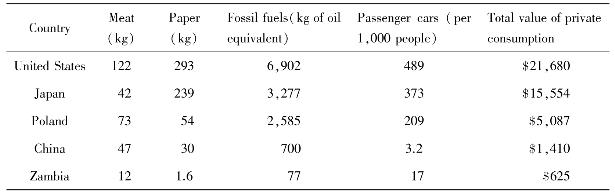
Concerns about the relationship between population growth and environmental degradation are frequently focused rather narrowly on aggregate population levels.Yet,the global impact of humans on the environment is asmuch a function of per capita consumption as it is of overall population size.For example,the United States comprises only 6% of the world’s population,but it consumes 30-40% of our planet’s natural resources.Together,regional overconsumption and uncontrolled population growth present a serious problem to the health of our planet.Unless we are willing to change the underlying cultural and religious value structure that sustains these ominous dynamics,the health of Mother Earth is likely to deteriorate even further.
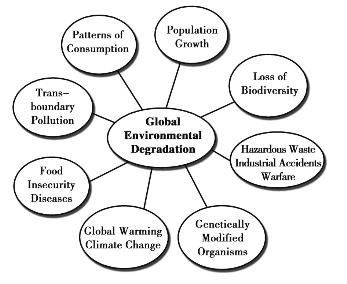
Major manifestations and consequences of global environmental degradation.
Human-induced climate change such as globalwarming represents another example of the decisive shift in both the intensity and extent of contemporary environmental problems.The rapid build-up of gas emissions,including carbon dioxide,methane,nitrous and sulphur oxides,and chlorofluorocarbons,in our planet’s atmosphere has greatly enhanced Earth’s capacity to trap heat.The resulting“greenhouse effect”is responsible for raising average temperaturesworldwide.
Annual consumption patterns(per capita)in selected countries in 2001
Although the precise effects of global warming are difficult to calculate,the USUnion of Concerned Scientists has presented data suggesting that the global average temperature increased from about l3.5°C(56.3°F)in 1880 to l4.4°C(57.9°F)in 2000.Further increases in global temperatures could lead to partialmeltdowns of the polar ice caps,causing global sea levels to rise by up to 90 centimetres by 2100—a catastrophic development that would threaten themany coastal regions around the world.
Trans boundary pollution represents another grave danger to our collective survival.The release of vast amounts of synthetic chemicals into the air and water has created conditions for human and animal life that are outside previous limits of biological experience.For example,chlorofluorocarbons have been used in the second half of the 20th century as nonflammable refrigerants,industrial solvents,foaming agents,and aerosol propellants.In the mid-1970s,researchers noted that the unregulated release of CFCS into the air seemed to be depleting Earth’s protective ozone layer.A decade later,the discovery of large‘ozone holes’over Tasmania,New Zealand,and large parts of the Antarctic finally resulted in a coordinated international effort to phase out production of CFCs and other ozone-depleting substances.Other forms of transboundary pollution include industrial emissions of sulphur and nitrogen oxides.Returning to the ground in the form of‘acid rain’,these chemicals damage forests,soils,and freshwater ecosystems.Current acid deposits in Northern Europe and parts of North America are at least twice as high as the criticallevel suggested by environmental agencies.
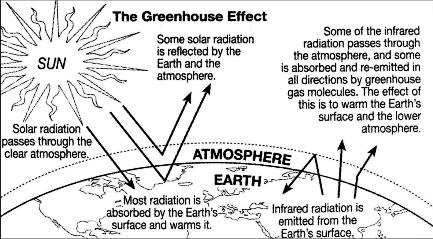
The Greenhouse Effect
Perhaps the most ominous problem associated with globalization of environmental degradation in the contemporary era is the worldwide destruction of biodiversity.In l998,a group of US scientists rated biodiversity loss as a more serious environmental problem than global warming or transboundary pollution.Seven out of ten biologists today believe the world is now in themidstof the fastestmass extinction of living species in the 4.5-billion-year history of the planet.According to recent OECD reports,two-thirds of the world’s farmlands have been rated as“somewhat degraded”and one-third have been marked as“strongly degraded”.Half the world’s wetlands have already been destroyed,and the biodiversity of freshwater ecosystems is under serious threat.Three-quarters ofworldwide genetic diversity in agricultural crop and animal breeds has been lost since 1900.Some experts fear thatup to 50% of all plant and animal species—most of them in the global South—will disappear by the end of this century.
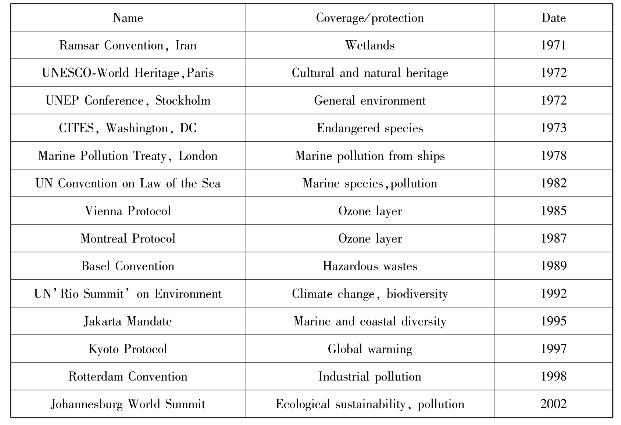
Despite this litany of bad ecological news,onemight find reason for cautious optimism in the rising number of international environmental treaties and agreements.Various clauses in these accords curtail air and water pollution,protect endangered species,and limit hazardous waste disposal.Unfortunately,however,most of these treaties lack effective international enforcementmechanisms.Moreover,such major environmental polluters as the United States and China have not yet ratified some of the key agreements.
In 1992,the Union of Concerned Scientists issued a communiquéentitled“Warning to Humanity”,which stated that the global environmentwas in the throes of a severe crisis.More than 1,500 scientists,includingmany Nobel laureates,have signed the document.It remains to be seen whether the growing recognition of the ecological limits of our planet will translate into a much-needed revision of cultural structures rooted in the desire for the unlimited accumulation ofmaterial things.
Major global environmental treaties,1971—2002
(Steger,M.B.Globalization:AVery Short Introduction.2003)