第九章 被动语态(passive voice)
语态(voice)是动词的一种形式,用以表示主语和谓语之间的关系。英语的语态分为主动语态(active voice)和被动语态(passive voice)。
主动语态表示主语是动作的执行者。如:
Yesterday! I brought a new dress.
昨天,我买了一条新裙子。
被动语态表示主语是动作的承受者。如:
The glass of the window was broken by Jerry.
玻璃被杰瑞打碎了。
1. 被动语态的结构和种类
被动语态大部分由主语加系动词be加及物动词的过去分词形式构成。如果需要说明施动者,则由介词by引出,置于动词的过去分词之后。如:
主动语态:Jack beat you. 杰克打你。
被动语态:You were beaten by Jack. 你被杰克打。
1)被动结构除常用be加过去分词构成之外,被动语态还有“get+过去分词”的结构。这种结构多用于口语中,后面一般不接by短语。如:
Hundreds of people get killed every year in a traffic accident .
每年都有几百人死于交通事故。
The boy got hurt on his way home.
男孩在回家的路上受伤了。
2)不定式之中也有被动语态,其句型模式为to be done,如:
If you want to be respected,you must respect yourself.
自敬者人敬之。
I never met a person who didn’t want to be appreciated.
我没见过不喜欢被表扬的人。
3)动名词之中的被动语态,其句型模式为:being done,如:
Everyone appreciates being appreciated.
人人喜欢被赞赏。
One who fears being conquered is sure of defeat.
害怕被打败的人是肯定会失败的。
4)还有含情态动词的被动语态,其结构是“情态动词+be+过去分词”。如:
This desk must be repaired as soon as possible.
这张桌子必须尽快修理。
What’s done cannot be undone.
覆水难收。
Life can only be understood backwards,but it must be lived forwards.
生活只能在过后被理解,但我们必须先生活。
These online materials are very old. They should be renewed.
这些网络资料太旧了,应该更新了。
Be careful when cross the road, or you might be knocked down.
过马路要非常小心,不然会被车撞倒的。
有部分短语动词相当于及物动词,所以这些短语动词也有被动语态。如:
Many interesting experiments are carried out in our class.
我们课堂上做了许多有趣的实验。(“有趣的实验”作为主语为动作承受者)
Boxing was gone in for here in the early years.
早些年,这里拳击很盛行。
5)有些由“动词+名词+介词”构成的短语动词,为避免其松散结构,变成被动语态,可以将名词和其后的介词拆开(使介词和其后的宾语合成一个介词短语)。这种被动语态常用于正式文体中。如:
汉语:学生宿舍里乱作一团。
英文主动句是:The students had made mess of their dormitory.
被动句是:Mess had been made of the students’ dormitory.
汉语:这件工具的利用率很高。
英文主动句是:They make good use of the tool.
被动句是:Good use is made of the tool.
6)被动语态的常见句型还有:
⑴It is done that…,如:
It is generally admitted that he is a trustworthy person.
大家一致公认他是个可信赖的人
It is reported that tomorrow is sunny.
预报说明天晴天。
常用于该句型的动词包括:
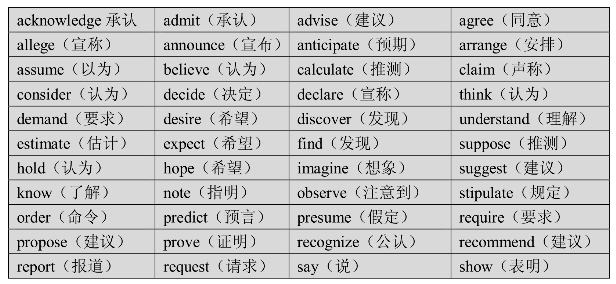
注:以上单词也经常用于Sth.(Sb.)is done to…句型。
⑵Sth.(Sb.) is done to…句型,如:
You’re believed to have a lot of money. 据说你很有钱。
7)被动语态可以用于各种时态,由此也出现句型模式的变化,较常用的有下列十种:
⑴一般现在时被动语态,句型模式is(am,are)+done,如:
He said the civil war must be fought soon.
他说不久内战将会爆发。
All human activity is prompted by desire.
人的行为靠欲望推动。
I don’t know who is wounded in the war.
我不知道谁在战争中受伤了。
Miss Wang, you are wanted in the office.
王小姐,办公室有事找你。
I don’t think he is so easily deceived.
我不认为他那么容易被骗。
⑵一般过去时被动语态,句型模式was(were)+done,如:
The room was cleaned by me yesterday.
我昨天把屋子清理了。
Because of friends I met along the way, my journey was kept alive.
因为一路结识了很多朋友,这使我的旅程充满生机。
We were taught how to respond to adversity.
我们被教会如何面对逆境。
I was invited to the concert.
我应邀参加了音乐会。
Our house was built in 1969.
我们家的房子建于1969年。
⑶一般将来时被动语态,句型模式will(shall)+be done,如:
She will be married next year.
她下周结婚。
Today’s work will be surpassed tomorrow.
今日努力明日收获。
We hope that an agreement will be arrived at.
我们希望会达成一项协议。
This matter will be looked into immediately.
这件事立即就要查明。
⑷过去将来时被动语态,句型模式would +be done,如:
I thought he would be praised at the meeting.
我认为他会在会上被表扬。
He said that the bridge would be built next year.
他说这座桥明年将建成。
He said the little girl, Allen, would be chosen to be the queen.
他说那个叫艾伦的小女孩会被选作王后。
At 10 o’clock,all doors would be locked and all lights extinguished.
十点整,所有的门都要锁,所有的灯都要熄灭。
⑸现在完成时被动语态,句型模式has(have)been done,如:
The flowers have been watered.
花浇了。
My car has been repaired.
我的汽车已修好了。
The meeting has been planned since the New Year.
这会议自新年起就已筹划了。
The students have been separated into two groups.
学生被分为两组。
⑹过去完成时被动语态,句型模式had been done,如:
Alice had not been born with a special talent,but she later became a success musician.
爱丽丝没有什么天赋,但不后来却成为一个成功的音乐家。
The painting had been taken down for this year because it always made him recalled the sorrow passed by.
那些总让他想起过去悲伤事情的画今年被取下了
He had been warned for times last year.
他去年就被警告过多次。
⑺将来完成时被动语态,句型模式will have been done,如:
One’s character will have been completed by the time his life comes to an end.
一个人的性格一生都在不断完善,直至死亡而止。
The new books will have been entered next week.
这些新书将在下周登记完毕。
This class will have been taught by Miss Li for two terms by next summer.
到明年夏天,这个班将由李老师教过两学期了。
If you entered the school that time you will have been graduated next year.
如果你那时候入学的话,明年就该毕业了。
⑻过去将来完成时被动语态,句型模式would be done,如:
She thought the work would be finished in one week at that time.
她认为当时那工作本应在未来的一周内就完成。
He said he would be loved if he loved others.
如果他爱别人的话,他将被爱。
The article would have been completed translated by six o’clock, our tutor said.
导师说这篇文章要在6点钟以前翻译完毕。
The government announced that the bridge would have been completed before July.
政府通知说这桥将于7月前完成。
⑼现在进行时被动语态,句型模式is(am,are) being done,如:
I am always being urged by my purpose.
我总是被我的目标激励。
He always feel sad when is being judged by the appearance only.
仅仅被人以外貌来评价的时候他总是很伤心。
This question is being discussed at the meeting.
这个问题正在会上讨论。
The children are being taken care of by their grandma.
孩子们现在正由奶奶照看着。
⑽过去进行时被动语态,句型模式was(were) being done,如:
He was being beaten when his aunt saw him.
他阿姨见到他时,他正在挨打。
When he called, tea was being served.
他来拜访时,正值上茶之际。
I touched the crown of my hat to be sure it wasn’t being crushed.
我摸摸帽子,以肯定它没有被压坏。
注:完成进行时态、将来进行时与过去将来进行时一般不用被动语态。
⑴完成进行时态的被动意义可用完成时态来表示,如:
She has been being examined.
她已被考过。
一般表达为:He has been examined.
⑵将来进行时与过去将来进行时可以用一般时态来表示,如:
Tom will be being examined while we are there.
汤姆将在我们在那里时被考。
一般表达为:Tom will be examined while we are there。
2.被动语态的用法
英语里多用主动语态,但用被动语态的场合也不少,似乎要比汉语用得广泛些,因为在英语中,被动语态便于论述客观事实,故常用于一些特殊场合、科技文章、新闻报道、书刊介绍及景物描写。
英语被动语态的常用场合如下:
1)动作的执行者不明。如:
He told us printing was introduced into Europe from China.
他告诉我们印刷术是由中国传入欧洲的。
There’s nothing left!Everything has been taken away.
什么也没有剩,一切都被拿走了。
2)当不必要提出动作执行者时。如:
I was born in 1984.
我生于1984年。
Such things are not done twice.
这种事不可再做。
3)当强调动作的承受者时。如:
The little boy is liked by everybody there.
那个小男孩为那里的每个人所喜欢。(强调the little boy)
A good time was had by all.
大家都玩得很痛快。(强调a good time)
4)当需要避免说出动作的执行者时。如:
Where can you be reached?
哪里可以和你接头?
You’ll be contacted.
会和你联系的。
5)当出于行文需要时。如:
The film was directed by Zhang Yimou.
该电影由张艺谋导演。(上文谈的是该影片)
Clare was sent to the school by her parents when he was eight.
克莱尔10岁时被父母送到这学校。(上文谈的是克莱尔)
6)有些动词习惯上常用被动语态。如:
It’s done!
完成啦!(可缩略为Done!)
现在一般时被动式表动作已完成。
She is said to be a good teacher.
她被认为是一个好教师。
The line of flags was slung between two trees.
一列国旗挂在两树之间。
He was born in 1923.
他生于1923年。
Wang Fei is reputed to be the best singer in China.
王菲被誉为是中国最佳歌手。
注意:在英语新闻标题中,被动语态结构“be+过去分词”中的助动词“be”,通常被省略。也经常不用“by”引出动作的执行者,只用过去分词在标题里就可直接表示被动意义,读者切忌将之误解为该动词的过去式。如:
FATHER JAILED FOR MURDER OF DAUGHTER
谋杀女儿的父亲被判入狱。
3.主动语态与被动语态的转换
主动语态变为被动语态,主要有以下三种情况:
1)“主+谓+宾”句型变为被动语态:
将主动结构中的宾语变为被动结构中的主语(宾语如为人称代词,须将宾格变为主格);将主动结构中谓语动词的主动语态变为被动语态;在谓语动词的被动语态之后加by,再将主动结构中的主语置于介词by之后(如为人称代词,须将其主格变为宾格)。如:
Thomas Edison invented the electric light.
托马斯爱迪生发明了电灯。(主动结构)
The electric light was invented by Thomas Edison。
电灯是托马斯爱迪生发明的。(被动结构)
The manager has not signed the papers.
经理没有在这些文件上签字。(主动结构)
The papers have not been signed by the manager.
这些文件还没有由经理签字。(被动结构)
被动结构中,如无需强调施动者,可将by短语省去,如:
He posted that letter last night.
他昨晚把那封信寄了。(主动结构)
That letter was posted last night.
那封信是昨晚寄的。(被动结构)
如宾语是that从句,变为被动语态时可用it作被动句的形式主语,如:
We know that cat is a lovely animal.
我们认为猫是一种可爱的动物。(主动结构)
It is known that cat is a lovely animal.
猫被看做是一种可爱的动物。(被动结构)
或把主动句中宾语从句的主语变为被动句的主语,宾语从句中的谓语部分变为不定式短语。如:
Cat is known to be a lovely animal.
猫被看做是一种可爱的动物。(被动结构)
将主动句变为被动句时,偶尔可把by短语放在过去分记词之前,如:
He was by someone known to have worked for the FBI.
有人知道他曾为联邦调查局干过事。
这里将by someone移至过去分词known之前是由于known和其后的to have worked的关系更为密切。
有时by短语也可放在主语补语之后,如:
Tea drinking is considered one of the pleasures of life by the Chinese.
喝茶被中国人认为是一种人生乐趣。
被动结构中的by短语除了代表动作的执行者之外,有时也表方式或原因,如:
A policeman is not always known by the clothes he wears.
警察不总能从他穿的服装认出来。(方式)
I was very much flattered by his asking me to dance a second time.
我对他再次请我跳舞感到高兴。(原因)
2)“主+谓+宾+宾”句型变为被动语态
此类句型中的两个宾语一般一为间接宾语,一为直接宾语,变为被动结构时,只将原主动结构中的一个宾语变为被动结构中的主语,另一宾语不变(保留宾语retained object)。如将直接宾语变为被动结构中的主语,间接宾语之前应加介词to(可省)或for(一般不可省)。如:
Father told her an interesting story.
他给她讲了一个有趣的故事。(主动结构)
She was told an interesting story.
她听了一个有趣的故事。(被动结构)
An interesting story was told to her.
有人对她讲了一个有趣的故事。
An interesting story was told to her,not to me.
有人给她讲了有趣的故事不是给我。
(被动结构强调间接宾语时,其前的介词to不可省去。)
Mother bought Lucy a new coat.
母亲给露西买了件新上衣。(主动结构)
Lucy was bought a new coat.
有人给露西买了件新上衣。(被动结构)
A new coat was bought for Lucy.
有人给露西买了件新上衣。(被动结构)
如双宾语结构中两个宾语都是直接宾语。变为被动结构时,一般皆将主动结构中指人的宾语变为主语。如:
The teacher asked me a very unusual question.
老师向我提了一个很不寻常的问题。(主动结构)
I was asked a very unusual question.
我被问了一个很不寻常的问题。(被动结构)
偶也可将主动结构中指物的宾语变为主语,但指人的保留宾语之前一般不可加任何介词。如:
She will forgive you your offence.
她将宽恕你的无礼。(主动结构)
Your offence will be forgiven.
你的无礼将得到宽恕。(被动结构)
3)“主+谓+复合宾语”句型变被动语态
复合宾语(含有一个宾语加宾语补语)变为被动结构时,只将主动结构中的宾语变为被动结构中的主语,宾语补语不变。如:
We chose Mary monitor.
我们选玛丽做班长。(主动结构,宾语补语为名词)
Mary was chosen monitor.
玛丽被选为班长。(被动结构)
He had a strange way of making his class lively and interesting.
他有一种奇特的办法使他上的课生动有趣。(主动结构,宾语补语为形容词)
His class was made lively and interesting .
他上的课被安排的生动有趣。(被动结构)
They recognized him as a genius.
他们认为他是一个天才。(主动结构,宾语补语为介词短语)
He was recognized as a genius.
他被认为是一个天才。(被动结构)
The villagers did not allow them to build a factory there.
村民不允许他们在那里建工厂。(主动结构,宾语补语为不定式)
They were not allowed to build a factory there.
他们不被允许在那里建工厂。(被动结构)
I saw him doing his homework.
我发现他在写作业。(主动结构,宾语补语为现在分词)
He was seen doing his homework.
他被发现在写作业。(被动结构)
We found all our seats occupied.
我们发现所有我们的位子都被占了。(主动结构,宾语补语为过去分词)
All our seats was found occupied.
所有我们的位子发现都被占了。(被动结构)
但在下列情况下,主动句一般不能变为被动句:
⑴当主动句的谓语是:及物动词leave,enter,reach,resemble,become(适合) suit,benefit,lack等时;或是不可拆开的take place,lose heart,change colour,belong to,consist of等短语动词时,主动句一般不能变为被动句。
⑵当主动句的宾语是:反身代词、相互代词、同源宾语、不定式、动名词等时;或虚词it,如cab it,foot it等时;或身体的某一部分,如shake one’s head等时;以及某些抽象名词,如interest(兴趣)等时,主动句一般不能变为被动句。
4.含被动意义的主动语态
有部分不及物动词(至于句中其主语大都指物)的主动语态可以表示被动意义。这种不及物动词有:
1)部分连系动词,如smell,taste,sound,prove,feel等。
The flowers smell sweet.
这花儿很香。
The cake tastes nice.
这蛋糕的味道好。
That sounds very interesting.
这话听上去很有趣。
The theory proved quite false.
这一套理论证实完全是假的。
2)部分与can’t,won’t等连用的不及物动词,如move,lock,shut,open等。
It can’t move.
它不能被挪动。
The door won’t shut.
这门关不上。
3)部分可和well,easily等副词连用的不及物动词,如read,write,wash,clean,
draw,burn,cook,photograph等。
The cloth of my skirt washes well.
我裙子的这种布料好洗。
Chinese ancient poems read smoothly.
中国的古诗读起来很流畅。
The shoes don’t clean easily.
这双鞋不容易弄干净。
This kind of rice cooks more quickly than that kind.
这种米做饭比那种熟得快。
4)部分可用于“主+谓+主补”结构中的不及物动词,如wear,blow等。
This material has worn thin.
这种布料已被穿薄了。
The window blew open.
窗户给吹开了。
有些不及物动词的进行时亦具有被动意义。如:
This dictionary is selling briskly.
这词典很畅销。
上述不及物动词有些亦可用作及物动词,但二者有所不同。如:
The door opened.
门开了。(强调“门”本身可开可关,不强调动作的执行者)
The door was opened.
门被打开了。(强调“门被人打开了”)
5.被动语态与系表结构的区别
这里要和被动语态作以区别的是“系动词+用作表语的过去分词”的系表结构,它与被动语态的形式完全一样,但表达的意思却有区别,一般来讲,它们有以下几点不同:
1)在被动语态中:过去分词为动词,表动作,可用by短语表动作的执行者;系表结构中:过去分词相当于形容词,表状态,一般不用by短语。如:
These books are sold quickly.
这些书售得快。(被动语态)
These books are all sold out.
这些书全售出了。(系表结构)
The novel was written with great care.
这小说写得很用心。(被动语态)
The novel is well written.
这篇作文写得好。(系表结构)
Such issues are often settled through negotiations.
这类事件通常通过谈判解决。(被动语态)
The question is settled.
这个问题解决了。(系表结构)
2)被动语态可以用于多种时态,而系表结构一般只用于现在一般时与过去一般时态。如:
The classroom was cleaned.
教室被打扫了。(被动结构过去时)
The trees will be planted next week.
下周种树。(被动结构将来时)
The glass of the windows is broken.
窗户玻璃是破的。(系表结构,指目前的状态)
This window was broken by Kale yesterday.
这窗户是凯乐昨天打破的。(被动语态)
3)被动语态中,常用much修饰过去分词;系表结构中,常用very修饰过去分词。如:
Aunt Wang is much loved by everyone.
王阿姨深受大家爱戴。(被动结构)
Usually the big man on campus is much sought by girl students.
往往校园里面出风头人物更能受到女学生的追求。(被动结构)
Tom was much agitated by the news.
汤姆听到消息后很激动。(被动结构)
She is very shortsighted.
她近视很深。(系表结构)
She is very talented.
她很有才华。(系表结构)
He was very agitated.
他很激动。(系表结构)
4)被动结构只表示被动含义,系表结构则表示主动意义。系表结构具有主动意义举例说明:
⑴系表结构中的过去分词与介词搭配,如:
James was puzzled about it.
詹姆斯为那件事感到困惑。
He was scared out of his wits.
他吓得不知所措。
He is interested in this subject.
他对这门课感兴趣。
We were surprised at the news.
我们对那消息感到惊讶。
I am accustomed to stay alone.
我习惯独处了。
5)系表结构中的过去分词是反身动词,如:
The way was lost in the shadows.
小路消失在阴影中。(主动式是lost itself)
The beautiful girl was bathed in light.
美丽的女孩沐浴在阳光中。(主动式是bathed herself)
⑶系表结构中的过去分词表示心理、感情,如:
I am resolved to become a artist.
我决心当一名画家。
Lucy is quite puzzled.
我感到十分困惑。
一般情况下,过去分词有时可以跟with,也可后跟by,一般by强调动作,with强调状态,如:
seized with a fever 发烧;
seized by a man 被人捉住;
covered by a lid 被盖子盖住;
covered with a lid 为盖子所盖住。
6) 有时被动结构与系表结构只能根据上下文才能加以区别,如:
The door was closed.
门关上了。既可是被动结构:门被人关上了;也可是系表结构:门是关着的。
The road was mended.
既可是被动结构:路被人修好了;也可是系表结构:路是修好的。
6.短语动词的被动语态
短语动词是一个整体,不可丢掉后面的介词或副词,例如:
This is a photo of the power station that has been set up in my hometown.
这是一张建在我家乡的电站的照片。
My sister will be taken care of by Grandma.
我妹妹将会由奶奶照看。
Such a thing has never been heard of before.
从来没有听说过这样的事。
表示“据说”或“相信”的词组
believe,consider,declare,expect,feel,report,say,see,suppose,think,understand,etc.
It is said that… 据说
It is reported that… 据报道
It is believed that… 大家相信
It is hoped that… 大家希望
It is well known that… 众所周知
It is thought that… 大家认为
It is suggested that… 据建议
It is taken granted that… 被视为当然
It has been decided that… 大家的决定是
It must be remember that…务必记住的是
7.不用被动语态的情况
1)appear,die,disappear,end(vi.结束),fail,happen,last,lie,remain,sit,spread,stand等不及物动词或break out,come true,fall asleep,keep silence,lose heart,take place等动词短语都没有被动语态。例如:
价格涨了。
The price has been risen. (错)
The price has risen. (对)
事故发生在上周。
The accident was happened last week.(错)
The accident happened last week. (对)
要想正确地使用被动语态,就须注意哪些动词是及物的,哪些是不及物的。特别是一词多义的动词往往有两种用法。
2)不能用于被动语态的及物动词或动词短语有:fit, have, hold, marry, own, wish, cost, notice, watch, agree with,arrive at/in,shake hands with,succeed in,suffer from,happen to,take part in,walk into,belong to等,如:
This key just fits this lock.
这把钥匙只适合这把锁。
Your story agrees with what had already been heard.
你的故事和我们刚刚听到的一样。
3)无被动语态的动词有:appear, be become, fall, feel, get, grow, keep, look, remain, seem, smell, sound, stay, taste, turn等。如:
听起来不错。
It sounds good. (对)
It was sounded well. (错)
4)同源宾语的及物动词如die, death, dream, live, life 等及反身代词、相互代词,不能用于被动语态,如:
她昨晚做了个不好的梦。
She dreamed a bad dream last night. (对)
A bad dream was dreamed last night by her.(错)
5)宾语是不定式时,很少用于被动语态。如:
她喜欢游泳。
She likes to swim. (对)
To swim is liked by her. (错)
6)主动形式表示被动意义的有:
⑴wash,clean,cook,iron,look,cut,sell,read,wear,feel,draw,write,sell,drive等,如:
The book sells well.
这本书销路好。
This knife cuts easily.
这刀子很好用。
⑵blame,let(出租),remain,keep,rent,build等,如:
I was to blame for the accident.
归咎于那场事故。
Much work remains.
还剩下很多工作。
⑶在need,require,want,worth(形容词),deserve后的动名词必须用主动形式,如:
The door needs repairing.
门需要修理。
This room needs cleaning.
这房间应该打扫一下。
This book is worth reading.
这本书值得一读。
⑷特殊结构:make sb. heard / understood (使别人能听见/理解自己),have sth.done (要某人做某事)。
7)被动形式表示主动意义的有:be determined,be pleased,be graduated(from),be finished,be prepared(for),be occupied(in),get marries 等,如:
He is graduated from a famous university.
他毕业于一所有名的大学。
注意:
表示同某人结婚,用marry sb. 或get married to sb. 都可,如:
他和一位富有的女孩结婚了。
He married a rich girl.
He got married to a rich girl.
当 need,want,require,worth(形容词)后面接doing也可以表示被动,如:
Your hair wants cutting.
你的头发该理了。
The floor requires washing.
地板需要冲洗。
The book is worth reading.
这本书值得一读。
典型例题:
The library needs___,but it'll have to wait until Sunday.
A. cleaning B. be cleaned C. clean D. being cleaned
答案A. need (实意) +n /to do,need (情态)+ do,当为被动语态时,还可need + doing.本题考最后一种用法,选A。
8.被动语态常见用法补充(注意主语与动词的关系)
1)一般现在时的被动语态构成:is / am / are + 及物动词的过去分词
Our classroom is cleaned everyday.
我们的教室每天都会打扫。(教室被打扫)
I am asked to study hard.
我被要求努力学习。(我被要求)
Knives are used for cutting things.
刀子是用来切东西的。(刀被使用)
2) 一般过去时的被动语态构成:was / were + 及物动词的过去分词
A new shop was built last year.
一个新商店去年建成了。(商店被建成)
Dinosaur eggs were laid long long ago.
恐龙蛋是很久很久以前生的。(蛋被生)
3) 现在完成时的被动语态构成:has / have + been + 及物动词的过去分词
This book has been translated into many languages.
这本书已被翻译成多种语言。
Many man-made satellites have been sent up into space by many countries.
数国的很多人造卫星已经发射到太空。(卫星被发射)
4)一般将来时的被动语态构成:will + be +及物动词的过去分词
A new hospital will be built in our city.
一个新医院将在我市建立。(医院被建立)
Many more trees will be planted next year.
明年会植更多的树。(树被植)
5)含有情态动词的被动语态构成:情态动词+ be +及物动词的过去分词
Young trees must be watered often.
小树苗必须经常浇灌。(树苗被浇灌)
Your mistakes should be corrected right now.
你的错误必须立刻改正。(错误被改正)
The door may be locked inside.
门可能从里面锁了。(门被锁)
Your homework can be handed in tomorrow.
你的作业可以明天早上交。(作业被交)
6)现在进行时的被动语态构成:am / is / are + being + 及物动词的过去分词
王叔叔正在修理我的自行车。
主动语态:Uncle Wang is mending my bike now.(强调王叔叔的动作)
被动语态:My bike is being repaired by Uncle Wang now.(强调自行车及其状态)
他们正在那里植树。
主动语态:They are planting trees over there. (强调他们的动作)
被动语态:Trees are being planted over there by them. (强调树及其状态)
7)不定式的被动语态:to + be + 及物动词的过去分词
There are two books to be read.
有两本书可读。(书被读)
There are twenty more trees to be planted.
还有二十多棵树要植。(树被植)
8)主动语态改成被动语态简单方法补充
把主动语态改为被动语态非常简单,可以遵循以下几个步骤:
⑴先找出谓语动词;
⑵再找出谓语动词后的宾语;
⑶把宾语用作被动语态中的主语;
⑷注意人称、时态和数的变化。
例:
①布鲁斯每周都写信。
Bruce writes a letter every week.(主语Bruce;谓语writes<一般现在时态>;宾语:a letter)→A letter is written by Bruce every week. (原宾语:a letter作为主语;原谓语write变
被动语态形式;原主语Bruce加介词by)
②李磊今天早上修理了那个坏自行车。
Li Lei mended the broken bike this morning.(主语Li Lei;谓语mended<一般过去时态>;宾语the broken bike;)
→The broken bike was mended by Li Lei this morning. (原宾语the broken bike作为主语;原谓语mended变过去时态的被动语态形式;原主语加介词by)
试分析以下句子的变化:
He has written two novels so far.→Two novels have been written by him so far.
They will plant ten trees tomorrow.→Ten trees will be planted by them tomorrow.
Lucy is writing a letter now.→A letter is being written by Lucy now.
You must lock the door when you leave.→the door must be locked when you leave.
9)使用被动语态应注意的几个问题:
⑴不及物动词无被动语态。
What will happen in 100 years?
一百年后将会发生什么?
The dinosaurs disappeared about 65 million years ago.
恐龙大致出现在650万年前。
⑵有些动词用主动形式表示被动意义。
This pen writes well.
这支钢笔很好写。
This new book sells well.
这本新书销量很好。
⑶感官动词或使役动词使用省略to的动词不定式,主动语态中不带to ,但变为被动语态时,须加上to。如:
make somebody do something→somebody be made to do something
see somebody do something→somebody be seen to do something
例如:
老板让小男孩干很重的活。
The boss made the little boy do heavy work.→The little boy was made to do heavy work by the boss.
一个女孩经过的时候看我钱包掉了。
A girl saw my wallet drop when she passed by.→My wallet was seen to drop by a girl when she passed by.
⑷如果是接双宾语的动词改为被动语态时,直接宾语(物)作主语,那么动词后要用介词,这个介词是由与其搭配的动词决定的。例如:
他给我一本书。
He gave me a book.→A book was given to me by him.
他给我看了一张票。
He showed me a ticket.→A ticket was shown to me by him.
爸爸给我买了一辆新自行车。
My father bought me a new bike. →A new bike was bought for me by my father.
⑸一些动词短语用于被动语态时,动词短语应当看作一个整体,而不能丢掉其中的介词或副词。 例如:
他每天都听广播。
He listens to the radio every day. →The radio is listened to by him every day.