Chapter 6 Abstracts for Academic Papers
Preview 知识预测
1.What is an abstract?
2.What are the guidelines to follow for abstracts?
3.What are the types of abstracts?
4.What are the qualities of good abstracts?
5.What are the basic components of an abstract?
Overview 知识概述
Abstracts are short pieces of academic writing that provide an overview of your research,either partially or in full.What is discussed in this chapter provides some helpful pointers to write an abstract and is particularly aimed at first time presenters to a conference or beginners in writing academic papers.
An abstract is a condensed version of the manuscript,which highlights the major points covered,concisely describes its content and scope,and reviews its material in abbreviated form.The abstract should also include all the key words in your research, so that other researchers can retrieve information from it.As it is usually the first section and sets the tone of the paper for the reviewer,it must be concise and easy to read and must cover the important points of the paper.
The abstract will follow a set of guidelines as stipulated by the conference where you will present your paper.Many publications have a required style for abstracts; the “Guidelines for Authors”provided by the publisher will provide specific instructions.Stay within the publisher’ s guidelines,or your manuscript might be rejected.
Two Types of Abstracts
According to the length and content,abstracts basically fall into two categories,descriptive abstracts and informative abstracts.
Descriptive abstracts are very short—usually a brief one-or two-sentence paragraph (sometimes appear on the title page of a journal article)under 100 words.They tell readers what information the report,article,or paper contains.Descriptive abstracts include the purpose,methods and scope of the report,article,or paper,and do not provide results,conclusions,or recommendations.The main purpose of descriptive abstracts is to introduce the subject to readers,who must then read the report,article,or paper to find out the author's results,conclusions,or recommendations.这类摘要又被称为指示型摘要、介绍型摘要、陈述型摘要,它仅使读者对论文的主要内容有一概括的了解。
Compared with descriptive abstracts,informative abstracts communicate specific information from the report,article,or paper.They include not only the purpose,methods,and scope,but also the results,conclusions,and recommendations of the report,article,or paper.Informative abstracts provide information from every major section in the body of the report by summarizing the key information from each of the main sections of the report.Informative abstracts omit introductory explanation (unless that is the focus of the main body of the report),definitions and other background information (if they are not the major focus of the report),and citations for source borrowings.这类信息型摘要又被称为报道型摘要、资料型摘要,是整篇论文的高度浓缩。目前国内外科技期刊中学术类研究型文章的摘要都属于信息型的,本章后文主要讨论这一类型的文摘。
The differences between the two types of abstracts can be illustrated in the following examples.
1a.Based on an exhaustive review of currently available products,this report concludes that none of the available grammar-checking software products provides any useful function to writers.
1b.This report provides conclusions and recommendations on the grammar-checking software that is currently available.
1c.This report presents conclusions and recommendations from a survey done on grammar-checking software.
Example 1a is the style of summarizing in the informative abstract,while 1b is what the descriptive abstract is like.Descriptive abstract can also be phrased as in 1c.Instead,the informative abstract must present the details of those conclusions and recommendations.
Qualities of a Good Abstract
A good abstract covers the major parts of your research by strictly following the chronology of the article,paper,or report,provides logical connections (or transitions)between the information included,adds no new information,but simply summarizes the report,and is readable to a wide audience,well-organized and not too jargon-laden.A good abstract contains no excess wordiness or unnecessary information.Passive verbs are often used to downplay the author and emphasize the information.Well developed paragraphs in a well-written abstract are unified,coherent,concise,and able to stand alone.
Basic Components of an Abstract
Despite the fact that an abstract is quite brief,it must do almost as much work as the multi-page paper that follows it.Abstracts are quite formulaic in structure, though there are variations.The following are the basic components of an abstract in any discipline.However,it’ s important to note that the weight accorded to the different components can vary by discipline.For models,try to find abstracts of research that is similar to your own research interest.
The first component is motivation or problem statement.It should be a general statement about some issue in the field that your study contributes to.At this point you typically don’ t mention your study yet but stake out the part of the field that you're speaking to,and raise the issue that you’ ll be addressing (this sets the stage for you to present your research as the solution to a problem, or as a challenge to a claim made by another scholar).Don’ t just present a topic; frame the issue as a puzzle or problem or gap or weakness in the literature.This shows why your work is important.Also don’ t just say you’ re applying someone else’ s ideas; make clear what this application adds to knowledge.Alternatively,you can open with one sentence stating what the paper is about and then contextualize it with a general statement about how it connects to an issue in the field,but the first way is a bit more elegant.
The next two components are methods (or procedure,approach)and results (or findings,product).They are the heart of the abstract.The solution to the problem described in the previous part will be stated here.Briefly give details about the study—where it was conducted and with whom (number and background of participants, sources of data), how long the study lasted and/or how many data were collected (e.g.,hours of recordings).Then summarize your research findings.You should typically include a brief example to illustrate your argument (this usually isn’ t possible if you are allotted less than 500 words for the abstract).Be sure to specify precisely how the example demonstrates your point.You should in any event include a detailed description of the results:specify your findings in detail (perhaps introduce key terms you use in the analysis).
The last component is the conclusion or implications.You now need to return the big picture:How do these findings address the issue raised at the beginning of the abstract? What does this imply for the field? This discussion needs not be lengthy,but it should convincingly convey that your research has significant implications.
Writing an efficient abstract is a hard work,but will repay you with increased impact on the world by enticing people to read your publications.Make sure that all the components of a good abstract are included in the next one you write.
Other Considerations in a Good Abstract
An abstract must be a fully self-contained,capsule description of the paper.It can’ t assume (or attempt to provoke)the reader into flipping through looking for an explanation of what is meant by some vague statement.It must make sense all by itself.
Let us begin with the general format and style for an academic abstract.Your abstract should be single-spaced in an easy-to-read 12pt font (like Times New Roman).You are strongly recommended to come as close as possible to the word limit without going over.In writing the abstract,do not use the future tense,even to say“In my presentation,I will...” .It sounds unnatural to use the present tense in this context,but if you use the future tense some abstract reviewers may think you haven’ t completed the research.Be extremely precise and detailed about your argument and analysis.Never simply say “Results of the study will be discussed”or the equivalent; state what the results are and why they matter.
If your data are in a language other than English,use only the Roman alphabet or the International Phonetic Alphabet to represent them; do not use other writing systems.Be sure to provide translations (and morpheme by morpheme glosses,if relevant to the analysis).
The title must be clear and informative that contains all the key elements of your presentation (e.g.,a key concept,the language or group under study,a general sense of your argument).Very short and very long titles are not recommended.Using a title and a subtitle separated by a colon is often a good way to maximize informativeness in a short space.It's easiest to choose a title after writing the abstract.
Some publications request “keywords” .These have two purposes.They are used to facilitate keyword index searches,which are greatly reduced in importance now that on-line abstract text searching is commonly used.However,they are also used to assign papers to review committees or editors,which can be extremely important to your fate.So make sure that the keywords you pick make assigning your paper to a review category obvious (for example,if there is a list of conference topics,use your chosen topic area as one of the keyword tuples).
You should cite a few references in the text (no more than 5 or so in a 500-word abstract)to show you know the field.Don’ t waste space with a long list; select the key references only.(Deciding who’ s key may partly depend on who’ s hosting the conference,the theme,the theoretical position of the conference,etc..)It’ s often best to cite at least one“classic”(i.e., canonical but not antique)reference and one“cutting-edge”recent reference.You should also cite anyone who centrally represents the issue you’ re discussing.If you cite yourself,do so in the third person so your anonymity is preserved.You should NOT include a bibliography; save the space for describing your study.
Typical Sentence Patterns for Abstracts
Generally,do not begin with“this paper/report...” .It is better to write about the research than about the paper.Do not explain the sections or parts of the paper.Avoid sentences that end in“...is described/reported/analyzed” .Do not begin sentences with“it is suggested/believed/felt that...”(In every case,the four words can be omitted without damaging the essential message.).Do not repeat or rephrase the title.Do not refer in the abstract to information that is not in the document.If possible,avoid trade names,acronyms,abbreviations,or symbols.You would need to explain them,and that takes too much room.
The following patterns are typically used at the beginning of an abstract.
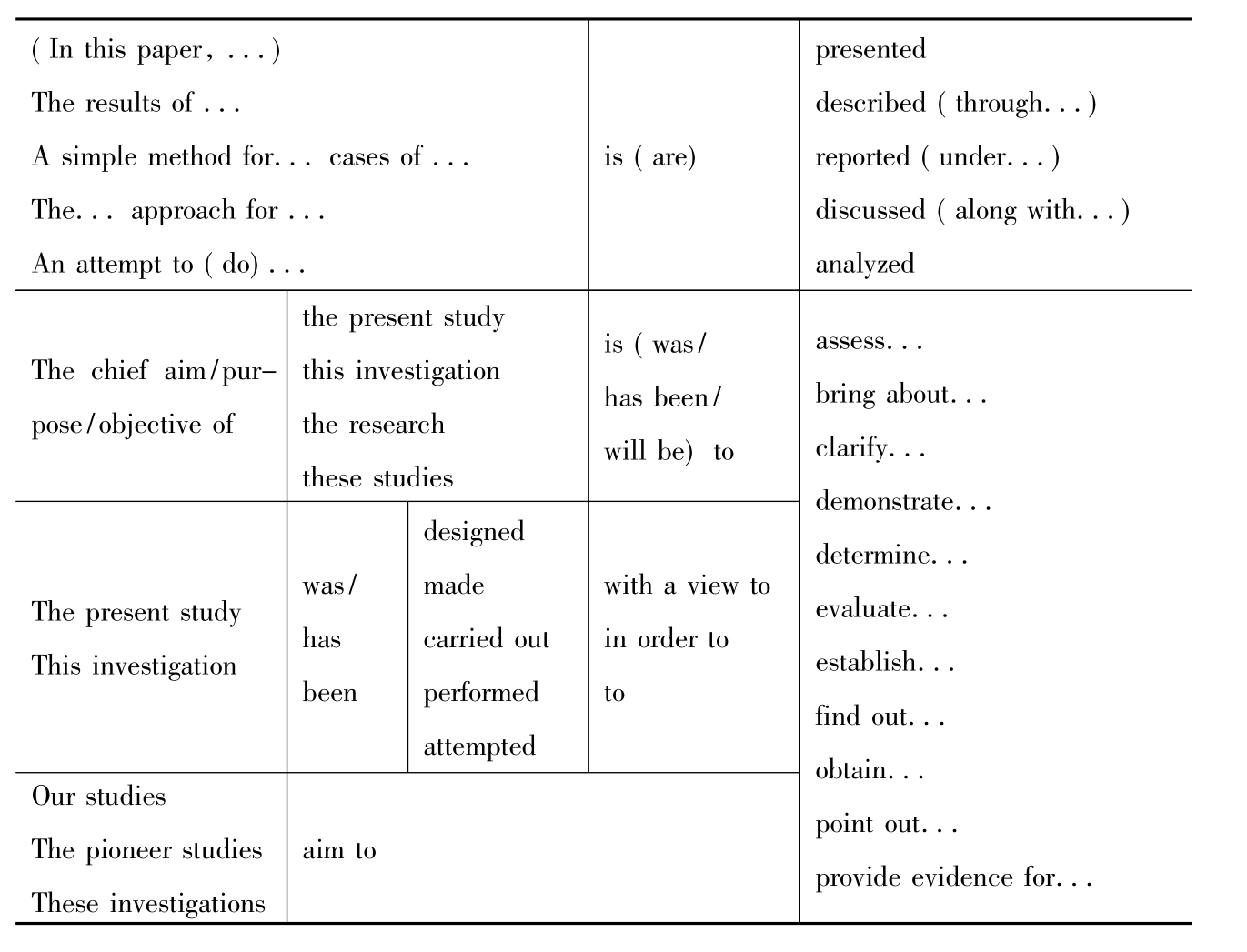
The following patterns are typically used at the end of an abstract.

Reinforcement 知识复习
1.The best source of example abstracts is journal articles.Please go to the library and look at journals or electronic journals on the web in your own discipline.Select several articles with the informative abstracts or descriptive abstracts and study the writing methods of the abstracts.
2.Read the abstract; read the article.Pick the best ones,the examples where the abstract makes the article easier to read,and figure out how they do it.(Note:Not everyone writes good abstracts,even in referred journals,but the more abstracts you read,the easier it is to spot the good ones.)
3.Choose one article in your research field and try to write an informative abstract.
Extension 知识拓展
Tips on Abstracting Your Own Writing
When abstracting your own work,it may be difficult to condense a piece of writing that you have agonized over for weeks (or months,or even years)into a 250-word statement.You could make it easier by using the following tips.
Reverse Outlining
This technique is commonly used when you are having trouble organizing your own writing.The process involves writing down the main idea of each paragraph on a separate piece of paper.For the purposes of writing an abstract, try grouping the main ideas of each section of the paper into a single sentence.For a scientific paper,you may have sections titled Purpose,Methods,Results,and Discussion.Each one of these sections will be longer than one paragraph,but each is grouped around a central idea.Use reverse outlining to discover the central idea in each section and then distill these ideas into one statement.
Cut and Paste
To create a first draft of an abstract of your own work,you can read through the entire paper and cut and paste sentences that capture key passages.This technique is useful for social science research with findings that cannot be encapsulated by neat numbers or concrete results.A well-written humanities draft will have a clear and direct thesis statement and informative topic sentences for paragraphs or sections.Isolate these sentences in a separate document and work on revising them into a unified paragraph.
Tips on Abstracting Someone Else’ s Writing
When abstracting something you have not written,you cannot summarize key ideas just by cutting and pasting.Instead,you must determine what a prospective reader would want to know about the work.There are a few techniques that will help you in this process.
Identify Key Terms
Search through the entire document for key terms that identify the purpose,scope,and methods of the work.Pay close attention to the Introduction (or Purpose)and the Conclusion (or Discussion).These sections should contain all the main ideas and key terms in the paper.When writing the abstract,be sure to incorporate the key terms.
Highlight Key Phrases and Sentences
Instead of cutting and pasting the actual words,try highlighting sentences or phrases that appear to be central to the work.Then,in a separate document,rewrite the sentences and phrases in your own words.
Don't Look Back
After reading the entire work,put it aside and write a paragraph about the work without referring to it.In the first draft, you may not remember all the key terms or the results,but you will remember what the main point of the work is.Remember not to include any information you do not get from the work being abstracted.