2.Too Busy to Notice You're Too Busy
By Alina Tugend
Recently I've found myself annoyed by how busy my friends seem.Putting aside the possibility that they are avoiding me,some are so on the go that they barely have time to tell me they do not have time to talk.Every phone call,no matter how short,seems to be interrupted by several others.That is,of course,if I actually get a live person on the other end of the phone.
I consider my life to be somewhat filled and fulfilling.I have a husband and two children,work part time,volunteer,exercise several times a week(well,usually)and socialize regularly.For the record,I do not have a baby sitter,but do have a house cleaner for about four hours every two weeks.
But,and I am almost embarrassed to admit this,I also have time to read novels,catch a movie or play once in a while and have the occasional long lunch with a friend.
In our busy,busy world,however,I sometimes feel as if I am the odd one out.Although those who are overworked and overwhelmed complain ceaselessly,it is often with an undertone of boastfulness;the hidden message is that I'm so busy because I'm so important.
Now I realize that busyness is not an absolute:everyone has a different threshold.I have one friend for whom more than one social engagement a weekend is just too much;others love to party,party,party.And most people would trade in bored and stagnant for a little stress if they were engaged in doing something they loved.
I am also aware that there are many who have no options;who must work exhausting hours simply to survive.But I am speaking about those who choose to keep up a frenetic pace that seems largely self-imposed,unnecessary—and unenjoyable.
Edward M.Hallowell,a psychiatrist and author of“CrazyBusy: Overstretched,Overbooked and About to Snap”(Ballantine Books,2006) writes about how he knew he had crossed into the dark side from busy to crazy busy when he got mad at a rotary phone while staying at a vacation house.
Unable to use a cellphone,he was driven nuts waiting for the dial to return to start.
Then calming himself,he timed how long the dialing actually took:11 seconds.
“What a fool I had beCome,”he writes.“I had beCome a man in a hurry even when I had no need to hurry.”
According to Dr Hallowell,there are many(26 in his book)overlapping reasons we all fall into the trap of being overly busy.A few are:
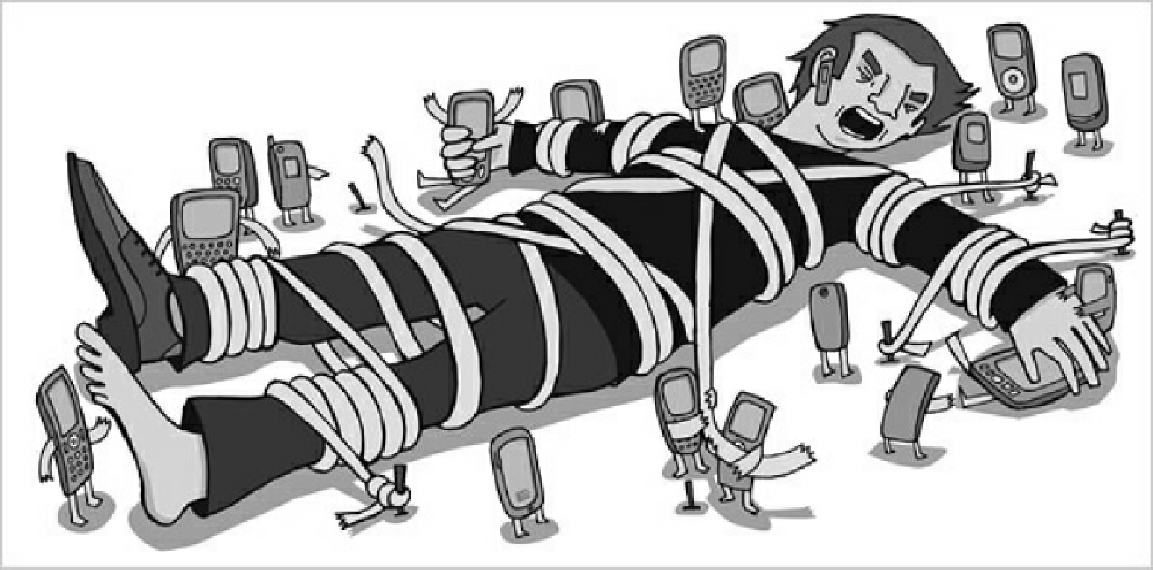
●It is so easy with cellphones and BlackBerrys a touch away.
●It is a kind of high.
●It is a status symbol.
●We're afraid we'll be left out if we slow down.
●We avoid dealing with life's really big issues—death,global warming,AIDS,terrorism—by running from task to task.
●We do not know how not to be busy.
Not only are we constantly occupied,but we,as Americans,are also famous for not knowing how to be unoccupied.
My husband and I would no more fail to use up vacation time than we would hand back our paycheck.But,according to a 2005 study,“Overwork in America,”released by the nonprofit group Families and Work Institute,36 percent of 1,000 salaried employees surveyed by telephone said they did not plan to take their full vacation.
Of course,it is not just in the work force that people are madly busy.Many people I know,who might be able to enjoy some downtime because their children are in school and they do not have paying jobs,pile errands on top of volunteering on top of working out on top of,well,you name it.When the children get out of school,they race from one activity to another,and if at some point life seems to calm down,then it is time to take on a big construction project,get a dog or have another baby.
Paradoxically,Dr Hallowell writes in“CrazyBusy,”it is in part the desire for control that has led people to lose it.
“You can feel like a tin can surrounded by a circle of a hundred powerful magnets,”he writes.“Many people are excessively busy because they allow themselves to respond to every magnet:tracking too much data,processing too much information,answering to too many people,taking on too many tasks—all in the sense that this is the way they must live in order to keep up and stay in control.But it's the magnets that have the control.”
One way to wrestle back control is to take a hard look at our priorities,he said,“to decide what matters.”This does not necessarily mean big career changes or moving from Manhattan to rural Vermont.It can also be figuring out in small,but significant ways how to scale down frantic to manageable.
My friend Leah and her husband have three children and have tried many different permutations of the work/life balance over the years.She had the full-time job while he worked part time;he went back to a fulltime career when she cut back to part time.Now,with a 14-year-old daughter coming up on college,they are both working full time.
“We've set up our lives,so we take turns doing the class trips for our kindergartner,so we can go to the field hockey games,but it's really tough,”she said.“I work hard at making life less insane.”
On a day when she had to pick up her father from the airport,for example,she made the decision to bring work home so she wouldn't race to her office,then rush to the airport,then hightail it back to her job.
“That's a big thing,”she said.“There's a conscious effort not to feel so chaotic,but I can't say it's always so successful.”
We can long for the days when parents at class events didn't spend as much time tapping on their BlackBerrys as watching their children haltingly recite their poetry;when cellphones were not the background noise of daily life.
But instead of bemoaning technology,it is time to make it a tool of good rather than evil.
Often,small changes can be amazingly simple.For example,one woman took back some of her time,Dr Hallowell said,by making a seemingly minor but crucial shift in her workplace:“She put her computer behind her instead of in front of her,so she had to swivel around to use it.To use the computer—to write,to do e-mail,go to Google,whatever—she had to make a conscious decision to do so.This is huge.”
Other times it can take a little training.
Answering and receiving e-mail messages can suck up enormous amounts of time during the workday,said Mike Song,a co-author of“The Hamster Revolution:How to Manage Your E-Mail Before It Manages You”(Berrett-Koehler Publishers,2007).
Mr Song,along with his co-authors,surveyed 8,000 employees working in major corporations over three years,and found that most say they spend about 40 percent of their workday on e-mail activity.
“E-mails put other people's priorities in your lives,”he said.And although his emphasis is on work,to a lesser extent we all see it at home in the form of the friend who constantly sends out the group messages or passes on every joke.
With a few relatively simple tactics,that time can be cut way back,said Mr Song,who used to be a money manager and now is a founding partner of Cohesive Knowledge Solutions,a firm that trains corporations on,yes,controlling e-mail.
For example,75 percent of those surveyed said their colleagues used the“reply all”function far too often.Yet only 15 percent said they felt that they themselves did so.
So Mr Song suggests largely eliminating the“reply all”and“cc”options.
I particularly like some of the codes you can use to avoid having to reply,such as NRN,for no reply needed,and NTN,for no thanks needed.I never thought I would accuse people of being overly polite,but perhaps we can cut a wee bit back on the e-mails that say“Thanks!”
The trouble with writing about busyness is that,like focusing on dieting or budgeting,I am now hyper-aware of how I spend each moment.It is exhausting.And if I didn't need to rush off,I would lie down.
(From The New York Times,March 31,2007)
Questions for Discussion(问题讨论)
1.How do you interpret the headline of this article?
2.What makes the author feel like“the odd one out”?
3.“My husband and I would no more fail to use up vacation time than we would hand back our paycheck.”Discuss the meaning of this sentence.
4.What does“permutations of the work/life balance”mean?
5.What would you think is a better attitude toward work and leisure?
Language Tips(阅读提示)
On the go:In constant activity,very busy.
For the record:Used to emphasize a point that you are making,so that the person you are speaking to takes notice.
注意别和“off the record”弄混淆。Off the record:when what you are going to say is not yet official and you do not want them to repeat it publicly.
The odd one out,or the odd man out:不合群的人A person or thing that is different from others or does not fit easily into a group or set.
Undertone:An underlying or implied tendency or meaning;an undercurrent.
Threshold:原为术语,意为“阈限”,如感觉阈限就分两类Absolute threshold:the lowest level at which a stimulus can be detected.Recognition threshold:the level at which a stimulus can not only be detected but also recognized.Differential threshold:the level at which an increase in a detected stimulus can be perceived.Terminal threshold: the level beyond which a stimulus is no longer detected.Here means a transitional interval beyond which some new action or different state of affairs is likely to begin or occur.
Rotary phone:老式转盘电话The rotary dial is a device mounted on or in a telephone or switchboard that is designed to send interrupted electrical pulses,known as pulse dialing,corresponding to the number dialed.The early form of the rotary dial used lugs on a finger plate instead of holes.The modern version of the rotary dial with holes was first introduced in 1904 but only entered service in the Bell System in 1919.The device was phased out from the 1970s onwards with the onset of Touch Tone dialing,which uses a telephone keypad instead of a dial.Some telephone systems in the US no longer recognize rotary dialing by default,in which case it would have to be ordered from the telephone company as a special feature,to support older customer equipment.Today the dial is a key pad or“dial pad”,generally with 12 keys numbered 0-9,*,and#which perform an equivalent signalling function to that of a rotating disk dial.
A touch away:指手指轻轻一摁就行了。类似说法还有a click away,指只需用鼠标稍稍一点就可以得到,这种表达均表示便捷。
Downtime:原指“The period of time when something,such as a factory or a piece of machinery,is not in operation,especially as the result of a malfunction”,也转指“a period of time when you have finished what you were doing,and you can relax or do something that you had not originally planned to do”,这里读者自然可以判断是什么意思。
Work out:在这里是“健身”的意思。名词是workout。To train the body by physical exercise.
You name it:常用于列举。used after a list of things to mean that there are many more you could mention or anything you can imagine.
Permutation:原是数学统计词,意为“排列”。Any of the different ways in which a set of things can be ordered.Here means mix.
Hightail it:To leave somewhere very quickly.
At class events:是指学生家长也参加的学校班级活动。
Way back:A long time.wray一词有时作副词,表示程度很高,相当于far,by a large amount,又如way ahead/behind,way above/below,也可接比较级如way smarter/bigger。
A wee bit:A little bit.
Cultural Notes(文化导读)
Work-life balance:Work-life balance is a broad concept including proper prioritizing between career and ambition on one hand,compared with pleasure,leisure,family and spiritual development on the other.As the separation between work and home life has diminished,this concept has beCome more relevant than ever before.According to some statistics,four out of ten employees state that their jobs are“very”or“extremely”stressful.Those in high stress jobs are three times more likely than others to suffer from stress-related medical conditions and are twice as likely to quit.The study states that women,in particular,report stress related to the conflict between work and family.
The number of stress-related disability claims by American employees has doubled according to the Employee Assistance Professionals Association in Arlington,Virginia.75%-90%of physician visits are related to stress and,according to the American Institute of Stress,the cost to industry has been estimated at$200 billion-$300 billion a year.
Steven L.Sauter,chief of the Applied Psychology and Ergonomics Branch of the National Institute for Occupational Safety and Health in Cincinnati,Ohio,states that recent studies show that“the workplace has beCome the single greatest source of stress.”Michael Feuerstein,professor of clinical psychology at the Uniformed Services University of the Health Sciences at Bethesda Naval Hospital states,“We're seeing a greaterincreaseinwork-relatedneuroskeletaldisordersfroma combination of stress and ergonomic stressors.”
It is clear that problems caused by stress have beCome a major concern to both employers and employees.Symptoms of stress are manifested both physiologically and psychologically.Persistent stress can result in cardiovascular disease,sexual health problems,a weaker immune system and frequent headaches,stiff muscles,or backache.It can also result inpoorcopingskills,irritability,jumpiness,insecurity,exhaustion,and difficulty concentrating.Stress may also perpetuate or lead to binge eating,smoking,and alcohol consumption.
According to James Campbell Quick,a professor of organizational behavior at the University of Texas-Arlington,“The average tenure of presidents at land-grant universities in the past ten years has dropped from approximately seven to three-and-a-half years.”
The feeling that simply working hard is not enough anymore is acknowledged by many other American workers.To get ahead,a seventy-hour work week is the new standard.What little time is left is often divvied up among relationships,kids,and sleep.This increase in work hours over the past two decades means that less time will be spent with family,friends,and community as well as pursuing activities that one enjoys and taking the time to grow personally and spiritually.
BlackBerry:“黑莓手机”是加拿大RIM公司推出的一种移动电子邮件系统终端,其特色是支持推动式电子邮件、手提电话、文字短信、互联网传真、网页浏览以及其他无线资讯服务。从技术上来说,BlackBerry是一种采用双向寻呼模式的移动邮件系统,兼容现有的无线数据链路。它出现于1998年,RIM的品牌战略顾问认为,无线电子邮件接收器挤在小小的标准英文黑色键盘,看起来像是草莓表面的一粒粒种子,就起了这么一个有趣的名字。但一般俗称的黑莓机,指的却不单单是一部手机,而是包含服务器(邮件设定)、软件(操作接口)以及终端(手机)大类别的Push Mail实时电子邮件服务。黑莓赖以成功的最重要原则——针对高级白领和企业人士,提供企业移动办公的一体化解决方案。企业有大量的信息需要即时处理,出差在外时,也需要一个无线的可移动的办公设备。企业只要装上一个移动网关,一个软件系统,用手机的平台实现无缝链接,无论何时何地,员工都可以用手机进行办公。它最大方便之处是提供了邮件的推送功能:即由邮件服务器主动将收到的邮件推送到用户的手持设备上,而不需要用户频繁地连接网络查看是否有新邮件。The BlackBerry is a wireless handheld device introduced in 1999 as a twoway pager.In 2002,the more commonly known smartphone BlackBerry was released,which supports push e-mail,mobile telephone,text messaging,internet faxing,web browsing and other wireless information services as well as a multi-touch interface.It is an example of a convergent device.Developed by the Canadian company Research In Motion(RIM),it delivers information over the wireless data networks of mobile phone service companies.BlackBerry first made headway in the marketplace by concentrating on e-mail.RIM currently offers BlackBerry e-mail service to non-BlackBerry devices,such as the Palm Treo,through the BlackBerry Connect software.The original BlackBerry device had a monochrome display,but all current models have color displays.While including PDA applications(address book,calendar,to-do lists,etc.)as well as telephone capabilities on newer models,the BlackBerry is primarily known for its ability to send and receive e-mail wherever it can access a wireless network of certain cellular phone carriers.It has a built-in QWERTY keyboard,optimized for“thumbing”,the use of only the thumbs to type.System navigation is primarily accomplished by a scroll ball in the middle of the device(older devices used a track wheel on the side).Some models also incorporate a Push-to-Talk(PTT) feature,similar to a two-way radio.
Further Online Reading(网络拓展阅读)
The New Snobbery—Keeping Busy
Marilyn Gardner
http://www.csmonitor.com/2001/0117/p18s1.html
How to...Look Busy
Ravi Somaiya
The GuardianMonday 11 December 2006
http://www.guardian.co.uk/money/2006/dec/11/careers.theguardian6
Too-Busy Teens Feel Health Toll
By Sandra G.Boodman
The Washington Post
Tuesday,July 15,2008
http://www.washingtonpost.com/wp-dyn/content/article/2008/07/14/AR2008071401396.html
Cellphones and Internet Help Us Stay in Touch,Not Necessarily Connected
Pew Study Shows Families Lean Heavily on Tech Tools.
By Tom ReganTheChristian Science MonitorOctober 26,2008
http://features.csmonitor.com/innovation/2008/10/26/cellphones-andinternet-help-us-stay-in-touch-not-necessarily-connected/
What's Happening to the American Home?
Traditional Ideas of Home as a Place of Refuge and Comfort Are Being Challenged By a‘Work-centric’Culture and Ever-larger Houses.
Marilyn GardnerThe Christian Science MonitorJuly 24,2002
http://www.csmonitor.com/2002/0724/p15s02-lihc.html
Journalism 101(报刊点滴)
英语报刊常见栏目名称:
■Ad/Advertisement广告
■Agony Column答读者问专栏;私事广告专栏
■Anecdote趣闻轶事
■Archive存档文章
■Around Nation国内新闻
■Around the Country国内新闻版
■Around the World国际新闻版
■Background新闻背景
■Blogs博客
■Blurb商品信息
■Book Page书评专页
■Book Review书评
■Books书评
■Brief简讯;简明新闻
■Briefing简报
■Budget要闻索引
■Bulletin新闻简报
■Business/Trade商业/贸易
■Business商业版
■Campus Life校园生活
■Candid Comera抓拍镜头;有照为凭
■Caricature漫画;讽刺画
■Cartoon漫画
■Chitchat Column闲话栏
■City本市新闻版
■City Edition本埠新闻版;地方新闻版
■City Page金融和商业新闻版
■Classified Ads/Classified Advertising分类广告
■Column专栏;栏目
■Comic Strip连环画
■Continued Story连载故事
■Correspondence Column读者来信栏
■Cover Story(杂志)封面报道
■Critique评论
■Crossword猜字游戏;纵横填字字谜
■Culture/Science文化/科技
■Digest文摘
■Domestic国内新闻
■Domestic News国内新闻
■Double Dayoff Supplement双休特刊
■Economics and Business经贸版
■Editor's Note编者按
■Editorial Page/Editorials社论版;言论版
■Opinion观点栏
■Op-ed(报纸的)专栏版,特写稿版(opposite editorial page的缩略通常与社论版面相对)
Reading Comprehension Quiz(选文测验)
Ⅰ.According to the article,determine which statements are true and which are false.
1.The author's friends are often going somewhere the moment she contacts them.That makes her annoyed.
2.The author thinks the way those overworked speak often reveals their self-importance and boast.
3.Different people have similar criteria for determining how busy makes them.
4.Americans know far more about how to keep them constantly occupied than unoccupied.
5.Technology should be treated as a boon rather than a bane.
Ⅱ.Choose the best answer to each of the following questions.
1.The phrase“for the record”indicates that the author________.
A.recalls something very clearly
B.wants to emphasize what she is going to say
C.does not want people to repeat what she is going to say publicly
D.talks about some records of her personal history
2.Edward Hallowell had to wait impatiently for the dial to return to start when using________.
A.a rotary phone at a vacation site
B.his old-fashioned cellphone
C.his Blackberry
D.none of the above
3.In“CrazyBusy:Overstretched,Overbooked and About to Snap”book,reasons listed for getting people into the trap of being overly busy include all the following except________.
A.status symbol
B.easy access to cellphones
C.fear of being left out
D.too many tasks to deal with
4.The word“downtime”in this article probably means________.
A.parents'cars don't work so they can take a day off
B.time when people have finished what they were doing and can relax
C.time when a machine is not working
D.both B and C
5.According to the article,which of the following statements is true?
A.75%people surveyed said their coworkers used the“reply to all”function frequently.
B.NRN stands for no reply needed.
C.Cellphones often beCome the background noise of daily life.
D.All of the above.