2.Selling the Green Economy
The Cost of Climate Inaction
By Robert J.Samuelson
Few things are more appealing in politics than something for nothing.As Congress begins considering anti-global-warming legislation,environmentalists hold out precisely that tantalizing prospect:We can conquer global warming at virtually no cost.Here's a typical claim,from the Environmental Defense Fund(EDF):
“For about a dime a day[per person],we can solve climate change,invest in a clean energy future,and save billions in imported oil.”
This sounds too good to be true,because it is.About four-fifths of the world's and America's energy Comes from fossil fuels—oil,coal,natural gas—which are also the largest source of man-made carbon dioxide(Co2),the main greenhouse gas.The goal is to eliminate fossil fuels or suppress their Co2.The bill now being considered in the House would mandate a 42 percent decline in greenhouse emissions by 2030 from 2005 levels and an 83 percent drop by 2050.
Re-engineering the world energy system seems an almost impossible undertaking.Just consider America's energy needs in 2030,as estimated by the Energy Information Administration(EIA).Compared with 2007,the United States is projected to have almost 25 percent more people(375 million),an economy about 70 percent larger($20 trillion)and 27 percent more light-duty vehicles(294 million).Energy demand will be strong.
But the EIA also assumes greater conservation and use of renewables.From 2007 to 2030,solar power grows 18 times,wind six times.New cars and light trucks get 50 percent better gas mileage.Light bulbs and washing machinesbeComemoreefficient.Higherenergyprices discourage use;by 2030,oil is$130 a barrel in today's dollars.For all that,U.S.Co2emissions in 2030 are projected to be 6.2 billion metric tons,4 percent higher than in 2007.As an example,solar and wind together would still supply only about 5 percent of electricity,because they must expand from a tiny base.
To comply with the House bill,Co2emissions would have to be about 3.5 billion tons.The claims of the Environmental Defense Fund and other environmentalists that this reduction can occur cheaply rely on economic simulations by“general equilibrium”models.An Environmental Protection Agency study put the cost as low as$98 per household a year,because high energy prices are partly offset by government rebates.With 2.5 people in the average household,that's roughly 11 cents a day per person.
The trouble is that these models embody wildly unrealistic assumptions: There are no business cycles;the economy is always at“full employment”;strong growth is assumed,based on past growth rates;the economy automatically accommodates major changes—if fossil fuel prices rise(as they would under anti-global-warming laws),consumers quickly use less and new supplies of“clean energy.”
There's no problem and costs are low,because the models say so.But the real world,of course,is different.Half the nation's electricity Comes from coal.The costs of“carbon capture and sequestration”—storing Co2 underground—areuncertain,andifthetechnologycan'tbe commercialized,coal plants will continue to emit or might need to be replaced by nuclear plants.Will Americans support a doubling or tripling of nuclear power?Could technical and construction obstacles be overCome in a timely way?Paralysis might lead to power brownouts or blackouts,which would penalize economic growth.
Countless practical difficulties would arise in trying to wean the U.S.economy from today's fossil fuels.One estimate done by economists at the Massachusetts Institute of Technology found that meeting most transportation needs in 2050 with locally produced biofuels would require“500 million acres of U.S.land—more than the total of current U.S.cropland.”America would have to beCome a net food importer.
In truth,models have a dismal record of predicting major economic upheavals or their consequences.They didn't anticipate the present economic crisis.They didn't predict the run-up in oil prices to almost$150 a barrel last year.In the 1970s,they didn't foresee runaway inflation.“General equilibrium”models can help evaluate different policy proposals by comparing them against a common baseline.But these models can't tell us how the economy will look in 10 or 20 years because so much is assumed or ignored—growth rates;financial and geopolitical crises;major bottlenecks;crippling inflation or unemployment.
The selling of the green economy involves much economic make-believe.Environmentalists not only maximize the dangers of global warming—from rising sea levels to advancing tropical diseases—they also minimize the costs of dealing with it.Actually,no one involved in this debate really knows what the consequences or costs might be.All are inferred from models of uncertain reliability.Great schemes of economic and social engineering are proposed on shaky foundations of knowledge.Candor and common sense are in scarce supply.
(From The Washington Post,April 27,2009)
The Cost of Climate Inaction
By Kristen Sheeran and Mindy Lubber
Wednesday,May 6,2009
Robert J.Samuelson's April 27 op-ed,“Selling the Green Economy,”was way off the mark on the economics of tackling climate change.It was a call to bury our collective heads in the sand simply because the future involves uncertainty—exactly the opposite of what we need to do.
Samuelson argued that the cost of moving to a clean-energy economy is higher than advocates expect and that transition can't happen nearly fast enough to meet the ambitious goals proposed in the climate and energy bill sponsored by Reps.Henry Waxman(D-Calif)and Edward Markey(D-Mass).
But this assumes that all costs involved in mitigating climate change—and there will be costs—represent new costs,without acknowledging the massive error in our market system that equates the price of carbon emissions to zero.This fundamental error skews everything that follows,because if emitting carbon costs nothing on a balance sheet,all steps to reduce pollution count as“new costs.”
The real cost of carbon emissions is far from zero.Each new scientific report brings proof of a changing climate that promises to disrupt agriCultural patterns,set off a scramble for dwindling resources,raise sea levels,propel population shifts and require massive emergency spending as we try to react to the growing crises.These are the costs of inaction.
A smart climate policy can create a mechanism to put the right price on carbon,and rapid economic change will follow that firm price signal,along with reduced climate risks.Our work with more than 100 economists nationwide and at RealClimateEconomics.org demonstrates the weight of economic analysis supporting this point.
The failure to put a real price on carbon emissions also undermines Samuelson's second point,that we cannot switch to clean energy technologies quickly.Many claim that these technologies will not work,at least in a cost-effective way,because we would already be using them if they did.
But we are not using them enough now because we have set the price of carbon pollution at zero and have devoted most of our financial incentives to fossil fuel production to gas up our vehicles,heat our homes and power our factories.Acknowledging the climate crisis and pricing its risks correctly,instead of passing them on to our children,would produce an amazingly quick shift to new technologies and behaviors.We change habits when it makes economic sense to do so.Price matters.
Ultimately,households and businesses care more about their total energy bill than costs per gallon or per kilowatt hour.Gas at$4 per gallon is cheaper in a car that gets 40 miles per gallon than$3-a-gallon gas in a clunker that gets 20 mpg.American entrepreneurial and research genius can move us to far greater energy efficiency quickly,using mostly existing technologies,when a carbon price rewards the effort.
The economic impacts on households,then,may not be as dramatic as some warn.We can mobilize the political will for clean technologies and emissions reduction when,as economic research demonstrates,there is a visible payoff in jobs and strides in international competitiveness from these technologies.
And none of this is in conflict with the business community.Quite the contrary.Consider Business for Innovative Climate and Energy Policy(BICEP),a coalition of nationally and globally known companies including Nike,Starbucks,Sun Microsystems,Timberland and Levi Strauss that the investor coalition Ceres coordinates.The heads of these companies believe that passing strong climate and energy legislation this year is in the interests of both the planet and their businesses.
Some BICEP businesses already see climate change affecting their supply chains,manufacturing and international markets.Those are costs.These companies see strong climate and energy policy as pro-business because increased energy efficiency saves them money and clear price signals on carbon help them plan competitive strategies on a more level playing field.
The cost of inaction is high and could be catastrophic.But,contrary to claims,the cost of switching to cleaner energy and dramatically lower emissions will spur competitive gains,cost far less and Come much more quickly once we have set our goals,adjusted our incentives and corrected the market's false signals.
History shows that big changes often Come in a rush,unforeseen by the critics of the day.We believe that honest accounting for the reality of climate change will bring a convergence of effort and interests,triggering change on a scale that will,once again,alter the course of history.
Kristen Sheeran is executive director of the Economics for Equity and the Environment Network,a nationwide group of economists focused on environmental policy.Mindy Lubber is president of Ceres,a national coalition of investors,environmentalists and public interest groups working with companies to address sustainability challenges.
(From The Washington Post,May 6,2009)
Questions for Discussion(问题讨论)
1.What is meant by the title“Selling the Green Economy”?Who does the writer think is selling it?
2.How does Robert Samuelson argue against environmentalist claims?
3.What does Samuelson think of the prospect of alternative and renewable energy?
4.How do Sheeran and Lubber rebut Samuelson's views?How much sense does the“fundamental error”pointed by Sheeran and Lubber make?
5.What do you think of the arguments and counter-arguments on global warming and environmentalism?
Language Tips(阅读提示)
Fossil fuel:Any of a class of materials of biologic origin occurring within the Earth's crust that can be used as a source of energy.Fossil fuels include coal,petroleum,and natural gas.They all contain carbon and were formed as a result of geologic processes acting on the remains of(mostly)plants and animals that lived and died hundreds of millions of years ago.All fossil fuels can be burned to provide heat,which may be used directly,as in home heating,or to produce steam to drive a generator for the production of electricity.Fossil fuels supply nearly 90%of all the energy used by industrially developed nations.
Greenhouse gas:Greenhouse gases are gases in an atmosphere that absorb and emit radiation within the thermal infrared range.This process is the fundamental cause of the greenhouse effect.Common greenhouse gases in the Earth's atmosphere include water vapor,carbon dioxide,methane,nitrous oxide,ozone,and chlorofluorocarbons.
Re-engineering:The application of technology and management science to the modification of existing systems,organizations,processes,and products in order to make them more effective,efficient,and responsive.
Light-duty vehicle:Light truck or light duty truck is a classification for trucks or truck-based vehicles with a payload capacity of less than 4,000 pounds(1,815 kɡ).
General equilibrium:General equilibrium theory is a branch of theoretical economics.It seeks to explain the behavior of supply,demand and prices in a whole economy with several or many markets.It is often assumed that agents are price takers and in that setting two common notions of equilibrium exist:Walrasian(or competitive) equilibrium,and its generalization;a price equilibrium with transfers.Broadly speaking,general equilibrium tries to give an understanding of the whole economy using a“bottom-up”approach,starting with individual markets and agents.Macroeconomics,as developed by the Keynesian economists,focused on a“top-down”approach,where the analysis starts with larger aggregates,the“big picture”.Therefore general equilibrium theory has traditionally been classed as part of microeconomics.
Biofuel:Fuel such as methane produced from renewable biological resources such as plant biomass and treated municipal and industrial waste.
Run-up:Originally it means the act of running or the distance you run,to gain speed before you jump a long distance,throw a ball,etc.Figuratively it refers to a period of time leading up to an important event; the preparation for this.
Ceres:Ceres(pronounced“series”)is a national network of investors,environmental organizations and other public interest groups working with companies and investors to address sustainability challenges such as global climate change.Its mission:Integrating sustainability into capital markets for the health of the planet and its people.For more information,visit http://www.ceres.org/.
Op-ed:An op-ed,abbreviated from opposite the editorial page(though often believed to be abbreviated from opinion-editorial),is a newspaper article that expresses the opinions of a named writer who is usually unaffiliated with the newspaper's editorial board.These are different from editorials,which are usually unsigned and written by editorial board members.Op-eds are so named because they are generally printed on the page opposite the editorial.
Off the mark:Also“wide of the mark”,meaning inaccurate,wrong,is also put as miss the mark,meaning“be mistaken”.It alludes to mark in the sense of“a target,”as do the antonyms“on the mark”and“hit the mark”,meaning“exactly right.”
Balance sheet:资产负债表Financial statement that describes the resources under a company's control on a specified date and indicates where they have Come from.It consists of three major sections:assets(valuable rights owned by the company),liabilities(funds provided by outside lenders and other creditors),and the owners'equity.On the balance sheet,total assets must always equal total liabilities plus total owners'equity.
A level playing field:a situation in which everyone has the same opportunities.Specifically,it refers to government policy of reducing the differences between the least and most favored industries or between the United States and foreign competitors.
Cultural Notes(文化导读)
Global warming:Increase in the global average surface temperature resulting from enhanComent of the greenhouse effect,primarily by air pollution.In 2007 the UN Intergovernmental Panel on Climate Change forecasted that by 2100 global average surface temperatures would increase 3.2—7.2°F(1.8—4.0℃),depending on a range of scenarios for greenhouse gas emissions,and stated that it was now 90 percent certain that most of the warming observed over the previous half century could be attributed to greenhouse gas emissions produced by human activities(i.e.,industrial processes and transportation).Many scientists predict that such an increase in temperature would cause polar ice caps and mountain glaciers to melt rapidly,significantly raising the levels of coastal waters,and would produce new patterns and extremes of drought and rainfall,seriously disrupting food production in certain regions.Other scientists maintain that such predictions are overstated.The 1992 Earth Summit and the 1997 Kyoto Protocol to the United Nations Framework Convention on Climate Change attempted to address the issue of global warming,but in both cases the efforts were hindered by conflicting national economic agendas and disputes between developed and developing nations over the cost and consequences of reducing emissions of greenhouse gases.
环保主义与环保怀疑派之争:Environmentalism is advocacy of the preservation or improvement of the natural environment,especially the social and political movement to control environmental pollution.Other specific goals of environmentalism include control of human population growth,conservation of natural resources,restriction of the negative effects of modern technology,and the adoption of environmentally benign forms of political and economic organization.Environmental advocacy at the international level by nongovernmental organizations and some states has resulted in treaties,conventions,and other instruments of environmental law addressing problems such as global warming,the depletion of the ozone layer,and the danger of trans-boundary pollution from nuclear accidents.Influential U.S.and British environmentalists have included Thomas Robert Malthus,John Muir,Rachel Carson,Barry Commoner,Paul R.Ehrlich,and Edward O.Wilson.In the social sciences,the term refers to any theory that emphasizes the importance of environmental factors in the development of culture and society.
Environmental skepticism is an umbrella term that describes those that argue that particular claims put forward by environmentalists and environmental scientists are incorrect or exaggerated,along with those who are critical of environmentalism in general.The use of the term is contested.Supporters of environmentalists argue that“skepticism”implies an open-minded attitude to empirical evidence and that their opponents are in fact advocates for predetermined positions reflecting ideological commitments or financial interests.Critics of environmental skepticism frequently use more pejorative terms such as denialism.
A recent study of the environmental skepticism movement found that the overwhelming majority of environmentally skeptical books published since the 1970's were either written or published by authors or institutions affiliated with conservative think thanks.The authors identified four defining themes in the movement:
●The“denial of the seriousness of environmental problems and dismissal of scientific evidence doComenting these problems”.
●The“questioning of the importance of environmentally protective policies”.
●The“endorsement an anti-regulatory/anti-corporate liability position”.
●And the promotion of the idea that“environmentalism is a growing threat to social and economic progress and the‘American way of life’”.
They“conclude that scepticism is a tactic of an elite-driven countermovement designed to combat environmentalism,and that the successful use of this tactic has contributed to the weakening of US commitment to environmental protection.”
The mainstream news media of the United States is an example of the effectiveness of skepticism as a“tactic.”A 2005 study reviewed and analyzed the US mass-media coverage of the environmental issue of climate change from 1988 to 2004.The authors confirm that within the journalism industry there is great emphasis on eliminating the presence of media bias.In their study they found that—due to this practice of objectivity—“Over a 15-year period,a majority(52.7%)of prestigepress articles featured balanced accounts that gave“roughly equal attention”to the views that humans were contributing to global warming and that exclusively natural fluctuations could explain the earth's temperature increase.”As a result,they observed that it is easier for people to conclude that the issue of globalwarmingandthe accompanying scientific evidence is still hotly debated.
Alternative energy and renewable energy:Alternative energy is an umbrella term that refers to any source of usable energy intended to replace fuel sources without the undesired consequences of the replaced fuels.Typically,official uses of the term,such as qualification for governmental incentives,exclude fossil fuels and nuclear energy whose undesired consequences are high carbon dioxide emissions,the major contributing factor of global warming according to the Intergovernmental Panel on Climate Change,and difficulties of radioactive waste disposal.Over the years,the nature of what was regarded alternative energy sources has changed considerably,and today because of the variety of energy choices and differing goals of their advocates,defining some energy types as“alternative”is highly controversial.
Renewable energy is energy generated from natural resources—such as sunlight,wind,rain,tides and geothermal heat—which are renewable(naturally replenished).When comparing the processes for producing energy,there remain several fundamental differences between renewable energy and fossil fuels.The process of producing oil,coal,or natural gas fuel is a difficult and demanding process that requires a great deal of complex equipment,physical and chemical processes.On the other hand,alternative energy can be widely produced with basic equipment and naturally basic processes.Wood,the most renewable and available so called“alternative”energy,burns the same amount of carbon it would emit if it degraded naturally.
Further Online Reading(网络拓展阅读)
Getting Real on Wind and Solar
By James Schlesinger and Robert L.Hirsch
Friday,April 24,2009
http://www.washingtonpost.com/wp-dyn/content/article/2009/04/23/AR2009042303809.html?
sid=ST2009050503250
In Climate Debate,Exaggeration Is a Pitfall Andrew C.Revkin
February 24,2009
http://www.nytimes.com/2009/02/25/science/earth/25hype.html
A Shift in the Debate Over Global Warming
Andrew C.Revkin
April 6,2008
http://www.nytimes.com/2008/04/06/weekinreview/06revkin.html
The Heat Is On
Sep.7th,2006
From The Economist
http://www.economist.com/surveys/displaystory.cfm?story_id=7852924
Global Warming Glasnost
December 4,2003
http://online.wsj.com/article/0,SB10705023739168500,00.html
Carbon Chastity
The First Commandment of the Church of the Environment
By Charles Krauthammer
Friday,May 30,2008
http://www.washingtonpost.com/wp-dyn/content/article/2008/05/29/AR2008052903266.html
Journalism 101(报刊点滴)
Brownout vs.Blackout:Brownout是一种典型的构词手段,通过Blackout,将其中black换成brown。Blackout是指“停电”。而brownout则是“部分停电”。类似的词如:
●Wikipedia←Wiki+encyclopedia
●Malware←Malicious+software
●Freeware←Free+software
●Chocoholic←Chocolate+alcoholic
●Infotainment←Information+entertainment
●Bacronym←Back+acronym
●Affluenza←Affluence+influenza
●Emoticon←Emotion+icon
Reading Comprehension Quiz(选文测验)
Ⅰ.According to the article,determine which statements are true and which are false.
1.Robert Samuelson opposes the idea that global warming can be conquered at the costs claimed by environmentalists.
2.Robert Samuelson discounts the“general equilibrium”models for their unrealistic assumptions and poor record of predictions.
3.Robert Samuelson thinks many of environmentalist claims are not candid though there is some common sense in them.
4.“Carbon sequestration”probably means capture and storage of carbon dioxide underground for mitigation of global warming.
5.“The Cost of Climate Inaction”thinks the fundamental error in Samuelson's view is the assumption that all costs of climate change mitigation are new costs and the price of carbon emission is zero.
Ⅱ.Choose the best answer to each of the following questions_________.
1.“General equilibrium”models are said to make the following assumptions except.
A.full employment
B.half of America's power Comes from clean energy like locally produced biofuels
C.there are no business cycles
D.the economy enjoys strong growth and automatically accommodates major changes
2.Samuelson accuses environmentalists of_________.
A.minimizing the impact of global warming
B.maximizing the costs of tackling global warming
C.maximizing the dangers of global warming while minimizing the costs of dealing with it
D.their adopted“general equilibrium models”not based on a common baseline
3.According to the first article,Samuelson_________.
A.attacks the position of the Energy Information Administration
B.ridicules the study by economists at MIT
C.agrees with most of the points made by the Environmental Defense Fund
D.none of the above
4.The last two sentences in Samuelson's artic le_________.
A.are corroborated by data and facts
B.are made with tongue in cheek
C.are more of a generalization than of a convincingly proved statement
D.none of the above
5.The House bill that Samuelson mentions is pr obably_________.
A.the bill sponsored by Henry Waxman
B.the bill sponsored by Edward Markey
C.both A and B
D.neither A nor B
3.Adapt or Die
Environmentalists have long said the world should concentrate on preventing climate change,not adapting to it.That is changing.
“I used to think adaptation subtracted from our efforts on prevention.But I've changed my mind,”says Al Gore,a former American vicepresident and Nobel Prize-winner.“Poor countries are vulnerable and need our help.”His words reflect a shift in the priorities of environmentalists and economists.
For years,greens said adaptation—coping with climate change,rather than stopping it—was a bit like putting out a fire on the Titanic: desirable,no doubt,but the main thing was to change course.In July,however,a committee of America's Senate set aside$20m for international adaptation efforts.That was peanuts;and nothing will Come of it anyway because there is no comparable legislation in the House of Representatives.But it was the first time American legislators had showed willingness to put money into global efforts at coping.In June,the United Nations hammered out the details of how to control spending of the first carbon tax earmarked for international adaptation.
Two things have changed attitudes.One is evidence that global warming is happening faster than expected.Manish Bapna of the World Resources Institute,a think-tank in Washington,D.C.,believes“it is already too late to avert dangerous consequences,so we must learn to adapt.”
Second,evidence is growing that climate change hits two specific groups of people disproportionately and unfairly.They are the poorest of the poor and those living in island states:1 billion people in 100 countries.Tony Nyong,a climate-change scientist in Nairobi,argues that people in poor countries used to see global warming as a Western matter:the rich had caused it and would with luck solve it.But the first impact of global warming has been on the very things the poorest depend on most:dryland agriculture;tropical forests;subsistence fishing.In a recent paper*for the Brookings Institution,a think-tank in Washington D.C.,Robert Mendelsohn of Yale University estimates that African farmers on rain-fed land will lose$28 per hectare per year for each 1°C rise in global temperatures.Global warming erodes coastlines,spreads pests and water-borne diseases and produces more erratic weather patterns.
The victims share two characteristics.They are too poor to defend themselves by expensive flood controls or sophisticated public-health programmes.And(unlike China or Brazil)their own carbon footprints are tiny.Kirk Smith,a professor at the University of California,Berkeley,calls climate change the world's biggest regressive tax:the poorest pay for the behaviour of the rich.
The new focus on adaptation shows itself in a slew of private-and publicsector projects.A private Australian company called New Forests cleans up degraded land in Southeast Asia,creates“biodiversity conservation certificates”and sells them to big firms which want to be greener.Swiss Re is designing new kinds of subsidized insurance to help poor farmers in a dozen African countries guard against some of the impacts of climate change,creating innovative climate-risk indices and weather derivative contracts.Dozens of small firms advise big ones on cutting their carbon footprints;although most aim at reducing emissions,a few invest in reforestation,soil protection and the like.
On the public-sector side,rich-country governments are levying new taxes and using the revenues for global poverty-reduction and adaptation.France,for example,imposes a tax on international flights of between 1 and40 per seat,using the money for HIV/AIDS in Africa.Some environmentalists want a similar tax on all international flights to help adaptation.Countries are creating adaptation funds by auctioning rights to pollute under cap-and-trade arrangements.A fifth of the money raised by the European Union's emissions-trading scheme—forecast at over$2 billion a year by 2020—is supposed to go on climate-change efforts including,as the scheme says,“developing countries'adaptation.”A bill proposed this year in America's Senate would have generated$10 billion-20 billion a year after 2025.The bill failed but similar steps have the backing of both Barack Obama and John McCain.
Most important,a United Nations conference in Bali last December set up what is essentially a global tax on carbon,with the money to be spent by an international body.Under the Kyoto protocol,companies in rich countries that have signed the climate accords can finance reductions in emissions by private firms in developing nations.In return,rich-country companies can offset a portion of their own(capped)emissions.These company-to-company deals produce“carbon credits”which have a value and can be traded.In June,it was agreed that 2%of that value(forecast at up to$950m by 2012)will go into an adaptation fund controlled by donors and recipients.About$100m-worth of these credits are already in the bank.
So adaptation is becoming a proper business.As it does so,however,it encounters a host of problems.
To begin with,the money involved is just a puff of smoke.Back-of-theenvelope calculations suggest the cost of coping with climate change is in the tens of billions a year for poor countries(see the takle below).The total pledged to date(cumulatively,not per year)is$300m,of which just 10%has actually been spent.China says rich countries should allocate 0.5%of their national inComes in official aid to help developing countries adapt.But most rich countries are failing to fulfil earlier promises to increase aid for other reasons,so that looks like a nonstarter.
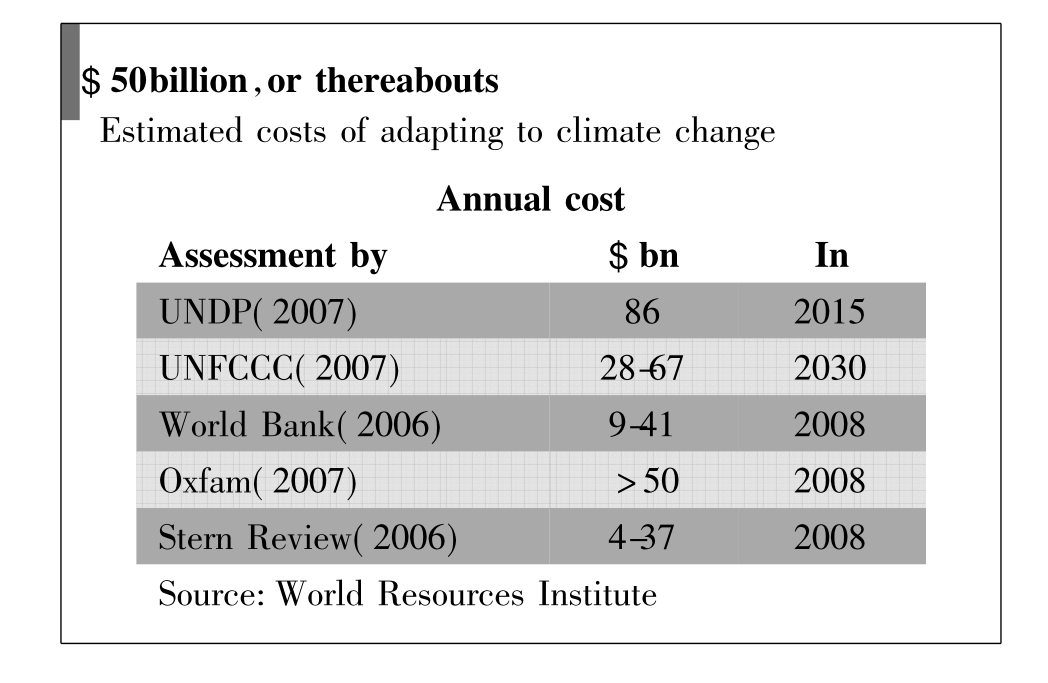
The discrepancy means poor countries will end up bearing most of the burden themselves.China has a national climate-change programme with an elaborate series of targets and exhortations to cope.Bangladesh this year put$50m into a national adaptation fund and invited rich countries to add of their plenty.But this sort of thing is much easier for giants like China or large countries like Bangladesh,than it is for poorer Mali or tiny Maldives.
With more problems than money,there will—as always—be a fight over the spoils.Rich countries may concede the poor are harder hit and need help,but once there is a pot of money,they too will want a share.For an American administration,rebuilding the levees of New Orleans(an adaptation programme)will take precedence over projects in Africa or the Caribbean.
Even if poor countries do get help,there are bound to be fights over how to use it.In general,says Saleemul Huq of the International Institute for Environment and Development in London,most adaptation spending should go on what countries are doing anyway—irrigation,droughtresistant seeds and so forth.But that leaves plenty of room for disputes.
If sea levels go up,do you build sea walls or rehouse people?If infectious diseases are rising,do you spend money trying to eradicate the worst ones,like malaria,or on health and nutrition in general?The latter makes sense but most donors concentrate on single-disease efforts.George Soros,afinancierwhorunsachainofphilanthropic organizations,says that in their experience,few people in poor countries have a clear idea about climate change and how to cope with it.
Lastly,the international arrangements that might help sort out some of these disputes are a shambles.Among developing countries,most negotiations on climate change(as on everything else)are led by the big three:China,India and Brazil.But they are large polluters themselves and their interests differ from very poor states and islands.Angus Friday,Grenada's ambassador to the UN who speaks for island states there,says the states most vulnerable to climate change are least able to participate effectively in climate-change talks.
The poorest lose out in another way.When industrial polluters in emerging markets cut emissions,they are rewarded through Kyoto.But the poorest are not rewarded for the big contribution they could make towards reducing emissions,which is the better management of tropical forests.That is because forests were excluded from Kyoto,to the chagrin of the poor.
Mary Robinson,a former president of Ireland and UN high commissioner for human rights,says that there should be a“rights-based”approach to climate change,meaning poor countries should have some redress under international law for the environmental costs they suffer.This seems like a recipe for alienating rich countries.But it reflects a growing impatience.As the costs of climate change bear down on the poor,so their demands grow that rich countries,which caused most of the problems,should help them cope.
*www.brookings.edu/events/2008/0801_development.aspx
(From The Economist,Sept.11th,2008)
Questions for Discussion(问题讨论)
1.What is the shift in priorities of environmentalists and economists? Why is the shift deemed necessary?
2.What is the writer's view on the positions taken by the US and China on climate change?
3.What do you think could be the rationale for tax imposed on international flights?
4.Why is China's proposed contribution of 0.5%GDP considered a non-starter?
5.What do you think developing,developed,big and small countries should do in tackling climate change?
Language Tips(阅读提示)
Titanic:The largest passenger liner afloat,until the early morning of 15 April 1912,on its maiden transatlantic voyage,when it struck an iceberg and sank.Altogether 1,513 died,out of a total complement of 2,224.The ship's band famously continued playing on the sloping deck as she sank,ending its selection with“Nearer,my God,to thee.”The Titanic beCome a national symbol for both hubris and courage.
Subsistence fishing:Growth of crops predominantly for consumption by the farm family rather than for sale.Form of farming in which nearly all the crops or livestock raised are used to maintain the farmer and his family,leaving little surplus for sale or trade.Preindustrial agriCultural peoples throughout the world practiced subsistence farming.As urban centers grew,agriCultural production beCome more specialized and commercial farming developed,with farmers producing a sizable surplus of certain crops,which they traded for manufactured goods or sold for cash.Subsistence farming persists today in sub-Saharan Africa and other developing areas.
Regressive tax:Tax levied at a rate that decreases as its base increases.Regressivity is considered undesirable because poorer people pay a greater percentage of their inCome in tax than wealthier people.Consumption taxes and sales taxes are usually considered regressive because of their set rate structures.Tobacco,gasoline,and liquor sales taxes,all major sources of tax revenue,are the most regressive taxes.In an effort to limit regressivity,a number of U.S.states have exempted medicine and grocery items from sales tax.Although the property tax is sometimes judged regressive because poorer people spend a larger percentage of their inCome on housing than wealthier people,property taxes are nonetheless effective in redistributing wealth from higher to lower inCome groups.
Progressive tax:Tax levied at a rate that increases as the quantity subject to taxation increases.Designed to collect a greater proportion of tax revenue from wealthy people,progressive taxes reflect the view that those who are able to pay more should carry a heavier share of the tax burden.Progressive inCome taxes may provide for exemption from tax liability for inComes under a specified amount,or they may establish progressively greater rates for larger and larger inComes.The presence of deductions can also make a tax progressive.Progressive taxes are a stabilizing force in periods of inflation or recession because the amount of tax revenue changes more than proportionately with an increase or decrease in inCome.For example,in an inflationary economy,as prices and inComes rise,a greater percentage of taxpayers'inCome goes toward taxes.Government revenues increase,and the government has more leverage over the economy.A side effect of this system is that lowerinCome taxpayers have an especially difficult time making ends meet when inflation is high.To compensate,many economists advocate indexation;several countries adjust their tax rates annually in times of inflation,usually in line with the consumer price index.
Back-of-the-envelope calculations:The phrase back-of-the-envelope calculations is an idiom referring to rough calculations that test or support a hypothesis.They are more trustworthy than a guess but less definite than a proof.The phrase is generally used in mathematics,physics and engineering.The idiom originates in the practice of quickly jotting down calculations on the nearest available piece of paper,such as the back of an envelope.Thedefiningcharacteristicofback-of-the-envelope calculations is the use of simplified,scaled-down models.A similar phrase is back of a napkin.
Non-starter:An idea,proposal,or candidate with no chance of being accepted or successful.
George Soros:(Born Aug.12,1930,Budapest,Hung.)Hungarian-U.S.financier.He left his native Hungary in 1944 and settled in London in 1947,where he studied and joined a merchant bank.He moved to New York City in 1956 and initially worked as an analyst of European securities.By 1979 his daring investments and currency speculation brought large profits,some of which he used to found Soros Foundations,dedicated to creating open societies in many eastern European countries and Russia.Other Soros programs have been dedicated to enlarging public debate on a wide range of controversial issues.In 1992 he reached new heights of wealth,making a profit of about$1 billion when Britain devalued the pound sterling,but in 1998 he suffered large losses from currency speculation in Russia.
Cultural Notes(文化导读)
Emissions-trading:Emissions-trading(or emission trading)is an administrative approach used to control pollution by providing economic incentives for achieving reductions in the emissions of pollutants.It is sometimes called cap and trade.
Weather derivatives:An instrument used by companies to hedge against the risk of weather-related losses.The investor who sells a weather derivative agrees to bear this risk for a premium.If nothing happens,the investor makes a profit.However,if the weather turns bad,then the company who buys the derivative claims the agreed amount.This is not the same as insurance,which is for low-probability events like hurricanes and tornados.In contrast,derivatives cover highprobabilityeventslikeadryer-than-expectedsummer.Weather derivatives are financial instruments that can be used by organizations or individuals as part of a risk management strategy to reduce risk associated with adverse or unexpected weather conditions.The difference from other derivatives is that the underlying asset(rain/temperature/ snow)has no direct value to price the weather derivative.Farmers can use weather derivatives to hedge against poor harvests caused by drought or frost;theme parks may want to insure against rainy weekends during peak summer seasons;and gas and power companies may use heating degree days(HDD)or cooling degree days(CDD)contracts to smooth earnings.A sports event managing company may wish to hedge the loss by entering into a weather derivative contract because if it rains the day of the sporting event,fewer tickets will be sold.
Further Online Reading(网络拓展阅读)
China,India and Climate Change Melting Asia
Jun 5th,2008The Economist
China and India are increasingly keen to be seen to be tackling climate change;though it is dirtier,China is making a more convincing show of action
http://www.economist.com/opinion/displaystory.cfm?story_id=11488548
The Kyoto Mechanisms
http://unfccc.int/kyoto_protocol/items/2830.php
C.imate Change Series
Financial Times
http://www.ft.com/climatechangeseries
Climate Change in Depth
Financial Times
http://www.ft.com/indepth/climatechange
Freedman:Warming up to Adaptation
By Andrew FreedmanNovember 10,2008
http://voices.washingtonpost.com/capitalweathergang/2008/11/freedman_time_to_adapt.html
Climate Change Myths and Facts
By Chris Mooney
Saturday,March 21,2009
http://www.washingtonpost.com/wp-dyn/content/article/2009/03/20/AR2009032002660.html
The Real Cost of Tackling Climate Change
By Steven F.Hayward
April 28,2008
http://online.wsj.com/article/SB120934459094348617.html
Climate Change Is the Cholera of Our Era
The medical profession needs to wake up:we should be in the vanguard of the green revolution Muir Gray
The TimesMay 25,2009
http://www.timesonline.co.uk/tol/comment/columnists/guest_contributors/article6355257.ece
Journalism 101(报刊点滴)
新闻价值。新闻的构成须有其新闻价值。构成新闻价值的要素在英语新闻报道中主要有以下几个方面:
●时效性(timeliness)。包含时间和内容两层含义。
●重要性(relevance)。指与当前社会生活和大众的切身利益的关系,如政局的变动、政策的变化、战争进展以及重大经济信息等。而重要的科技发明、天气的显著变化和重大的灾害、疾病等,往往能引起读者的重视和兴趣。
●显著性(prominence)。指新闻中的人物、地点或事件越是突出,新闻价值就越大,通俗地说:
■Ordinary person+usual occurrence is not news
■Ordinary person+unusual occurrence→news
■Extraordinary person+usual occurrence→news
■Extraordinary person+unusual occurrence→good/big news
●接近性(proximity)。指新闻与读者地理上或思想、利益上的接近。
●奇异性(novelty)。即所谓“狗咬人不是新闻,而人咬狗则是新闻”。(When a dog bites a man,that's not news;but when a man bites a dog,that's news.)“坏消息才算好消息”。(Bad news is good news.)
●趣味性(interest)。指能够引起人们感情共鸣,富有人情味和生活情趣,即通常所讲的趣闻奇事。
Reading Comprehension Quiz(选文测验)
Ⅰ.According to the article,determine which statements are true and which are false.
1.Adaptation means letting climate change take its course rather than averting or stopping it.
2.“Peanuts”here means a very small amount of money.
3.Al Gore used to think adaptation approach compromised prevention efforts on climate change.
4.American legislation has consistently showed great interest in international adaptation efforts.
5.Maldives and Mali are typical of the two specific groups that are worst hit by climate change:the former being the poorest of the poor and the latter a tiny island state.
Ⅱ.Choose the best answer to each of the following questions.
1.Which of the following is one of the two things that have changed attitudes toward global warming?
A.Global warming is not getting faster than expected.
B.Two groups of people bear the disproportionate and unfair burden of climate change.
C.It is not too late to reverse dangerous consequences of global warming.
D.Nairobi has to depend on subsistence fishing.
2.Which of the following do the worst hit victims of global warming share?
A.Too poor to defend themselves.
B.Regressive tax is levied on them.
C.Impressive carbon footprints.
D.Flood controls are too expensive.
3.A number of adaptation-focused projects from both private and public sectors include_________.
A.a U.S.Senate bill for international adaptation efforts
B.money from EU's emissions-trading scheme to be appropriated on climate change
C.new Forests works on“biodiversity conservation certificates”
D.all of the above
4.In the adaptation process,a host of problems are encountered,such as_________.
A.China,India and Brazil led all negotiations among developing countries
B.financial donors don't concentrate on single rather comprehensive efforts
C.there is a huge discrepancy among the money needed,money pledged and money actually available
D.rich nations tend to prefer the Caribbean to Africa over the use of adaptation funds
5.Which of the following is true about the Kyoto Protocol?
A.There can be carbon credits as a result of deals between richcountry companies and private firms in developing nations.
B.Part of carbon credits value is used as adaptation funds controlled by donors and recipients.
C.Some polluters are rewarded by Kyoto for their emissions cut but the poorest are not rewarded for their contribution.
D.All of the above.
4.The Litany and the Heretic
Why Has Bjorn Lomborg Created Such a Stir Among Environmentalists?
“I'm afraid there isn't much scientific controversy about Mr Lomborg.He occupies a very junior position in Denmark(an“associate professor”does not exactly mean the same as it does in the United States),he has one possibly very flawed paper in an international journal on game theory,no publications on environmental issues and yet manages to dismiss the science of dozens of the world's best scientists,including Nobel laureates,Japan and Crawford prize winners and the like.As any sensible person would expect,his facts are usually fallacies and his analysis is largely non-existant.”
Those contemptuous words from Stuart Pimm,a professor of conservation biology at Columbia University,are fairly representative of the response from many environmental scientists and activists to Bjorn Lomborg's recent book,“The Skeptical Environmentalist.”In the weeks since the books release,virtually every large environmental group has weighed in with a denunciation.Numerous heavy weights of science have penned damming articles and reviews in leading journals.Dr Pimm,for one railed against Dr Lomborg in Nature magazine,while Scientific American recently devoted 11 pages of attacks from scientists known for their environmental activism.
Dr Lomborg's critics protest too much.They are rattled not because,as they endlessly insist,Dr Lomborg lacks credentials as an environmental scientist and is of no account,but because his book is such a powerful and persuasive assault on the central tenets of the modern environmental movement.
Just the facts
Curious about the true state of the planet,the author—who makes no claims to expertise in environmental science,only to statistical expertise—has scrutinized reams of official data on everything from air pollution to energy availability to climate change.As an instinctive green and a former member of Greenpeace,he was surprised to find that the world's environment is not,in fact,getting worse.Rather,he shows,most environmental indicators are stable or improving.
One by one he goes through the“litany”,as he calls it of the four big environmental fears:natural resources are running out;the population is ever growing,leaving less and less to eat;species are becoming rapidly extinct,forests are vanishing and fish stocks are collapsing and;air and water are becoming ever more polluted.
In each case,he demonstrated that the doom and gloom is wildly exaggerated.Known reserves of fossil fuels and most metals have risen.AgriCultural production per head has risen—the numbers facing starvation have declined.The threat of bio-diversity loss is real but exaggerated,as is the problem of tropical deforestation.And pollution diminishes as countries grow richer and tackle it energetically.
In other words the planet is not in peril.There are problems and they deserve attention but nothing remotely so dire as most of the green movement keeps saying.
Nor is that all he shows.The book exposes—through hundreds of detailed meticulously footnoted examples—a pattern of exaggeration and statistical manipulation,used by green groups to advance their pet causes and obligingly echoed through the media.Bizarrely,one of Dr Lomborg's critics in Scientific American,criticises as an affectation the book's insistence on doComenting every statistic and every quotation with reference to a published source.But the complaint is not so bizarre when one works through the references,because they so frequently expose careless reporting and environmentalists'abuse of scientific knowledge.
The replies to Dr Lomborg in Scientific American and elsewhere score remarkably few points on substance.His large factual claims about the current state of the world do not appear to be under challenge—which is unsurprising since they draw on the official data.What is under challenge,chiefly,is his outrageous presumption in starting a much needed debate.
Some argue that scientists who favour stronger policies to improve the environment must use the same tactics as any other political lobby—from steel companies fighting for tariffs on imports to farmers demanding more subsidies.The aim after all,is to win public favour and government support.Whether such a view is consistent to the obligation that science owes to the truth is debatable,at best.If scientists want their views to be accorded the respect due to science,then they must speak as scientists,not as lobbyists.
Dr Lomborg's work has its flaws.He has some errors in his statistical analysis,as he acknowledges on his website.And there are broader issues,especially to do with the aggregation of data and the handling of uncertainty,where his book is open to challenge.For instance,his approach to examining data at a global level,while statistically sound,tends to mask local environmental trends.Global marine productivity has indeed risen,as he says—but this disguises collapses in particular species in particular places.Dr Lomborg argues that such a loss,seen in a long-term perspective,do not matter much.Many would disagree not least the fishermen in the areas affected.
Allen Hammond of the World Resources Institute(WRI)makes a related point.He accepts Dr Lomborg's optimistic assessment of the environment but says it holds only for the developed world.The aggregate figures offered in the book mask worsening pollution in the mega-cities of the poor world.Dr Lomborg agrees that there are local and regional environmental pressures and that these matter a lot but it is fair to point out that the book has little to say about them except to argue that rising inComes will help.
The book gives little credit to environmental policy as a cause of environmental improvement.That is a defensible position but the book does not trouble to make the case.And another important question is somewhat skated over:the possibility that some environmental processes involve irreversible“triggers,”which once pulled lead to a sudden and disastrous deterioration.Climate scientists believe and Dr Lomborg does not deny,that too much warming could lead to irreversible bad outComes such as the collapse of the mid-Atlantic“conveyor belt”(an ocean current that warms Europe).The science here is thin:nobody knows what level of greenhouse gases in the atmosphere would trigger such a calamity.But the risk argues for caution.
Dr Lomborg's assessment of the science in this area leads him to venture that warming is more likely to be at the low end of the range expected by leading experts than at the high end.He argues that the most cited climate-models misjudge factors such as the effect of clouds,aerosols and the solar cycle.That is plausible and there is science to support it but the conclusion is far from certain.Again it is reasonable to argue that such uncertainty makes it better to err on the side of caution.
Sensible people will disagree about the course that policy should take.Dr.Lomborg—a courteous fellow—seems willing to talk calmly to his opponents.For the most part,while claiming in some cases to be men of science,his opponents do not return the compliment.
Homo ecologicus
Despite its limitations,“The Skeptical Environmentalist”delivers a salutary warning to conventional thinking.Dr Lomborg reminds militant greens,and the media that hang on their every exaggerated word about environmental calamity,that environmental policy should be judged against the same criteria as other kinds of policy.Is there a problem? How bad is it?What will it cost to fix?Is that the best way to spend those resources?
This is exactly what Tom Burke,a leading British environmentalist,denied in a debate he had with Dr Lomborg in Prospect,a British magazine.“What I find most egregious[in]your climate change argument,however,is the proposition that the world faces a choice between spending money on mitigating climate changes and providing access to clean drinking water and sanitation in the developing world.
We must and can do both.Such artificial choices may be possible in an academic ivory tower where ideas can be arranged to suit the prejudices of the occupant but they are not available in the real world and it is dishonest to suggest they are.”
On the contrary,Mr Burke.Only in an academic tower could have choices such as these be called“artificial”.Democratic politics is about nothing but choices of that sort.Green politics needs to learn that resources are not unlimited.
(From The Economist,February 2002)
Questions for Discussion(问题讨论)
1.What reaction has the book The Skeptical Environmentalist caused?
2.In what ways do environmentalists attack Lomborg?
3.Why do environmentalists react so aggressively to Lomborg's book?
4.What approach has Lomborg taken to“green”issues and what are his conclusions?
5.What is the author's attitude to Lomborg and his book?
Language Tips(阅读提示)
Game theory:Branch of applied mathematics devised to analyze certain situations in which there is an interplay between parties that may have similar,opposed,or mixed interests.Game theory was originally developed by John von Neumann and Oscar Morgenstern in their book The Theory of Games and Economic Behavior(1944).In a typical game,or competition with fixed rules,“players”try to outsmart one another by anticipating the others'decisions,or moves.A solution to a game prescribes the optimal strategy or strategies for each player and predicts the average,or expected,outCome.Until a highly contrived counterexample was devised in 1967,it was thought that every contest had at least one solution.
博弈论(Game Theory),有时也称为对策论,或者赛局理论,是研究具有斗争或竞争性质现象的理论和方法,它是应用数学的一个分支,既是现代数学的一个新分支,也是运筹学的一个重要学科。目前在生物学、经济学、国际关系学、计算机科学、政治学、军事战略和其他很多学科都有广泛的应用。主要研究公式化了的激励结构(游戏或者博弈(Game))间的相互作用,是研究具有斗争或竞争性质现象的数学理论和方法,也是运筹学的一个重要学科。博弈论考虑游戏中的个体的预测行为和实际行为,并研究它们的优化策略。表面上不同的相互作用可能表现出相似的激励结构(incentive structure),所以它们是同一个游戏的特例。其中一个有名有趣的应用例子是囚徒困境悖论(Prisoner's dilemma)。具有竞争或对抗性质的行为成为博弈行为。在这类行为中,参加斗争或竞争的各方各自具有不同的目标或利益。为了达到各自的目标和利益,各方必须考虑对手的各种可能的行动方案,并力图选取对自己最为有利或最为合理的方案。比如日常生活中的下棋、打牌等。博弈论就是研究博弈行为中斗争各方是否存在着最合理的行为方案,以及如何找到这个合理的行为方案的数学理论和方法。
Nobel laureates:Winner of a Nobel Prize.
Greenpeace:International environmental organization.Founded in Canada in 1971 to oppose U.S.nuclear testing in Alaska,it later expanded its goals to include saving endangered species,stopping environmental abuses,and increasing public awareness of environmental problems.It has specialized in“direct,nonviolent action”in protests often designed to garner wide publicity.Its members have frequently steered small inflatable craft between the harpoon guns of whalers and their prey.In 1985 the Rainbow Warrior,a Greenpeace ship being used to obstruct French nuclear testing in the South Pacific,was sunk by French agents,resulting in the death of a photographer.Greenpeace has offices in some 40 countries.绿色和平是绿色和平组织的简称,属国际性非政府组织,以环保工作为主,总部设在荷兰的阿姆斯特丹。绿色和平于1971年9月15日成立于加拿大,创始人为工程师戴维·麦格塔格(David McTaggert),捐款的人数已经累积到280万。在全球40个国家设有办事处。它开始时以使用非暴力方式阻止大气和地下核试验以及公海捕鲸著称,后来转为关注其他的环境问题,包括水底拖网捕鱼、全球变暖和基因工程。绿色和平组织宣称自己的使命是:“保护地球、环境及其各种生物的安全及持续性发展,并以行动作出积极的改变。”不论在科研或科技发明方面,绿色和平都提倡有利于环境保护的解决办法。对于有违以上原则的行为,绿色和平都会尽力阻止。其宗旨是促进实现一个更为绿色、和平和可持续发展的未来。
Doom and gloom:注意此处两词的押韵。An overly negative perspective or view point.类似的还有dine and wine,fair or foul,rhyme or reason等。
Bio-diversity:Quantity of plant and animal species found in a given environment.Sometimes habitat diversity(the variety of places where organisms live)and genetic diversity(the variety of traits expressed within a species)are also considered types of biodiversity.The estimated 3-30 million species on Earth are divided unequally among the world's habitats,with 50%-90%of the world's species living in tropical regions.The more diverse a habitat,the better chance it has of surviving a change or threat to it,because it is more likely to be able to make a balancing adjustment.Habitats with little biodiversity(e.g.,Arctic tundra)are more vulnerable to change.The 1992 Earth Summit resulted in a treaty for the preservation of biodiversity.
Pet causes:Causes preferred above all others and treated with partiality.
Political lobby:A group of people who try actively to influence government legislation.
Greenhouse effect:温室效应Warming of the Earth's surface and lower atmosphere caused by water vapour,carbon dioxide,and other trace gases in the atmosphere.Visible light from the Sun heats the Earth's surface.Part of this energy is radiated back into the atmosphere in the form of infrared radiation,much of which is absorbed by molecules of carbon dioxide and water vapour in the atmosphere and reradiated toward the surface as more heat.(Despite the name,the greenhouse effect is different from the warming in a greenhouse,where panes of glass allow the passage of visible light but hold heat inside the building by trapping warmed air.)The absorption of infrared radiation causes the Earth's surface and lower atmosphere to warm more than they otherwise would,making the Earth's surface habitable.An increase in atmospheric carbon dioxide caused by widespread combustion of fossil fuels may intensify the greenhouse effect and cause long-term climatic changes.Likewise,an increase in atmospheric concentrations of other trace greenhouse gases such as chlorofluorocarbons,nitrous oxide,and methane resulting from human activities mayalsointensifythe greenhouse effect.From the beginning of the Industrial Revolution through the end of the 20th century,the amount of carbon dioxide in the atmosphere increased 30%and the amount of methane more than doubled.It is also estimated that the U.S.is responsible for about onefifth of all human-produced greenhouse-gas emissions.
Militant greens:A militant reformer concerned with or supporting protection of the environment as a political principle.
Academic ivory tower:A state of mind often removed from normal day to day concerns.Academic elitism is a charge sometimes levied at academic institutions and academics more broadly;use of the term“ivory tower”often carries with it an implicit critique of academic elitism.Anti-intellectuals often perceive themselves as champions of ordinary people and populism against elitism,especially academic elitism.These critics argue that highly educated people form an isolated social group and tend to dominate political discourse in higher education(academia).
Cultural Notes(文化导读)
Environmental skepticism:Environmental skepticism is an umbrella term that describes those that argue that particular claims put forward by environmentalists andenvironmentalscientistsareincorrector exaggerated,along with those who are critical of environmentalism in general.The use of the term is contested.Supporters of environmentalists argue that“skepticism”implies an open-minded attitude to empirical evidence and that their opponents are in fact advocates for predetermined positions reflecting ideological commitments or financial interests.Critics of environmental skepticism frequently use more pejorative terms such as denialism.The popularity of the term was enhanced by Dr.Lomborg's book The Skeptical Environmentalist.Lomborg approached environmental claims from a statistical and economic standpoint,and concluded that often the claims made by environmentalists were overstated.Lomborg argued,on the basis of cost benefit analysis,that few environmentalist claims warranted serious concern.
Global warming controversy:Global warming controversy is a dispute regarding the nature,causes,and consequences of global warming.The disputed issues include the causes of increased global average air temperature,especially since the mid-20th century,whether this warming trend is unprecedented or within normal climatic variations,and whether the increase is wholly or partially an artifact of poor measurements.Additionaldisputesconcernestimatesofclimate sensitivity,predictionsofadditionalwarming,andwhatthe consequences of global warming will be.The debate is vigorous in the popular media and on a policy level,with individuals,corporations,and political organizations all being involved.
Climate change denial:Climate change denial describes efforts to counter all or part of the theory of global climate change.While the term“climate skeptic”generally refers to scientists taking good faith positions on the global warming controversy,climate change denial usually refers to disinformation campaigns alleged to be promoted and funded by groups with a financial interest in misrepresenting the scientific consensus on climate change,particularly groups with ties to the energy lobby.Newsweek,as well as numerous journalists,including George Monbiot and Ellen Goodman,among others,describe it as a form of denialism.
Reserves of natural resources:In the case of oil,reserves that could be extracted at reasonably competitive prices would keep the world economy running for about 150 years at present consumption rates.Coment,aluminium,iron,copper,gold,nitrogen and zinc account for more than 75%of global expenditure on raw materials.Despite an increase in consumption of these materials of between two-and ten-fold over the past 50 years,the number of years of available reserves has actually grown.
AgriCultural production:According to the United Nations,this has increased by 52%per person,in the developing world,since 1961.The daily food intake in poor countries has increased from 1,932 calories,barely enough for survival,in 1961 to 2,650 calories in 1998,and is expected to rise to 3,020 by 2030.Likewise,the proportion of people in developing countries who are starving has dropped from 45%in 1949 to 18%today,and is expected to decline even further to 12%in 2010 and just 6%in 2030.
Population growth:This has turned out to have an internal check:as people grow richer and healthier,they have smaller families.Indeed,the growth rate of the human population reached its peak,of more than 2%a year,in the early 1960s.The rate of increase has been declining ever since.It is now 1.26%,and is expected to fall to 0.46%in 2050.The United Nations estimates that most of the world's population growth will be over by 2100,with the population stabilising at just below 11 billion.
Biodiversity loss:Although species are becoming extinct,only about 0.7%of them are expected to disappear in the next 50 years,not 25%-50%,as has so often been predicted.
Air pollution:Many analyses show that air pollution diminishes when a society beComes rich enough to be able to afford to be concerned about the environment.For London,the city for which the best data are available,air pollution peaked around 1890.Today,the air is cleaner than it has been since 1585.There is good reason to believe that this general picture holds true for all developed countries.And,although air pollution is increasing in many developing countries,they are merely replicating the development of the industrialized countries.When they grow sufficiently rich they,too,will start to reduce their air pollution.
Further Online Reading(网络拓展阅读)
Chill Out
Stop Fighting over Global Warming—Here's the Smart Way to Attack it By Bjorn Lomborg
Sunday,October 7,2007
http://www.washingtonpost.com/wp-dyn/content/article/2007/10/05/ AR2007100501676.html
Environment and Science:Danes Rebuke a“Skeptic”
By Andrew C.Revkin
Published:Wednesday,January 8,2003
http://www.nytimes.com/2003/01/08/international/europe/08SKEP.html
Greener Than You Think
“The Skeptical Environmentalist:Measuring the Real State of the World”by Bjorn Lomborg
Reviewed by Denis Dutton
Sunday,October 21,2001
http://www.washingtonpost.com/ac2/wp-dyn/A12789-2001Oct18?language= printer
Skepticism Toward The Skeptical Environmentalist
April 15,2002
http://www.scientifiComerican.com/article.cfm?id=skepticism-toward-theske
Misleading Math about the Earth
Science Defends Itself Against The Skeptical Environmentalist
http://www.scientifiComerican.com/article.cfm?id=misleading-mathabout-the
Clash:What Will Climate Change Cost Us?
The science is clear:the climate is changing thanks to human activity.
The question beComes:will preventing further globe-warming pollution ruin the global economy?
November 26,2007
http://www.scientifiComerican.com/article.cfm?id=clash-what-willclimate-change-cost-us
Journalism 101(报刊点滴)
新闻的分类。新闻的种类很多,按照不同的分类标准,有各种不同的分类方法。按传播工具,可分为报纸新闻(newspaper coverage)、杂志新闻(magazine coverage)、广播新闻(radio news)、电视新闻(TV news)、有线电视新闻(cable news)和通讯社新闻(news agency dispatch)。按照新闻事实发生的地域和范围,又有国际新闻(world news)、国内新闻(home news)和地方新闻(local news)之分。若按报道的内容,新闻则可分为政治新闻(political news)、经济新闻(economic news)、科技新闻(technological news)、文化新闻(Cultural news)、体育新闻(sports news)、暴力与犯罪新闻(violence and crime news)、灾难新闻(disaster news)、天气新闻(weather news)、讣告(obituary)和娱乐新闻(entertainment)等若干大类。如按照事件的性质,新闻又可分为“硬新闻”(hard news)和“软新闻”(soft news)两大类。硬新闻亦称“纯消息报道”(spot news or straight news),指题材比较严肃、具有一定时新性的客观事实报道。软新闻是指分析评论类新闻,或人情味较浓、写法轻松活泼的社会新闻。软新闻既会引起读者情感上的共鸣,又会在思想和心智上引发思考。
Reading Comprehension Quiz(选文测验)
Ⅰ.According to the article,determine which statements are true and which are false.
1.The author of the article is generally supportive of Lomborg and his research.
2.Dr Lomborg has sympathy for the“green”movement.
3.The book the Skeptical Environmentalist is deeply flawed in its approach.
4.Environmentalists overstate the environmental dangers to manipulate the public and governments.
5.Lomborg is too subjective in his approach.
Ⅱ.Choose the best answer to each of the following questions.
1.Lomborg's analysis________.
A.tends to hide the differences between the developed and the developing world
B.tends to take an optimistic approach when handling uncertainty
C.tends to undervalue the danger of irreversible changes which may occur to the earth's climate
D.all of the above
2.The author of the article appears to feel that an economic analysis approach to environmental problems________.
A.is dishonest and misleading
B.ignores many essential factors
C.is justified and relevant in the real world
D.represents an“ivory tower”approach
3.Environmentalists attack Dr Lomborg on the basis of his________.
A.lack of credentials as an environmentalist scientist
B.lack of statistical expertise
C.flawed data
D.both A and C
4.Dr Lomborg asserts that________.
A.the environment in the whole world,everywhere,is improving
B.food production has risen
C.energy reserves will last perhaps for ever
D.none of the above
5.Environmentalists are so angry at the book b ecause________.
A.Lomborg exposes many fallacies often stated as facts by the green movement
B.Lomborg believes environmental problems should be treated like any other problem
C.the data Lomborg uses does not fit his conclusions
D.both A and B