1.Education Reform
Top of the Class
How to Learn the Right Lessons from Other Countries'Schools
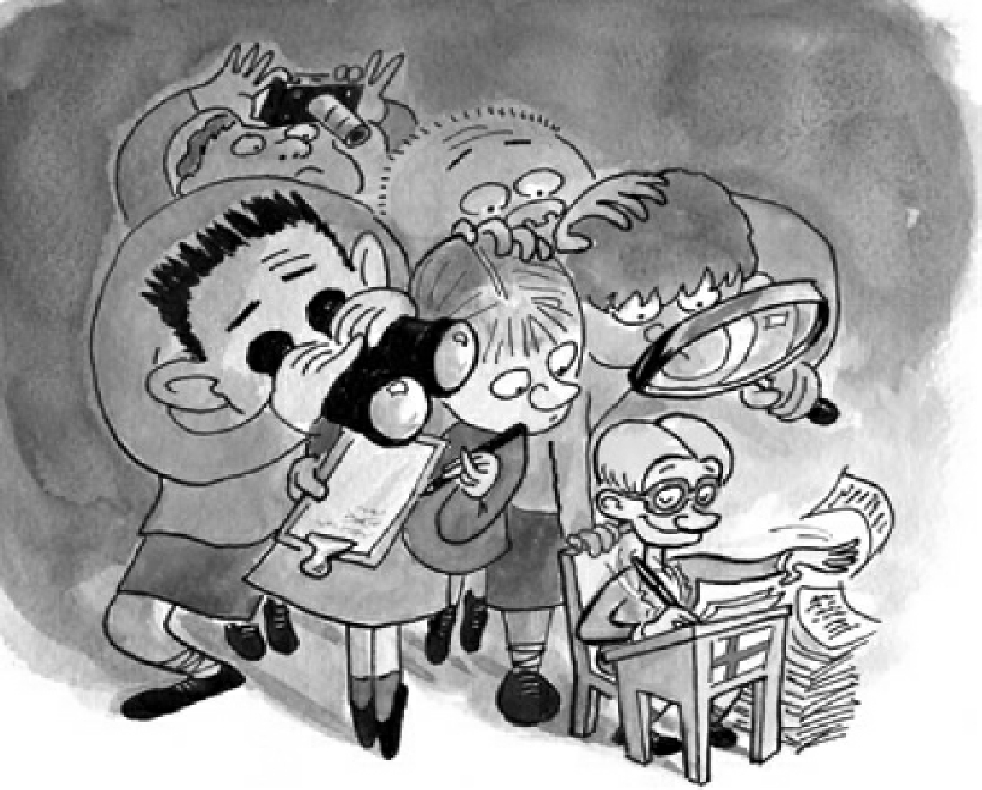
The children at Kulosaari primary school,in a suburb of Helsinki,seem unfazed by the stream of foreign visitors wandering through their classrooms.The head teacher and her staff find it commonplace too—and no wonder.The world is beating a path to Finland to find out what made this unostentatious Nordic country top of international education league tables.Finland's education ministry has three full-time staff handling school visits by foreign politicians,officials and journalists.The schools in the shop window rotate each year;currently,Kulosaari is on call,along with around 15 others.Pirkko Kotilainen,one of the three officials,says her busiest period was during Finland's European Union presidency,when she had to arrange school visits for 300 foreign journalists in just six months of 2006.
Finland's status as an education-tourism hot spot is a result of the hot fashion in education policy:to look abroad for lessons in schooling.Some destinations appeal to niche markets:Sweden's“voucher”system draws school choice aficionados;New Zealand's skinny education bureaucracy appeals to decentralizers.Policymakers who regard the stick as mightier than the carrot admire the hard-hitting schools inspectorate and highstakes mandatory tests in England(other bits of Britain have different systems).
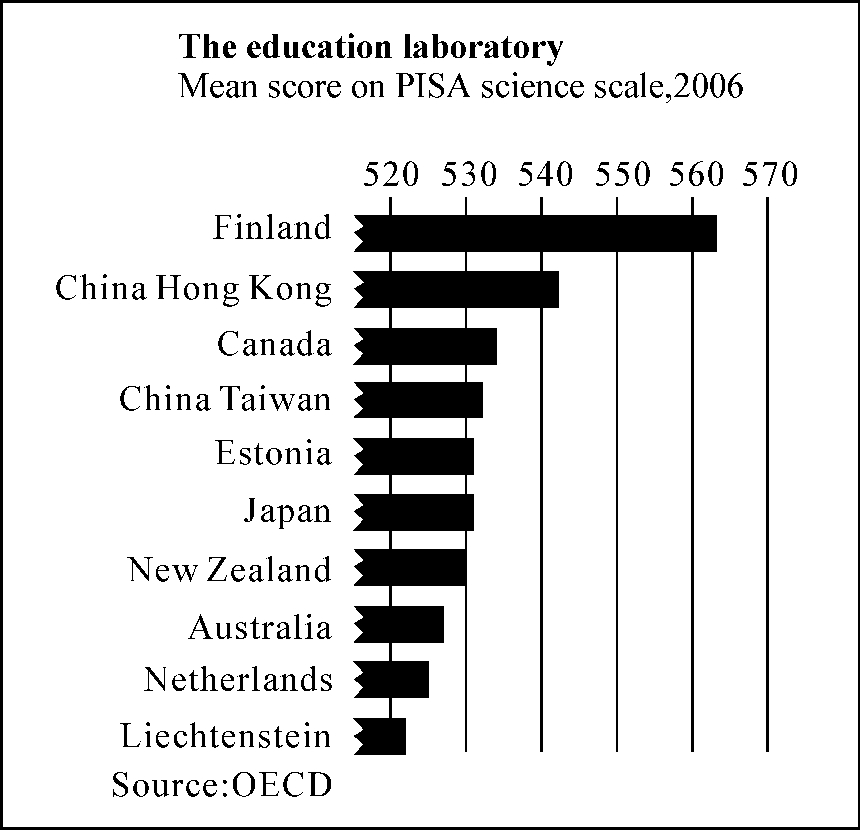
But visitors to Finland—and to a lesser extent to South Korea,Japan and Canada—are drawn by these countries'high scores in a ranking organised by the Paris-based Organisation for Economic Cooperation and Development(OECD),a rich-country think-tank.Its Programme for International Student Assessment(PISA)tests 15-year-olds from dozens of countries or regions(most recently 56)in literacy,mathematics and science.Finland habitually Comes top;the others jockey for places as runners-up(see chart).
Such a quest is understandable but misguided,says Alan Smithers,an expert in cross-border education Comparisons at Britain's University of Buckingham.Importing elements of a successful education system—the balance between central and local government,the age of transfer to secondary school,the wearing of school uniforms and so on—is unlikely to improve performance.“You shouldn't try to copy the top performers in PISA,”he says,“because position in those league tables depends on lots of other things besides what happens in schools.”
Bearing out Mr Smithers's caution is an analysis of Finland's most recent PISA results,from 2006,by Jarkko Hautam-ki and his colleagues at Helsinki University.They highlight only one big policy element that could easily be replicated elsewhere:early and energetic intervention for struggling pupils.Many of the other ingredients for success that they identify—orthography,geography and history—have nothing to do with how schools are run,or what happens in classrooms.
In Finnish,exceptionally,each letter makes a single logical sound and there are no irregular words.That makes learning to read easy.An economy until recently dependent on peasant farming in harsh latitudes has shaped a stoic national character and an appetite for selfimprovement.Centuries of foreign rule(first Swedes,then Russians) further entrenched education as the centrepiece of national identity.So hard work and good behaviour are the norm;teaching tempts the best graduates(nearly nine out of ten would-be teachers are turned down).
Few countries would want to copy Finland's austere climate or sombre history even if they could(though spelling reform in English might merit consideration).More instructive,perhaps,is looking not at how Finland's schools are run,but how decisions about education are made.As in other European countries,Finland merged specialist academic and vocational schools into comprehensive ones in the 1970s.The first point Mr Hautam-ki highlights is broad consensus,cautiously but irrevocably reached.“They simply kept going until they reached agreement,”he says.“It took two years.”
Comprehensive schools were introduced in 1972 in the sparsely populated north,and then over the next four years in the rest of the country.Matti Meri,a teacher-trainer at Helsinki University,was a teacher at the time.“Grammar-school teachers were quite afraid of the reforms,”he recalls.“They used to teach only one-third of the students.But the comprehensive schools used almost the same curriculum as the grammar schools had—and we discovered that the twothirds were mostly able to cope with it.”By the time comprehensives reached the more populous south,teachers were eager to join in what was clearly a roaring success.
“What you are planning might be the right thing to do,but if teachers aren't on board it will be very hard to make anything happen,”says Sam Freedman,the director of education for Policy Exchange,a Londonbased think-tank.He points to Canada,where Alberta and Ontario both introduced major reforms in the 1990s.Alberta's provincial government won generalsupportforitsideas,andthereformsarenow uncontentious.In Ontario,by contrast,politicians‘rhetoric was confrontational and the teachers’unions bitterly opposed.The current government is having to work hard to mend fences.
Finland's education reforms may have taken ten years from conception to full implementation,but they have proved durable:little has needed changing in the 30 years since.Mr Smithers draws a gloomy contrast with the permanent revolution that reigns in England's schools.“Politicians here seem to think that a day without an education announComent is a day wasted,”he says.New policies should build on previous ones,agrees Andreas Schleicher,the OECD's head of education research.“In some countries,though,a new government's greatest ambition is to undo everything its predecessors did.”
Mr Schleicher acknowledges that the hopeful,or simply naive,sometimes rifle through the PISA studies for shiny new education initiatives to pilfer.But,he says,international Comparisons teach a crucial lesson:what is possible.“In 1995,at the first meeting of OECD ministers I attended,every country boasted of its own success and its own brilliant reforms.Now international Comparisons make it clear who is failing.There is no place to hide.”
(From The Economist,June 26th,2008)
Questions for Discussion(问题讨论)
1.Why do so many foreign visitors go to see Finnish schools in particular?
2.How do orthography,geography and history affect Finnish education?
3.What is the purpose of the discussion of“comprehensive school”in the article?
4.How does British education contrast with Finnish one?
5.According to the article,how should a country learn the right lessons from other countries'schools?
Language Tips(阅读提示)
Head teacher:A head teacher,headteacher,head master or head mistress(all often referred to simply as the head)is the most senior teacher and leader of a school in the United Kingdom and elsewhere.此词常被误解为中国的“班主任”,其实不是,而是中小学校长,美国常用principal或headmaster。
Beat a path to:英语成语,意为“be interested in something you are selling,a service you are providing,or something can do or tell them”。
This unostentatious Nordic country:注意此处的回指。读者应该能看出是指哪个国家。这种回指在报刊中极其常见,又如that rogue state,the most populous nation等。人们往往从这些回指表述中能读出作者对被指对象的态度。这些表示态度的词(如unostentatious)起着标签的作用,但有时主观色彩很浓,读者应有其自己的判断与甄别。Nordic意同Scandinavian,就是我们说的北欧,包括挪威、瑞典、丹麦、冰岛与芬兰。
League table:排名 Originally used in sport,league tables(联赛成绩记录及名次表),group teams of similar abilities in a chart generally published in newspapers,to show the current standing of the participants(teams or individuals)in a sports league or competition.A league table is a chart or list which compares sports teams,institutions or companies by ranking them in order of ability or achievement.In the United Kingdom,many public-sector industries,including hospitals,compete in league tables.In North America,a league table is often referred to as a standings or ranking chart.In Australia it is referred to as a ladder.In education,league tables compare the academic achievements of different institutions.In business,a league table refers to a ranking of companies based on a set of criteria such as revenue,earnings,deals or any other relevant metrics.The rankings are organized into lists,which can be used for investment research purposes or as promotional material for the companies on the list.
Shop window:A shop window(also called store window,display window)is a window in a shop displaying items for sale.Usually,the term points to the larger windows in the front facade of the shop.注意此篇文章中大量借用商业词汇用于描述非盈利性质的教育状况。读者从这些词汇的选用中可依稀窥见文章作者对此问题的现状与做法是颇有微词的。本文前两段还可见on call,education-tourism,hot fashion,niche market等词。
On call:Available when requested.常用于指值班或随时待命。
Hot spot:热点,通常是指麻烦地点或危险地带。An area in which there is dangerous unrest or hostile action。但此处显然是指a lively and popular place,旅游热点。
Niche market:The subset of the market on which a specific product is focusing on.Therefore the market niche defines the specific product features aimed at satisfy specific market needs,as well as the price range,production quality and the demographics that is intending to impact.Niche market是指填补稳固市场缝隙的新市场。Niche一词源自法语。法国人信奉天主教,在建造房屋时,常常在外墙上凿出一个不大的神龛,以供放圣母玛利亚。它虽然小,但边界清晰,洞里乾坤,后来被引来形容大市场中的缝隙市场。niche还指悬崖上的石缝,人们在登山时,常常要借助这些微小的缝隙作为支点,一点点向上攀登。有人将此翻译成利基市场(或缝隙市场、壁龛市场、针尖市场),指那些被市场中的统治者或有绝对优势的企业忽略的某些细分市场。利基市场是指企业选定一个很小的产品或服务领域,集中力量进入并成为领先者,从当地市场到全国再到全球,同时建立各种壁垒,逐渐形成持久的竞争优势。
Voucher system:A school voucher,also called an education voucher,is a certificate issued by the government by which parents can pay for the education of their children at a school of their choice,rather than the public school to which they are assigned.
Hard-hitting:Not afraid to talk about or criticize sb/sth in an honest and very direct way.
High stakes:命运攸关的,极为重要的。
Think tank:智囊团,研究机构。英国著名的智囊团有“International Institute for Strategic Studies(IISS)”。美国著名的智囊团有“Brookings Institution,Carnegie Endowment for International Peace,RAND Corporation,Woodrow Wilson International Center for Scholars”。
Jockey for:Try all possible ways of gaining an advantage over other people.
Bear out:Show that somebody is right or that something is true.
Orthography:拼字法 The orthography of a language specifies the correct way of using a specific writing system to write the language.While“orthography”colloquially is often used synonymously with spelling,spelling is only part of orthography.Other elements of the field of orthography are hyphenation,capitalization,word breaks and punctuation.Orthography describes or defines the set of symbols used,and the rules about how to write these symbols.
Latitude:纬度 The angular distance north or south of the earth's equator,measured in degrees along a meridian,as on a map or globe.Technically,latitude is an angular measurement in degrees(marked with)ranging from 0°at the equator(low latitude)to 90°at the poles(90°N or+90°for the North Pole and 90°S or-90°for the South Pole).与此相关的词是经度 Longitude:angular distance on the earth's surface,measured east or west from the prime meridian at Greenwich,England,to the meridian passing through a position,expressed in degrees.Longitude is given as an angular measurement ranging from 0°at the prime meridian to+180°eastward and-180°westward.中国广州市的经纬度大约是23°7'0″N,113°14'0″E。文章中的“harsh latitude”是指纬度偏高的寒带。
Stoic:坚忍克己之人 Originally,a member of an originally Greek school of philosophy,founded by Zeno about 308 B.C.,believing that God determined everything for the best and that virtue is sufficient for happiness.Its later Roman form advocated the calm acceptance of all occurrences as the unavoidable result of divine will or of the natural order.The word“stoic”now commonly refers to someone indifferent to pain,pleasure,grief,or joy.另外,斯多葛主义是古希腊的四大哲学学派之一,也是古希腊流行时间最长的哲学学派之一。另三个著名学派是柏拉图的学园派Platonism,亚里士多德的逍遥学派Peripateticism和伊壁鸠鲁学派Epicureanism。当时的犬儒派Cynicism影响也较大。
Comprehensive school:State funded secondary education in Britain was arranged into a structure containing three types of school,namely: grammar school,secondary technical school and secondary modern school.Pupils were allocated to their respective types of school according to their performance in the Eleven-plus examination.It was the prevalent system under the Conservative governments of the 1951 to 1964 period,but was actively discouraged by the Labour government after 1965.It was formally abolished in England and Wales in 1976,giving way to the Comprehensive System.However,elements of similar systems persist in several English counties.The system's merits and demerits,in particular the need and selection for grammar schools,proved to be a contentious issue at the time and still remain so.
Grammar school:A grammar school is one of several different types of school in the history of education in the United Kingdom and other English-speaking countries.The original purpose of medieval grammar schools was the teaching of Latin.Over time the curriculum was broadened,first to include Ancient Greek and sometimes Hebrew,and later English and other European languages,as well as the natural sciences,mathematics,history,geography and other subjects.Grammar schools beCome the selective tier of the Tripartite System(grammar school,secondary technical school and secondary modern school)of state-funded secondary education operating in England and Wales from the mid-1940s to the late 1960s and continuing in Northern Ireland.With the move to non-selective comprehensive schools in the 1960s and 1970s,some grammar schools beCome fully independent and charged fees,while most others were abolished or beCome comprehensive.Today,“grammar school”commonly refers to one of the remaining fully selective state-funded schools in England and Northern Ireland.Grammar school pupils were given the best opportunities of any schoolchildren in the state system.Initially they studied for the School Certificate and Higher School Certificate,replaced in 1951 by General Certificate of Education examinations at O-level(Ordinary level)and A-level(Advanced level).In contrast,very few students at secondary modern schools took public examinations until the introduction of the less academic Certificate of Secondary Education(known as the CSE)in the 1960s.Until the 1960s,children from public and grammar schools effectively monopolized access to university.These schools were also the only ones that offered an extra term of school to prepare pupils for the competitive entrance exams for Oxbridge.
On board:原指上车、上船、登机。这里转指参与、加入行列。
Mend fences:Find a solution to a disagreement with someone.
Rifle through:Search quickly through something in order to find or steal something(迅速搜查).
Pilfer:虽说意同steal,但往往指偷一丁点儿或并不值钱的东西。
Cultural Notes(文化导读)
OECD:经济合作与发展组织,简称经合组织,是由30个市场经济国家组成的政府间国际经济组织,旨在共同应对全球化带来的经济、社会和政府治理等方面的挑战,并把握全球化带来的机遇。经合组织的历史可以追溯到二战后重建欧洲经济的马歇尔计划。常被称作“智囊团”、“监督机构”、“富人俱乐部”或“非学术性大学”。其30个成员国是:澳大利亚、奥地利、比利时、加拿大、捷克、丹麦、芬兰、法国、德国、希腊、匈牙利、冰岛、爱尔兰、意大利、日本、韩国、卢森堡、墨西哥、荷兰、新西兰、挪威、波兰、葡萄牙、斯洛伐克、西班牙、瑞典、瑞士、土耳其、英国、美国。International organization founded in 1961 to stimulate economic progress and world trade.Based in Paris,the OECD serves as a consultative assembly and a clearinghouse for economic data,and it also coordinates economic aid to developing countries.The OECD has been called a think tank,monitoring agency,rich man's club,and unacademic university.
PISA:PISA assesses how far students near the end of compulsory education have acquired some of the knowledge and skills that are essential for full participation in society.In all cycles,the domains of reading,mathematical and scientific literacy are covered not merely in terms of mastery of the school curriculum,but in terms of important knowledge and skills needed in adult life.国际学生评估项目的缩写,是一项由经济合作与发展组织(OECD)统筹的学生能力国际评估计划。主要对接近完成基础教育的15岁学生进行评估,测试学生们能否掌握参与社会所需要的知识与技能。PISA会在各个国家或地区中抽取4 500—10 000名15岁学生作为调查对象,以测试学生是否能够掌握社会所需的知识与技能,因此试题注重于应用及情境化。受测学生必须灵活运用学科知识与认知技能,针对情境化的问题自行建构答案,因此能深入检视学生的基础素养。经合组织最新测试结果显示,芬兰学生在测试中名列第一。PISA测试的重点是看学生全面参与社会的知识和技能,对学生阅读、数学和科学能力的考查并不限于书本知识,还包括成年人生活中需要的知识和技能。其官方网站是:http://www.pisa.oecd.org.
Further Online Reading(网络拓展阅读)
OECD Programme for International Student Assessment(PISA)2006 Results
http://www.pisa.oecd.org/doComent/2/03343en_32252351_
3.236191_39718850_1_1_1_1,00.html
Big Changes Ahead in Latest University Rankings
http://www.timesonline.co.uk/tol/life_and_style/education/good_university_guide/article6191606.ece
The Top 20 Places Where Students Love to Study
http://timesonline.typepad.com/schoolgate/2008/09/the-top-20-plac.html
Ability Comes First in the Classroom:Segregating School Students by Gender or Grouping Them According to Age Simply Doesn't Make Sense http://www.guardian.co.uk/commentisfree/2009/apr/25/education
Journalism 101(报刊点滴)
The stick mightier than the carrot:此语让人联想到英语的两个成语。一是“萝卜加大棒”政策或做法,即Carrot and stick(also“carrot or stick”)。It is an idiom that refers to a policy of offering a combination ofrewards(positive reinforComent)andpunishment(negative reinforComent)to induce behavior.This is an erroneous use of the phrase.It in fact Comes from the figure of a carrot on a stick.In this case,the driver would tie a carrot on a string to a long stick and dangle it in front of the donkey,just out of its reach.As the donkey moved forward to get the carrot,it pulled the cart and the driver so that the carrot would always remain out of reach.这里carrot比喻奖励鼓励做法,而stick是指惩罚做法。另一成语是“The pen is mightier than the sword”,句中pen与sword均为metonymy,分别转喻“动文”与“动武”。
Reading Comprehension Quiz(选文测验)
I.According to the article,determine which statements are true andwhich are false.
1.Finland was on the EU presidency on rotation in 2006.
2.At the time of writing,there were 16 schools in Finland open to foreign visitors.
3.Some schools in Britain use sticks rather than carrots for classroom instruction.
4.Drawn by their high scores in PISA ranking,more people go to visit Canada than Finland.
5.PISA tests 15-year-olds in schools in reading,mathematical and scientific literacy.
II.Choose the best answer to each of the following questions.
1.“The world is beating a path to Finland to find out...”probably means______.
A.other countries are trying every means to build roads to Finland
B.other countries are all discussing Finland's educational success
C.other countries are all interested in Finnish top performance in education
D.none of the above
2.Which of the following best distinguishes New Zealand or Sweden from Finland as a popular destination for“education tourism”?
A.Unlike Finland,the former are mere“niche markets”for foreign visitors.
B.New Zealand's education bureaucracy is too lean.
C.Sweden implements voucher system in school choice.
D.Policymakers in Finland think that hard-hitting approach is mightier.
3.Both Alan Smithers and Jarkko Hautam-ki thi nk______.
A.there is only one element that could easily be copied elsewhere.
B.importing elements of a better education system is impossible to improve performance.
C.caution is required when a country is learning from other countries'schools.
D.wearing of school uniforms has nothing to do with how schools are run.
4.The word“orthography”in the article is probably related to______.
A.geography and latitudes
B.letter,sound,words and reading
C.foreign rule or history
D.national identity
5.Which of the following is NOT true according to this article?
A.English may need to learn from Finnish and consider some reform in spelling.
B.Consensus building across the board is important for decision making in education.
C.Grammar schools have an earlier history than comprehensive schools.
D.Britisheducationalsystemismoreevolutionarythan revolutionary.