3.Electronic-book Readers
Well Read
Electronic Books Are Becoming Popular.Will Newspapers Follow?
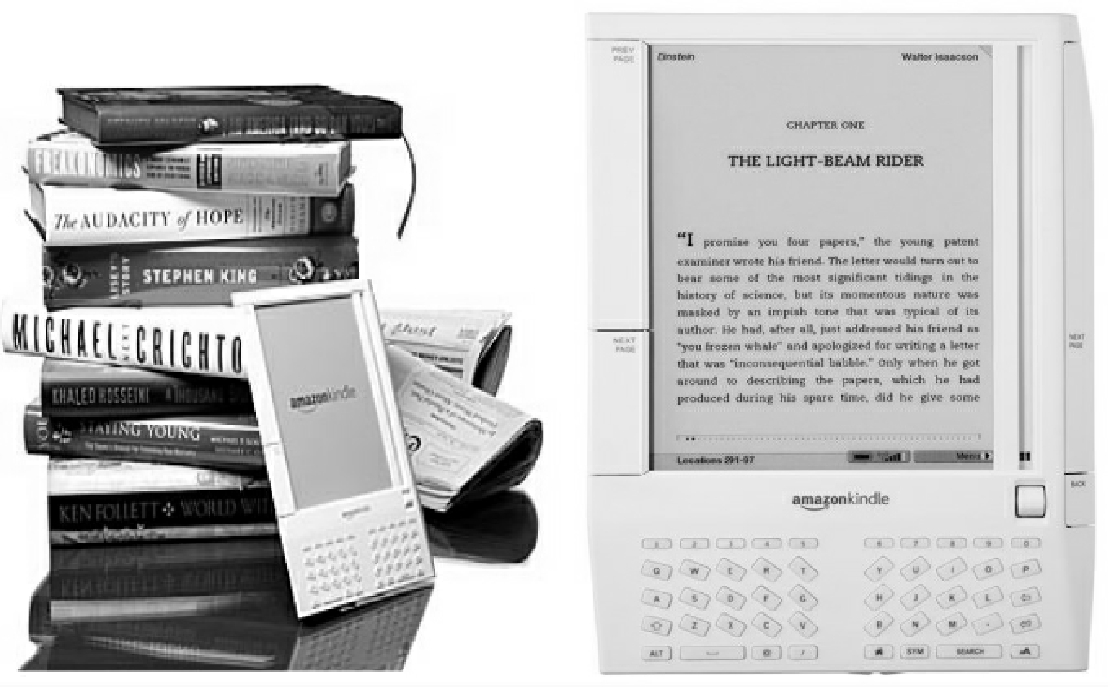
Jeff Bezos,Amazon's boss,pays attention to symbolism.He named his e-commerce company after the world's largest river to suggest a flood of books and other products.He named Amazon's e-book reader,launched in 2007,the Kindle to suggest that it would spark a fire(and not of the book-burning sort).This week he unveiled the Kindle 2,an improved version for the same$359,against the backdrop of a library that was once the private collection of John Pierpont Morgan.Assisting him was Stephen King,a popular author who has written a novella that will be available only on the device.The Kindle 2,Mr Bezos means to say,is about preserving a great tradition—book reading—and improving it,not about replacing it.
In many ways,this is true.The Kindle is an unusual gadget in that it does not obviously target young people,or early-adopting technophiles.Instead it appeals to passionate readers,who want no fiddling with cables(the Kindle works without a computer)or complicated pricing plans(Kindle users pay to buy books and other content,but do not have to pay wireless-subscription fees).It is,in short,perfect for older people.The Kindle is a surprisingly“conservative”device,says John Makinson,the boss of Penguin Group,a large book publisher,so it is an additional distribution channel and thus“good for us.”(Penguin is an arm of Pearson,which partly owns The Economist.)
Steve Kessel,a member of Amazon's Kindle team,says that Kindle owners seem to read more.“It's the convenience—they think of a book and can be reading it within 60 seconds,”he says,thanks to the instant wireless downloads,and“they're now carrying all their books around with them all the time.”The Kindle 2 can hold about 1,500 books,and one battery charge allows two weeks'reading.And since the screen is not backlit but imitates real ink and paper,Kindle owners can read for hours without straining their eyes.
So far,says Mr Kessel,this does not seem to spell the end of paper books,since Kindle users buy just as many bound books as before,so that their total consumption of books goes up by 2.6 times.That may change as more titles beCome available.More importantly,the Kindle and similar devices made by Sony and others represent only one side of the evolving e-reader market.They are for aficionados,since paying$359 for a device makes sense only if you read quite a lot of books,newspapers or magazines on it.
For everybody else,such as infrequent readers and the young and cashstrapped,the mobile phone may beCome the preferred e-reader.A popular software application on Apple's iPhone,called Stanza,already turns that device into a book reader,with one-handed page turning that is ideal for public transport.A backpacker who consults his“Rough Guide”for snippets of up-to-date information in a dark tent is unlikely to tote along a Kindle and a lamp,or a paper book,if he can get the e-book on his backlit phone.
It is now only a matter of time until absolutely all books beCome available,and properly formatted,for mobile phones.Google,an internet giant that has been scanning and digitizing books for inclusion in its search engine,now offers thousands of books that are in the public domain free on mobile phones.It seems likely that,eventually,only books that have value as souvenirs,gifts or artefacts will remain bound in paper.
Newspapers and magazines are on the same trajectory.Their paper editions are in decline in most of the developed world,as readers opt for the web versions on their computers and laptops,or on smart-phones such as the iPhone.The Kindle could accelerate that shift since it also lets users subscribe to news publications,which are automatically delivered.
All this has led to a new phrase in the book and newspaper industries:Is this the“iPod moment”?It is a layered and loaded analogy.On the one hand the iPod,Apple's now legendary music-player,and its associated iTunes store opened up a new market for legal digital-music downloads.On the other hand,the iPod accelerated the decline in CD sales and shifted power from record labels to Apple.Will the Kindle similarly put Amazon in a dominant position,while weakening publishers?
This is unlikely.Books,says Penguin's Mr Makinson,are different from music.Sales of CDs were harmed because iPod users could“unbundle”the albums that record labels had forced on them,and download only the songs they wanted.By contrast,there is no obvious reason to unbundle narrative books into individual chapters or paragraphs.A book sold via a Kindle thus has no marginal cost,but adds revenues.Another difference is that music was being widely pirated before Apple made legal downloading attractive.There is no such crisis in the book business.
Nor is Amazon likely to achieve anything near Apple's power over the music industry.True,when a newspaper or magazine reader drops his paper for a Kindle subscription,he enters a billing relationship with Amazon rather than the publisher.(Neither Amazon nor its partners will reveal how the revenue is split.)But for record labels,Apple was the only viable and legal route.For the news industry,says Craig McKinnis at USA Today,a large American daily,the Kindle is“just one of the splinters”among many new distribution channels,from the web to mobile-phone applications to e-readers.What happened in music“I cannot imagine taking place”in news,he says.
Indeed,the Kindle and other e-readers could be a boon to newspapers.With rare exceptions,newspapers have accustomed their readers to expect digital editions to be free.As circulation revenue has declined,this made them dependent on advertising,just as the recession hit.On the Kindle,by contrast,the news has no ads.Instead,readers seem happy to pay for it—just as they pay for services in any other industry that offers something worthwhile.
(From The Economist,Feb.12th,2009)
Questions for Discussion(问题讨论)
1.What are advantages and disadvantages of the Kindle e-book reader?
2.How fierce is the Kindle's competition in the market today?
3.Why does the writer say the“iPod moment”is a layered and loaded analogy?
4.How does the writer compare Kindle's impact on book industry with iPod's impact on music industry?
5.Why does the writer think the Kindle and other e-readers could be a boon to newspapers?
Language Tips(阅读提示)
Kindle:A portable e-book device from Amazon.com that provides wireless connectivity to Amazon for e-book downloads as well as Wikipedia and search engines.Wireless access is free.It also includes a built-in dictionary.Introduced in late 2007 with 88,000 titles in its(slightly modified)Mobipocket e-book format,more than a hundred best sellers were offered.Downloads take a minute.Weighing 10 ounces,the Kindle uses an electronic ink(e-ink)monochrome display and holds more than 200 books,blogs and newspapers in the Kindle 1,and up to 1,500 in the Kindle 2.For a fee,newspapers such as The New York Times and Wall Street Journal are downloaded during the night for morning reading.Also for a small conversion fee,photos and word doComents can be e-mailed to Amazon and downloaded to the Kindle for viewing.
Kindle 2:In February 2009,Amazon debuted a thinner,faster second generation device with 2GB storage,improved navigation buttons and longer battery life.With gray levels boosted from 4 to 16,the screen is sharper,and users can opt to listen to their content with the built-in textto-speech.By the time Kindle 2 was introduced,Amazon offered more than 230,000 titles for downloading.
Cable:(宽带上网服务的一种)A broadband internet service provision using cable modem.Cable modem is used to convert analog data signals to digital form and vice versa,for transmission or receipt over cable television lines,especially for connecting to the Internet.A cable modem modulates and demodulates signals like a telephone modem but is a much more complex device.Data can be transferred over cable lines much more quickly than over traditional phone lines.Transmission rates range from about 8 megabits per second(Mbps)for basic services to some 50 Mbps for premium services.Cable Internet access is regarded as a replaComent for slower dial-up,ISDN,and DSL connections.
Backlit:An LCD screen that has its own light source from the back of the screen,making the background brighter and characters appear sharper.
Bound books:这里显然是指与网络电子版相对的纸质装订书。
iPhone:A smartphone from Apple that integrates cellphone,iPod,Comera,textmessaging,e-mailandWebbrowsing.Dataand applications can be sent to the phone wirelessly or via Apple's iTunes software,which is used to organize music,videos,photos and applications.Introduced in the U.S.in mid-2007,the iPhone is available exclusively from AT&T until 2010.The iPhone 3G,introduced in July 2008,adds GPS,higher data speed and an application platform that turns the iPhone into an ultra-mobile,general-purpose computer.With the 3G,the iPhone was finally introduced in Canada by Rogers Communications and its Fido subsidiary.It was also made available in many other parts of the world.A major breakthrough in usability,the user interface was also carried forward in the next-generation iPod.iPhone由苹果公司(Apple,Inc.)首席执行官史蒂夫·乔布斯在2007年1月9日举行的Macworld宣布推出,2007年6月29日在美国上市,将创新的移动电话、可触摸宽屏iPod以及具有桌面级电子邮件、网页浏览、搜索和地图功能的突破性因特网通信设备这三种产品完美地融为一体。iPhone引入了基于大型多触点显示屏和领先性新软件的全新用户界面,让用户用手指即可控制iPhone。iPhone还开创了移动设备软件尖端功能的新纪元,重新定义了移动电话的功能。
Rough Guides:Rough Guides Ltd.is a travel guidebook and reference publisher,owned by Pearson PLC.Their travel titles cover more than 200 destinations,and are distributed worldwide through the Penguin Group.The series began with the 1982 Rough Guide to Greece,a book conceived by Mark Ellingham,who was dissatisfied with the polarisation of existing guidebooks between cost-obsessed student guides and“heavyweight Cultural tomes.”Initially,the series was aimed at lowbudget backpackers.Rough Guides have incorporated more expensive recommendations since the early 1990s and colour printing since the late 1990s and are now marketed to travellers on all budgets.Much of the travel content is also available online.The motto of Rough Guides is“Make the Most of Your Time on Earth.”
Public domain:原义——All lands and waters in the possession of the United States,and all lands owned by the several states,as distinguished from lands possessed by private individuals or corporations.转义——Information,the source of which is available to anyone and is not subject to copyright.
Record label:In the music industry,a record label is a brand and a trademark associated with the marketing of music recordings and music videos.Most commonly,a record label is the company that manages such brands and trademarks,coordinates the production,manufacture,distribution,marketing and promotion,and enforComent of copyright protection of sound recordings and music videos;conducts A&R;and maintains contracts with recording artists and their managers.
Marginal cost:边际成本In economics and finance,marginal cost is the change in total cost that arises when the quantity produced changes by one unit.It is the cost of producing one more unit of a good.Increase or decrease in the total costs of a business firm as the result of one more or one less unit of output.Also called incremental cost or differential cost.在经济学和金融学中,边际成本指的是每一单位新增生产的产品(或者购买的产品)带来到总成本的增量。边际成本和单位平均成本不一样,单位平均成本考虑了全部的产品,而边际成本忽略了最后一个产品之前的成本。例如,每辆汽车的平均成本包括生产第一辆车的很大的固定成本(在每辆车上进行分配)。而边际成本根本不考虑固定成本。
USA Today:National U.S.daily general-interest newspaper,the first of its kind.Launched in 1982 by Allen Neuharth,head of the Gannett newspaper chain,it reached a circulation of one million within a year and surpassed two million in the 1990s.Initially considered gimmicky and insubstantial,it gradually developed a reputation for higher quality while increasing its circulation and advertising revenues at a time when few papers were experiencing growth.The features that originally set it apart—abundantcolourfulgraphics,verybriefstories,anda concentrationonsportsandcelebrity—haveinfluencedother newspapers.《今日美国》是美国唯一的彩色版全国性对开日报,1982年9月15日创刊,总部设在弗吉尼亚州,属全美最大的甘尼特报团。《今日美国》每周出版5天,有国内版和国际版。国内版每天56版,国际版每天16版,向50多个国家发行。发行量从创刊时的20万份已一跃而达140万份,创造了美国报业史上发行量增长速度最快的纪录。据统计,1988年在全美10家发行量最大的报纸中,它已高居第二,仅次于《华尔街日报》。
Splinter:(常用于指splinter group)A part of an organization that breaks away from the main body,usually owing to disagreement.
Cultural Notes(文化导读)
E-reader:An e-book reader,sometimes also called an e-book device,is a device used to display e-books.It may be a device specifically designed for that purpose,or one intended for other purposes as well.The term is restricted to hardware devices,not software programs.The main advantages of these devices are portability,light diffusion,and long battery life.It should be noted that any Personal Data Assistant(PDA)capable of displaying text on a screen is capable of being an ebook reader.
On February 9,2009,Amazon announced the Kindle 2 also featuring 6-inch display,which beCome available for purchase on February 23,2009 for the price of$359.The Kindle 2 features improved battery life,20 percent faster page-refreshing,a text-to-speech option to read the text aloud,and overall thickness reduced from 0.8 to 0.36 inches(9.1 millimeters).The Kindle 2 has 2 GB of internal memory of which 1.4 GB is user-accessible.Amazon estimates that the Kindle 2 will hold about 1,500 books.Unlike the original Kindle,Kindle 2 does not have a slot for SD memory cards.To promote the new Kindle,author Stephen King has made his new novella entitled UR available exclusively through Kindle.According to an early review by website iFixIt,the new Kindle 2 features a Freescale 532 MHz,ARM-11 90 nm processor,32MB main memory,2GB moviNAND flash storage,and 3.7 V 1530 mAh lithium polymer battery.
Smart phone:A smartphone is a mobile phone offering advanced capabilities,often with PC-like functionality.There is no industry standard definition of a smartphone.For some,a smartphone is a phone that runs complete operating system software providing a standardized interface and platform for application developers.For others,a smartphone is simply a phone with advanced features like e-mail,Internet and e-book reader capabilities,and/or a built-in full keyboard or external USB keyboard and VGA connector.In other words,it is a miniature computer that has phone capability.Growth in demand for advanced mobile devices boastingpowerfulprocessors,abundant memory,large screens and open operating systems has outpaced the rest of the mobile phone market for several years.Smart phones differ from ordinary mobile phones in two fundamental ways:how they are built and what they can do.智能手机是一种在手机内安装了相应开放式操作系统的手机。智能手机可以是传统的手机增加智能功能,也可以是传统PDA加上手机通信功能,这些智能手机的类型有相融合的趋势。
Symbolism与technophile:本文中的symbolism已由原来抽象的象征派实化为象征即symbol。这类抽象词具体化在报刊中时有出现,又如idealism在上下文中意义可实化为“理想”,而不是原初的“理想主义”了。Technophile是一种典型的合成词,有主词加后缀“喜欢……的人”,如bibliophile。其名词形式是philia,相反的后缀分别是phobe和phobia。
Further Online Reading(网络拓展阅读)
Amazon in Big Push for New Kindle Model
By Brad Stone and Motoko Rich
Published:February 9,2009
http://www.nytimes.com/2009/02/10/technology/personaltech/10kindle.html
Kindle E-reader:A Trojan Horse for Free Thought
By Emily Walshe
March 18,2009
http://www.csmonitor.com/2009/0318/p09s01-coop.html
State of the Art
The Kindle:Good Before,Better Now
By David Pogue
Published:February 24,2009
http://www.nytimes.com/2009/02/24/technology/personaltech/24pogue.html?_r=1&fta=y
Looking to Big-Screen E-Readers to Help Save the Daily Press
By Brad Stone
Published:May 3,2009
http://www.nytimes.com/2009/05/04/technology/companies/04reader.html?_r=1
Journalism 101(报刊点滴)
英语新闻标题中的引典:allusion在英语新闻标题中使用较普遍,其目的一是唤起读者先前认知,二是引发读者阅读兴趣,三是幽默调侃讽刺。以上目的的达到,尤其是第三目的即修辞效果的产生,很大程度上取决于读者对英语的熟悉以及文化的修养。如:
●英国《金融时报》上的标题“To aid or not to aid,that is the question”即源于莎士比亚《哈姆雷特》中经典独白“To be or not to be,that is the question”。
●同期《金融时报》上又有Guant︶namo's Gordian Knot标题。其中Gordian Knot则是与亚历山大大帝Alexander the Great相关的一典故,意为“a very difficult or impossible task or problem”。(传说:King Gordius tied a very complicated knot and said that whoever undid it would beCome the ruler of Asia.Alexander the Great cut through the knot with his sword.)
Reading Comprehension Quiz(选文测验)
I.According to the article,determine which statements are true and
which are false.
1.Amazon says the Kindle 2 can improve the tradition of book reading.
2.The Kindle is designed to target older people.
3.Both Penguin and USA Today confirm that the Kindle is good for them.
4.According to Steve Kessel,Kindle users don't buy as many paper books as before.
5.Eventually,few books will remain bound in paper.
II.Choose the best answer to each of the following questions.
1.The Kindle 2 is ideal for__________.
A.older people only
B.infrequent readers
C.aficionados
D.none of the above
2.“Stanza”mentioned in this article is__________.
A.a popular software application for e-reading
B.preferred by a backpacker
C.used on Apple's iPhone
D.all of the above
3.iPod__________.
A.is developed by Apple
B.is a popular music-player associate with iTunes
C.accelerated the decline in CD sales
D.all of the above
4.All of the following about Google are true ex cept__________.
A.Google has been digitizing books
B.Google includes those scanned and digitized books in its search engine
C.Google offers many books free on its proprietary phone
D.Google is an Internet giant
5.Which of the following best summarizes this passage?
A.Amazon is very ambitious about e-book reader market and the Kindle series will hold more and more books for easy reading.
B.Quickly evolving e-book readers like the Kindle can be a great convenience to many and may not spell the end of book or newspaper industries.
C.The Kindle and other e-readers may not grow that fast as some analysts predict so newspapers don't have to follow suit.