2.America's Longest War:September 11th Remembrance
A nation once joined together in shock and vulnerability is now riven by failure and recrimination.
On the morning of September 12th 2001,Americans woke up to a changed country.They had seen the twin towers of the World Trade Centre reduced to rubble,the Pentagon aflame and a field in Pennsylvania transformed into a graveyard.Almost 3,000 people had been killed and twice as many injured,in the bloodiest day on American soil since the battle of Antietam in 1862.They had seen their president—the most powerful man in the world—flitting from pillar to post.And they had seen the face of a new enemy.Before September 11th few people even in the administration had heard of Al-Qaeda.After that day there was no getting away from the images of Osama bin Laden and his agent,Mohammed Atta.
That September 11th changed America dramatically is hardly open to debate:George Bush's presidency has been about little else since then.But some of the changes have been unexpected.Who would have guessed,as a shocked country rallied round the flag,that five years later partisan divisions would be deeper than ever?Who would have guessed,as the president pledged that“the people who knocked these buildings down will hear all of us soon,”that five years later Mr bin Laden would still be at liberty and America would be bogged down in Iraq?
The immediate result of September 11th was a surge in national unity.The country was draped in flags.Wal-Mart sold 116,000 of them on September 11th and 250,000 the day after.The mood killed partisan politics.Congressman Dick Armey,a firebrand conservative,put an arm around Maxine Waters,a firebrand congresswoman on the left.Mr Bush embraced Tom Daschle,the Democratic leader,on the Senate floor.Conservatives denouncedJerryFalwellandPatRobertson,two evangelical broadcasters,for entertaining the notion that September 11th was God's punishment of“the pagans,and the abortionists and the feminists and the gays and lesbians”.Leftists excoriated Susan Sontag for implying that the assault was payback for America's crimes.
The attacks brought an abrupt end to the“holiday from history”that followed the fall of the Soviet Union.They also brought an abrupt end to America's sense of invulnerability:for all its military might and oceanic moats,the country was wide open to attack from fanatics living in caves in Afghanistan.
All this produced a mood of soul-searching.A Newsweek cover article asked,“Why do they hate us?”and books on Islam topped the bestseller lists.It also produced something more visceral:a desire for revenge.Three days after the attacks the congregation in the National Cathedral in Washington,D.C.,concluded a memorial service for those who had died with the“Battle Hymn of the Republic”.
The administration capitalized on the more vengeful mood to produce a wide-ranging response.On September 11th Mr Bush concluded that America was at war.That day,too,he stated that he would make no distinction between terrorists and those who harboured them.This rapidly beCome the“Bush doctrine”.America would not wait for the next attack:it would take the war to the enemy.That did not mean Al-Qaeda alone.Any state sponsoring terrorists or supplying them with weapons of mass destruction(WMD)would be dealt with,even before the threat was fully developed.And America would not simply treat symptoms.It would tackle the causes of Islamic terrorism.
Strong,but vulnerable
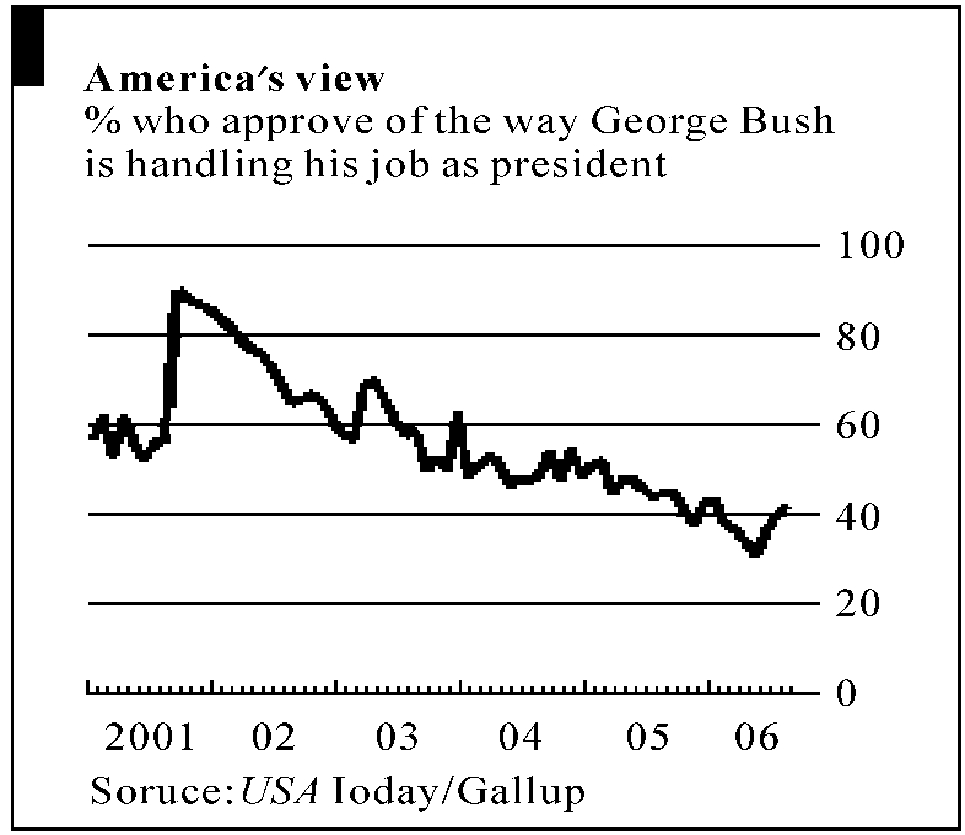
The doctrine drew on two contradictory beliefs:that America was mighty enough to reorder the world and that it was vulnerable to still worse attacks.Vice-President Dick Cheney then enunciated his own policy,known as the“1%doctrine”:if there were even a 1%chance of terrorists getting hold of WMD,America would act as if it were a certainty.September 11th gave an enormous boost to Mr Bush.In the aftermath of the attacks,the percentages of Americans who told pollsters they approved of him shot up from the 50s to the 90s,the highest scores ever recorded for a president.His ratings remained above 60%for 16 months,the longest boom in presidential popularity since the second world war.And September 11th strengthened Mr Bush in a more personal way:the frat boy who had grown up in the shadow of his overachieving father acquired a new steel and a new determination.
The administration relentlessly used the president's popularity to strengthen the power of the executive.In the wake of September 11th it engineered the biggest expansion in executive power since the days of Franklin Roosevelt.Mr Bush declared himself a“war president”.And he took a series of decisions that were to Come back to haunt him—from monitoring telephone calls without explicit approval from the courts to establishing military tribunals.Even when he was guaranteed a rubber stamp from a compliant Congress,he preferred to go it alone.Chuck Hagel,a Republican senator,grumbled that the administration treated Congress like a“constitutional nuisance”.
Reporting for defeat
At the same time September 11th strengthened the Republicans while weakening the Democrats.In the second half of the 20th century the Republicans had Come to be seen as the more trustworthy party in matters of national security.In 2001 the Democrats were conscious of that but could not decide what to do about it.First,they tried to change the subject to their strong suits,health and education,and then,when they chose John Kerry to be their presidential candidate,overcompensated by turning their 2004 convention in Boston into a Vietnam veterans'rally.There Mr Kerry,saluting his audience,introduced himself with the words,“Reporting for duty.”
The Republicans made strong advances in the 2002 mid-term elections,solidifying their control over the House and capturing the Senate.It was only the third time since the civil war that the president's party had gained seats in mid-term elections.And Mr Bush won the 2004 presidential election with more votes than any president in history.September 11th drove both victories.When it Come to“keeping America strong”,the opinion polls showed the Republicans with a lead of almost 40 points in 2002.At the Republican convention in New York two years later,every speaker,most powerfully Rudy Giuliani,who had been the city's heroic mayor in 2001,invoked the lessons of that day of fire.
The bipartisan feelings that followed September 11th could hardly have lasted for ever.But it is still surprising how far the warm courage of national unity has turned into fiery partisanship.The change was first seen in Howard Dean's revolt against the Democratic establishment as he sought the party's presidential nomination—an establishment which,in his view,had allowed Mr Bush to turn the terrorist attacks into a carte blanche for his party.And it continues to drive not just politics but also popular culture.Neil Young,whose 2001 song Let's Roll paid tribute to the bravery of the passengers who stormed the hijackers on the flight that crashed in Pennsylvania,is now singing about impeaching the president.
The main cause of this partisanship is the Iraq War,which is proving even more divisive than Vietnam.Immediately after September 11th Americans were ready to blame Saddam Hussein:in a poll taken two days later 34%of respondents thought it“very likely”that he had been personally involved and 44%thought it“somewhat likely”.Large majorities of both political parties—80%of Republicans and 69%of Democrats—backed the war with Iraq.
But conservative hawks were always keenest on making the link.At a meeting in Camp David just after September 11th Paul Wolfowitz,the deputy defence secretary,argued three times that America should attack Iraq rather than Afghanistan.And many Democrats were always sceptical:126 Democratic House members and 21 senators voted against the Iraqi War resolution in October 2002.Democratic opposition to the war expanded as America failed to get UN approval for deposing Mr Hussein.And it turned to fury when America failed to find WMD or to quell the resistance.Today nothing inspires more anger on the left than the belief that Mr Bush exploited September 11th to justify long-laid plans to remove the Iraqi president.
Might isn't right

The American left,in particular,has reverted to its pre-September 11th,and perhaps even pre-Clinton,suspicion of American power.A survey conducted by the Massachusetts Institute of Technology in November 2005 found that only 59%of Democrats still supported the decision to invade Afghanistan,compared with 94%of Republicans.A survey by the Century Foundation asked left-wingers and conservatives to rate their two main foreign-policy goals.Conservatives put destroying Al-Qaeda at the top of their list;leftists put it at number ten.
It is tempting to argue that the most remarkable thing about September 11th,five years on,is how little it has changed America.Many features of the political landscape are much as they were on September 10th—a polarizing president,an electorate divided almost 50-50 in terms of party allegiance,a Republican Party that loves to wrap itself in the flag and a Democratic Party more worried about outsourcing than terrorism.But look more deeply and you find dramatic changes.
The main one is a new emphasis on national security.In 2000,despite a series of increasingly devastating terrorist attacks,including the first bombing of the World Trade Centre,only 12%of Americans cited“world affairs”as a“paramount issue”.Today they are central.
The shadow of September 11th will hang over the mid-term elections.Ken Mehlman,the chairman of the Republican National Committee,argues that the big question in November is,“Do you believe we're at war?”The Democrats fight back by arguing that,thanks to his war in Iraq and neglect of security at home,Mr Bush is making America less safe.
September 11th may also hang over the 2008 presidential election.John McCain(tortured by the Vietnamese)and Mr Giuliani(a stirring September 11th performance),two of the Republican front-runners,boast perfect credentials for the new terror-racked world.Hillary Clinton,the Democratic front-runner,has been burnishing her own tough-gal credentials on the Senate Armed Services Committee.The concentration on national security reflects a second big change: America's new but continuing sense of vulnerability.This has deepened over the years.The war in Iraq has proved how difficult it is for America to use its military might to change the world.The fiasco of failing to find any WMD in Iraq underlined the weakness of its intelligence services.The response to Hurricane Katrina showed dramatically what several congressional reports had already pointed out:that the administration had done little to prepare for another catastrophic attack.
Lastly,September 11th has turned the Bush presidency into a big deal.Before the aircraft struck,Mr Bush looked like a small-bore president—divisive,to be sure,but divisive about little things.On the morning of September 11th Mr Bush was reading“My Pet Goat”to a class of second-graders.His speech-writer,Michael Gerson,was working on a speech on“Communities of Character”.America is now as divided as possible about Mr Bush.His supporters regard him as a“transformative”figure like Ronald Reagan.His critics view him as a catastrophe—possibly the worst president in American history,according to Sean Wilentz,a Princeton historian.But,thanks to September 11th,nobody can dismiss him as a mere footnote.
(From The Economist,August 31,2006)
Questions for Discussion(问题讨论)
1.At the beginning of the article,why the contrast“joined in shock and vulnerability”with“riven by failure and recrimination”?What purposes does it serve?
2.What do words like“frat boy”suggest about the article's attitude toward Bush?
3.What is meant by“thanks to September 11th,nobody can dismiss him as a mere footnote”?
4.What have changed in America,if any,since“9·11”?
5.How did“9·11”affect American partisan politics?
Language Tips(阅读提示)
Flit from pillar to post:Be forced to go from one place to another in an unceremonious or fruitless manner and in rapid succession,occasioning much frustration and anger in the process.
Partisan politics:One in multi-party political systems in which politicians are overly supportive of policies of the party to which they belong and reluctant to acknowledge correctness of their political opponents in almost any situation.
Firebrand:someone who deliberately foments trouble or tries to make people angry about a law,government,etc.,so that they will try to change it.
Evangelical broadcaster:Also called televangelist.Evangelicalism is a type of Protestant religion based on the idea that people needed to open their hearts and redirect their wills toward Christ,not only to secure an eternal place in heaven,but also to better their lives on earth.Such religious programs on television are usually hosted by a fundamentalist Protestant minister,who conducts services and often asks for donations.Prominent televangelists include Billy Graham,Oral Roberts,Jerry Falwell,and Pat Robertson.
Soul-searching:反省,深思 Its excessive form would be“navelgazing”,often used by journalists.
Frat boy:A college student who is a member of a fraternity.Frat boys just want to have fun with the sorority girls.They can be normally found in their natural habitat passed out on a bench,soccer field,couch,or in front of the Public Safety office.
Rubber stamp:As a political metaphor,refers to a person or institution with considerable formal power but little de facto power,one that rarely disagrees with more powerful organs.The legislature may be a“rubber stamp”of approval on the executive's decrees and the monarch is typically a“rubber stamp”to an elected parliament.
Strong suits:一手同花大牌 Figuratively,it refers to a quality,activity,or skill in which a person excels.In playing card,the suits are called hearts(红桃),clubs(梅花),diamonds(方块)and spades(黑桃).
Carte blanche:(French for blank doComent)Full discretionary power; permission or freedom to do whatever you want.
Outsourcing:Outsourcing is often defined as the delegation of non-core operations or jobs from internal production within a business to an external entity(such as a subcontractor)that specializes in that operation.Outsourcing is a business decision that is often made to lower costs or focus on competencies.A related term,offshoring,means transferring work to another country,typically overseas.Offshoring is similar to outsourcing when companies hire overseas subcontractors,but differs when companies transfer work to the same company in another country.
Tough-gal credentials:Hillary Clinton当年竞选总统时竭力将自己塑造成一个beer-and-shot tough-gal(相对于tough-guy)。她的言行姿态(尤其是在外交事务方面)便构建成她的凭证与资历。
Small bore:Small caliber;trivial or insular or parochial in scope,attitude,etc.
To be sure:这种短语常用于句中肯定前面说的确有道理,但接下来有不同意见。重点在后半部,是论述中批驳他人观点陈述自己看法的常见形式。语气上相当于汉语的“诚然”。
Cultural Notes(文化导读)
Battle of Antietam:Fought on September 17,1862 in Maryland,the first major battle in the American Civil War between the Confederate and the Union to take place on Northern soil.It was the bloodiest single-day battle in American history,with almost 23,000 casualties.Although the battle was tactically inconclusive,it had unique significance as enough of a victory to give President Abraham Lincoln the confidence to announce his Emancipation Proclamation.
Osama bin Laden or Usama bin Laden is a militant Islamist and also the founder of Al-Qaeda.Bin Laden is a member of the prestigious and wealthy bin Laden family and issued a 1998 edict that Muslims should kill civilians and military personnel in the United States and allied countries until they withdraw their forces from Muslim countries and from Israel.
Mohammed Atta al-Sayed was named by the FBI as the suicide pilot of American Airlines Flight 11,the first plane to crash into the World Trade Center during the September 11,2001 attacks.
Susan Sontag(1933-2004)was a well-known American essayist,novelist,intellectual,filmmaker and activist.
Holiday from history:The relatively uneventful decade of 1990s,roughly between the end of the Cold War and the“9·11”attacks.(参见http://www.aish.com/societyWork/society/Holiday_From_History.asp.)It may also remind people of the idea of“The End of History”by Francis Fukuyama(弗朗西斯·福山教授提出的“历史的终结”)in late 1980s and early 1990s that“What we may be witnessing is not just the end of the Cold War,or the passing of a particular period of post-war history,but the end of history as such:that is,the end point of mankind's ideological evolution and the universalization of Western liberal democracy as the final form of human government.”
“The Battle Hymn of the Republic”is a patriotic anthem,written by Julia Ward Howe,which was made popular during the American Civil War.
Bush Doctrine.The Bush Doctrine is a set of foreign policy guidelines first unveiled by President George W.Bush in his commenComent speech to the graduating class of West Point given on June 1,2002.The policies,taken together,outlined a broad new phase in US policy that would placegreateremphasisonmilitarypre-emption,military superiority(“strength beyond challenge”),unilateral action,and a commitment to“extending democracy,liberty,and security to all regions”.The Bush Doctrine is a marked departure from the policies of deterrence and containment that generally characterized American foreign policy during the Cold War and the decade between the collapse of the Soviet Union and 9/11.The Bush Doctrine provided the policy framework for the 2003 invasion of Iraq.
Franklin D.Roosevelt(or FDR,January 30,1882-April 12,1945) served as the 32nd President of the United States and was elected to four terms in office.He served from 1933 to 1945,and is the only President to serve more than two terms.A central figure of the 20th century,scholarly surveys rank him among the three greatest U.S.Presidents(along with George Washington and Abraham Lincoln).
Camp David:戴维营 The mountain retreat of the President of the United States.Camp David has often been used for formal and informal discussion between the United States and world leaders.Probably most famous is the summit that led to the peace agreement between President Anwar Sadat of Egypt and Prime Minister Menachem Begin of Israel that was forged at Camp David in 1978 with U.S.President Jimmy Carter,known as the Camp David Accords(1978),aka(also known as)“Camp David I.”In 2000 there were also the talks that led to the Roadmap for Peace on the resolution of the Israeli-Palestinian conflict at the summit meeting between U.S.President Bill Clinton,PLO Chairman Yasser Arafat and Israeli Prime Minister Ehud Barak known as the Camp David 2000 Summit or“Camp DavidⅡ.”
My Pet Goat:A children's story contained in the book Reading MasteryⅡ:Storybook 1,part of the thirty-one volume Reading Mastery series published by the SRA Macmillan early-childhood education division of McGraw-Hill.The story gained notoriety because U.S.President George W.Bush,as part of a photo op,was reading it with schoolchildren in a Florida elementary school when he was informed of the September 11,2001 terrorist attacks.
Ronald Reagan:(1911-2004)Ronald Reagan was the 40th President of the United States(1981-1989).For two terms,he served as governor of California.His persuasive speaking style earned Reagan the accolade“The Great Communicator.”He was an anti-communist who negotiated arms reductions with the Soviets;his policies are sometimes credited with accelerating the demise of the Soviet Union.
Further Online Reading(网络拓展阅读)
Between the leaves
Perspectives on September 11 have changed;the essence of that day has not.
http://www.timesonline.co.uk/tol/comment/leading_article/article 1085353.ece
Viewpoints:The world since 9/11(BBC)
After the attacks on the US in September 2001,many commentators and political leaders declared that the world had changed for ever.
http://news.bbc.co.uk/2/hi/americas/5317612.stm
September 11-Five Years on(Financial Times)
http://www.ft.com/cms/1e993a1e-410e-11db-827f-0000779e2340.html
9/11 Lesson Plan(New York Times)
http://www.nytimes.com/2002/09/04/opinion/04FRIE.html?scp= 6&sq=9/11
Journalism 101(报刊点滴)
●报刊作为新闻文体,自有其语言特色。如本文中的小标题的妙用。“Strong,but vulnerable”显然是个paradox,借以描述“9·11”事件之后美国的外强中干。“Reporting for defeat”源于新兵报到就职时说的“Reporting for duty”,这里是个irony,讽刺民主党总统候选人Kerry的惨败。最后小标题“Might isn't Right”是Might is Right的变体(parody)。Might is Right意为“强权即公理”,这里是在提醒美国仅凭借其经济与军事强势并非就能做到公正。因其鲜明特征,这类paradox,irony以及parody等修辞手段在新闻文体的标题中较为常见。
Reading Comprehension Quiz(选文测验)
Ⅰ.According to the article,determine which statements are true and which are false.
1.Prior to the 9/11 attacks,few U.S.Federal government officials had heard of al-Qaeda.
2.Conservatives in the U.S.believed that September 11th was God's punishment of those homosexuals.
3.Soul-searching after 9/11 also triggered off an emotion-charged desire on the part of some Americans for retaliation.
4.As far as the cause of the 9/11 attacks is concerned,Maxine Waters and Susan Sontag would most probably disagree with each other.
5.Though it does not expressly states so,the“1%doctrine”implies that there is a slim chance of terrorists getting hold of weapons of mass destruction.
Ⅱ.Choose the best answer to each of the following questions.
1.According to the article,what does the“Bush Doctrine”contain?
A.More pre-emptive than reactive toward the enemy.
B.The enemy may include some states.
C.It intends to tackle the root cause of terrorism,not merely its symptoms.
D.All of the above.
2.In what way did the September 11 greatly boost George W.Bush?
A.His popularity ratings shot up.
B.It expedited the discovery of WMD in Afghanistan.
C.He walked out of the shadow of his father and established himself.
D.Both A and C.
3.What does this article imply about Franklin Roosevelt?
A.He's another war president.
B.He took advantage of military tribunals to advance his own goals.
C.He exercised enormous executive power during his tenure.
D.He made U.S.Congress a rubber stamp.
4.“September 11th drove both victories.”What were the two
victories?
A.John Kerry's nomination as Democratic presidential candidate and 2004 convention.
B.President's party had gained seats in mid-term elections and Bush won the 2004 presidential election with more votes than any president in history.
C.NYC mayor and Howard Dean's nominations as presidential candidates.
D.U.S.invasion of Iraq and Afghanistan.
5.What does a survey conducted by the MIT in November 2005 sayaout the pollsters'attitude toward the decision to invadeAfghanistan?
A.More Republicans support the decision.
B.More Democrats support the decision.
C.Both equally support the decision.
D.None of the above.