Communication Competence,Social Support,and Depression among College Students.Amodel of Facebook and Face-to-Face Support Network Influence
Kevin Wright(1)
Depression among college students has been identified as a serious health concern(Eisenberg,Gollust,Golberstein,& Hefner,2007;Weitzman,2004),and decades of research has documented a variety of contributing variables,including stress,financial factors,race and ethnicity,loneliness,relational skill deficits,and loneliness(Berman & Sperling,1991; Cutrona,1982;Joiner,1997;Wei,Russell,& Zakalik,2005;Wolf,Scurria,& Webster,1998).Symptoms of depression appear to peak in late adolescence—a time of considerable social stress and transition,including adjustment to college life(Aseltine,Gore,& Colton,1994; Fisher,1988).Depression has been linked to a multitude of health problems among college students,including alcohol and substance abuse,increased usage of tobacco products,anxiety and related mental health problems,reduced immune system functioning,and increased risk of committing suicide(Eisenberg et al.,2007;Kisch,Leino,& Silverman,2005;Lenz,2004; Weitzman,2004).In addition,most lifetime mental disorders have their first onset shortly before or during the typical college age(Kessler et al.,2005).
Many of the factors that contribute to college student depression are social in nature,such as differences in relational development skills,differences due to sex,race,and sexual orientation,and individual differences in problem-solving skills(Zurilla,Chang,Nottingham,& Faccini,1998).Communication skills appear to influence the impact of these variables on student loneliness and subsequent depression(Berg & McQuinn,1989;DiTammaso,Brennen-McNulty,Ross,& Burgess,2003;Fisher,1988;Jones,Hobbs,& Hockenbury,1982;Spitzberg & Canary,1985).
The current study examines the influence of both social networking site(Facebook)and face-to-face support networks on college student depression.Specifically,the authors utilize Kreps'(1988)Relational Health Communication Competence Model(RHCCM)as a framework for examining the influence of communication competence on social support network satisfaction and depression.Moreover,the authors also examine the influence of interpersonal and social integrative motives on communication competence,social support network choice,and social support satisfaction.Toward that end,the following section reviews literature about Krep's(1988) RHCCM,social capital/support within social networking sites,motives for using face-to-face and computer-mediated support networks,and communication competence,social support,and depression.This is followed by a proposed theoretical model based on this literature and the results and implications of a study designed to test this model with a sample of undergraduate college students.
Communication Competence,Social Support,and Depression
Krep's(1988)Relational Health Communication Competence Model(RHCCM)has been a useful theoretical framework for studying the interrelationships among communication competence,social support,and health outcomes,including stress and cognitive depression(Kreps,1988; Kreps,O'Hair,& Clowers,1995;Query & Kreps,1996;Wright,Banas,Bessarabova,& Bernard,2010).Kreps'(1988)model places communication competence as the central variable when examining the effectiveness of the interdependent communication roles in the health-related contexts.According to Query and Kreps(1996),health communication competence is characterized by provider and consumer knowledge and skills,including empathetic listening,verbal and nonverbal sensitivity,encoding and decoding skills,as well as interaction management.The RHCCM posits that increased communication competence leads to“therapeutic communication,social support,satisfaction,information exchange,and cooperation”whereas decreased competence leads to“pathological communication,lack of social support,dissatisfaction,information barriers,and lack of cooperation”(Kreps,1988,p.354)
In a study of lay caregivers of Alzheimer's patients,Query and Kreps(1996)found that individuals with high communication competence reported higher levels of social support satisfaction as compared to individuals with low communication competence,and that communication competence was negatively related to cognitive depression.Wright et al.(2010),in their research involving health care workers,similarly found that higher levels of face-to-face communication competence predicted increased social support satisfaction and lower stress and burnout scores.
Competence and depression among college students
According to Aseltine et al.(1994),friendships take on increased importance for late adolescents with family problems,as adolescents seek greater social distance from family membersby“turning to peer relationships as their primary sphere of social participation and emotional investment”(p.253).These researchers found that social support from friends significantly predicted lower levels of depression(in both asymptomatic and chronic depression cases),whereas support from family members was not related to depression scores.Communication competence has been linked to a variety of relational outcomes,such as locus of control when dealing with stressful situations(Canary,Cunningham,& Cody,1988)as well as increased relational satisfaction and social support(Canary & Lakey,2006;Canary & Spitzberg,1987; Cupach & Canary,2000;Query & Wright,2003).
Researchers have examined the influence of social competencies on relational development processes and depression among college students.For example,Jones et al.(1982)found that college students who were experiencing high levels of loneliness and depression tended to possess limited social competencies to build satisfactory relationships with peers.Moreover,Wei et al.(2005)found that university students possessing a high degree of self-efficacy toward developing interpersonal relationships and increased self-disclosure within relationships predicted lower depression.Given empirical support for Krep's(1988)RHCCM and previous work dealing with college student relational competencies and depression,it follows that both face-to-face and computer-mediation communication competencie smay likely influence social support network size and satisfaction,which,in turn,may influence depression.
Social Networking Sites and Social Capital/Social Support
The widespread use of social networking websites(SNSs),including Facebook,has gained the attention of social scientists in recent years due to their potential for enhancing interpersonal networks(Ellison,Steinfield,& Lampe,2007;Snyder,Carpenter,& Slauson,2006;Xie,2008)as well as the challenges computer-mediated communication presents to interpersonal relationships(Tong,Van Der Heide,Langwell,& Walther,2008;Walther,2007;Wise,Hamman,& Thorson,2006).Related studies of computer-mediated communities have found that they can enhance social support and reduce depression(Houston,Cooper & Ford,2002;Walther & Boyd,2002).
Since its creation in 2004,Facebook has become immensely popular among college students.For example,Facebook reached 100 million active users in August2008 and proceeded to double this membership base to surpass200 million active users by April2009(Facebook.com).Part of its popularity can be linked to how Facebook(and similar social networking sites)appears to facilitate relational initiation and development,relational maintenance,and relational reconnection(Acquisti & Gross,2006;Ellison et al.,2007;Lampe et al.,2006),all of which may extend the size of and quality of one's social support network(Walther & Boyd,2002;Wright & Bell,2003;Ye,2010).Social networking sites,such as Facebook,also appear to enhance or extend face-to-face support networks in terms of providing greater access to the increased social capitalavailable in a larger,easier to maintain,network of individuals who are often geographically separated(Lampe et al.,2006;Ye,2006).
A number of researchers have argued that on-line social networks have the potential to foster increased social capital,particularly among people who use it for interpersonal and community-building purposes(Drentea & Moren-Cross,2005;Haythornthwaite,& Wellman,2002;Quan-Haase,Wellman,Witte,& Hampton,2002;Sreter,2000),including Facebook(Ellison et al.,2007).Social capital can be defined as“resources embedded in a social structure that are accessed and/or mobilized in purposive actions”(Lin,2001,p.29).According to Putnam,social capital refers to networks among individuals and trust,norms,and values arising from social networks(Putnam,1995a,1995b,2000).Social capital is facilitated by strong interpersonal ties,reciprocity norms,interpersonal trust,and shared values.Putnam(2000)posits that there are abilities,resources,and values embedded in social networks and relationships that can potentially create emotional,informational,and instrumental benefits,but that the realization of these benefits may depend upon the types of individuals with which a person interacts on a regular basis and how well he or she can capitalize on these resources.
Complications in receiving appropriate social support
In many ways,such as those just mentioned,the practice of seeking support can involve a complicated process of managing difficult individual coping needs while simultaneously attempting to handle delicate relational concerns.Findings from a variety of research programs(See Albrecht,Burleson,& Goldsmith,1994;Barbee,Derlega,Sherburne,& Grimshaw,1998; Brashers,Neidig,& Goldsmith,2004)suggest that many individuals find it difficult to obtain appropriate support from friends and family as they may feel these potential sources of support lack experience or have limited information about certain problems.Furthermore,many people may feel uncomfortable discussing their problems with members of their support network for a variety of other reasons,such as a desire to avoid feeling stigmatized,patronized,or being judged when discussing sensitive topics.
Other complicating relational concerns in social support situations may include reluctance toward receiving inappropriate support,or not wanting to appear vulnerable or incapable of handling one's own problems.In addition,there are complications associated with role obligations and reciprocity issues in many relationships(Albrecht & Goldsmith,2003;Chesler & Barbarin,1984;LaGaipa,1990).Previous research has identified satisfaction with one's support network to be a more reliable predictor of positive social and psychological outcomes than the size of one's support network(see Query & James,1989;Query & Kreps,1996;Query & Wright,2003; Wright et al.,2010).
Motives for Using Facebook
One important exogenous variable is the motives individuals have for using social networkingsite such as Facebook.Uses-and-gratifications theory(Katz,Blumler,& Gurevitz,1974) examines motives individuals have for using various types of media.In terms of CMC research,scholars using a uses-and-gratifications approach to the study of CMC relationships(Courtois,Merchant,De Marez,& Verleye,2009;Ebersole,2006;Papacharissi & Rubin,2000;Wright,2002)have found motives to be important antecedent variables in terms of understanding cognitive processes behind various CMC behaviors,such as the amount of time individuals spend on-line and in relational development and maintenance activities.
Given the interpersonal nature of the current study,the researchers were interested in two specific socially-oriented motives for using Facebook:(1)interpersonal motives,or the goal/desire to use the medium to develop,enhance,or maintain relationships,and(2)social integrative motives,which involve using the medium in an attempt to find information about relational partners and helping individuals feel“connected”with others.Several researchers(See Muhtaseb & Frey,2008;Papacharissi and Rubin,2000;Wright,2002)found that interpersonal and social integrative motives predicted increased interpersonal communication,relational development and maintenance,and social involvement in on-line communities.It follows that individuals with higher interpersonal motives and social integrative motives will likely demonstrate increased computer-mediated competence(as well as face-to-face interpersonal communication competence),given the desire to enhance one's interpersonal skills to achieve more interpersonal-oriented goals(such as relational development,social support,etc.).However,in revious work,such motives have been implied rather examined empirically in terms of their effects on communication competence.
Perceived Communication Competence
Communication competence is described as persons'abilities to demonstrate skills,either innate or developed,to accomplish communicative goals(Spitzberg,1993)or“to choose among available communicative behaviors”in the attempt to accomplish“interpersonal goals during an encounter while maintaining the face and line”of“fellow interactants within the constraints of the situation”(Wiemann,1977,p.198).Moreover,communication competence describes“the evaluative impression of the quality of interaction”(Spitzberg & Cupach,1989,p.575).
Due to a longstanding interest in communication competence among communication researchers,many definitions of this construct can be found;for example,communication competence has been conceptualized as a variety of communication skills and behaviors,including empathy,affiliation,behavioral flexibility,relaxation,and other skills such as interaction management(Wiemann & Backland,1980),and also as the ability to adapt to changing situations,efficiency,and conversational involvement(Canary & Lakey,2006).Wiemann and Backland's(1980)conceptualization of communication competence consisted of five dimensions(i.e.,empathy,affiliation,behavioral flexibility,relaxation,and perceived interactionmanagement),which,as Wiemann and Backland argued,help“distinguish competent communicators from their incompetent counterparts”(p.195).Communication competence has been found to predict a variety of variables,including increased relational satisfaction and social support(Albrecht & Adelman,1987;Apker,Ford,& Fox,2003;Cupach & Canary 2000; Query & Wright,2003).
CMC competence.Competent communication occurs in the degree to which the contextual demands are considered in the selection of communicative behaviors and how well the behaviors are consistent with features of the context in question(Spitzburg & Brunner,1991).Thus,competent communicators adapt their behaviors not only to improve their attempts to attain prescribed goals,but also to adhere to situational constraints.
Spitzberg(2006)offers amodel of computer-mediated communication competence similar to earlier views of interpersonal communication competence,where competence is determined by the motivation,knowledge,and skills of the interactant in relation to the demands of the context and desired outcomes of the discourse.One important element in self-presentation is self-disclosure because it allows an individual some ability to shape and control self-relevant knowledge.Communication competence plays a significant role in how one engages in self-presentation.Spitzberg(2006)states that“FtF and CMC interaction are more similar than they are different”(p.652),as they both involve the use of relevant interpersonal communication skills.According to Spitzberg(2006),previous research largely supports the idea that the goal of Internet and CMC technologies is,for the majority of individuals,to expand and enhance relationship networks,specific relational ties,and often to enhance the quality of relational interaction.In this research,CMC users were found to be more likely to choose these CMC channels where they anticipated positive results from the channel use.
Internet relationships,support,and depression.Some equivocality remains as to the relative benefits of face-to-face(FtF)versus online interactions.According to Cai(2004),time invested online may detract individuals from investing in(FtF)relationships by reducing contact,network size,density,or quality of interaction.Several early CMC studies reported slight but significant increases in loneliness and depression over time(Kraut et al.,1998),and decreases in social and familial involvement(Kraut et al.,1998;Nie & Erbring,2000)with increasing Internet use.However,later studies(see McKenna,Green,& Gleason,2002)revealed that Internet use and depression were related in more complex ways.These studies found that depression is mediated by appraisals of social support offered by on-line network members.Although face-to-face support network mobilization often decreases with increased on-line use,heavy Internet users often turn to computer-mediated support to compensate for more traditional face-to-face supportive interactions(Ellison et al.,2007;Xie,2008;McKenna,Green,& Gleason,2002).
Given the empirical support for Krep's(1988)RHCCM and other theories/studies regardingthe interrelationships between motives,communication competence,social support,and depression discussed in the above sections,the researchers proposed the following hypotheses:
H1:Increased interpersonal motives for using Facebook will be associated with greater communication competence(both face-to-face and CMC).
H2:Increases in social integrative motives for using Facebook will be associated with increases in Facebook social support satisfaction.
H3:Increases in face-to-face communication competence will lead to increases in face-to-face social support satisfaction.
H4:Increases in CMC competence will lead to increases in social support satisfaction.
H5:Increases in face-to-face social support network satisfaction will result in decreases in depression.
H6:Increases in Facebook social support network satisfaction will lead to decreases in depression.
The associations between these hypotheses are summarized in the theoretical model(See Figure 1).
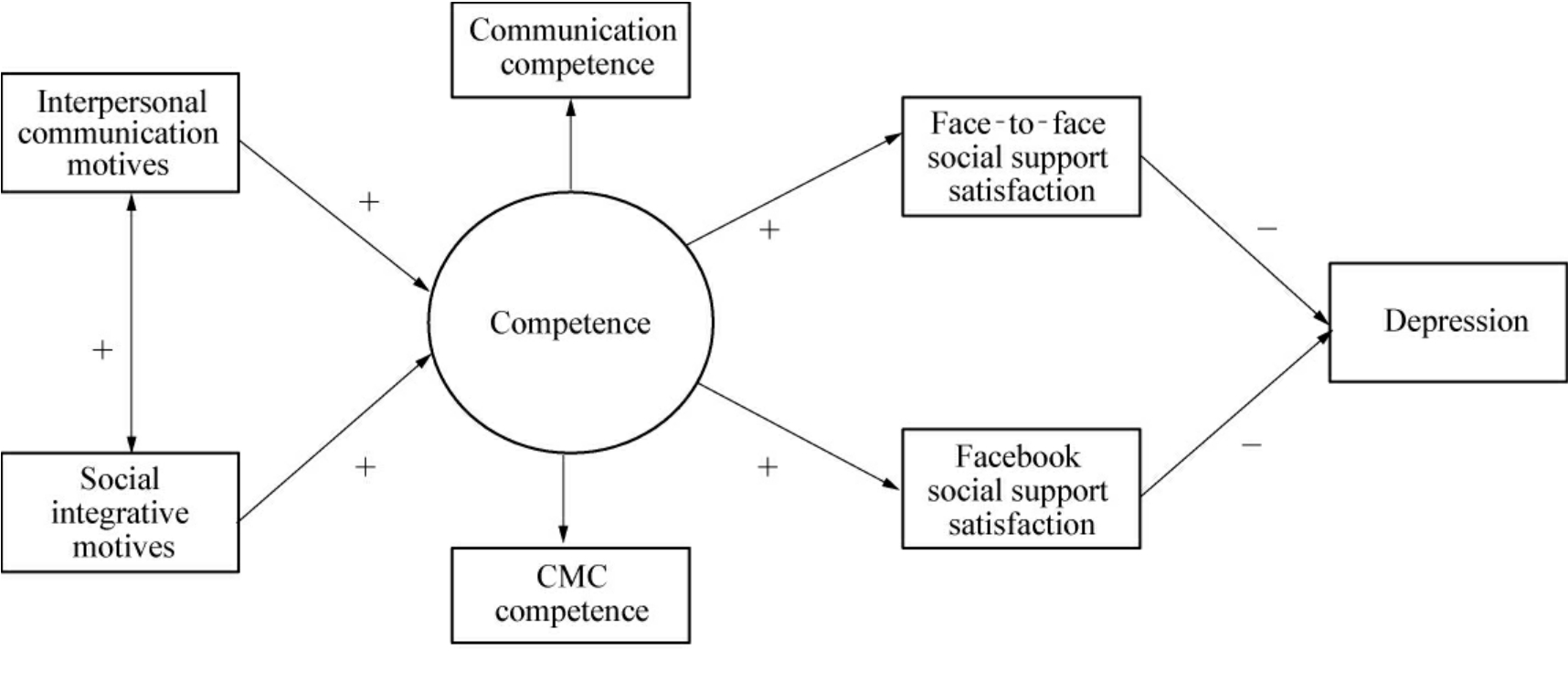
Figure 1.Theoretical Model
Method
Participants
Three-hundred-sixty-one(N=361)undergraduate students from a large southwestern university participated in a survey for extra course credit.All participants were current users of Facebook.Of these students,168 were male and 193 were female.The average age of the respondents was 20.26(SD=2.72).In terms of race,the majority of the sample were white(278 individuals),followed by Native American(31),Latino/Hispanic(16),Asian-American(13),African-American(12),and other(12).The majority of the students were college sophomores(119),followed by freshmen(100),juniors(81),and seniors(61).In terms of relational status,206 individuals were single,138 reported that they were dating,14 individuals were married,and 2 people were divorced.The participants reported spending an average of2.04 hours a week(SD=2.01)using Facebook,and the average number of Facebook friends for the sample was560.09(SD=409.16).
Measures
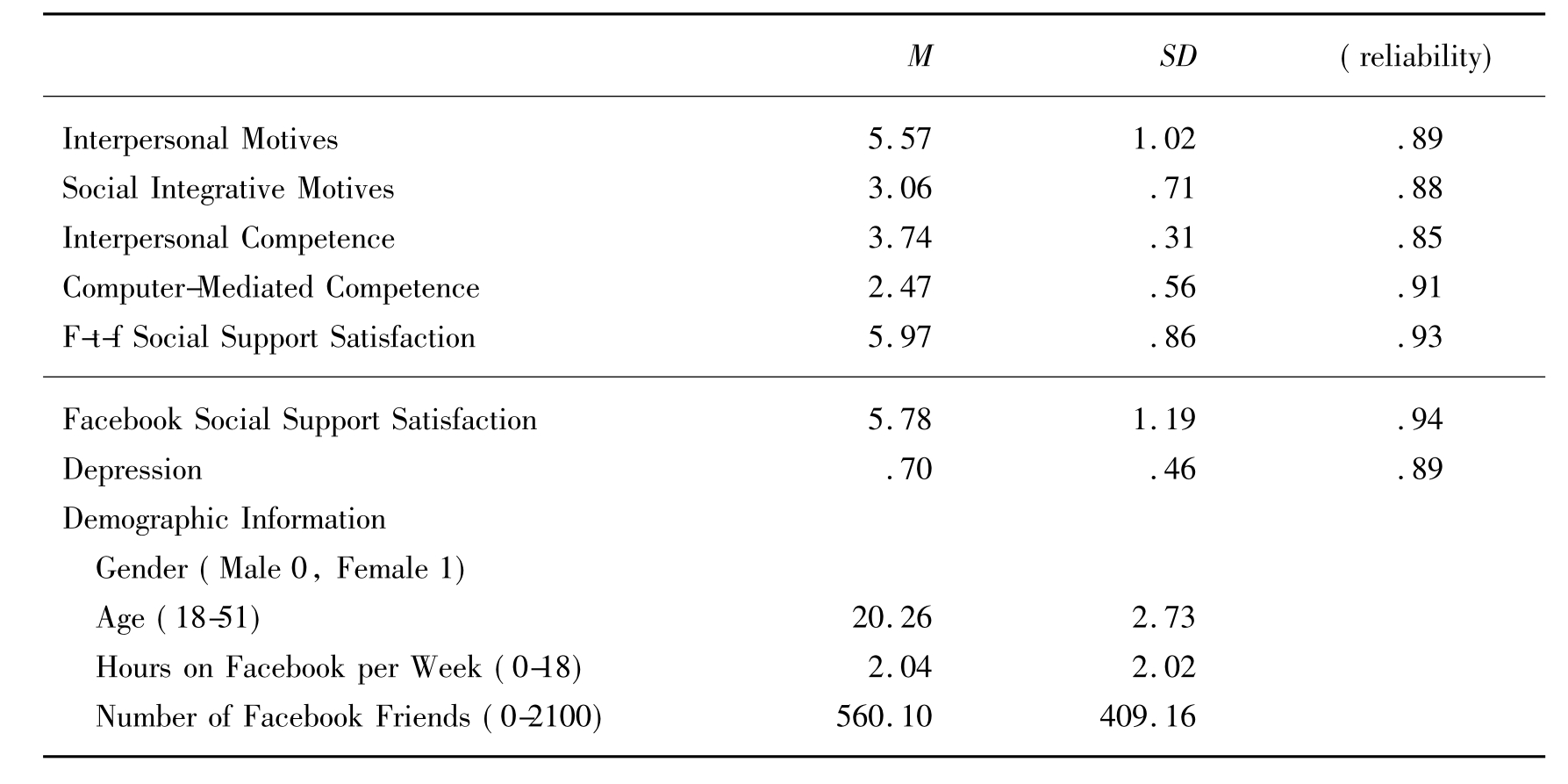
The survey consisted of a number of well-established measures.All reliabilities were assessed using Cronbach's alpha.The descriptive statistics and reliabilities for these variables appear in Table 1.
Table 1 Means,Standard Deviations,and Cronbach's Alphas for all Variables
Interpersonal/social integrative motives.Interpersonal and social integrative motives for interacting with on-line and face-to-face social network members were measured using Papacharissi & Rubin's(2000)scale for measuring Internet motives.Although this measure includes a number of motives for using the Internet,including passing time,downloading music/ video files,etc.,given the interpersonal focus of the current study,the researchers measured only interpersonal motives and social integrative motives for using Facebook.This measure consisted of twelve 5-point,Likert-type items,including,“I use Facebook to talk with friends and people I know”(interpersonal motive),and“I use Facebook to keep up with what is going on in specific places”(social integrative motive).
Perceived communication competence.The researchers measured face-to-face communication competence using Wiemann's(1977)36-item communication competence scale.The response option to each question was a five-point Likert-type scale.The questionnaire included such items as“I am a good listener”,“I am relaxed and comfortable when communicating”and“I can adapt to changing situations”.Higher scores on the scale reflected greater perceived communicationcompetence than lower scores.
Computer-mediated communication competence.The researchers measured computer-mediated communication competence using Spitzberg's(2006)computer-mediated communication competence(CMC competence)scale.The scale included 26 items that were measured on a 5-point,Likert-type scale.Examples of the items include,“I am skillful at revealing composure and self-confidence in my CMC interactions”,“I am expressive inmy CMC conversations”and“I am careful to make my comments and behaviors appropriate to the situation.”Higher scores on the scale reflected greater perceived CMC competence than lower scores.
Social support size/satisfaction.To assess social support network size and support network satisfaction both on Facebook and in face-to-face networks,two versions(one for each network)of Sarason,Shearin,and Pierce's(1987)Social Support Questionnaire(SSQ)were used.Participants were asked to complete the measure with their coworker relationships in mind.Items included such questions as,“Who can you really count on to help you feel better when you are feeling generally down-in the dumps?”and“How satisfied are you with that support?”The items were measured on a seven-point Likert-type scale,with higher scores indicating higher level of satisfaction.
Depression.The researchers assessed depression using the Center for Epidemiologic Studies Depression(CES-D)Scale(See Radloff,1991).This scale consists of 20 items measured on a five-point Likert-type scale,and it has been used in several studies of adolescent and college student depression.Sample items included statements such as,“I do not feel hopeful about the future”and“My life is without enjoyment”.
Results
Overview of Analyses
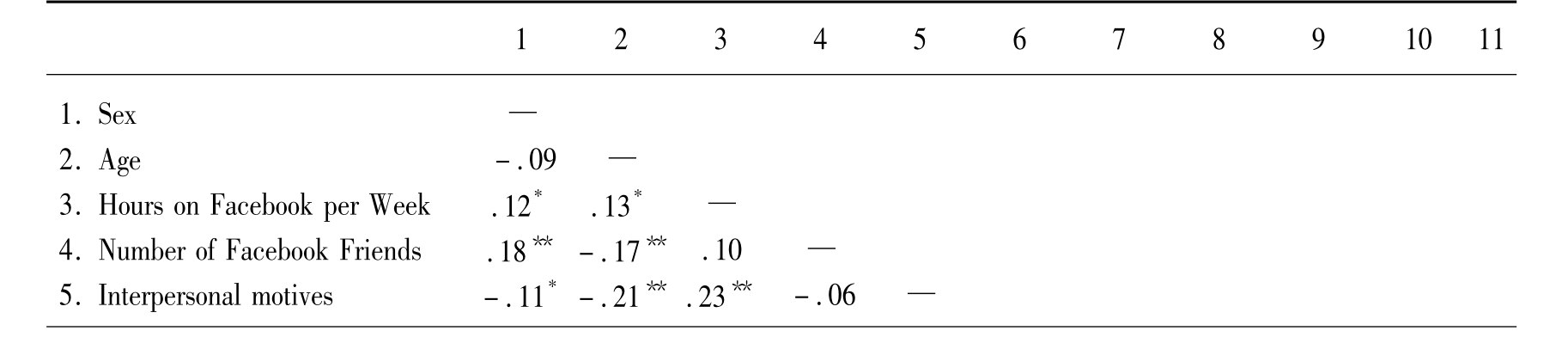
The proposed model displayed in Figure 1 was tested using structural equation modeling(SEM)(EQS 6.1,Bentler,2006).SEM enables researchers to test all components of a model simultaneously while at the same time modeling measurement error.Preliminary examination revealed that all assumption of linear regression and SEM(e.g.,linearity,multivariate normality,random residuals)were met.Further,examination of the bivariate correlation matrix did not reveal any problems related to multicollinearity(see Table 2).
Table 2 Correlations among all Variables
(续 表)
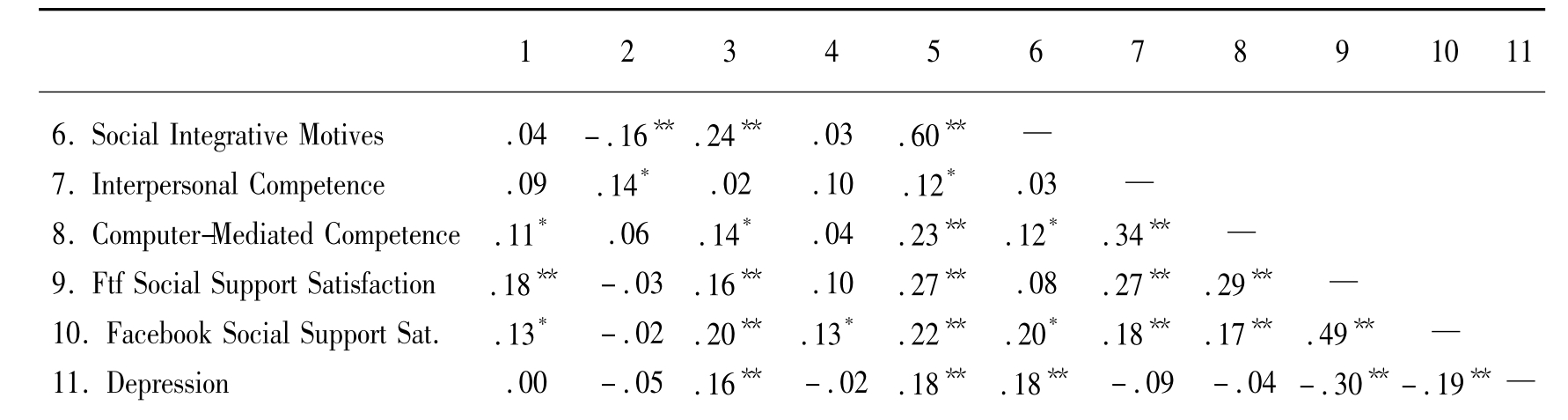
*p<.05.**p<.01
Two tables were created to help describe the data in this sample.Table1 presents the means,standard deviations,and Cronbach's alphas for all continuous variables.Table 2 displays bivariate correlations between all continuous variables in this study.To test the proposed model,the data were analyzed using a partial structural model.Face-to-face social support network size and Facebook social support network size were included as exogenous variables and initially left in the model free to affect all other variables.When social support network size,for both face-to-face and Facebook,were found to be not significantly associated with any of the study variables,they were subsequently removed from the model.
Competence was defined as a latent factor in the model.The competence factor consisted of communication competence and computer-mediated communication competence;the path for communication competence was fixed at 1.0,as it accounted for the most variance in the latent factor.Maximum likelihood(ML)estimation method was used,as the multivariate normality assumption was not violated.Based on the sample size recommendations by Bentler(2006),the present sample size(N=363)is sufficient to test the proposed model including covariates with a 10∶1 N∶q ratio(where q represents the number of free parameters estimates)—the recommended ratio is between 5∶1 and 10∶1(i.e.,5 to 10 cases for every parameter estimates).The N∶q ratio is considered a good assessment of power because it considers the complexity of the model to be estimated,rather than simply the number of observed/measured variables in the model(Jackson,2003).Finally,the model was properly overidentified,with 7 known parameters to 17 unknown parameters.
The hypothesized model fit the data quite well,2(11,N=363)=44.97,p=.00,CFI=.91,RMSEA=.09(CI=.07,.12).The path from social integrative motives to competence was not significant(shown in Figure 2 as dotted line).In addition,the modification indices indicated a direct path between interpersonal communication and depression,social integrative motives and depression,and yet another path from social integrative motives to Facebook social support satisfaction(shown in Figure 2 as dashed lines).In the revised model the path between social integrative motives and competence was eliminated.Direct paths from interpersonal communicationmotives to depression,from social integrative motives to depression,and from social integrative motives to Facebook social support satisfaction were added.The revised model fit the data better than the original model,2(9,N=363)=16.91,p=.05,CFI=.98,RMSEA=.05(CI=.00,.09).In this final model,the change in chi-square from the initial model is significant(Δ2= 28.06,p<.001),suggesting a significant improvement in fit.Additionally,the comparative fit index(CFI)is above.90 and the root mean square error of approximation(RMSEA)is.05(with the lower bound of the RMSEA confidence interval close to0 and the upper bound not above.10),which are all indicative of a good fit.The standardized estimates for the final trimmed model are shown in Figure 2.
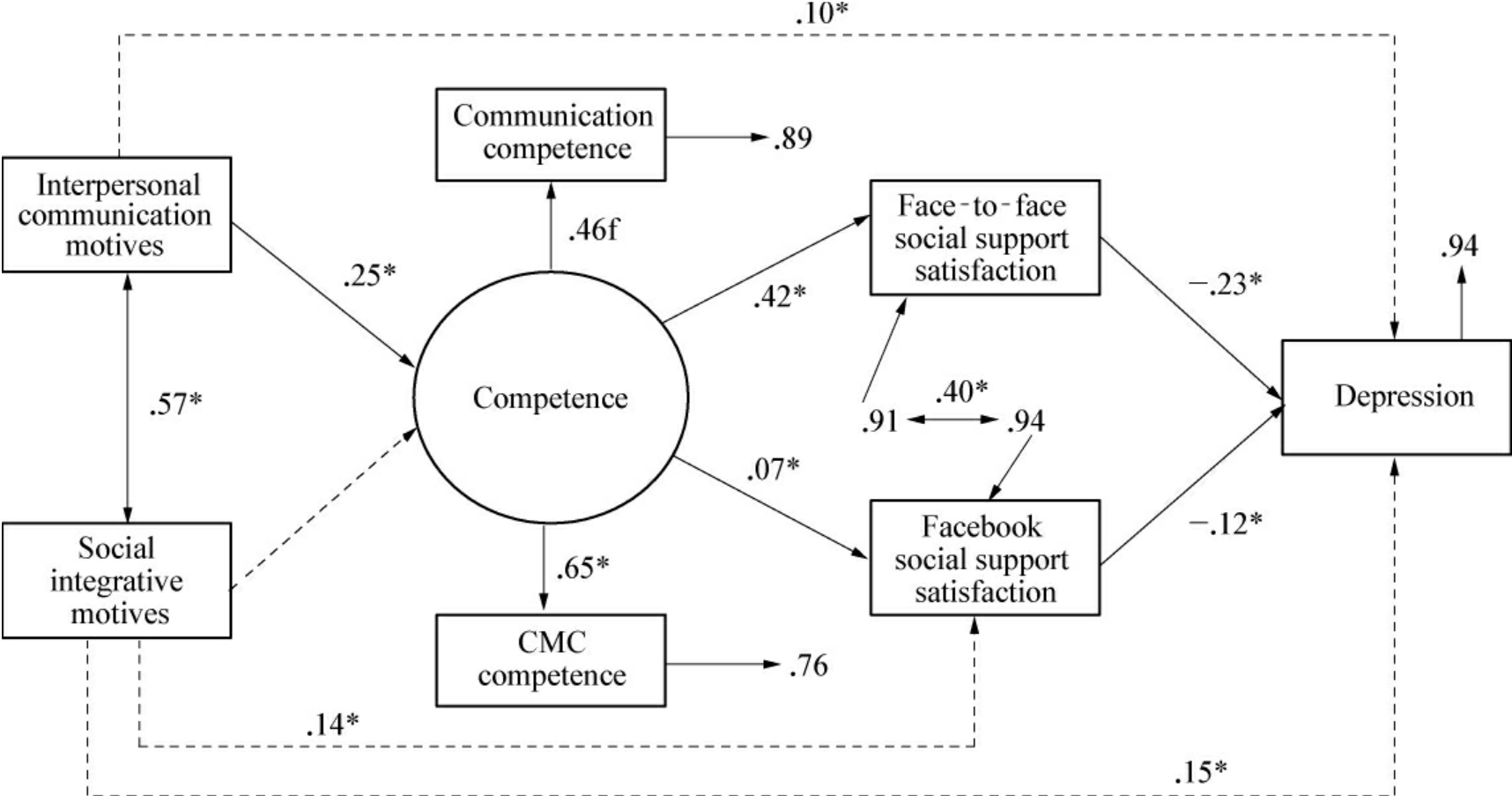
Figure 2.Final Model
Notes:In accordance with identification procedures,the pathway between Competence and Communication competence was fixed,as it accounted for the most variance in the latent factor.Error terms between Face-to-face social support satisfaction and Facebook social support satisfaction were allowed to correlate.Standardized parameters estimates are presented in the model; significance levels for these paths are based on the unstandardized estimates as EQS does not provide standard errors to conduct significance tests for standardized estimates.Parameters with a significance of p>.05 were deleted from the final model(and are represented by the dotted lines).
*p≤.05
All 6 hypotheses were supported in the model(See Figure 2).Specifically,interpersonal communication motives and social integrative motives were related to communication competence(interpersonal communication competence and computer-mediated communication competence).Furthermore,competence was positively related to face-to-face social support satisfaction and social support satisfaction on Facebook.Finally,face-to-face social support satisfaction and Facebook social support satisfaction were both negatively related to depression.
Discussion
The purpose of this study was to examine the influence of computer-mediated and face-to-face communication competence on Facebook and face-to-face social support network size and satisfaction,and the subsequent influence of these variables on depression among college students.In addition,interpersonal and social integrative motives for using Facebook were assessed as exogenous variables in the theoretical model.The results provided support for the theoretical model overall,with the exception of Facebook and face-to-face social support network size.This section presents a number of implications of the current study findings for Krep's(1988)RHCCM,as well as the application of this framework to the study of social support and depression within social networking sites such as Facebook in general.Moreover,it discusses some of the key limitations of the study and directions for future research in this area.
It appears that interpersonal motives for using Facebook,more so than social integrative motives,may influence computer-mediated communication competence along with one's face-to-face communication competence.Given the typical overlap between college students'Facebook social networks and their face-to-face social networks,it makes conceptual sense that the desire to achieve relational goals would influence CMC competence as well as face-to-face communication competence.For such populations,members of one's Facebook social network and face-to-face social network tend to consist of many of the same individuals.However,the desire to communicate with others using Facebook versus face-to-face interaction likely stems from other needs such as convenience and other factors that are unique to social networking sites(such as metacommunication,or commenting on another individual's wall posts or status).Future research should take these variables into account when attempting to predict whether individuals will choose computer-mediated versus face-to-face interaction as a means of achieving relational goals.
Consistent with Krep's(1988)RHCCM,the results indicate that increased communication competence(face-to-face and computer-mediated communication competence)predict higher social support network satisfaction and lower depression scores.Previous studies using the RHCCM(See Query & Wright,2003;Wright et al.,2010)did not take into account the simultaneous use of both computer-mediated and face-to-face social support networks.
However,the data suggest that although both face-to-face and Facebook support network satisfaction may to lead to reductions in self-reported depression scores,face-to-face support network satisfaction appears to have a larger effect on reducing depression than Facebook support network satisfaction.Yet,this finding may be tied to the specific population used in this study(college students),and perhaps computer-mediated support may be more beneficial for other populations in terms of reducing depression,such as individuals who are socially isolated or living with a stigmatized health condition,such as HIV/AIDS or a disability(see Wright & Bell,2003;Wright & Miller,2010),whereas other individuals may prefer face-to-face support(see Wright & Miller,2010;Wright,Rains,& Banas,2010).Certainly,identifying who may benefit from CMC versus face-to-face support is an important question for developing supportive interventions for individuals dealing with a variety of health issues,including depression among college students.
These findings have important implications for Krep's(1988)Relational Health Communication Competence Model(RHCCM).Demonstrating the specific paths through which perceived communication competence may affect social support,stress,and ultimately depression through shows both the contextual and empirical strength of this framework.Future studies should explore variables other than social support on Facebook that might also influence depression,such as negatively appraised supportive attempts or behaviors such as lack of message postings on Facebook that may increase an individual's sense of social isolation(which may increase depression).
Future studies of college student depression would benefit from an intervention designed to increase communication skills as well as to improve social support networks within a student's face-to-face and computer-mediated social network.In general,the findings suggest that communication competence may be an important set of skills among college students in terms of mobilizing social support and decreasing depression.Although the degree of communication competence an individual exhibits may be linked to a variety of factors,such as awareness/mindfulness of their own behaviors,Canary and Lakey(2006)contend that communication competence skills can be learned and honed through education and experience.Therefore,future interventions should consider attempts to increase communication competence skills through education and training in an attempt to reduce depression and other health outcomes,keeping in mind other variables(such as social support and job stress)that may have a mediating effect on these variables.
Limitations
There are several limitations to the current study.One limitation was the use of a convenience sample of college students.Future work in this area should attempt to study a more diverse sample of Facebook users to see if the findings can be replicated.A second limitation was the reliance on self-report instruments that ask individuals to reflect on dynamic variables,such as social support satisfaction,job stress,and depression.Perceptions of these(and other variables that were measured in the study)may change from day-to-day,and thus these measures should be triangulated with other research methods in future work(along with assessing the relationships among the variables longitudinally).Finally,a third limitation to the current study was the use of cross-sectional data which limits the ability to make causal inferences regarding the relationships among variables.Future research would benefit from randomized treatment/control group studies that examine the relationships among these variables in an effort to strengthen our ability to make causal claims.
【注释】
(1)Kevin Wright,Ph.D. & Professor Department of Communication St.Louis University.