1
新能源汽车专业英语
1.8.2 6.2 The Various Types of Chargers
6.2 The Various Types of Chargers

Text(课文)

1.The external charger supplying the battery directly

This is the traditional charge method used for all industrial traction battery applications.Each pack of industrial vehicle batteries is connected to this type of charge.

The traditional recharging of traction batteries is done by an external charger connected directly to the battery by cables using grips or low-voltage connectors.It is this method which was adopted for the first electric vehicles at the beginning of the 20th century,and remains today the method preferred for industrial trucks and other industrial vehicles.

2.The on-board charger

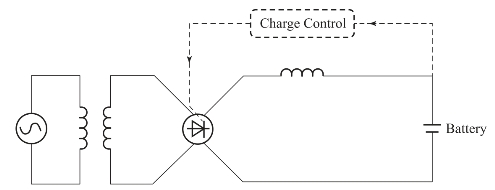
For urban electric cars we prefer on-board chargers(Figure 6.1),which allow recharging on all electrical outlets having a gauge and adequate protection.

The convenience of this solution for the customer largely compensates for the disadvantages related to the on-board additional weight and the increase in cost of each vehicle.

Moreover,the charger is perfectly suited to the battery.The use of external chargers for electric cars will be reserved for fast charging requiring heavy,voluminous equipments.

Figure 6.1 Diagram of an on-board charger using a 50 Hz transformer

The main constraints of this type of charger:

volume;

insulation between the network and the battery;

the shape of the absorbed current;

the use of a domestic plug(also dealt with in standardization);

the maximization of the power available on a domestic wall-plug.

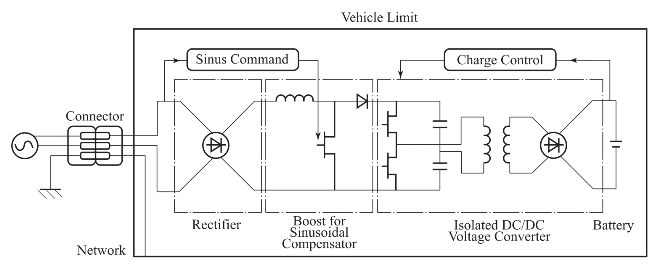
Today,chargers are of the switching-system type(PWM,Figure 6.2).

Make-up of a current electronic charger:

1)conditioning of the network current(rectifier);

2)power oscillator;

3)high-frequency transformer and rectification.

The evolution of chargers in the future will see an increase in power,and/or a reduction in volume and a reduction in costs.

If we accept a non-insulated charger,we can consider the use of the motor inverter and motor coil to carry out the charge function.

Figure 6.2 PWM charger

3.Fast charging

Fast charging allows 80% of a battery to be recharged in 20 minutes,which requires an external system and high power(20 kV·A and 400 A).

4.On-board fast charging

Physical limits to fast charging:

maximum current permitted by the battery;

limits to the charging(between 50% and 80%);

limits according to the type of battery;

maximum current permitted by connectors.

Type of circuit used for the charger:

50 Hz and high-frequency transformer,three-phase current,compensation of the powerfactor.The need for a particular dialog protocol between the vehicle and the charging station.

New words and expressions(单词和短语)

1.New words(单词)

2.Expressions(短语)

Notes to the text(难点解析)

★1.The convenience of this solution for the customer largely compensates for the disadvantages related to the on-board additional weight and the increase in cost of each vehicle.对于顾客来说,这种解决方案的便利性在很大程度上弥补了该方案增加了车辆重量和提高了购车成本的缺点。

★2.The need for a particular dialog protocol between the vehicle and the charging station.车辆和充电站之间需要特定的连接协议。

Exercises(练习)

◆1.Translate the following passages(expressions)into Chinese(英译汉)

(1)It is this method which was adopted for the first electric vehicles at the beginning of the 20th century.

(2)insulation between the network and the battery

(3)three-phase current

(4)power-factor

◆2.Translate the following passages(expressions)into English(汉译英)

(1)高频变压器

(2)快速充电

(3)民用插座

◆3.Directions:Answer the following questions briefly according to the text.

What is the on-board charger?

Reading material(阅读材料)

When the number of electric vehicles exceeded the number of thermal cars,recharging was done directly via external chargers installed in garages.

The recharging of traction batteries for the majority of industrial applications is performed by an external charger connected to the electric network.The connection between the charge equipment and batteries is carried out by two flexible wires with a two-pin specific connector.In addition to the two high-power contacts,the connector can comprise a link for protection wires ground link and for the realization of additional controls with auxiliary contacts.

It is the method which is most generally adopted for the recharging of utility vehicle fleets and small golf cars.This system shown in Figure 6.3,rustic but robust,was useful for the first experiments on electric vehicles whose technology was directly based on industrial vehicles.

Figure 6.3 Diagram of a traditional charger using a 50 Hz transformer

5.Induction charger

Text(课文)

Recharging by induction makes it possible to transfer energy to the vehicle without requiring physical contact between the vehicle and the charger.Energy is transmitted by a magnetic field through a transformer with separable primary coil and secondary coil.Although it is possible to carry out an energy exchange with transformers operating at the frequency of the electric network(50 Hz or 60 Hz)it is more common to use a high-frequency oscillating circuit to provide this function in order to reduce the volume of the transformer coils.Indeed,the power that can be transmitted through a transformer air gap is proportional to the induction(field intensity),the transfer and the frequencies.It is thus useful to increase the operating frequencies of the systems and to maximize the power of the field in order to reduce the volume of the coils.

The operating principle of chargers with high-frequency induction is similar to that already indicated for on-board electronic chargers and the electric diagram can appear more or less identical.

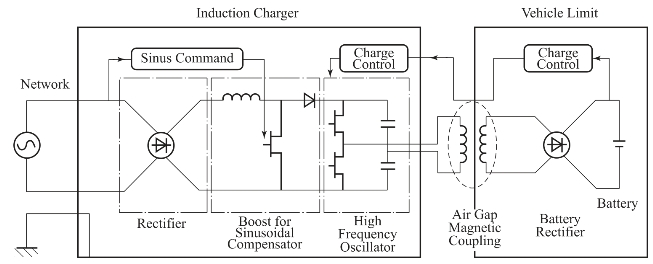
The diagram is divided into two as shown in Figure 6.4:

the network rectifier,the power-factor corrector and the high-frequency oscillator are housed in the equipment on the ground;

the connection between the vehicles and the charger is carried out by the transformer without Ohmic contact;

the high-frequency rectifier and the charge detection system are housed in the vehicle.

Figure 6.4 Diagram of an induction charge system

It is noted that this diagram requires an information exchange protocol,as is the case for the fast charger.

Note:the diagram of 50 Hz supply with the rectifier is given as an example.This functionality can be carried out in various ways(three-phase current supply,passive filtering,etc.).We can use other types of high-frequency oscillators.

Application of inductive recharging for automated connection as shown in Figure 6.5.

Figure 6.5 Induction charge system:Tulip prototypes from PSA Peugeot Citroen

New words and expressions(单词和短语)

1.New words(单词)

2.Expressions(短语)

Notes to the text(难点解析)

★1.Energy is transmitted by a magnetic field through a transformer with separable primary coil and secondary coil.能量是由可分离的一次线圈和二次线圈组成的变压器形成的磁场传输的。

★2.It is more common to use a high-frequency oscillating circuit to provide this function in order to reduce the volume of the transformer coils.但是使用的更普遍的是髙频振荡电路,以便能够减小变压器线圈的体积。

Exercises(练习)

◆1.Translate the following passages(expressions)into Chinese(英译汉)

(1)Recharging by induction makes it possible to transfer energy to the vehicle without requiring physical contact between the vehicle and the charger.

(2)on-board electronic chargers

(3)high-frequency induction

◆2.Translate the following passages(expressions)into English(汉译英)

(1)接触电阻

(2)高频整流器

(3)感应充电器

◆3.Directions:Answer the following questions briefly according to the text.

What is induction charger?

6.Wireless charging

Text(课文)

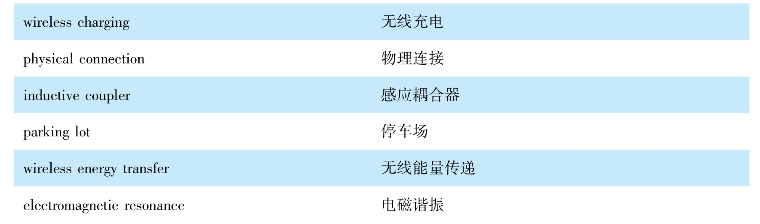
Wireless charging involves the use of power and energy transfer at a much longer distance.It is different from inductive charging which involves a transformer with closely placed primary and secondary windings.Although inductive charging can eliminate the direct electric contact,it still needs a plug,cable,and physical connection of the inductive coupler.Wear and tear of the plug and cable could cause danger as well.

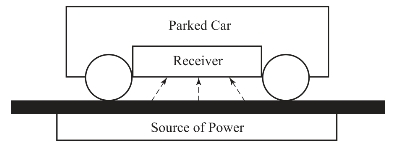
Wireless charging could eliminate the cable and plug altogether.In this scenario,a driver can pull the car over to a specially designed parking lot and the car battery is automatically charged without the pulling of any cable or plug as shown in Figure 6.6.It provides the safest approach for EV battery charging.

Figure 6.6 Wireless charging of a PHEV/EV on a parking floor

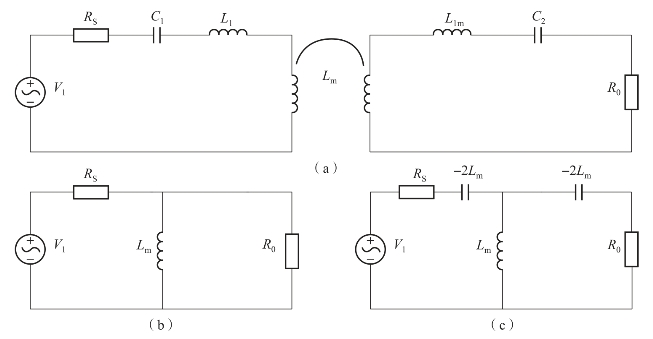
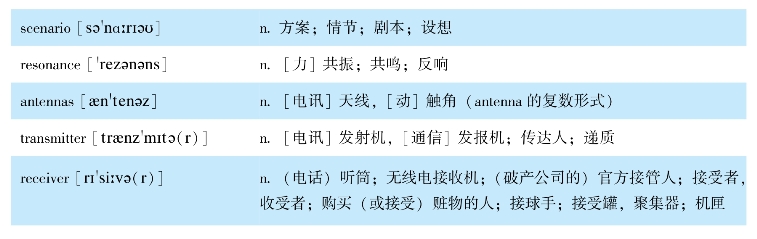
There have been a few different experiments carried out for wireless energy transfer.The most promising technology is using electromagnetic resonance as shown in Figure 6.7.In this setup,there is a pair of antennas with one inside the parking structure as the transmitter and one inside the car as the receiver.The two antennas are designed to resonate at the controlled frequency.The limitations are the level of power transfer,and efficiency due to the large air gap between the two antennas.

Figure 6.7 Circuits for electromagnetic resonance-based wireless charging:

(a)circuit;(b)equivalent circuit at resonance frequency condition1;(c)equivalent circuit at resonance frequency at condition 2

New words and expressions(单词和短语)

1.New words(单词)

2.Expressions(短语)

Notes to the text(难点解析)

★1.The car battery is automatically charged without the pulling of any cable or plug.汽车的电池自动充电,无须任何插头和电线。

★2.In this setup,there is a pair of antennas with one inside the parking structure as the transmitter and one inside the car as the receiver.在这种设置中,有一对天线,其中一个天线放在停车场作为发射装置,另一个天线放在车内作为接收装置。

Exercises(练习)

◆1.Translate the following passages(expressions)into Chinese(英译汉)

(1)Wireless charging could eliminate the cable and plug altogether.

(2)physical connection

(3)secondary winding

◆2.Translate the following passages(expressions)into English(汉译英)

(1)无线充电

(2)停车场

(3)两个天线被设计成在可控频率内谐振。

◆3.Directions:Answer the following questions briefly according to the text What is the wireless charging?