7.2.3 Concept-mediation vs word-association
(1)Introduction
Research on bilingual memory suggests that words in each language are stored in separate lexical systems,but that concepts are stored in a representation common to both languages.When individuals are in early phases of acquiring a second language,lexical connections appear to mediate cross-language performance.However,as second language learners acquire expertise,they begin to conceptually mediate their understanding of second language words.In this part we focus on the implications of this change for second language representation.We present(1)evidence that suggests that lexical connections between the two languages remain active after concept mediation is achieved,and(2)a model of bilingual representation in which cross language connections between lexical and conceptual memory are asymmetric.
(2)Background
Central question in past research on cognitive processes in the bilingual is whether the bilingual represents his or her two or more languages in separate or common memory systems.If one assumes that the hierarchical model accurately reflects the different levels of knowledge one has associated with the languages one knows,one can then ask how lexical memory for second language words becomes interconnected in this representational system as a second language is acquired.Two of the alternatives that have been considered in past research are presented schemantically in Figure 7.12.The word association model proposes that second language words are associated to first language words and that only through first language mediation do second language words gain access to concepts.In contrast,the concept mediation model proposes that second language words directly access concepts.
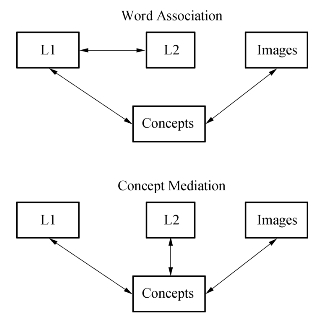
Figure 7.12 The Word Association and Concept Mediation models of lexical and conceptual memory in the bilingual.Source:Potter,et al.(1984)
An initial test of these models was described by Potter et al.(1984).The logic of their study was to compare translation and picture naming,under the assumption that picture naming requires conceptual access.The two models make contrasting predictions about translation and picture naming into the second language.The word association model predicts that translation from the first language into the second should be substantially faster than naming a picture in the second language,because picture naming requires conceptual access whereas translation does not.In contrast,the concept mediation model predicts that translation and picture naming in the second language should be similar,because both require similar conceptual processing.Potter and her colleagues found that translating into the second language took about the same amount of time as naming pictures in the second language,and concluded that the pattern of results supported the concept mediation model.A surprising aspect of the results was that the same concept mediation pattern appeared to hold for all subjects,regardless of how fluent they were in the second language.Kroll and Curley(1988)questioned the finding that all second language speakers are concept mediators regardless of their expertise.Indeed,people in early phases of second language learning often report that they are consciously aware of the first language.A reasonable alternative to the Potter et al.conclusion is that early in second language learning,individuals mediate understanding of second language words through the first language.That is,they follow the word association model.At later stages of second language learning,individuals may be able to directly understand the meaning of second language words without first language mediation.Kroll and Curley(1988)argued that past experiments may not have observed this change because the novice bilinguals tested in those studies,although far from being expert,were in fact beyond an early critical period of second language acquisition.When they compared translation and picture naming in a group of students learning German,with the group including students who had studied for less than two years,they found support for a shift from word association to concept mediation with increasing expertise.Their data are presented in a new way in Figure 7.13.The panel on the left is simply the time to name words and pictures in English,the native and dominant language of the subjects.These data replicate the standard word advantage in naming,and the two groups of subjects who differed only in their fluency in German,did not differ in English.The panel on the right shows the time to translate words and name pictures in the second language.The dark bars are the more fluent subjects and the white bars are the less fluent subjects.The less fluent subjects were slower in the second language than the more fluent subjects,but the important result concerns the relative speed of translation and picture naming.For the less fluent subjects,translation times were faster than picture naming times,as the word association model predicts.For the more fluent subjects,translation and picture naming were not statistically different,as the concept mediation model predicts.These results thus supported the proposal that there is a shift during second language learning from a strategy of understanding second language words by accessing the first language,to a strategy in which concepts directly mediate second language comprehension.Chen and his colleagues have reported similar results in both crosslanguage Stroop tasks and in translation and picture naming task(Chen,1989).The goal of this research has been to determine whether the observed change in the processing of second language words reflects the hypothesized shift from reliance on first language words to reliance on concepts.
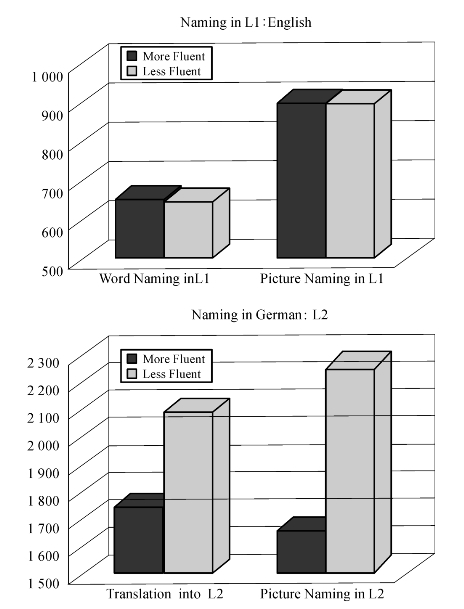
Figure 7.13 Dataaveraged from Kroll and Curley(1988).The time to name words and pictures in English and to translate words from English into German and to name picturesin German for subjects who were more and less fluent in German.
Despite the empirical support for the proposed shift from word association to concept mediation with increasing proficiency in the second language,there are two issues raised by the past research that require additional discussion.At a theoretical level,there is the question of the fate of the lexical connections once concept mediation is achieved.Do word associations between the two languages decay once an individual becomes more fluent?Or,do the initial lexical links between languages remain in place as an alternative route for processing the second language?At an empirical level,there is also a puzzling result that we have found repeatedly:the speed and accuracy of translation depends on the direction of translation.Performance is faster and more accurate to translate from the second language into the first(L2 to L1)than from the first language into the second(L1 to L2).
A comparison of translation latencies for each direction of translation from a set of past studies is shown in Figure 7.14.These data are for subjects who were relatively fluent in their second language.The same pattern of results was found for nonfluent subjects,although they took longer than fluent subjects to perform both types of translation.The subjects in the Kroll and Curley(1988)and Kroll and Stewart(1989)studies were native English-speaking college students who were relatively fluent in German.The subjects in the Kroll and Stewart study were highly fluent Dutch-English bilinguals.
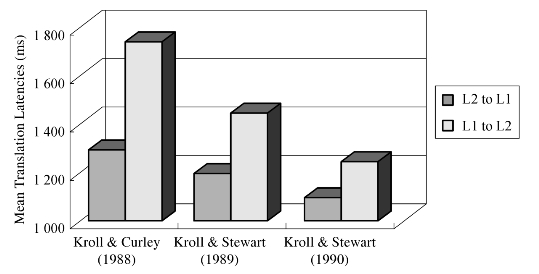
Figure 7.14 Acomparison of the speed of translation from L 2 to L 1 and L 1 to L 2 from three studies.Note:The Kroll and Curley(1988)data above were from that study but did not appear in that paper.
Neither the concept mediation model nor the word association model can,in principle,explain this translation asymmetry without making additional assumptions.The two models make different predictions about the relative speed of translation compared to picture naming,but make no explicit predictions about the two directions of translation.If the longer time to translate from L1 to L2 was attributable to longer production latencies in the second language,then the difference between the two types of translation might be expected to mirror the difference between simple naming in the first and second languages.However,in the studies for which translation data is shown in Figure 7.14,one consistently finds that the naming difference between L1 and L2 is smaller than the translation asymmetry.And because the initial recognition in naming the second language is also of a second language word,whereas initial recognition in translation is of the first language word,this comparison is likely to underestimate the translation effect relative to the naming difference.
Kroll and Stewart(1990)hypothesized that the difference in the two forms of translation reflected a difference in reliance on lexical vs conceptual mappings such that translation into L2 required concept mediation whereas translation into L1 could be accomplished by lexical mediation from L2 to L1.The observed asymmetry in translation latencies led us to propose that the strength of connections between lexical and conceptual representations differs for a bilingual's different languages primarily as a function of fluency in L2 and relative dominance of L1 to L2.Specifically,lexical links from L2 to L1 are hypothesized to be stronger than lexical links from L1 to L2,but conceptual links for L1 are stronger than those for L2.Kroll and Stewart(1990)proposed a revision of the representational model of bilingual memory based on the asymmetry described.The revised model is shown in Figure 7.15.
In this part,bilingual performance in translation and semantic priming tasks to evaluate support for the proposed model will be examined.A critical prediction of the revised model is that translation from L1 into L2 is conceptually mediated and should therefore the more sensitive to conceptual context than translation from L2 into L1.
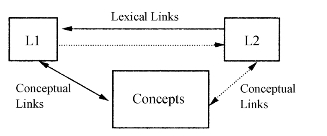
Figure 7.15 Arevised hierarchical model of bilingual memory representation.Source:Kroll&Stewart(1990)
(3)Evidence from translation
Kroll and Stewart(1991)compared translation and naming latencies for a group of highly fluent Dutch-English bilinguals.Subjects were asked to name or translate words in both languages in lists that were either semantically categorized or randomly mixed.The categorized lists contained words that were drawn from the same category(e.g.,fruits or animals).Following the naming and translation portion of the experiment,subjects were given an incidental recall task.The translation data from that study are shown in Figure 7.16,where mean translation latencies are plotted as a function of the direction of translation(from L1 to L2 or from L2 to L1)and the type of list(categorized or randomized).
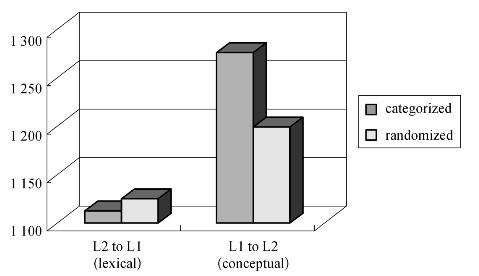
Figure 7.16 Mean translation latencies as a function of the direction of translation;and whether the list was semantically categorized or not.Data are from highly fluent Dutch-English bilinguals.
The time to translate was significantly longer from L1 to L2 than from L2 to L1.But,most critical for the evaluation of the revised model,the semantic organization of the list had a significant effect only when subjects translated from Ll into L2.These results support the hypothesis that the translation route from L1 to L2 requires conceptual processing.The finding that categorized lists produced interference rather than facilitation in translation is similar to previous reports of category interference in Stroop-like translation tasks(La Heij,1990)and in picture naming(Kroll,1989,June).Multiple access to conceptual memory may inhibit selection of a single lexical entry.Furthermore,the fact that the category structure of the list had no effect on translation from L2 to L1 supports the hypothesis that the route from L2 to L1 is mediated by lexical connections.The results are also consistent with the findings of studies that have examined tasks such as word naming that are hypothesized to be primarily lexical;word naming is not particularly sensitive to the effects of semantic priming or to the effects of category structure in lists(Kroll&Smith,1989).The naming data in the Kroll and Stewart(1991)study replicated the previous results in that there were no effects of the type of list on the time to name words in either Dutch(L1)or in English(L2).
Additional evidence to support the claim that translation from L1 to L2 is conceptually mediated,but that translation from L2 to L1 is not,was provided by the findings for incidental recall that followed the translation tasks in the Kroll and Stewart(1991)study.These data are shown in Figure 7.17 where the mean percent recalled are plotted as a function of the direction of translation and the type of list.The main result was that significantly more words were recalled from the categorized list condition than from the randomized list,but only when the direction of translation was from L1 to L2.Although it might be argued that subjects were more aware of the category structure in the L1 to L2 translation condition because the words appeared in L1 recall for the same L1 words in categorized lists when the task was simple naming was poor,and no better for categorized than randomized lists.The Kroll and Stewart(1991)results thus suggest that the translation route from L1 to L2 specifically engages conceptual information that influences the speed and accuracy of translation performance and also has consequences for later tests of explicit memory.
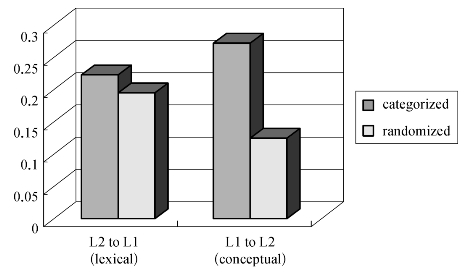
Figure 7.17 Mean percent incidental recall as a function of the direction of translation and whether the list was semantically categorized or not.Data are from highly fluent Dutch-English bilinguals.
The revised model shown in Figure 7.15 can account for two important aspects of the translation data we have described.First,the two directions of translation differ because translation from L2 to L1 is more likely to be accomplished lexically than translation from L1 to L2,which is more likely to engage conceptual processing.Just as picture naming is longer than word naming(Potter&Faulconer,1975),the more conceptual route to translation will be longer than the lexical route.If this explanation is correct,then the more conceptual translation(from L1 to L2)will also be more likely to be influenced by the presence of conceptual factors,such as the category structure of the list to be translated,and that has generally been the case in all of the experiments in which the two forms of translation have been compared.