7.0.4 Models of semantic representation
(1)Hierarchical network model
The first cognitive model of semantic representation,by Collins and Quillian,appeared in 1969.An illustration of their approach to semantic representation appears in Figure 7.6.Individual concepts such as animal and fish are represented as“nodes,”with the properties specific to each concept stored at the same level and connections between associated concepts.This hierarchical network model proposed that concepts are organized in one's minds as“pyramids”of concepts,with broader,superordinate concepts(such as animal)at the top of the pyramid,and more specific,subordinate concepts(for example,chihuahua)at the bottom(Collins&Quillian,1969,1970,1972).In the middle are basic level categories(such as bird,dog,elephant,and fish).
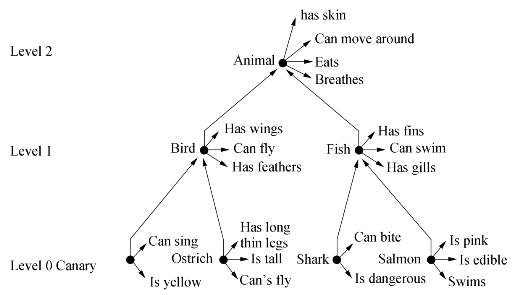
Figure 7.6 Example of a hierarchically organized memory structure.Source:Collins&Quilian(1969)
One important aspect of the model in Figure 7.6 is its emphasis on cognitive economy.Obviously,any member of a superordinate category such as animal will have all the features attributed to animal,plus its own features.However,in Collins and Quillian's semantic network,the features would only be stored at the higher-level concept in order to save space.For example,both birds and fish,by virtue of being animals,have all the features attributed to animals—having skin,being able to move,eat,and breathe.However,one does not see these features duplicated at the birds and fish nodes,because this would violate the concept of cognitive economy.In a now classic experiment,Collins and Quillian(1969)presented subjects with one of two types of semantic verification tasks.In the first,subjects were asked to judge category membership with statements such as,“A canary is bird,”or,“A canary is an animal.”In the second,subjects were asked to judge feature attributes of given concepts in property verification statements such as,“An Ostrich has skin,”or“An ostrich has feathers.”To which of the two sentences in these experiments do you think subjects would respond more quickly(have a lower reaction time)?Why?What would the hierarchical network model predict?Collins and Quillian were interested in judging“semantic distance effects.”That is,looking at Figure 7.6 again,canary is further away from animals than it is from birds.Thus,according to the model,A canary is an animal should take longer to verify than a canary is a bird because in the former,two nodes must be traversed instead of just one.Property verification statements require us to go to the appropriate node before one can retrieve the features at that level.As with category statements,the number of nodes that must be traversed to determine feature attributes will determine reaction times.To verify an ostrich has skin,one must traverse two nodes up(birds,animals),and then note that has skin is an attribute of animals.To verify an ostrich has feathers,one only needs go up one node to birds and note the features there.It should thus take longer to verify that an ostrich has skin than that it has feathers.It should also take longer to verify features than to verify category membership because not only must one move from node to node,but one must also retrieve features stored at that node.All these assumptions were found to be the case across numerous experiments(Collins&Quillian,1969,1970):the further the semantic distance between two concepts,the longer the reaction times in the semantic verification tasks.Additionally,property verification statements require longer time than category membership statements.
A second finding of interest in these experiments was the category size effect.That is,the larger the category,the longer time required for search.For example,because the concept animal embodies all instances of birds,as well as all instances of fish,dogs,horses,and so forth,it is of necessity a larger category than any of its member categories.Presumably,larger categories force one to muddle through more information before retrieving the relevant facts.
Several logical and empirical criticisms of the hierarchical network model of conceptual organization were responsible for modifying experimenters'views and for the creation of subsequent semantic network models that could better explain the data.One problem with the hierarchical network model is that it is too hierarchical and may only work for taxonomic categories such as animals,dwellings,furniture,and so forth,but not for more abstract concepts such as virtue,good,and emotion.
An important study by Conrad(1972)revealed other empirical and theoretical criticisms of the hierarchical network view.Conrad found that semantic distance effects were confounded by frequency effects of features.For example,subjects list the feature,“moves,”as a feature of animals more frequently than“has ears,”even though both are assumed to be stored at the animals node.Likewise,Conrad argued that the semantic distance effects found by Collins and Quillian(1969)need not be explained by semantic distance at all but by the strength of association between two concepts or between a concept and a feature.For example,“sings”may be verified as a property of canary more rapidly than“has skin”because singing is more frequently associated with canary.
A third criticism of the hierarchical network theory is that it cannot account for reverse category size effects that turned up later.In some cases,subjects take longer to verify that an item is an instance of a superordinate category than it does to verify that it is an instance of a lower-level category.For example,subjects took less time to respond to,“A chimpanzee is a primate,”than it did to,“A chimpanzee is an animal,”even though ammo/would be stored at a higher category level than primate(Smith et al.,1974).
(2)Feature comparison model
Smith et al.(1974)also took a feature-oriented view of meaning.Instead of nodes,however,they postulated that concepts are represented as lists of features of two types,both(1)defining features,which are critical for inclusion in a category,and(2)characteristic features,which members of a category usually but do not necessarily have.For example,it is a defining feature of a professor to have an academic appointment,and characteristic but not necessary that the professor wear tweed.Likewise,it is necessary for birds to have skin and bones but not that they fly(think of chickens and penguins).In contrast to the hierarchical network theory,all features are assumed to be stored under all relevant concepts.Although this violates the assumption of cognitive economy,it renders the feature comparison model better able to account for some of the empirical findings.
According to Smith et al.(1974),semantic verification tasks are performed by comparing the number of overlapping features of two or more concepts.Feature comparison in semantic decision tasks is assumed to be a two-stage process.In the first stage,all the features-defining and characteristic of two concepts are compared in a global comparison.A sufficient level of similarity produces a“yes”response.If the degree of similarity is too close to call,a second comparison step is instituted in which only the defining features of the two concepts are compared.Thus,this second stage would be slower and more evaluative than the first more global comparison.For example,refer to Figure 7.7 to see how a robin would be verified as a category member of bird,relative to how it would be verified in the hierarchical network model.
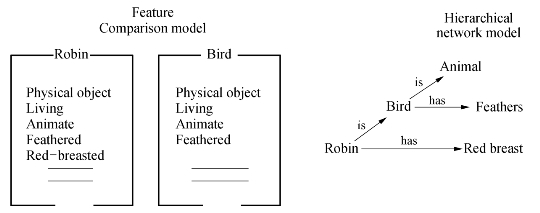
Figure 7.7 Distinction between the feature comparison model and the hierarchical network model.Source:Smith(1978)
Because comparisons are based on similarity rather than category size,the feature comparison model can account for both category size effects and reverse category effects because its predictions are based on number of overlapping features between two concepts rather than distance.The model also predicts semantic distance effects;collie should be classified as a dog more quickly than an animal because more features overlap with the concept dog.The effects of typicality can also be explained;more typical members of a category would be verified more quickly because the number of overlapping features would be larger than for less typical members.For example,the concept of robin should share more features with bird than does flamingo.
Feature comparison theory is not without its share of problems.Most critical is an issue with which you are already familiar—whether or not there really are defining features of concepts.It is not always clear that humans rely on defining features(for example,“lays eggs”for birds)to make category judgments,and sometimes the distinction between defining and characteristic features is unclear.Second,why couldn't we store category membership directly,as one of the features under a concept?That is,why couldn't one store“is a fish”as a feature under the concept salmon?That way,to decide that a salmon is a fish,one need only scan the list of salmon features rather than compare the feature lists from both concepts.
Another criticism of this model is that feature lists cannot account for all that people know about concepts;they also know that some features correlate more highly than others.Features are linked units,not independent units.For example,the features of“small”and“sings”are highly correlated for birds.Likewise,despite the fact that small spoons are considered more typical than large spoons,small wooden spoons are considered less typical than large wooden spoons(Rumelhart&Ortony.1977).A theory such as the feature comparison view,which posits lists of independent features,cannot account for Rumelhart and Ortony's findings(Medin,1989).
(3)Spreading activation network model
In order to better account for the empirical findings that challenged his first semantic model,Collins,of Collins and Quillian(1969,1970),developed a spreading activation model of semantic representation(Coilins&Loftus,1975).As in the earlier hierarchical network,concepts are represented as nodes and associated concepts are connected(see Figure 7.8).However,now properties such as large,red,or transports people are also nodes within this model,and in this way are treated as concepts in their own right.Relations between concepts(including concepts and feature concepts)are represented via connecting nodes,not the number of overlapping features as in the feature comparison view.The length of each line between nodes represents the degree of association between the two concepts—shorter lines mean stronger associations.Again,this distance is only metaphorical,and does not necessarily represent how far apart concepts are stored in the brain.
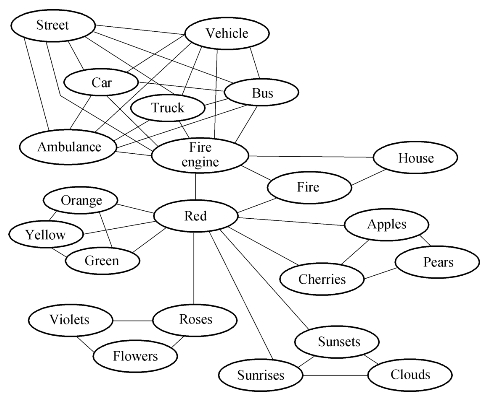
Figure 7.8 Spreading Activation Network Model.Source:Collins&Loftus(1975)
Like the hierarchical model,thespreading activation model is still an associated network.However,the structure is not that of a strict hierarchy,but a more complex web of concepts and relations between concepts.Note its resemblance to connectionist models of cognition such as the connectionist model of lexical access discussed earlier in the chapter.For example,the concept flowers is linked not only to violets and roses,but indirectly to fire truck via the red concept node.With regard to concepts,no distinction is made between defining and characteristic features;some connections simply appear stronger than others.The degree of association between nodes is represented by distance,with highly associated concepts,such as canary and sings,closer than more weakly associated concepts,such as canary and skin.
An important aspect of this model is the principle of spreading activation,from which it gets its name.Think of the model as a large electrical network.When a single concept is activated,the“electricity”spreads to connected concepts,decreasing in strength as it emanates outward.Like the electricity in a circuit,all nodes connected to the concept salmon,such as fish,animal,stream,pink,edible,and gills,would be activated to a certain degree as well.Thus,the sentence,“A salmon has gills,”should be quicker to verify than“A salmon has feathers.”Why?Because once salmon is activated,gills will also receive some activation,whereas feathers will not.Likewise,“A salmon has gills,”should be more quickly verified than“A salmon has skin,”because gills are more highly associated with salmon and thus“closer”together in the network.Likewise,cherry would be confirmed more quickly than fig as fruit because cherry is closer to the subordinate category(fruit),because of its higher frequency and stronger association.
The strength of association between concepts(including property concepts),represented via degree of distance in the model,can explain category effects,reverse category effects,and typicality effects in categorization and semantic verification tasks.Notice that the spreading activation network can also be used to explain priming effects.In lexical decision tasks,it should take a shorter time period to recognize the word nurse if it follows the term doctor,than if it follows bread,because the concept node for nurse would have already been somewhat activated from doctor.Similar to the logogen and connectionist models of lexical access,semantic priming in the spreading activation model is accomplished by lowering thresholds.You can see that a major advantage of such a model is its explanatory power in accounting for a wide variety of experimental findings.The spreading activation model is flexible enough to account for multiple access routes to concepts and their features and to explain many of the empirical findings related to lexical and conceptual research.