1
语法—翻译教学法面面观
1.6.2.1.1 7.0.1 Lexical access in speech production
7.0.1 Lexical access in speech production

What is the rate of lexical access in normal conversation?Some 120-150 words per minute on the average,but there are spurts of up to double this rate(Deese,1984).

How many words do we have to select from?We don't know.There are reliable ways of estimating the size of our word recognition lexicon(Oldfield,1963,estimated the vocabulary size of Oxford undergraduates at about 75 000 words),but no such tests exist for measuring the active production lexicon.Levelt(1989)estimated the production lexicon of normal educated adults at about 30 000 words.Still,there is no doubt that we can access a huge lexical database at high rates,over long stretches of time,and without signs of fatigue worth mentioning.This alone characterizes lexical access as a cognitive skill par excellence.The skill is further marked by an astonishingly low error rate.Garnham,Shillcock,Brown,Mill,and Cutler(1982)found 86 errors of lexical selection in a spoken text corpus of 200 000 words,and 105 other slips of the tongue.That is an error rate of about one per thousand.Butterworth(this issue)gives similar data.It is important to stress this low error rate,because much of what we know about lexical access is based on careful analyses of naturally occurring speech errors.Reading this literature may create the misleading impression that felicitous lexical access is a matter of good luck rather than of exquisite design.

Are we aware of how we do it?As for most other high-speed skilled behavior,the answer is“no”.We can muse about the meanings of lexical items.We can even reject a word that jumps to mind and go for a more appropriate one.But we cannot trace the process by which we retrieve a word to start with.Introspection is largely useless in the study of lexical access.

This being so,another important issue became how to study the process.Since the 1960s and 1970s,the dominant answer has been to study failures of access,slips of the tongue,speech errors(Cohen,1965);for a bibliography of the early work.And indeed,this work has provided us with the main outlines of the processing architecture subserving speech in general,and lexical access in particular.Another approach has been the analysis of pre-lexical hesitations in spontaneous speech.

It took longer until issues of lexical access were put to experimental test at any scale,or at least so it seems.The initial steps were to elicit speech errors in the laboratory,with Baars Motley,and MacKay as the pioneers,or to elicit‘tip-of-the-tongue’effects(Brown,1966).But in addition,reaction time paradigms intruded the study of lexical access,with Oldfield and Wingfield(1965)as pioneers and discoverersof the word frequency effect.In fact,the reaction time study of lexical access was much older,going under headings such as picture naming,color naming,or even more disguised under the name of“Stroop effect”(La Heij,1988).

At present,research in lexical access has a pluralistic methodology,ranging from the analysis of naturally observed slips of the tongue,via error elicitation to picture naming and pictureword interference studies.In addition,the pathology of lexical access in aphasic patients is increasingly contributing to our understanding of the underlying mechanisms.

This brings us to the main issue that emerged.What kind of processing mechanism governs the skill of accessing words?If we cannot introspect the mechanism,we are at the mercy of our theoretical inventiveness.The first serious proposal was Morton's logogen theory(Morton,1969),which is still a significant competitor on the theoretical battleground.The mental lexicon was conceived of as a pandemonium,a collection of so-called logogens,each sensitive to its own specific information.For speech production(exclusive of reading)a logogen's relevant information stems from the“cognitive system”,which is semantically active.The logogen becomes activated by semantic information relevant to“its”word.When the activation exceeds some threshold value,the logogen fires,and sends the phonological code of its word to a so-called“response buffer”,from which an overt articulatory response can be initiated.

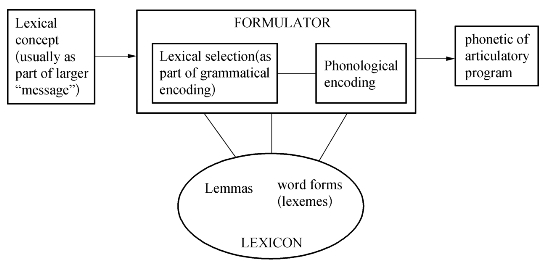
The logogen theory has(at least)two attractive features.One is that all logogens are simultaneously active in“watching”the cognitive system.There is parallel processing,which makes the speed of access largely independent of the size of the lexicon.The other is that lexical access is a two-step process.The first step,the logogen's activation to threshold,is semantic in nature.The second step,the logogen's firing and the preparation of response execution,is phonological in nature.This two-step approach to lexical access is,in one guise or another,common to all modern views of lexical access(Butterworth,1989).There are two component processes to lexical access.Firstly,the lexical selection retrieving the one appropriate word from among thousands of alternatives.Secondly,the phonological encoding computing the phonetic shape from the selected item's phonological code or form specification as it is stored in the mental lexicon(Kempen&Huijbers,1983),called this stored phonological code the lexeme as lexical selection shown in figure 7.1.

Figure 7.1 An outline of lexical access in speech production.Source:Willem(1991)

A speaker's mustering of words usually serves the performance of some speech act.And a speech act is a way of revealing some communicative(and hence interactive)intention by means of spoken language.It is important not to ignore this larger perspective when discussing matters of lexical selection.

Recent years have seen substantial convergence on the following general picture of the initiation of a speech act.In order to reveal some communicative intention(e.g.to commit oneself or the interlocutor to some action,to share certain experiences with the interlocutor),the speaker will encode a so-called“message”whose expression can be effective in revealing that intention.So,for instance,if the speaker intends the addressee to recognize that his intention is to let her know that her younger sister has arrived,an effective message might be the declaration that her sister has arrived.But it need not be,dependent on the context.It may,for example,be more effective to declare that an angel or a witch(as the matter may be)has arrived.Or the context may make it even more effective for the speaker to express the question whether he might just have seen a woman entering the door.

The choice of message is a subtle function of the relation between the interlocutors,their common ground,the existence of secondary intentions,such as to understate or to express irony,and other factors have an immediate impact on lexical selection(sister,angel,witch,woman in the above example,all intended to make reference to the same person).

It is widely held that a message is a conceptual structure,cast in a prepositional language of thought.It forms the input to the so-called formulator whose task is to map the message onto linguistic form.Its final output is a phonetic plan that can be executed by the articulatory motor system.The formulator involves two component processes:grammatical and phonological encoding(see Figure 7.1).

Grammatical encoding takes a message as input,retrieves lexical items from the mental lexicon,and delivers a surface structure as output.A surface structure is a hierarchical organization of syntactic phrases.Its terminal elements are lemmas.These are lexical items unspecified for phonological form.They are however,semantically and syntactically specified.Their semantic specification is a set of conceptual conditions whose fulfillment in the message is a necessary requirement for their retrieval.Their syntactic specification involves category and subcategorization information,as well as the way in which grammatical subcategory functions of the lemma are mapped onto the conceptual arguments in its semantic description.

Lexical selection drives grammatical encoding.Lemmas are retrieved(activated,selected)when their semantic conditions are met in the message.In their turn,they call(activate,trigger)syntactic procedures corresponding to their syntactic specifications.A verb will instigate the construction of a verb phrase,prep the construction of a prep phrase,etc.Grammatical encoding is somewhat like solving a set of simultaneous equations,simultaneously realizing the appropriate thematic role assignments for all lemmas retrieved.Because lemmas can become available at different moments in time,dependent on the speaker's unfolding of the message.Different orders of lemma selection can lead to vastly different syntactic constructions.

But there is a special set of lemmas whose retrieval is not conceptually driven.They all belong to the closed class vocabulary.In the woman that arrived the relative pronoun that is itself called by the syntactic procedure that constructs relative clauses.The retrieval of that is not semantically driven,such as the retrieval of woman.Here,in other words,grammatical encoding drives lexical selection.Notice,however,that many other closed class items do have some semantic specification,such as sex or definiteness;these specifications must be met at the message level for the item to be selected(except when they are syntactically derived by agreement).