6.1.1 Contrastive analysis hypothesis
In 1967 Politzer was enthusiastic in stating:‘Perhaps the least questioned and least questionable application of linguistics is the contribution of contrastive analysis.’(For a recent review of the subject,see James,1980.)It was believed that by comparing two linguistic systems,that of the mother tongue and that of the target language,it was possible to predict areas of difficulty,and thus errors.This theory is related to the notion of‘interference’mentioned above.It was found that,contrary to expectations,not all the areas of difference between two language systems actually resulted in errors.“Areas where no difficulty had been predicted did produce errors.”The main problem with contrastive analysis seems to be that while parts of two language systems may or may not differ,this does not tell us much about how a learner will go about the learning task.Nor does it account for the well-attested fact that the same errors are made by first language speakers from very differing language backgrounds.For example,the learners who made these errors had different backgrounds,one spoke an Asian language as his mother tongue,the other a European language:
People often hear such sentences like:“When I reached home,I kiss him”.“When the evening came,we go to the moves.”Teachers who have experience in different countries,or of teaching students with different first languages in the same class,will have noticed that similar errors tend to recur,virtually independently of the students’multilingual class:
(a)Does he know to find the way?
(b)Does she know to play hockey?
The other problem,perhaps even greater than the failure of contrastive analysis to predict errors,is the sheer magnitude of the task of writing any contrastive analysis of two languages.In theory you would need as near a complete structural description of both languages as possible.Then,it is necessary actually to contrast the structures.This is no easy task,since it is extremely difficult to devise a consistent system or basis for contrast.For example,look at this English sentence with the Chinese translation underneath.The literal translation of the Chinese is given in italics.
(c)Where is the railway station?
Huo che zhan zai na li?
fire cart stop at which side
From this sentence one will notice that there are a number of structural differences between the two languages.The main one is that there is no verb equivalent in the Chinese sentence for‘is’.Then the two‘words’for‘where’appear at the end of the sentence,not the beginning.And so on and so on...It can be seen from this very limited example that to make any kind of contrastive study of two languages is an enormous task,and one,moreover,which has very seldom been carried out.
However,for the classroom teacher,contrastive analysis is not entirely useless.Many teachers of English will have a good enough knowledge of the two languages(the students'mother tongue and the target language)to become familiar with certain characteristic errors that the students make,and,if there are any,parallel forms of the mother tongue.A suitable treatment for errors arising from translation from the learners L1 might,at an intermediate or advanced level,involve pointing out that while in the mother tongue it is possible to say something in this way,nevertheless in the target language it is not.The danger of this approach is that it can lead to an analytical teaching style,which as its prime aim seeks to eliminate certain errors rather than to teach communication through the target language.
Contrastive analysis can,especially in the field of pronunciation,indicate with fair probability certain areas of difficulty.For example,in Thai,some words begin with the ng sound,as in English sing.In English this sound does not occur at the beginnings of words.Therefore this might prove a problem for English speakers learning Thai.Note that this is only a possibility;some learners might not find this particularly difficult.
Contrastive analysis can be regarded then by teachers as one of a number of devices in their study of learners'errors.It has its problems,the main one being that anyone using the technique needs to know both the mother tongue and the target language and would also need a good grounding in grammar.
Lado was responsible for a more controversial position,however,when he claimed that‘those elements that are similar to his native language will be simple for him,and those elements that are different will be difficult’(Lado,1957:2).Similarly,Weinreich(1953:1)asserted:‘The greater the difference between two-systems,i.e.the more numerous the mutually exclusive forms and patterns in each,the greater is the learning problem and the potential area of interference.’The conviction that linguistic differences could be used to predict learning difficulty gave rise to the contrastive analysis hypothesis(CAH);Where two languages were similar,positive transfer would occur;where they were different,negative transfer,or interference,would result.
One should be quick to point out that many CAs were not merely lists of binary predictions of the form:similarity/difference=ease/difficulty;indeed,those in the University of Chicago series are considerably more sophisticated.Table 6.1 presents a simplified version of Stockwell,Bowen and Martin's(1965a)hierarchy of difficulty.Their examples are of an English speaker learning Spanish.
Table 6.1 Hierarchy of Difficulty
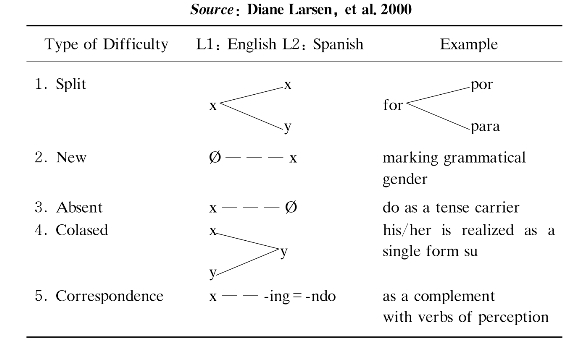
Stockwell,Bowen and Martin's hierarchy is more complicated than this because,among other things,they distinguish between structural and functional/semantic correspondence.Nevertheless,from the table here one can see that they would expect the easiest linguistic point.for a language learner to master to be one where the L1 and the L2 correspond structurally and functionally/semantically.Progressively more difficult are those which are coalesced,where several forms in the L1 collapse in the L2;a form which is present in the L1 but absent in the L2;and a form which Bateau(1970),for instance,found that for English speakers learning French,the French sentences that correspond literally to their English equivalents are not necessarily the easiest to learn(p.138).Psychologist Osgood(1953)had earlier commented on such a phenomenon:when two sets of materials to be learned are quite different or are easily discriminated by the learner,there is relatively little interaction,that is,learning one has little effect upon learning the other.If they are similar in such a wav that the learning of one serves as partial learning of the other,there may be facilitative,or possible transfer.If,however,the similarities either of stimuli or responses are such that responses interfere with one another,then there will be greater interference as similarity increases(Torry,1971:26).CAH—a hypothesis of particular interest to those linguists who are engaged in language teaching and in writing language-teaching materials.However,the contrastive analysis hypothesis also raises many difficulties in practice,so many in fact that one may be tempted to ask whether it is really possible to make contrastive analyses.And even if the answer to that question is a more or less hesitant affirmative,then one may well question the value to teachers and curriculum workers of the results of such analyses.
Actually the contrastive analysis hypothesis may be stated in two versions,a strong version and a weak version.In this part the claim will be made that the strong version is quite unrealistic and impracticable,even though it is the one on which those who write contrastive analyses usually claim to base their work.On the other hand,the weak version does have certain possibilities for usefulness.However,even the weak version is suspect in some linguistic circles.
It is possible to quote several representative statements of what has just been referred to as the strong version of the CAH.First of all,Lado in the preface to Linguistics Across Cultures(1957)writes as follows:(Lado,1957)“The plan of the book rests on the assumption that we can predict and describe the patterns that will cause difficulty in learning,and those that will not cause difficulty,by comparing systematically the language and culture to be learned with the native language and culture of the student.”Lado goes on to cite Fries in support of this proposition.Here is the appropriate quotation from Fries's Teaching and Learning English as a Foreign,Language(Fries,1945:9).“The most efficient materials are those that are based upon a scientific description of the language to be learned,carefully compared with a parallel description of the native language of the learner.”More recently,in a book edited by Valdman(1966:37)entitled Trends in Language Teaching,Banathy,Trager,and Waddle state the strong version of the contrastive analysis hypothesis as follows:the change that has to take place in the language behavior of a foreign language student can be equated with the differences between the structure of the student's native language and culture and that of the target language and culture.The task of the linguist,the cultural anthropologist,and the sociologist is to identify these differences.The task of the writer of a foreign language teaching program is to develop materials which will be based on a statement of these differences;the task of the foreign language teacher is to be aware of these differences and to be prepared to teach them;the task of the student is to learn them.
The same idea is presented in each of these three statements,the idea that it is possible to contrast the system of one language—the grammar,phonology,and lexicon—the system of a second language in order to predict those difficulties which a speaker of the second language will have in learning the first language and to construct teaching materials to help him to learn that language.
In an attempt to reconcile this observation with the disappointing results of empirical investigations,Wardhaugh(1970)proposed a distinction between a strong version and a weak version of the contrastive analysis hypothesis.The strong version involved predicting errors in second language learning based upon an a priori contrastive analysis of the L1 and L2,and as one has seen,the predications are not always borne out.In the weak version,however,researchers start with learner errors and explain at least a subset of them by pointing to the similarities and differences between the two languages.Thus,although CAH might not be useful as a priori,it was still claimed to possess a posteriori explanatory power.Thus,it was useful in a broader approach to detecting the source of error,namely error analysis.
An evaluation of this strong version of the CAH suggests that it makes demands of linguistic theory,and,therefore,of linguists,that they are in no position to meet.At the very least this version demands of linguists that they have available a set of linguistic universals formulated within a comprehensive linguistic theory which deals adequately with syntax,semantics,and phonology.Furthermore,it requires that they have a theory of contrastive linguistics into which they can plug complete linguistic descriptions of the two languages being contrasted so as to produce the correct set of contrasts between the two languages.Ideally,linguists should not have to refer at all to speakers of the two languages under contrast for either confirmation or disconfirmation of the set of contrasts generated by any such theory of contrastive linguistics.They should actually be able to carry out their contrastive studies quite far removed from speakers of the two languages,possibly without even knowing anything about the two languages in question except what is recorded in the grammars they are using.Such seems to be the procedure that the strong version of the contrastive analysis hypothesis demands of linguists.Stated in this way,the strong version sounds quite unrealistic,but much emphasis should be put on the fact that most writers of contrastive analyses try to create the impression that this is the version of the hypothesis on which they have based their work or at least could base their work if absolutely necessary.
If one looks specifically at how phonological problems have been dealt with in this strong version,he can easily find evidence to support the assertions just made.Many a linguist has presented contrastive state and many linguists claim to use it in their work.None of them has actually conformed to its requirements in such work.However,there have been attempts,some more successful and some less successful,to use what may be called the weak version of the CAH.In this case,one must offer his own definition of the weak version,because the literature contains little or no reference to what linguists have actually done in practice,in contrast to what they have claimed they were doing or could do.
The weak version requires of the linguist only that he use the best linguistic knowledge available to him in order to account for observed difficulties in second language learning.It does not require what the strong version requires,the prediction of those difficulties and,conversely,of those learning points which do not create any difficulties at all.The weak version leads to an approach that makes fewer demands of contrastive theory than does the strong version.It starts with the evidence provided by linguistic interference and uses such evidence to explain the similarities and differences between systems.There should be no mistake about the emphasis on systems.In this version systems are important,because there is no regression to any presystemic view of language,nor does the approach result in merely classifying errors in any way that occurs to the investigator.However,the starting point in the contrast is provided by actual evidence from such phenomena as faulty translation,learning difficulties,residual foreign accents,and so on,and reference is made to the two Stockwell,R and Bowen,systems only in order to explain actually observed interference phenomena.
A close reading of most of the contrastive analyses that are available shows them to conform to some of the demands made by the weak version of the theory and not at all to the demands of the strong version.Even the two highly regarded texts on English and Spanish by Stockwell and Bowen.The Sounds of English and Spanish(1965)and The Grammatical Structures of English and Spanish(1965),fall into this category.It appears that Stockwell and Bowen use their linguistic knowledge to explain what they know from experience to be problems English speakers have in learning Spanish.The linguistic theory they use is actually extremely eclectic and contains insights from generative transformational,structural,and paradigmatic grammars;nowhere in the texts is there an obvious attempt to predict errors using an overriding contrastive theory of any power.
Large scale projects have been set up for the comparative study of languages with the justification that the results will prove significant and valuable for language teaching.The stimulus to all this activity was provided in 1957 by the publication of Robert Lado's Linguistics Across Cultures.It was this book that brought together a large quantity of evidence of the sort presented above,and on this basis developed a view of language learning that has dominated the linguistic study of language teaching for fifteen years.The importance of CA as stated initially by Lado and subsequently taken up by others is as follows.The errors and difficulties that occur in our learning and use of a foreign language are caused by the interference of our mother-tongue.Wherever the structure of the foreign language,the mother-tongue we can expect both difficulty in learning and error in performance.Learning a foreign language is essentially learning to overcome these difficulties.Where the structures of the two languages are the same,no difficulty is anticipated and teaching becomes unnecessary.Simple exposure to the language will be enough.Teaching will be directed at those points where there are structural differences.By and large,the bigger the differences between the languages,the greater the difficulties will be.It follows that the difficulties of various groups of people learning,say,English as a foreign language will vary according to their mother-tongue,and since teaching is to be directed at the differences between languages,the teaching itself will vary according to the mothertongue of the learners.If a comparative study—CA of the target language and the mother-tongue is carried out,the differences between the languages can be discovered and it becomes possible to predict the difficulties that the learners will have.This in turn determines what the learners have to learn and what the teacher has to teach.The results of the contrastive analysis are therefore built into language teaching materials,syllabuses,tests and research.Different text-books will have to be produced for each language group.In summary,the function of CA is to predict the likely errors of a given group of learners and thereby to provide the linguistic input to language teaching materials.
Some of these notions can also be expressed in Lado's own words.He says that‘the fundamental assumption of this book'is‘that individuals tend to transfer the forms and meanings and the distribution of forms and meanings of their native language and culture to the foreign language and culture—both productively when attempting to speak the language and act in the culture,and receptively when attempting to grasp and understand the language and the culture as practiced by natives.’(Linguistics Across Cultures,p.2.)
Elsewhere he says,‘Problems are those units and patterns that show structure differences between the first language and the second...Thestructurally analogous units between languages need not be taught:mere presentation in meaningful situations will suffice...Different emphases in teaching are required for the different language backgrounds and‘A comparison tells us what we should test and what we should not test.’(Linguistics Across Cultures,p.6.)
In the first quotation above the word transfer occurred.It is a term used by psychologists in their account of the way in which present learning is affected by past learning.Faced with a new learning task,an organism will make use of what knowledge or skills it already possesses to ease the process of acquisition.When learning a foreign language an individual already knows his mother-tongue,and it is this which he attempts to transfer.The transfer may prove to be justified because the structure of the two languages is similar—in that case we get‘positive transfer’or‘facilitation’—or it may prove unjustified because the structures of the two languages are different—in that case we get‘negative transfer’or‘interference.’In either case there must be some reason why the learner has been led to identify the forms of the two languages in the first place.Some element of similarity must exist.Presumably,for example,a learner will not try and use a adjective from his mother-tongue as an adverb in the target language.They are grammatically so distinct that any transfer is most unlikely.This would be a case of‘nil transfer’.