4.3.2 Structuralism
(1)Introduction
Since the publication of Jespersen's Essentials,the United States has seen the evolution of two new and quite different schools of language study.The first school had its roots in the 1930s,but did not gain wide recognition until after World WarⅡ.This school is commonly known as structural linguistics.The second new school can be dated from the publication by Noam Chomsky in 1957 of a monograph entitled Syntactic Structures.This school is usually referred to as transformational grammar.What are the main claims of these new schools,and how do they differ from each other and from what had gone before?
Both of these schools consider themselves scientific revolutions,so perhaps a good way to begin is to examine what it is that they are revolting against.The tradition that preceded structural linguistics is called traditional grammar.This term means different things to different people.At its worst,it means a confused blend of prescriptive and descriptive grammars aimed.It changes linguistic behavior along the most artificial lines.At its best,however,it means the work of a scholar such as Jespersen.His Essentials of English Grammar belongs to a long and honorable tradition,and one that is still alive.The following passage on reflexive pronouns from Jespersen's Essentials of English Grammar is a good example of the best kind of traditional grammar.The passage is taken from a chapter that deals with the“relations of verb to subject and object.”
When the subject and object are identical,we use for the latter a so-called reflexive pronoun,formed by means of self,e.g.I defend myself.The pronouns are the following;
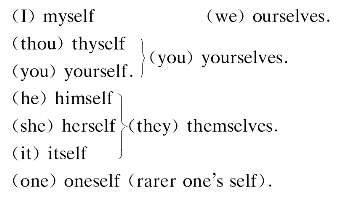
A few verbs are always used reflexively:
①She prides herself on her good looks.
②He absented himself from all committee meetings.
There is a tendency to get rid of these pronouns whenever no ambiguity is to be feared:
③I washed,dressed and shaved,and then felt infinitely better.
④He is training for the race.
⑤He drew back a little.
⑥The army retired in good order.
⑦The disease spread rapidly.
⑧You must prepare for death.
Sometimes a difference is made,or may be made,between the fuller and the shorter expression;behave oneself is often used of good manners and breeding,while behave is used for action generally:the troops behaved gallantly under fire.
⑨He settled himself comfortably in an easy-chair.
⑩They settled in America.
⑪ No opportunity offered.
⑫ He offered himself as an interpreter.
Sometimes there is an element of exertion in the reflexive use:“We kept ourselves warm”by walking to and fro is more deliberate than“we kept warm”,etc.;cf.the soup did not keep warm very long.He proved himself a fine fellow emphasizes his endeavors,while he proved a fine fellow merely means that people saw that he was.
It is natural that the tendency to use verbs without the reflexive pronouns is stronger in English,where these pronouns are heavy and cumbersome,than in other languages where the corresponding forms are short and light(French se,German sich,etc.).
The reflexive pronouns are also used after prepositions:
⑬ He looked at himself in the glass.
⑭ He lives by himself in an old house.
But if the preposition has a purely local meaning,the simple forms without self are used:
⑮ Shut the door behind you!
⑯ I have no change about me.
⑰ She stood,looking straight in front of her.
⑱ They had the whole afternoon before them.
From the purely descriptive standpoint of presenting accurate information about the usage of the reflexive,this passage would be hard to improve on.Note that the explanations Jespersen gives are almost always concerned with the meaning of the usage;for example,the reflexive can be deleted from the sentence when“no ambiguity is to be feared”or when the reflexive follows a preposition of“purely local meaning.”Jespersen also points out that the presence or absence of a reflexive sometimes changes the meaning of the verb.For Jespersen,a descriptive grammar describes usage,and usage can be explained in terms of its effect on meaning.
(2)The structural revolution
The one book written from the viewpoint of structural linguistics that has probably had the greatest impact on the teaching of English is Charles Carpenter Fries's(1952)The Structure of English.Let us look at the main ideas in this book in order to see how a leading structural grammarian viewed the structural revolution.Bear in mind.However,that there were other structural linguists besides Fries,and that what is true for Fries may not be necessarily true for them.No field of study is perfectly monolithic.
At the end of the first chapter,Fries states that the purpose of his book is to challenge anew the conventional use of“meaning”as the basic tool of analysis in the area of linguistic study in which it has had its strongest hold—sentence structure and syntax.Otto lespersen insists,for example,“But in syntax meaning is everything.”A Modern English Grammar(Heidelberg,1931,Ⅳ:291)(Fries's footnote.)(Fries,1952:7)
In this quotation one sees one of the major ideas of structural linguistics.Linguistics cannot use meaning as a tool in the analysis of language,a position diametrically opposed to the basic ideas of traditional grammar.The structuralists argued that the goal of linguistic analysis is to see how meaning is conveyed.Since meaning is the aim,it cannot at the same time be a means used to reach the goal,or else the discovery process is completely circular meaning is discovered by the use of meaning.For Fries,language is a physical,observable phenomenon that must be studied objectively.
Fries criticizes traditional grammar for providing analyses that merely label the elements in a sentence but do not explain how meaning is conveyed.
In the usual approach to the grammatical analysis of sentences one must know the total meaning of the utterance before beginning any analysis.The process of analysis consists almost wholly of giving technical names to portions of this total meaning.For example,given the sentence“The woman gave the boy the money”,the conventional grammatical analysis would consist in attaching the name“subject”to the word woman,the name“predicate”to the word gave,the name“indirect object”to the word boy,the name“direct object”to the word money,and the name“declarative sentence”to the whole utterance.If pressed for the basis upon which these names are given to these words,one would,in accord with the traditional method,say that the word woman is called“subject”because it“designates the person about whom an assertion is made”,that the word gave is called“predicate”because it is“the word that asserts something about the subject”;that the word boy is called“indirect object”because it“indicates the person to or for whom the action is done”;and that the word money is called“direct object”because it“indicates the thing that receives the action of the verb”.The sentence is called a“declarative sentence”because it“makes a statement.”The whole procedure begins with the total meaning of the sentence and consists solely in ascribing the technical terms“subject,”“predicate,”“indirect object,”“direct object,”and“declarative sentence”to certain parts of that meaning.“Knowing grammar”has thus meant primarily the ability to apply and react to a technical terminology consisting of approximately seventy items.It is this kind of“grammatical knowledge”that is assumed in the usual discussions of the value of“grammar”for an effective practical command of English,or for English composition,or for mastery of foreign language.It is this kind of grammatical analysis,this starting with the total meaning,and the using of this meaning as the basis for the analysis—an analysis that makes no advance beyond the ascribing of certain technical terms to parts of the meaning already known—it is this kind of grammatical analysis that modern linguistic science discards as belonging to a prescientific era(Fries,p.54-55).
Fries begins his analysis of the sentence the man gave“The boy the money”by distinguishing between two different kinds of meaning.One kind of meaning is lexical meaning.The lexical meaning of man,for instance,is the dictionary definition of the word:it tells us what the word man refers to in the real world.However,what the dictionary cannot tell us is how the word man is used in the sentence quoted above.In the sentence“The boy gave the man the money”,the function of the word man is quite different from its function in the first sentence.The grammatical function of a word in a sentence is called the structural meaning of the word in Fries's terminology.Thus,in order to understand a sentence,we must know both what its words mean(the lexical meaning)and their grammatical function within the sentence in question(the structural meaning).
Fries next addresses himself to the question of how we recognize structural meaning.He argues that structural meaning is“signalled by specific and definite devices.It is the devices that signal structural meanings that constitute the grammar of a language.The grammar of a language consists of the devices that signal structural meanings.”(p.56)When the appropriate structural signals are absent from a sentence,the sentence will be ambiguous because we can assign it more than one possible structural meaning.Fries illustrates this point with the sentence
①Ship sails today.(Fries,p.62)
The sentence is ambiguous because both ship and sails could be either a noun or a verb.However,if the appropriate structural signals were present,the sentence would not be ambiguous;for example,
②The ship sails today.
③Ship the sails today.
In this case,“the”signals the structural meaning of ship and sail in the two sentences.
One of the deeply held tenets of structural linguistics is that the recognition of structural meaning is independent of lexical meaning.In other words,speakers of a language do not depend on the meaning of the word in a sentence to tell them what its grammatical function is.In support of this position,Fries makes up sentences with words that have structural meaning but no lexical meaning,for example,Woggles ugged diggles,(p.71)The fact that we know that waggles and diggles are nouns and that ugged is a verb means that we identify parts of speech without reference to meaning.
Fries also discusses the inadequacy of the traditional definitions of parts of speech.Again,the basis of his objection to traditional definitions is not that their classification is faulty,but that their definitions are not really defining:
What is a“noun,”for example?The usual definition is that“a noun is the name of a person,place,or thing.”But blue is the“name”of a color,as is yellow or red and yet,in the expressions a blue tie,a yellow rose,a red dress we do not call blue and yellow and red“nouns.”We do call red a noun in the sentence“This red is the shade I want”.Run is the“name”of an action,asis jump or arrive.Up is the“name”of a direction,as is down or across.In spite of the fact that these words are all“names”and thus fit the definition given for a noun they are not called nouns in such expressions as“We ran home,”“They were looking up into the sky,”“The acid made the fiber red.”The definition as it stands that“A noun is a name”does not furnish all the criteria necessary to exclude from this group many words that our grammars in actual practice classify in other parts of speech(Fries,p.67).
However valid Fries's criticism of certain kinds of traditional grammars may be,it is not a valid criticism of sophisticated traditional grammarians like Jespersen.In his Essentials of English Grammar,Jespersen makes no attempt to define nouns,either by meaning or otherwise.He simply gives a list of typical types of nouns with the following comment:“It is practically impossible to give exact and exhaustive definitions of these[part of speech]classes;nevertheless the classification itself rarely offers occasion for doubt and will be sufficiently clear to students if a fair number of examples are given.”(Jespersen,p.66)
Fries also rejects the traditional meaning-based definitions of such functional relationships as subject,direct object,indirect object,appositive,and the like.Instead,he identifies these relationships in terms of formal signals of structure.For example,“subject”is defined as being that noun which is“tied”to a verb by agreement,that is,by the change in the form of the verb that is correlated with the number of the preceding noun;for example:
④The boy loves potato chips.
⑤The boys love potato chips.
Other functional relations are defined in terms of linguistic formulas or patterns—For example,given the pattern determiner-noun-verb-determiner-noun the second noun,by definition,is a direct object.
Fries's task is to identify the structural signals by which speakers actually recognize the speech class of a word.Here are structural signals by which Fries claims that speakers recognize a noun to be a noun:
(a)Contrast of form between nouns and other parts of speech.For example,noun/verb:arrival/arrive,defense/defend;noun/adjective:bigness/big,truth/true.
(b)Compounds ending in-one,-body,-thing,-self/selves.For example,someone,somebody,something,myself.
(c)Contrast of singular versus plural forms marked by“s.”For example,boys/boy,desks/desk.
(d)Irregular contrasts of singular and plural forms.For example,men/man,children/child.
(e)Possessive“s.”For example,man/man's/men/men's.
(f)Position after determiners.For example,in the following phrase the italicized words are nouns because they follow determiners:The poor and the rich,the very lowest and the very highest are....(p.118)
(g)Position after prepositions.For example,at school,by telephone.
(h)Recognition of the other parts of speech in the sentence.Fries gives an example of this category the following newspaper headlines:(p.119)
Bus fares Cheap in Emergency.
Bus fares Badly in Emergency.
We recognize fares to be a noun in the first sentence and a verb in the second sentence because we recognize the part of speech of the word following fares.
The formal characteristics of nouns that Fries gives above break down into two types:characteristics of the form of the word(groups(a)-(e))and characteristics of position within the sentence(groups(f)-(h)).These two basic types of characteristics are also used in the characterization of the other three parts of speech.
At the risk of dreadful oversimplification,structural linguistics(as represented by Fries's The Structure of English)may be described as a revolutionary departure from traditional grammar in terms of which there is in language that needs to be explained.For Jespersen,explanation means discussion of how a certain form or construction came to be used the way it is.The explanation can be semantic or purely historical.For the structural linguist,the basic question of linguistics that needs explanation is a psychological one:how does language convey meaning?The structuralists'answer to this question is,I think,fairly summed up in this quotation from Fries:
The total linguistic meaning of any utterance consists of the lexical meanings of the separate words plus such structural meanings.No utterance is intelligible without both lexical meanings and structural meanings.How,then,are these structural meanings conveyed in English from the speaker to a hearer?Structural meanings are not just vague matters of the context,so called;they are fundamental and necessary meanings in every utterance and are signalled by specific and definite devices.It is the devices that signal structural meanings that constitute the grammar of a language.The grammar of a language consists of the devices that signal structural meanings(Fries,p.56).
For the structuralist,two basic conclusions follow from the position just stated:
(a)There is a one-to-one tie between structural signals and meanings.The language learner comes to associate certain meanings with certain forms.As Fries puts it:
One of the earliest steps in learning to talk is this learning to use automatically the patterns of form and arrangement that constitute the devices to signal structural meaning.So thoroughly have they become unconscious habits in very early childhood that the ordinary adult speaker of English finds it extremely difficult not only to describe what he does in these matters but even to realize that there is anything there to be described(Fries,pp.57-58).
(b)Linguistic analysis needs to distinguish between the kind of information available to the user and the kind of information that is not.The former will have relevance to the acquisition and use of language,while the latter will not.Historical information about the English language may be of interest to the specialist,but it is obviously irrelevant to any examination of how language conveys meaning,since the typical speaker does not have historical information available.From this point of view,Jespersen's excursions into the history of the language are irrelevant to the central topic of how language conveys meaning.
For the structural grammarian,the goal of linguistics is to account for linguistic behavior.The basis of the transformational revolution is ultimately the simple observation that explanations of our linguistic behavior cannot account for the extent of our linguistic knowledge.For example,Fries demonstrates the importance of structural signals by showing that if these signals were omitted from a sentence(as in newspaper headlines),the resulting sentence would be ambiguous.Chomsky points out that there are other kinds of ambiguity that have nothing to do with structural signals.A well-known example from Syntactic Structures is the phrase
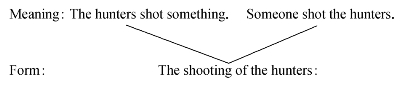
⑥The shooting of the hunters
This phrase can mean either(a)the hunters shot something,or(b)someone shot the hunters.Here we have one form with two different meanings.However,unlike the ambiguity of“ship sails today”,it is very difficult to see how the phrase can be made unambiguous by adding structural signals.In other words,the ambiguity of the shooting of the hunters is not due to a confusion as to the proper part of speech classification.There is no doubt that shooting is a gerund(a verb changed into a noun by the addition of-ing)and that hunters is a noun.Even knowing this,the sentence is still ambiguous.One possible solution from a structural standpoint would be to argue that the ambiguity is due to the function word of in that particular pattern.In other words,when we have the sequence gerund-of-noun the sequence will be ambiguous in the same way that the shooting of the hunters is.The problem with this solution is that it does not work.Chomsky cites two phrases that appear to have exactly the same structure as the shooting of the hunters:
⑦The growling of lions
⑧The raising of flowers
Neither one of these phrases is ambiguousin the sense that the shooting of the hunters is.This is a fact that native speakers of English simply know.Furhermore,we know that the relation of the gerund to the noun in the two phrases above is not alike.In the growling of lions the relation of lions to growling is similar to the relation of hunters to shooting in the first meaning of the shooting of the hunters,namely,the lions growled and the hunters shot.In the raising of flowers,the relation of flowers to raising is similar to the relation of hunters to shooting in the second meaning of the shooting of the hunters,namely,someone grew flowers and someone shot the hunters.
⑨Active:The dentist saw the accident.
⑩Passive:The dentist was seen by the detective.
In structural terms,the two sentences above are totally unrelated.The subject noun of the active sentence is dentist,while the subject noun of the passive is accident.The verb of the active sentence is see in the past tense.The verb of the passive sentence is was plus see in the past participle form.The object of the active sentence is accident,while in the passive sentence it is dentist.Despite these obvious differences,every speaker of English knows that in a very profound sense these two sentences are basically the same.Furthermore,we all know that the passive is a kind of alternative version of the active,and not the other way around.Paraphrase relations are a second way in which our knowledge of the language cannot be accounted for in terms of lexical meanings of words and structural signals.
We may represent the connection between form and meaning by the following diagram:
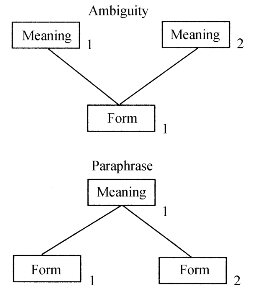
For example,the phrase“the shooting of the hunters”is ambiguous because the one form has two meanings:
The paraphrase relation between the active and passive results from one meaning with two forms:

For the transformational grammarian the basic goal of linguistics is to account for what speakers know about their language.The transformational revolution is a radical shift in the kinds of questions that linguists deal with,just as the structural revolution was a radical shift away from the questions that traditional grammarians concerned themselves with.A scientific revolution is not so much a matter of changing the answers,but changing the relevant questions.
We have already seen that native speakers of a language are aware of ambiguity and paraphrase relationships beyond what can be accounted for in terms of structural signals.What kind of knowledge does this awareness imply?For one thing,it implies that a speaker of a language,in some unconscious,intuitive way,“knows”the internal structure and the relationship of one part with another of all the sentences in his language.This knowledge does not depend on any prior exposure to each particular sentence,nor does it necessarily depend on the meaningfulness or appropriateness of the sentence to some situation.Chomsky illustrates both of these points in Syntactic Structures with the following pair of nonsense sentences:
⑪ Colorless green ideas sleep furiously.
⑫ Furiously sleep ideas green colorless.
When Chomsky first made up these sentences,it is safe to assume that neither had ever occurred in the history of the English language.Both are unique,and both are meaningless.Yet every speaker of English knows that the first sentence,no matter how witless,is a grammatical sentence in English and that the second sentence is not.We may characterize native speakers'knowledge of their language as the ability to make judgments about sentences:they can decide whether a sentence is grammatical or not(more accurately,they can decide if two sentences are equally grammatical,equally ungrammatical,or one more grammatical than the other);they can decide whether two sentences mean the same thing or not(paraphrase);they can recognize which sentences have more than one meaning(ambiguity);they can decide if the relation of the parts to the whole in one sentence is the same as or different from the relation of the parts to the whole of another sentence.In short,the transformational grammarian is interested in linguistic knowledge.
In crude terms,a transformational grammar is a system or device that duplicates the kinds of judgments people make.This system is what transformationalists call a grammar.A transformational grammar of English is a device that mirrors the judgments a native speaker of English would make.In a very basic sense,a transformational grammar cannot do anything that a speaker of English cannot do.In other words,the grammar is an attempt to make explicit and conscious what the speaker of English does intuitively and unconsciously.
At this point we might consider an old riddle.What has two eyes like an Indian,two arms like an Indian,two legs like an Indian,and looks exactly like an Indian,but is not an Indian?The answer,of course,is a picture of an Indian.A transformational grammar is a picture or model of our linguistic ability to make judgments about our language.However,it is not that ability itself;it is a device that duplicates the kind of judgments people make about their own language,and not a direct statement about what goes on between people's ears.