3.1.4 The view of language in modern linguistics
In principle,linguistics is concerned with all languages and every aspect of language.The following are the views of language in modern linguistics.
(1)Within a language the linguists acknowledge the existence of the spoken or written mode.According to older school traditions,the written form was regarded of greater worth.Literacy was(and still is)a key issue for schooling;and as a vehicle of literary expression,the written form received most attention.By contrast,modern linguistics hasstressed the priority of speech—because‘it is the“natural,”or primary,medium in transference of speech to a secondary,visual medium’(Lyons,1970:18).The importance of written language is not denied.Especially in literate societies,the written language may acquire a considerable independence from the spoken language.Again,however,the linguist attempts to deal with this aspect of language as he finds it as speech and writing independent of each other,or in relation to each other.The complexity of the relationship between language as speech or writing has in recent years also been widely recognized in language education.
(2)The linguist also recognizes and accepts existence of language varieties,such as regional dialects and social dialects(or sociolects).Here again school traditions—certainly in the past,perhaps lessso tidy—have tended to emphasize a single‘correct’standard form,to inculcate that standard,and to downgrade variations.Linguistics acknowledges as a social fact that a certain dialect may be treated by society as a standard form(for example,standard British English,standard North American English)or is regarded as prestigious by some members of a society(for example,‘King's English’,‘Oxford accent’),whereas another is treated as socially inferior or condemned as‘provincial’,‘lower class’,or‘vulgar’.But the interest or the linguist can be focused,without condescension or condemnation,on non-prestigious as well as prestigious language varieties.
In this connection,it is worth noting that linguists in recent decades have become more and more interested in the language of people who,by a rigid conception of a standard language,do not talk‘properly’the language of small children and foreigners.The study of child language has therefore become a linguistic interest quite apart from its psychological interest as the development of speech in infancy.
Characteristics is the variety that second language learners develop.Such studies are usually referred to as‘interlanguage’studies or the study of‘learner languages’.The concept of interlanguage was suggested by Selinker(1972)in order to draw attention to the possibility that the learner's language can be regarded as a distinct language variety or system with its own particular characteristics and rules.As a teacher,one has been accustomed,in the past,to look upon the learner's language merely as‘wrong’English or‘wrong’French to be eradicated without paying too much attention to the characteristics of the‘interlanguage’.Whether it is right to consider the learner's language as a‘language’is debatable,but the attempt to do so illustrates the linguist's intention of understanding all kinds of language varieties(Corder,1981).
Another relevant language variety that has lately also been examined is the language use which native speakers adopt when talking to babies and to foreigners:‘baby talk’and‘foreigner talk’are characterized by certain simplifications of language that may have universal features(for example,Ferguson,1975).
Different situations,interests,occupations,or social roles demand different uses of language.A number of concepts are employed in linguistics—especially in that branch of linguistics which relates the study of language to the study of society,sociolinguistics to indicate these functional variations and choices within one language:style,register,domain,and code.Styles,for example,have been classified from‘high’to‘low’on a fivepoint scale:frozen,formal,consultative,casual,and intimate(Joos,1961).
Questions of the choice of dialect or other variety arise regularly in language teaching.Should the English class be taught American or British English?Which variety of French or Spanish or Arabic should be selected?
The recognition of relatively different linguistic varieties has brought about in language pedagogy many attempts to make a deliberate choice of a variety of language that is most directly connected particular groups of learners.The so-called LSP approach(language for special purposes:for example,English for Special Purposes,English for Science and Technology,English for Academic Purposes)is in part an application of the view of language varieties(for example,Strevens,1977a).
(3)A consequence of the synchronic approach,advocated by Saussure,has been that language in modern linguistics is looked upon as a system of relationships or as an elaborate structure of mutually supporting parts,arranged in some hierarchical order.‘A language is a highly integrated system’(Langacker,1972:18).In that sense,all modern linguistics,regardless of the particular school of thought,is‘structural’.A linguistic description identifies and explains the units or constituent elements that make up the language and shows how they interrelate and interact.It is therefore not enough to accumulate and enumerate observation on the language.The linguist aspires to reveal the workings of a language as a unified system,and it is here that the arguments among different school of thought arise.
As a language teacher one equally is interested in viewing a language as a coherent and well-defined system because,unless one has a conceptual scheme of what a language is,one cannot plan to teach it.It is beside the point whether the scheme is to be understood by the learner;that is an issue that presents itself as a question of methodology.But for planning language teaching,a view of a language as a coherent structure is unavoidable and therefore the linguist's effort to develop schemes of this kind is of great interest to language pedagogy.
(4)Another relational set of concepts,syntagmatic versus paradigmatic relations,has also acquired much importance in linguistics.
Saussure offers as examples of the syntagmatic relationship combinations of morphemes,words,and clauses,for example,retire,centre tous,la vie humaine,s'il fait beau temps,nous sortirons.The quality of language units to combine is syntagmatic.
Within an utterance,a particular item,for example,‘he’in‘He is coming’forms part of a system of pronouns(‘she’,‘you’,‘they’,etc.)that constitute a paradigm.In the same utterance,‘is’forms part of another paradigm constitute a paradigm.In the same utterance‘is’forms part of Saussure's illustration.These paradigmatic relationships are associative;that is they may be evoked in the mind of the language user,whereas the syntagmatic relationship is visible or audible in the utterance.
Language teachers have employed practice techniques that indicate that intuitively they are familiar with this duality in language.Traditional practice tended to emphasize the paradigmatic aspect,particularly in the teaching of grammar(je suis,tu es.,il est).Since the forties,practice techniques have shifted towards an emphasis on syntagmatic relations,particularly through sentence pattern drills to the point of tabooing the paradigm as a legitimate teaching device.
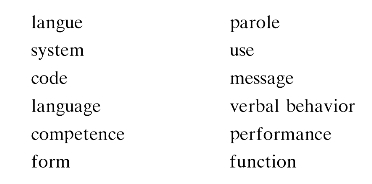
(5)A distinction of great importance to modern linguistics—and also to language teaching theory—that,like the previous set of terms,was first developed in Saussure's course,is that between language as a system or structure,langue and the use of that language in utterances,parole.
The object of study for linguistics is not principally the mass of individual utterances,parole,but the underlying system,langue,shared by all the speakers of the language as a first language or of the variety of the language under investigation.Similar pairs of concepts have been developed by a number of theorists;they can be tabulated as follows:

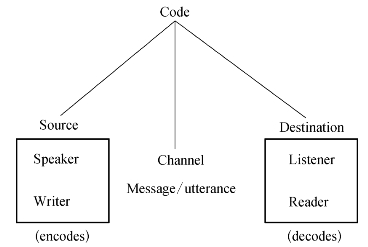
Information theory operates with the concept of the code,i.e.,the system of communication that is employed,in order to send messages.As this simplified model of the act or communication indicates(adapted from Osgood and Sebeok 1965:1-3),both sender(source)and receiver(destination)must already be familiar with the code if the message to be sent is to be encoded at the source and to be decoded and understood by the receiver.
A language as a system of communication can,minimally,be likened to a‘code’that is shared by individuals for the purpose of transmitting‘messages’.According to this analogy,linguistics—if we adopt Sassure's emphasis on langue—is principally concerned with describing the code the system of formal rules,which manifests itself in the utterances or messages.Applying the same analogy to language teaching,the purpose of the language class is to teach the‘code’,i.e.,the second language,so that the learner can encode(speak/write)or decode(listen/read)the second language.
Rejecting the parole-tongue distinction,Skinner(1957)in a challenging book on verbal behavior adopted a strictly behavioristic point of view and argued that the only observable object of scientific study is the verbal behavior,the speech utterances and texts(i.e.,parole).Langue according to Skinner,is a mentalistic and unscientific abstraction.His work on verbal behavior is an attempt to account for all linguistic activities entirely within terms of overt and observable events without my appeal to an‘underlying system’.

Figure 3.5 Model of the communicative act(Osgood and Sebeok,1965)
The competence-performance distinction was introduced by Chomsky.‘Performance’refers to the infinitely varied individual acts of verbal behavior with their irregularities,inconsistencies,and errors.The capacity of the individual to abstract from these acts of performance and to develop system and order is competence.Chomsky has made the point that the language user himself must possess intuitively and unconsciously this capacity to abstract from the concrete manifestations of language.According to Chomsky,the task of linguistics is to study competence,the knowledge of the language,or‘the underlying system of rules that has been mastered by the speaker-hearer.’(Chomsk,1965:4)