1
语法—翻译教学法面面观
1.5.1.1 3.0 lntroduction
3.0 lntroduction

Since language teaching is concerned with the acquisition by individuals of a dual language command,its theory is bound to operate with linguistic and psychological concepts of language use and language learning.Both linguistic and psychological thinking on these topics form essential parts of language teaching theory.Corder(1973a)once summed up in his book Linguistic Theory and Applied Linguistics:“there can be no systematic improvement in language teaching without reference to the knowledge about language which linguistics gives us.”While linguistics is concerned with language in general and scientific approaches to particular language and speech communities,psychology directs our attention to the individual person,first as a language user and second as a language learner.Linguistics and psychology are the adjacent disciplines of foreign language teaching.They serve as the bases for the discussion of the G-T Method.

In order to discuss foreign language teaching and its adjacent disciplines coherently,a conceptual framework is needed,as a map to guide the exploration.Such a map,at the stage of the enquiry,must be regarded as tentative and open to revision as we proceed.

To begin with,let us consider a few of the attempts that have already been made.There has been a growing awareness over the last three or four decades of the enormous complexity of foreign language teaching,leading to the belief that foreign language teaching is to be a truly professional enterprise,it must deal with the various aspects involved in a scholarly and scientific manner and establish a sound theoretical framework.From around 1940 to 1960,it looked as if a well-reasoned application of linguistics and psychology could provide the best basis for solving the problems of foreign language teaching.But radical changes in both disciplines which took place between 1960 and 1970 dampened these hopes.The interaction between teaching languages as a practical activity and the theoretical developments in language sciences was recognized as less simple and straightforward than it had appeared in the earlier period.A number of scholars came to the conclusion that applied linguistics as a mediating discipline between theoretical developments in the language sciences and the practice of language teaching could perhaps smooth the way for a more effective participation of the language sciences in language teaching.A few influential books of the period from 1964 to the mid-seventies expressed this viewpoint,for example,McIntosh,Strevens(1964)and Mackey(1965).A lengthy discussion on the scope of applied linguistics which took place in the U.S.A.in connection with the foundation of the American Association of Applied Linguistics between 1973 and 1978 made it clear that these issues had not been settled by the end of the last decade.

This prolonged debate has crystallized around a few questions:(a)Which of the language sciences can be said to have bearing on foreign language teaching,and what is the most effective relationship to be established between them and language teaching practice?(b)What other factors besides the language sciences play a significant part in foreign language teaching theory?

Various schemes or models have been put forward for consideration.They tried to deal with these questions and to establish a conceptual framework that would put the major factors to be considered into some ordered relationship to each other.

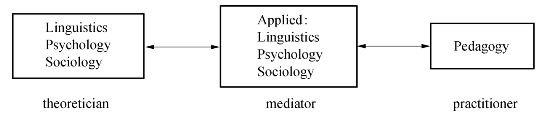
The relation between the language sciences and foreign language teaching has emerged as one of the very important issues in the development of a language teaching theory.A simple and clear presentation of these relationships by Campbell,an American applied linguist,would probably receive widespread support among scholars.In Campbell's view(1980:7),applied linguistics is the mediator between the practitioner and the theorist:

Figure 3.1 Campbell's model of the relationship between theory and practice.Source:Campbell(1980)

Campbell's model of the relationship to linguistics alone is insufficient and therefore Campbell(op.cit:8)suggests an expanded version of this model which again would hardly be called into question by any applied linguist today,although there might be differences of opinion as to which disciplines to include in the list:

Figure 3.2 Campbell'smodel of the relationship between theory and practice.Source:Campbell(1980)

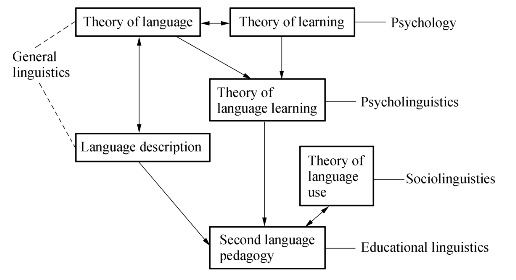
A closely argued and detailed case for the contribution of certain disciplines is made in a model developed by Spolsky(1978).Rather like Campbell and others have done,Spolsky(1980)with the help of two diagrams,first shows that linguistics alone is inadequate as a basis for language teaching,and that even linguistics and psychology are insufficient.In a third and final figure,he outlines what in his view represents a more adequate conceptual framework:

Figure 3.3 Spolsky's educational linguistics model.Source:Spolsky(1980)

According to this representation,language teaching(‘second language pedagogy’)has three main sources:(a)language description;(b)a theory of language learning and;(c)a theory of language use.A theory of language learning in turn must ultimately derive from a theory of language and a theory of learning.Language description must also be founded in a theory of language.The disciplines that provide the necessary theoretical foundations and the data underlying language teaching are psychology for the theory of learning,psycholinguistics for the theory of learning,general linguistics for a theory of language and language descriptions,and sociolinguistics for a theory of language use in society.These four disciplines come together in dealing with the problem of language education and thus constitute a problem-oriented discipline which Spolsky calls educational linguistics,and which others have called applied linguistics.According to Spolsky,applied linguistics can adopt a similar approach to the one outlined by him for second language pedagogy in other applied fields such as translation,language planning and lexicography.Educational linguistics is therefore a more clearly named specialization within applied linguistics.Naturally,educational linguistics is not only relevant to second language pedagogy but has relevance to other question of language education,such as first language teaching,reading instruction,or speech education.What Spolsky's model makes particularly clear is the main components of a language teaching theory,and the specific role that each discipline performs in relation to these components.It should be noted that in Campbell and Spolsky's models double-headed arrows indicate interactive processes.

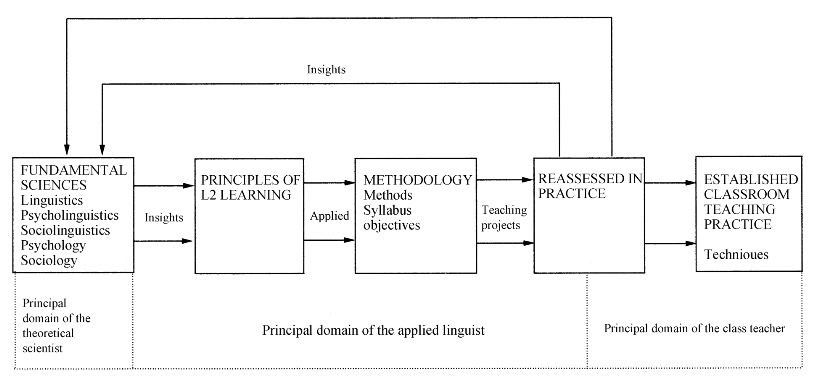
Figure3.4 Ingram'smodelforthedevelopmentoflanguageteachingpractice.Source:Ingram(1980)

However,a third model still illustrates some of these missing features.Ingram(1980:42)once again offers a similar list of disciplines and allocates the tasks of theoretician,applied linguist,and practitioner in much the same way as Campbell does.This model shows in greater detail the functions of the applied linguist and the relative distribution of tasks among applied linguist and class teacher.Feedback from practice is acknowledged.However,people might be inclined to question the limited role that is allocated to the practitioner in comparison to the applied linguist,and the notion that methodology and practice are ultimately and exclusively derived from theoretician-mediator-practitioner relationship is viewed largely as unidirectional leading from the language sciences to practice rather than in the opposite direction.