序
癸巳岁末,肖辉女士从南京来电称,复旦大学出版社拟出版其《语法—翻译教学法面面观》(Aspects of the Grammar-Translation Method and Foreign Language Teaching)一书,并索序。著者肖辉教授,文学博士,系南京财经大学外国语学院院长。其治学也,求真务实,其思维也,清晰精勤,吾於其著作中见之。在此旧岁新年交替之际,得此喜讯,深感欣慰,遂欣然敲击键盘,撰斯序。
20世纪80年代以降,域中外语教学再度勃兴,对外语教学法的研究也随之高涨。域外文章典籍纷涌中土,学派迭出,新理接踵,界说纷呈,所推介的外语教学法林林总总,不胜列举,其中也夹杂着对语法—翻译教学法的挞伐之声。对此,肖辉己在其书中言之详矣。
然著者冷静以对,潜沉於外语教学法之研究,得其奥旨。她认为,尽管外语教学法名目繁多,但按它们对母语的态度可概括为两大类:一类主张利用母语;一类主张排斥母语。第一类教学法以认知教学法为中心,包括传统的语法—翻译教学法,主张从学生已有的知识出发学习新知识,认为母语是学习者共有的已有知识,应在教学中广为利用,没有必要排斥。第二类教学法以听说法为中心,包括直接法、自然法、视听法等,主张把第一语言习得的原则运用到第二语言的学习上。其理论基础是结构主义语言学和行为主义心理学,认为“语言是习惯的综合体系”,第二语言是独立于母语的一套习惯,学习外语就是要养成独立于母语的一套新的语言习惯,而第二语言学习者错误主要或全部来源于母语的干扰。作者进而指出,随着认知科学以及心理学的发展,人们渐渐发现这一论点的偏颇之处。语言本质上是创造性的,人们说每一个句子都有所创新,不能把语言简单地理解为一种习惯。再者,人的知识是一个有系统的整体,学习者原有的知识必然成为新学知识的参照系。在外语学习中摒弃母语的做法,无论在理论上还是在实践上都是不可能的。无独有偶,英国学者皮特·科德将学习者的错误分为三类:一是形成系统前的错误(presystematic errors),学习者在尚未掌握某种表达方式时,只好从其己知的语言知识中搜罗一些手段去仓促应付。这种错误显然是由于语言能力的不足而发生的。二是系统的语言障碍(systematic errors),学习者了解了系统中的规则,但对规则掌握的不完整,不知道某些限制,如将gentleman的复数说成gentlemans。三是形成系统后的错误(postsystematic errors),学习者虽然以掌握了较完整的语法概念,但尚未形成习惯,仍会说出gentlemans,但是在意识到错误之后可自行改正。从这三类错误来看,真正可以归咎于母语干扰的只有第一类。而这一类错误的根本原因在于语言知识和语言能力的不足。随着学习的进展,这类错误会逐渐得到克服。肖书既考证钩稽,又评述阐释;多见旁搜远绍,又不乏烛幽索隐。披读此书,处处可见其探究发现之精神,与穷治其事之韧劲。可谓博采众长,集纳众说。理益明,说益坚,令人倾心悦服,吾无间然。
肖辉系英文科班出身,教授英文兼治译学已多年矣。其著以英文作,言语自然规范、文字平实晓达。依吾之见,此“小言”娓娓道来,比之于空洞无物之“大言”,其言简意赅亦且翔实明了。今君索余一言以为弁首,余知君年稔,其可以默而息乎?爰述成书颠末,俾治学之士,得以考焉。是之为序也。
张柏然
乙未(2015)新春于沪上临港庐舍
0.1 The Grammar-Translation Method and foreign language teaching
0.1.1 Concept of language teaching
Language teaching can be defined as the activities that are intended to bring about language learning.All that need to be pointed out here is that‘language teaching’is more widely interpreted than‘instructing a language class’.Formal instruction and methods of training are included,so is individualized instruction,self-study,computer-assisted instruction,and the use of media,such as radio or television.Likewise,the supporting activities,such as the preparation of teaching materials,teaching grammars,or dictionaries,or the training of teachers,as well as making the necessary administrative provision inside or outside an educational system—they all fall under the concept of language teaching(Stern,1997).
0.1.2 Studies on language acquisition
No one knows exactly how people learn language although a great deal of research has been done into the subject.Certain theories have,however,had a profound effect upon the practice of language teaching(and continue to do so)and it seems sensible,therefore,to consider them.In an article published in 1920,two psychologists,Watson and Raynor,reported the results of experiments they had carried out with a young baby called Albert.When Albert was nine months old,they discovered that the easiest way to frighten him was to make a loud noise(by striking a steel bar with a hammer).At various intervals over the next three months,they frightened Albert in this way while he was in the presence of various animals(a rat,a rabbit and a dog).The result of these experiments was that after three months,Albert showed fear when confronted with these animals even when the noise was not made,and even showed unease when a fur coat was put in front of him.The psychologists suggested that they would be able to cure Albert's fear but were unable to do so because he was no longer available for experimentation,and they even discussed the possibility of Albert's fear of fur coats when he reached the age of twenty!The ethics of this experiment are highly questionable,but Albert's experiences are an early example of the idea of conditioning.
The idea of conditioning is based on the theory that you can train an animal to do anything(within reason)if you follow a certain procedure that has three major stages,stimulus,response,and reinforcement.In the classic form of the theory,a rat is placed in a box.A signal light is operated(the stimulus),the rat goes up to a bar in the cage and presses it(the response)and a tasty food pellet drops at its feet(the reinforcement).If the rat's behavior is reinforced a sufficient number of times,it will always press the bar when the light comes on.
Reinforcement in that example took the form of a reward and was therefore positive.But you could also train the same rat not to do something by giving him negative reinforcement,maybe in the form of a small electric shock.
A psychologist develops an approach to the shaping of animal behavior and demonstrates its effectiveness on rats and pigeons and then takes the reckless step of assuming that similar solutions apply to human behavior.Language teachers,impressed by the apparent authority of science,follow suit and try to teach by means of operant conditioning.The solution shifts from pigeons to people in general to pupils in particular.B.F.Skinner held the view that language is essentially a matter of behavior being shaped by stimulus control which provided theoretical warrant for an approach to language teaching which focused on habit formation.The same model of stimulus-response-reinforcement accounts for how a human baby learns a language.An internal stimulus such as hunger prompts crying as a response,and this crying is reinforced by the milk that is subsequently made available to the baby.Our performance as language users is largely the result of such positive(or negative)reinforcement.
Behaviorism,which was after all a psychological theory,was adapted for some time by the language teaching profession,particularly in America,and the result was the Audio-Lingual Method still used in many parts of the world.This method used consistent and unending drilling of the students followed by positive or negative reinforcement.Of course,the approach wasn't quite as crude as that,but the stimulus-responsereinforcement model formed the basis of the methodology.The language‘habit’was formed by this constant repetition and the reinforcement of the teacher.Mistakes were immediately criticized,and correct utterances were immediately praised.
In 1959 Chomsky published a strong attack upon Skinner's Verbal Behavior that has become rightly famous.In his review of the book,he explained his rejection of the behaviorist model of language acquisition(how a baby learns a language)on the basis of his model of competence and performance.The strength of the attack can largely be produced by the asking of questions:if all language is learnt behavior,how is it that young children can say things they have never said before?How is it possible that adults all through their lives say things they have never said before?How is it possible that a new sentence in the mouth of a four-year-old is the result of conditioning?Language is not a form of behavior,Chomsky maintained.On the contrary,it is an intricate rulebased system and a large part of language acquisition is the learning of this system.There are a finite number of grammatical rules in the system and with knowledge of these,an infinite number of sentences can be performed in the language.It is competence that a child gradually acquires,and it is this language competence(or knowledge of the grammar rules)that allows the child to be creative as a language user(e.g.experimenting and saying things that he has not said before).
Language teaching has never adopted a methodology based on Chomsky's work,after all Chomsky never intended that his theory should have anything to do with adult language learning and has repeatedly made this clear.Nevertheless the idea that students should be allowed to create their own sentences based on an understanding of a rule is widely accepted in many classrooms.
During a major part of the twentieth century,approximately between 1925 and 1965,linguistics gave attention increasingly to the second theme,grammar,which proved to be one of the most productive and most controversial areas for linguistic analysis.Grammar,a somewhat ambiguous term today,has been defined as‘the branch of the description of languages which accounts for the way in which words combine to form sentences.’(Lyons,1971:63).The importance of grammar will hardly be questioned by teachers.Most language courses and textbooks are organized along grammatical criteria.Language teachers for generations have operated with grammatical concepts and categories that have been considered as a self-evident and simple basis of language.It is often handled in school in an authoritarian manner,and children are sometimes chided for‘not knowing their grammar.’
Over a period of about forty years,linguistics has taken a fresh look at grammar and have attempted to rethink grammatical analysis from first principles.A review of modern grammatical theories for example,Allen and Widdowson(1975)reveals an extraordinary variety of different systems.For language pedagogy,it is the shifts of categories,concepts,terminologies,emphases and approaches that have been confusing and frustrating.At the same time,these changes have created a sense of the complexity of grammar,contracting the views of grammar as simple and self-evident.Instead,they are an invitation to teachers to treat the grammar of a second language as a puzzling and challenging phenomenon and as a subject of worthwhile and fascinating study.
0.1.3 The Grammar Translation Method and foreign language teaching
Grammar Translation was in fact first known in the United States as the Prussian Method.It was the offspring of German scholarship.The teaching of grammar has always been a central aspect of foreign language teaching.For centuries,in fact,the only activity of language classrooms was the study of grammar and vocabulary.The twentieth century,especially the last half,has changed all that dramatically.Now,as we are in the twenty-first century,language teachers are often confused by a swarm of mixed messages about the place of grammar and in the language classroom.Can we teach grammar in our CLT framework?Or should it just be somehow absorbed without direct teaching?
Varied opinions on whether or not to teach grammar in language classes can be found in the literature on language teaching.Historically,grammar has been central.But in recent decades,a few extremists have advocated no teaching of grammar whatsoever.Reason,balance,and the experience of teachers in recent CLT tradition tell us that judicious attention to grammatical form in the adult classroom is not only helpful,if appropriate techniques are used,but essential to a speedy learning process.Appropriate grammar focusing techniques:
(1)are embedded in meaningful,communicative contexts.
(2)contribute positively to communicative goals.
(3)promote accuracy within fluent,communicative language.
(4)do not overwhelm students with linguistic terminology.
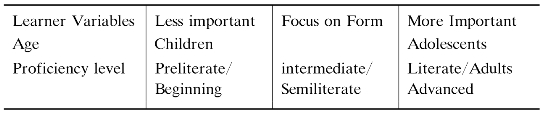
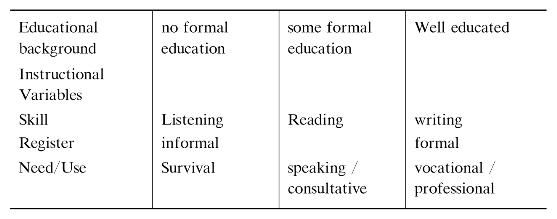
(5)are as lively and intrinsically motivating as possible.For adults,the question is not so much whether to teach or not to teach grammar,but rather,what are the most proper conditions for overt teaching of grammar.Marianne Celce Murcia(1991)offered six easily identifiable variables that can help people to determine the role of grammar in language teaching(see Table 1).Notice that for each variable,the continuum runs from less to more important;however,it does not say that grammar is unimportant for any of the six variables.
Adults learning a foreign language are not like children learning their native language.The latter have a tremendous amount of time to acquire their language,and it is a slow process.The former,however,may be very limited in the amount of time they have to learn,and they may want or need to see results quickly.One way of assuring such results is to help students to learn consciously items of the grammar of the language that they can study(side by side,of course,with a great deal of input and language use in communicative situations).A major reason for such formal instruction is that adult students generally expect it and want it,and it does seem to be true that language that is‘learnt’in this way,and then practiced,can become part of the acquired store.It has been suggested that communicative activities may act as a switch that allows‘learnt’language to pass to this acquired store.And whereas younger learners of English may not benefit greatly from an emphasis on conscious learning,adults have a wide variety of learning strategies that they can draw upon,and it is being suggested that conscious learning is one way of helping them to internalize rules for later‘acquired’knowledge.
Table 1.Variables That Determine the Importance of Grammar(Marianne Celce-Murcia,1991:465)
continued
Human beings are thinking people who,hopefully,can rationalize,and it seems sensible to give them an opportunity to use their reasoning powers when learning new language in the unnatural situation of the classroom.Teachers should,in other words,allow them to‘create’language on the basis of rules teachers introduce.Students will be encouraged to use their new knowledge of grammar rules to make,at an early stage,their own sentences and language.The use of this knowledge will be encouraged,too,at stages of practice where students are prompted to use the new language in different contexts and in combination with other items.
To know a language is to be able to create new sentences in the language.In Chomsky's words(1966b:46):“normal linguistic behavior...is stimulus free and innovative”.In most situations,it is quite impossible to predict what will be said.The“stimulus”of this book,for example,will bring out different“responses”from every reader.Such stimuli obviously do not determine the responses.But if language use is basically innovative,it is innovative only within the bounds of grammaticality.Not all collections of English words result in grammatical sentences.In fact,the chances are not great that you could find any six consecutive head words in a dictionary that would produce a grammatical sentence:somnolent son sonance sonant sonar sonata.It is the grammar that allows us to tell the difference between The man led the horse too fast and The fast horse led the man too.In a grammatical sentence we know what the subjects and predicates are.In the first sentence above,we know that the man did the leading and that“too”modifies“fast,”making an adverbial phrase which tells us more about this particular act of leading.In the second sentence,the horse himself is fast and does the leading,and“too”modifies the whole sentence.
Take the sentence quoted by Hill,above,“Tall the man cigar the smoked black.”This sentence is clearly not grammatical.What is the subject?What is the predicate?What is the grammatical function of“black”?It is not irrelevant that the meaning remains unknown.In spite of the English words,this is not an English sentence.
The limitations of grammaticality rule out a large number of word combinations,but in spite of this,the innovative power of language is theoretically infinite.There can be no limit to the length of sentences,and thus no limit to the number of different grammatical sentences.(A given sentence can always be lengthened by absorbing other sentences into it.)Many long parliamentary resolutions,with all their long“whereas”clauses,are no more than one sentence long and we can always add another“whereas...”But suppose we arbitrarily set a limit of 20 words for grammatical sentences,how many would we have then?George Miller has made a conservative estimate that there are at least l020 grammatical twenty-word sentences in English.“Putting it differently,”he says,“it would take 100,000,000,000 centuries(one thousand times the estimated age of the earth)to utter all the admissible twenty-word sentences of English.Thus the probability that you might have heard any particular twenty-word sentence before is negligible.Unless it is a cliche,every sentence must come to you as a novel combination of morphemes.Yet you can interpret it at once if you know the English language”(Miller,1964b).This is to say that an infinite number of sentences can be produced by what seems to be a rather small finite number of grammatical rules.A speaker does not have to store a largenumber of ready-made sentences in his head;he just needs the rules for creating and understanding these sentences.
In foreign-language learning,understanding the fundamental rules on grammar can“multiply our experience a thousand times.”(That is to say that a conscious effort at figuring out how to say things will be rather more efficient than hoping that people will unconsciously learn how to say things if people memorize enough basic sentences.)As de Sauze puts it,“We found,also,in our experiment that the practical results,such as reading,writing,speaking,and understanding were achieved in greater proportion and in less time when the technique involved a maximum amount of conscious reasoning.”(Sauze,1929)
Linguists are sometimes hesitant to say that ordinary people“know”the rules of their language,because linguists themselves have such a hard time trying to formulate these rules explicitly.Leonard Bloomfield(1942:13),for example,seemed to doubt whether unschooled people could isolate the different words of a sentence.But words are obviously psychologically real units,when children learn to speak,the first that they do is to isolate words.Only later do the combine them into sentences,and it is even later before they add the grammatical inflections and the articles(a,an,the).If children are not able to formulate the rules of grammar that they use,in what sense can we say that they“know”these rules?This is the question that has bothered linguistics.The answer is that they know the rules in a functional way,in a way relates the changes in abstract grammatical structure to changes in meaning.Knowledge does not always have to be formulated.Children can use tools before they learn the names for these tools.
The key distinction to note here is the difference between a rule and a formulation of a rule.For example,Max Black has pointed out that there is a rule of chess to the effect that“A pawn on reaching the eighth rank must be exchanged for a piece.”But there are other equally good formulations of the rule,among which Black lists these:“Pawns shall be promoted on reaching the end of the chessboard”;“Pawns reaching the last rank are replaced by pieces”;and“Pawns must be replaced by pieces whenever a further move would carry them off the chessboard.”Further,as Black points out,“each of these formulations could be translated into German,or any other language containing names for chess pieces and their moves...It follows from this that it would be a mistake to identify the rule about the promotion of pawns with any one of its formulations,for there is one rule,but indefinitely many formulations of it”(Black,1962:101).Knowing a rule and being able to act on it is quite independent of being able to formulate the rule adequately.The rule can be psychologically real without any formulation of it.
It is worthwhile pursuing the matter of rule following in chess,as it can help clear up some of the problems regarding rule following in language.It is essential that chess be played according to the rules.If a player tries to move a rook diagonally across the chessboard,he is making an illegal move,and his opponent will surely stop him from this action.Legality in chess moves is like grammaticality in language.Just as we say“you can't do that in chess,”we object to ungrammatical sentences with“you can't say it that way in English.”
The chief argument given by the empiricists that language is a set of habits,not rules,is that language use is automatic and not on a level of intellectual awareness.As O'Connor and Twaddell(1960:4)put it,“There is no time for puzzle-solving or applications of rules in the real comprehension and use of a language.In real use,the spoken words follow one another at the rate of several hundred a minute”.But in chess,after a little practice,the application of rules becomes quite automatic.We do not think of the rules at all until our opponent tries to violate them.It is“analogy”that requires puzzle-solving;rules need only to be followed,not puzzled out.
The empiricist argument that language is learned by conditioning and drill also seems to rest entirely on the premise that language use is automatic.But this does not follow,either.The general fallacy involved is pointed out by Scheffler in discussing an argument of Ryle's.What is it that leads Ryle to say that facilities are built up by drill?Surely his reason must be that facilities are routinizable,becoming increasingly automatic as they are developed.This does not however,at all imply that drill alone is capable of building them up.Once they are developed,they are indeed automatic and repetitive;it cannot be inferred that they are therefore acquired in an automatic and repetitive way.“After the toddling-age,”says Ryle,“we walk on pavements without minding our steps.”But then during the toddling-age,we do mind our steps,and drill is,at least at this stage,inappropriate(Scheffler,1965:105).
This should be an obvious point:routine and automatic facilities are often built up slowly and painstakingly.A good typist can type almost as easily as he speaks,without thinking about what he is doing;but when he first learned to type he had to spell out each word and concentrate on where to place each finger.The same is true of language learning.In de Sauze's words,there are two stages of knowledge of a language:the‘conscious’one,during which we use the language slowly,applying rules of grammar,reasoning various relationships as we proceed.The second one,the‘automatic’stage,occurs when we speak,read,and write the language substantially like our mother tongue(de Sauze,1953:14).
What does it mean to“learn”the rules of grammar that we apply so carefully when we first speak a foreign language?It does not mean to memorize the formulations of the rules from a grammar book.Let us take again the example of chess:the most efficient way to master the rules of chess would not be to memorize the official rule booklet,instead one should have a teacher who would show him how to move each piece,and how to castle,and how to capture the opponent's pieces.The teacher would help him make the moves and would guide him through his first game.Rules for action are best learned in conjunction with demonstration and practice of the action.The particular formulation of the rules is not terribly important:the rules of chess could probably be explained by sign language alone.But suppose instead of explaining the rules,you had a learner memorize some championship games:how much longer would it take for a person to figure out the simple moves that each piece can make!So it is with language.
0.2 Differing views of the Grammar-Translation Method
0.2.1 lntroduction
In this part various attitudes of the G-T Method will be presented and fully discussed.And also careful comparisons will be made concerning both negative views and positive views of this method.
Many teachers were encouraged to feel negative about grammar,to adopt an emotional anti-grammarian stance,and to regard grammar as inherently‘dull’or‘old-fashioned’.From this point of view,the teaching of grammar,if it had to be done at all,should be done surreptitiously.We must make an effort to free ourselves of such prejudices and to re-examine the possibilities and merits of grammar in the language class.This does not mean,of course,that we should accept all grammar teaching without question or condone inappropriate,excessive,or incompetent grammar teaching.
The Direct Method advocates insisted on the use of the target language in explaining grammar rules,and they tended to move from examples to generalization rather than from a general principle to its application.The Audio-Lingual Method emphasized rapid oral drills,while cognitive theories found a new role for grammatical explanation.All of these approaches involved some form of overt grammar teaching.
A much more radical challenge was presented by those who denied the value of any overt grammar teaching or covert selection of grammatical input.This position,which evolved during the 1970s as a result of second language acquisition studies and interlanguage research,received its clearest formulation in the writings of Dulay Burt,and Krashen.Krashen's view on learning and acquisition was to have a particularly powerful influence on the rejection of overt grammar teaching.
Various positions on the grammar teaching issue fall roughly on a continuum,as follows:
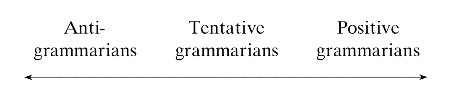
Positions adopted towards the role of grammar in language teaching
Anti-grammarians answer the question‘Can syntax be taught?’(Ellis,1984)with a clear and unambiguous‘No’.They believe that the analysis of grammatical features has no bearing on the ultimate competence of a second-language acquirer.If we adopt this position,the overt teaching of grammar or any other formal feature of language such as phonology is ruled out.While in practice,this viewpoint has not been widely adopted in its extreme form,it has strongly influenced the other two positions on the grammar teaching continuum.As Chastain(1976:34)put it:‘At various times grammar has been almost an unmentionable in second-language education’.At the other extreme,positive grammarians adopt a confident and sometimes an almost aggressively positive stance:It's believed that old-fashioned grammar rules and practice in applying them in structural drills remain the crucial center of the process of language learning.
Between these two extremes,we find different gradations of accepting or rejecting the centrality of grammar in the classroom.One point of view,which is not at all uncommon,is that of the tentative grammarians.They acknowledge that there is an important aspect of second language acquisition that cannot be influenced by grammatical analysis.Yet the practical experience suggests to them that one cannot entirely do without overt grammar teaching,and they tend to adopt a cautious tentative attitude towards grammar.
All grammar teaching pays attention to forms and structures whether the analysis is made explicit to the learner or is simply an underlying covert intention on the part of the teacher,expressed in the course design or emphasis of the teacher's input.
Language learning,besides other things,does involve paying attention to and eventually mastering the formal features of the second language.The untutored second language learner tends to miss these features,because they are often inconspicuous aspects of a language involving minor variations in word order,small words like prepositions or conjunctions,and slight inflections of form that it is easy to miss.Grammar teaching,positively looked at,helps learners to become skilled in recognizing,analyzing,and eventually mastering these elusive structural features which are an essential aspect of proficiency.
0.2.2 Negative views of the Grammar-Translation Method
The negative views of the Grammar-Translation Method held by opponents of translation as a teaching technique are mainly in the following:
(1)Thinking in the mother tongue inhibits thinking directly in the target language(where“directly”is the key word).
(2)It interposes an intermediate process between the concept and the way it is expressed in the foreign language,thus hindering the development of the ability to think directly in the new language(Rivers,1978).This intermediate process with its occasional misapplication of L1 rules to the L2,is sometimes referred to as interference.
(3)Too much reliance on the first language will result in the fossilization of an interlanguage(Selinker,1992).
(4)The use of the first language wastes too much valuable class time that would be better spent on the target language.This is sometimes referred to as the time on task argument(Modica,1994).
The Grammar-Translation method has been widely criticized:as Richards and Rodgers observe in their summary of the methods and approaches to foreign language teaching:‘It is a method for which there is no theory...there is no literature which offers a rationale or justification for it or that attempts to relate it to issues in linguistics,psychology,or educational theory.’(Richards,1986)
The opponents of translation as a teaching technique also hold that translation,especially from the native to the target language,is likely to cause the students to think in their first language before expressing themselves in the second language,whether orally or in writing.They claim this learning process prevents students from mastering the new language.That is to say,the students cannot fully develop their competence and improve their performance in the second language because of their continued reliance on the mother tongue.Those who do not strongly object to the use of translation say that they occasionally want to have students do translation work,but they worry that this activity might be too difficult for students who do not yet have a good command of the second language.Translation should be limited to those with high language skills only.
While all the above might be true to some extent,it need not be so.Duff says,“Translation does not have to be alone,pointless struggle between student and text.Many other approaches are possible.Translation can be introduced purposefully and imaginatively into the language learning program.”(Duff,1989)The author of the present study totally agrees with this idea.It is found that in spite of all the limitations,translation can have many more benefits than has often been thought.If people can find a way to offset the weak points and make the best use of its assets,translation as a teaching technique can be used to help students learn a second language more thoughtfully and effectively.Through the eclectic use of translation and other approaches,students are likely to have good‘competence’as well as good‘performance’in the second language.
0.2.3 Positive views of the Grammar-Translation Method
There are many reasons that explain the popularity of the Grammar-Translation Method.First,it was as explicit teaching device,emphasizing the teaching of vocabulary items,grammar and structure.It had a systematic,graded presentation of syntax,inductive instruction of grammar and lexical instruction.Aside from this,it strongly encouraged language learning“by practice”from translation exercises.Teachers also found it an easy method to use.They did not have to possess strong teaching skills of foreign-language speaking skills since classes were mostly taught in the students'native language.Because the objectives were limited,they were not difficult to achieve.The texts were not complicated and normally included vocabulary lists,grammar rules and sample sentences with interlinear translation from source language to the target language.With these sample sentences,the teachers could use simple contrastive techniques to clearly summarize that the principal appeal of the G-T was the cognitive and systematic use of grammatical rules as a basis of instruction.The directness of translation and the utilization of students'native language proficiency were also appealing features.
It is no longer a deeply entrenched idea that the use of learners'first language causes negative transfer to the second language.Instead of trying to eliminate the use of students'mother tongue,people should capitalize on the students'knowledge of the native language that is so strongly ingrained that no amount of the Direct Method practice can override its influence.If the teacher and all the learners are acquainted with the languages concerned,the use of the learners'first language in translation as a teaching technique should not be considered objectionable.In fact,the proper use of translation to deal with suitable materials,particularly at intermediate and advanced levels,should be encouraged.According to Chellapan,we should not simply eliminate‘translation’but we should absorb translation into a larger creative process of learning.He points out:“Translation can make the student come to closer grips with the target language.A simultaneous awareness of two media could actually make the student see the points of convergence and divergence more clearly and also refine the tools of perception and analysis resulting in divergent thinking.”
Duff,unlike the behaviorists,also has a positive view of the role of the learner's mother tongue in second language acquisition.He says that our first language forms our way of thinking and,to some extent,shapes our use of the foreign language(choice of words,word order,sentence structure,etc.).Translation helps us to understand the influence of one language on the other,e.g.,areas of potential errors caused by negative transfer from the first language.Fully aware of the interference,students will try to avoid making such errors when performing in the second language.When errors do occur,the students will be able to explain why and try not to make the same mistakes again.
The following are some reasons for the elimination of the learners'mother tongue from the second language classroom.This is mainly because the input most students receive in second language learning comes chiefly from a classroom setting.They are rarely exposed to the new language in a natural environment.Because of the great imbalance of input between the first and second languages,no matter how hard we try to avoid using the learners'mother tongue in class,we can rarely override its influence on second language learning.Therefore,the author of the present study thinks that instead of trying to minimize the role of the students'native language,it is preferable to find a way to use it,via translation tasks,for the maximum benefit of second language learning.
Aside from the theoretical reasons that are basically concerned with language learning theory,there are many practical reasons which support the use of translation in language teaching.First of all,translation material is authentic and can be of a great variety.This is one advantage of translation.Since all styles and registers of both spoken and written language are relevant to translation,the students will be exposed to a wide range of language input,not just made-up sentences of the variety normally presented in language textbooks.The reality of the language will help increase both the students'competence and their productive abilities.
Another significant benefit of translation in language teaching is that teachers can use translation as an effective means of explaining particular aspects of language,such as polysemies(words with several different but related meanings),cultural differences,grammatical rules and syntactic structures with which the students have difficulty.Chellapan explains that this way of using translation involves a conscious process of learning.Through translation,a learner can be aware of the distinctiveness of similar structures in the two languages,and also of the different processes used in conveying the same message.“Deliberate translation,”as he calls it,focuses on lexical items,where the contrasts in the two languages vary,but it should be done in a larger context.These items should not be treated individually as in the traditional Grammar-Translation Method.This will help the students learn the different distributions in the two languages and also show that the meaning of any item is part of the total environment of the text in the two languages.Of course,teachers have to prepare materials and exercises carefully.They need to select aspects that can be appropriately illustrated via translation tasks.The materials must be appropriate to the students'level of proficiency as well.
With carefully prepared materials and clear objectives,teachers can use translation not only to improve the students'second language proficiency but also to investigate the areas with which the students have difficulty.It's often the case that students learning English tend to pay little attention to their use of modals,auxiliaries and subordinates clause and they are also very likely to avoid using certain types of structures especially when writing long,complex sentences.Translation tasks,however,impose some control on them and force them to find a solution to their problems.In this active learning process,teachers help explain and clarify all the difficult points,while the students who do most of the translation work,develop their competence.
It might appear that in this teaching method,the students play a more active role than teachers because they have to do a lot of translation activities.However,the teachers need to work equally hard,or even harder.All the materials must be carefully selected in order to meet the teaching objectives.Should anything call for clarification,the teachers must be able to explain it.This means the teacher must know both the first and second language very well.Moreover,they need to have enough background in basic linguistic theory in order to give clear explanations of the similarities and differences in meaning,grammatical systems and syntactic structures between the two languages.They must also explain to their students how different languages perceive and conceptualize external reality so the students can have a good grasp of how these languages work.That is to say,by means of translation,the teachers can illustrate how the same message is conveyed in two separate languages.
Aside from a basic knowledge of linguistic theory,teachers need to have a clear terminal objective when carrying out a contrastive study between two languages.For instance,if they aim to teach grammar and syntactic structures,they should make a contrastive analysis of the surface structure of the sentence,and translation tasks should be done from the first language to the second language.If they focus on meaning,they cannot just look at the lexical items or the surface structure of the sentences.They have to carry out a contrastive analysis of the semantic aspects of the two languages.Translation tasks in this case can be done from the first language to the second language or vice versa.The translation method used to achieve each separate purpose is also different.For example,literal translation should be used in teaching grammar and sentence structures while free translation should be used in teaching vocabulary and expressions.If a language is taught by means of translation,both the students and the teachers are required to work equally hard.The success of language instruction via translation depends on both partners.
There is another benefit of translation in language instruction that needs to be mentioned.That is,this teaching method enhances interaction both between the teacher and the students and among the students themselves.This is because by the very nature of translation,there is rarely a‘right’answer.Learners normally search for what they think are the most accurate and appropriate words to convey the message in the text.This allows students to contribute their own thoughts to a discussion.More importantly,the students will be trained to justify their own translation or why they have chosen certain words and structures.Anyone with a different opinion should be able to give some explanation.In addition,it is not necessary for all translation work in class to be done individually and in writing.Students can work in groups or participate in oral discussions to get the best translation.Activities like these make translation interesting and not at all boring since the students are learning the language in an active and inquiring way.The teachers'workload is also reduced since there are fewer student papers to correct.
Still another main use of the L1 is during the classroom activities,teachers are encouraged to use the L2 throughout the class,as we have seen that students are exposed to use the L2 even in activities where there would be natural codeswitching with fellow students who share the same classes—particularly the less disciplined or motivated ones—to keep to the target language.While the practical rationale of the teacher's ignorance of the students'languages again excuses this in multilingual classes,this restriction should not apply to those classes where the students share a common L2.L2 users have the L1 permanently present in their minds.Every activity the student carries out visibly in the L2 also involves the invisible L1.The superficial L2 nature of the classroom disguises the presence of the L1 in the minds of the students.From a multi-competence perspective,all teaching activities are‘crosslingual’.In the sense of Stern(1992):the difference is whether the first language is visible or invisible,not whether it is altogether absent.
The last but the most important benefit of using translation is that it helps to develop the learner's competence and to improve performance.According to Chomsky(1965),there is a clear distinction between competence(the knowledge of a language)and performance(the actual use of language in concrete situation).In Chomsky's view,the learner's ability to perform is based on his/her competence,which is entirely linguistic.Hymes(1972),on the contrary,proposes a broader notion of competence,but that of communicative competence.He claims that the learner's performance reflects both knowledge of grammatical rules and knowledge of how these rules are used to communicate competence rather than linguistic competence.
Whether the learner's competence is purely linguistic or both linguistic and communicative will not be discussed here.Rather the main concern of the author of the present study is to argue that translation can be used effectively to help learners acquire the most important linguistic ability,that is the ability“to understand and produce utterances which are grammatical as well as appropriate to the context in which they are made.”(Campbell,1970:247)
Certainly,reading comprehension is closely related to translation since before one can do any translation work,one must read the text and thoroughly analyze it for features such as sentence structure,context,and register.The students,learning a second language via translation,also begin their job in a similar way.Because they are trained to do textual analysis as the first step in the translation process,students'reading skills are developed and their comprehension is greatly improved.
As for the students'knowledge of linguistic rules,the translation method can be used very successfully to teach grammar and structural patterns.It helps point out and clarify the differences between the grammatical system and syntactic structures in the target and native languages.As mentioned above,translation,more than other methods of instruction,enables students to understand more clearly how various grammatical features are used.
As Hymes(1972)notes,grammatical rules would be useless without rules of language use.Students need to learn how to use grammatical rules in actual communicative situations.Again,translation can help students to produce utterances that convey the intended message clearly.This is mainly due to the very nature of translation,where the same meaning can be translated in many different ways.Because students are required to select the best way to convey the intended meaning.They are being trained to develop sensitivity to alternative ways of expressing meaning.The students come to see the link between language form and language use.The utterances that the learners produce are not only grammatical but also appropriate to the cultural context or communicative situation in which these utterances are made.
0.3 Arguments in the present dissertation
0.3.1 lntroduction
The teaching of grammar has provided the main battle for the controversies and methodological discussions concerning the teaching of languages.It is evident that all languages are governed by a set of grammatical norms,and therefore grammar is present in all teaching-learning situations of a language.
This dissertation is an attempt to argue for the use of translation in adult second language instruction.It presents various attitudes of this teaching method.It also gives an overview of the historical role of translation in the language teaching community in order to give a clear picture of the development of this method.The whole dissertation is divided into seven chapters.Foreign language teaching approaches,studies from historical perspective and theoretical considerations;theories of linguistics and psychology have been carefully discussed.Empirical research findings of Mother Tongue Interference(MTI)and learners'errors have been revealed.Bilingual mental lexicon and its implications have been explored.In the end,a critique of the Grammar-Translation method has been presented.Based on all those discussions,the dissertation draws the conclusion that the use of translation can benefit second language learning activities.
To many people—former students in my college—learning another language is essentially a question of grammar.We hear the complaint:“I was never any good at learning languages because I could never remember the grammar.”We saw that some of the variations stemmed from the attitudes of the teachers towards grammar.“It is tremendously important that the students know their grammar,”said teacher A,while teacher D spoke of giving the students“confidence in the active use of the structural patterns of the language”—surely another way of speaking about grammar.Some teachers,on the other hand,maintain that we can speak and write our native language with ease and assurance“without knowing any grammar,”and that a knowledge of grammar should therefore not be required of the person learning another language.Yet others maintain that our students cannot use their native language properly in speech and writing,because they were never taught grammar.So the controversy goes on.As soon as the fundamental question of the role of grammar is raised in language-teaching circles,the discussion becomes animated,even heated.What's more when talking about translation,most people think of it as a means of communication or a process of transferring meanings from one language to another.Translation is also regarded as an activity confined to those who have already achieved a high degree of language proficiency.However,in the viewpoint of language teachers,translation is not only a means of communication but also a teaching device that can help students to understand and use the target language more clearly and accurately.
Translation has played a role in language instruction for hundreds of years.In the nineteenth century,for instance,translation tasks served as a major teaching technique.At other times,however,it was rejected from language classrooms.The main reasons for this were the emergence of new teaching methods that were supposed to be more effective and practical.The new methods were thought to help students to improve the four major language skills:listening,speaking,reading and writing,while translation was good probably for only the last two.As a result,most language teachers today have been trained to use an approach that avoids translation tasks.
For the past two decades or more,translation has been generally out of favor.Most language teachers seem to prefer theory-based methods,in particular the Communicative Approach.But because this movement focuses on communicative competence and largely ignores linguistic competence,there has been a resurgence of interest in traditional methods such as translation.Many language teachers find it a valid activity for language practice and improvement.They consider that it is a valuable teaching technique that language teachers ought to adopt.They propose that the benefits of translation should be fully exploited by combining this technique with other more innovative ones in order to help students to improve their language proficiency to the fullest extent possible.
0.3.2 Translation and language teaching before the linguistic period
Translation was used as a language teaching method long before the invention of both language learning theories and linguistic theories.This teaching method was called the G-T Method because translation was used mainly as a means of teaching grammar.Conversely,grammatical rules were provided largely as the basis for translation.Although this approach did not reach full bloom until the early decades of the nineteenth century,its roots are clearly visible in the eighteenth century or even much earlier.Some saythat the antecedents of the G-T Method date back to as early as the classical period when it was used mainly for teaching Greek and Latin.For instance,Roman poets in the second and third centuries B.C.used translation as an advanced exercise.It was also used as a language-teaching device in Gaul and Alexandria(Kelly,1969:15).Language instruction during this period placed much emphasis on grammar and translation because its primary objective was to enable learners to read Greek and Latin textbooks and literature.
During the middle ages and Renaissance,translation tasks remained a major part of language learning.Dictation was given in the vernacular for students to translate into Latin.Simple vernacular paragraphs were carefully analyzed.The analysis mainly consisted of examining each word or phrase,explaining its grammatical use,and identifying equivalents in Latin.The paragraphs were then translated for both grammatical and rhetorical training.This continued into the seventeenth century but it was not until the eighteenth century that the idea a basic understanding of a foreign language should be gained by analytical mastery of the vernacular grammar became widely accepted.This idea,coupled with the publication of various textbooks consisting of grammatical rules and translation exercises helped to promote the use of this method in language teaching.In the nineteenth century,the G-T continued to enjoy widespread acceptance.It was the dominant method and served as the cornerstone of second/foreign language instruction,particularly English,until the end of the century.
There are many reasons that explain the popularity of the G-T Method:(1)It was an explicit teaching device,emphasizing the teaching of vocabulary items,grammar and structure.It had a systematic,graded presentation of syntax,inductive instruction of grammar and lexical instruction;(2)It strongly encouraged language learning“by practice,”from translation exercises;(3)Teachers also found it an easy method to use.The texts were not complicated and normally included vocabulary lists,grammar rules and sample sentences with interlinear translation from the source language to the target language.With these sample sentences,the teachers could use simple contrastive techniques to clearly explain the similarities and differences between the students'native language and the foreign language they were learning.
Since in this teaching technique translation serves basically as a tool for grammar and vocabulary instruction,the translation method used is highly text-based.This method,called literal translation,attempts to be as faithful as possible to the original text,preserving both grammatical structures and lexical words.The translation method used in language teaching corresponded with the one used in professional translation during this time.In the early days,professional translators were mainly scholars who were proficient in various languages.They normally translated religious texts that proved to be well-suited to the literal translation method.During this period,those who could produce very faithful translation work were considered talented translators.
It is apparent that before the end of the nineteenth century,both professional translation and translation for pedagogical purposes moved in the same direction.They placed an emphasis on surface level substitution of first or second language equivalents.Furthermore,they did not have any theoretical basis to support their practice.However,the early twentieth century,which saw the beginning of modern linguistics,marked an important turning point.Under the influence of numerous linguistics activities,translation for both purposes changed significantly.
0.3.3 The declining role of translation in language instruction
At the end of the nineteenth century,the G-T Method was challenged by a new teaching approach—the Direct Method.Unlike the G T,the major principle of this method was an emphasis on the teaching of receptive skills prior to productive skills,and since the main objective of this method was to help develop speaking skills,the use of students'native language was strictly prohibited.By the turn of the century,the G-T was losing support from most language teachers,who tended to favor the Direct Method.
This,however,was not the major reason why translation was excluded from the foreign language classroom.The development of structural linguistics and behaviorist learning theory in the first half of the twentieth century contributed greatly to the declining role of translation in language instruction.Structural linguists and behaviorists advocated the use of the Audio-Lingual Method(which is similar to the Direct Method in many respects)in language learning through imitation,repetition and reinforcement of sentence patterns.The language input provided to the learners,therefore,should be in the target language only.If there is anything that calls for explanation,the explanation must also be made in the target language,or alternatively,by means of visual aids instead of through the students'first language.The use of the learners'mother tongue is not at all encouraged.
The reason behind this is the psychological concepts of behaviorists like J.Watson,E.L.Thorndike,and B.F.Skinner on learning theory,which says that in the process of habit formation via stimulus and response,old habits tend to get in the way of new ones.It was this concept that was applied to second language learning.
Behaviorist learning theory predicts that negative transfer from the first to the second language will take place in the learning process.This is especially the case when there are differences between the learners'native language and the target language.In other words,differences between the two languages create learning difficulties that frequently result in errors.
As a consequence of the behaviorists'notion of interference from the native language,there have been attempts to identify areas of difficulty and to predict possible problems and errors in second language learning by conducting contrastive studies of the student's first language and the second language to determine their differences.Most of these studies have been based on surface structure characteristics,such as those described by the structuralists.It is believed that the elimination of the mother tongue from the learning environment,combined with the predictive power of contrastive analysis,will facilitate rapid and easy second language learning.
As a result of the structuralists'and behaviorists'firm stand on the negative role of the students'first language in second language acquisition,translation,which involves both the first and second languages,could no longer be used as a teaching method in language classrooms.This belief continued into the second half of the twentieth century when the Audio-Lingual Method was the predominant method used in language instruction.
Most orthodox EFL teaching methods minimize the role of the L1 called the G-T Method(Hawatt,1984:212),virtually all the language teaching methodssince the Reform Movement of the 1880s have insisted that teaching techniques should not rely on the L1,whether the Audio-Lingual and Audio-Visual Methods or the Communicative Approach.The following arguments are an attempt to reassure teachers and students that they are right to use the L1 in the classroom,despite the prevailing climate of opinion.
One way of using the L1 in the classroom should be made clear here.That is for presenting meaning:when students need the meaning of a new word or grammatical structure,they can access it through translation into their L1,whether by the teacher or by looking it up in a dictionary,or through explanation in the L1,again from the teacher or from a grammar-book.Clearly multi-competence theory looks for links between the languages that can be developed,such as translation,rather than trying to see the languages as being in two separate compartments.
Between these two extreme postures,practiced by the followers of the G-T Method and those who favor the Audio-Lingual Method,respectively,there are several intermediate possibilities.On the other hand,there will be no single solution valid for all occasions.The greater or lesser degree of explicit grammar teaching in any given English course will depend on the age of the students,their academic formation and other factors related to their intellectual capacity and education.
In my opinion,based on my experience as a teacher of many years standing,the type of student who studies in my college is perfectly capable of understanding basic grammatical explanations;and what is more,these explanations are useful to our students and help them in their task of learning and perfecting the English language.
This does not mean,of course,that one should limit him to presenting a series of grammatical rules without concern for how these are registered and productively assimilated in the student's mind.Grammar instruction appears to be very convenient if not absolutely essential for acquiring a good level of proficiency in the target language.This does not mean,however,that grammar can be taught in isolation from the other language aspects and components.
While all the above might be true to some extent,it need not be so.Just as Duff(1989:6)says,“Translation can be introduced purposefully and imaginatively into the language learning program.”The author of the present study totally agrees with this idea.It has been found that in spite of all the limitations,translation can have many more benefits than has often been thought.Judgingfrom all the benefits of the G-T Method just mentioned above,it may be concluded that if one can find a way to offset the weak points and make the best use of its benefits,translation as a teaching technique can be used to help students learn a second language more thoughtfully and effectively.Through the eclectic use of translation,students are likely to have good‘competence’as well as good‘performance’in the second language.
To summarize,the Grammar-Translation Method offers many more benefits to language learners than is often believed.First,it provides students with natural,authentic and varied language input,which helps increase their power and range of expression.Second,this method promotes interactive learning via pair work or group discussion.Most importantly,this method can help the students to develop competence and to improve their performance.It can be used effectively to teach vocabulary,idioms and expressions,grammar and syntactic structures,while it also focuses on the communicative function of the language.As a result,aside from understanding and knowing how to use linguistic rules correctly,the students can apply these rules to express themselves appropriately in different communicative setting.
0.3.4 Research method and procedure
Two hundred and twenty three students are randomly chosen in Nanjing University of Finance and Economics from grade one to grade four to give their answers to the questions in a questionnaire containing ten questions concerning the application of the G-T method.Among them,there are one hundred and twenty-seven female students and ninety-six male students.(The questionnaire is attached below.)
Questionnaire for Students'Use
1.When I don't know the meaning of a new word,I________ask my teacher for the translation of the unknown words.
always________; usually________;
sometimes________; never________.
2.When I don't know the meaning of a new word,I________consult an English-Chinese Dictionary to get the Chinese meaning.
always________; usually________;
sometimes________; never________.
3.When I don't know the meaning of a new word,I________consult an English-English dictionary,it's not necessary for me to know the Chinese meaning.
always________; usually________;
sometimes________; never________.
4.When I don't know how to express my ideas in English inside or outside the classroom,I________used L1 in conversation with teachers or other speakers.
always________; usually________;
sometimes________; never________.
5.My teacher________uses the G-T Method in English teaching.
always________; usually________;
sometimes________; never________.
6.I think that teacher uses the G-T Method in the class is very helpful________.
strongly agree ________;
agree________; disagree________; strongly disagree________.
7.I think that teacher uses the G-T Method in the class is very boring________.
strongly agree________;
agree________; disagree________; strongly disagree________.
8.I think that teacher uses the G-T Method in the class is very necessary________.
strongly agree________;a
gree________; disagree________; strongly disagree________.
9.When myteacher uses the G T Method in my class,I can understand much better the meaning of the text.
strongly agree________;
agree________; disagree________; strongly disagree________.
10.I like my teacher to use the ________;
Audiolingual Method
G-T Method________in my class.________;
Audiovisual Method________;
Direct Method________;
Communicative Approach________.
0.3.5 Results of the analysis
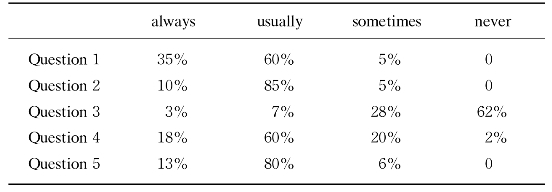
In Table 1,the author of the present study lists four choices according to question 1 to 5,the students'proportion in percentage for different choices is listed.
According to Table 1,it can be seen that there are 60%students usually ask their teachers for the translation of the unknown words when they don't know the meaning of new words;there are 85% students usually consult English-Chinese Dictionaries to get the Chinese meanings when they don't know the meaning of new words;there are 62%of students never consult English-English Dictionaries;there are 60%students usually use L1 in conversation with teachers or other speakers when they don't know how to express their ideas in English inside or outside classrooms;there are 80%teachers usuallyuse the G-T Method in English teaching.
Table 1
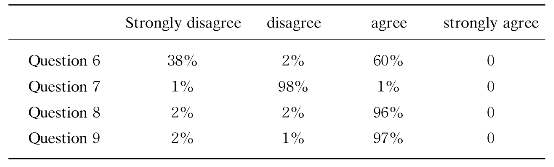
In Table 2,the present author lists four choices according to question 6 to 9,the students'proportion in percentage for different choices are listed.
According to Table 2,it can be seen that there are 60%students agree that teachers use the G-T Method in the class is very helpful;there are 98%students disagree that teachers use the G-T Method in the class is boring;there are 96%students agree that teachers use the G-T Method in the class is very necessary;there are 97%studentsagree that they can understand much better the meaningof the text when their teachers use the G-T Method in their class.
Table 2
In Table 3,there are 52%students like their teachers to use the G-T Method in their class.
Table 3

Forty teachers are randomly chosen from Nanjing Naval Medical School,Central South University in Changsha,Southeast University in Nanjing and Nanjing University of Finance and Economics to give their answers to the questions in a questionnaire containing two questions concerning the application of the G-T method.(The questionnaire is also attached below.)
Questionnaire for teachers'use
1.I think the G-T Method is________in foreign language teaching.
veryuseful________; useful________;
of littleuse________; of novalue________.
2.I________usetheG-T Method in myclass.
always________; usually________;
sometimes________; never________.
In Table 4,there are 93%teachers think that the G-T Method is very useful,nobody thinks that it is of no value;
Table 4

In Table 5,there are 80%teachers usually use the G T Method in their class.
Table 5

All in all,the overwhelming percentage of students have positively looked at the application of the G-T Method in their studies and teaching.The G-T Method is a common practice,it indeed has played a very important role in Foreign Language Teaching(FLT)and Foreign Language Learning(FLL)situations.
0.3.6 Methodology and scope of limitation
In this study,the G-T Method in FLT is pursued from theoretical and empirical study perspectives.The present study is interdisplinary in that it benefits not only from comparisons with other methodologies,but from its adjacent disciplines as linguistics and psychology as well.The positive role of mother tongue as a learner's strategyin the G-T Method and study of mental lexicon are also very beneficial.Instead of making subjective and arbitrary judgments on the advantages of the G-T Method,qualitative and quantitative analyses of the application of the GT Method are employed.
The present study adopts a theoretical and empirical approach to the investigation of the critique of the G-T Method in FLT.Though both theoretical and empirical analyses have been made concerning the topic of the present dissertation,despite numerous psycholinguistic experiments which show the order in which rules are learned and mistakes made in learning a fewer isolated syntactic phenomena,mostly in English,no study has shown how the child shifts out of the rules from the huge mass of data,how he decides what is grammatical from the semi-grammatical and ungrammatical strings he hears along with the fully-grammatical rules.Also unknown is how he tells what rules are uninversed,what are not.It's not likely that people will know the answers to these questions for a long time.The question of the nature of firstlanguage acquisition is just as dark as second language acquisition.This is the area the authors'scope of further research of the present topic is limited,and perhaps this is the area in which psycholinguistic studies have much to achieve.
0.4 Summary
Most language teachers realize that there is no such thing as“the best teaching method,”and therefore,few professionals in the field today persist in using only one approach or one method.On the contrary,teachersshould try to be as flexible as possible in choosing the teaching techniques that will enable them most effectively to achieve their main goal to give students both grammatical accuracy and communicative proficiency in a foreign language.Translation as an alternative which can contribute to the realization of teaching goals can be used effectively to promote second language learning.