二、句子种类
英语句子有不同的分类方法。按使用目的可分为陈述句、疑问句、祈使句和感叹句。按其结构又可以分为简单句、并列句和复合句。
(一)陈述句
陈述句用于叙述某件事情的内容、发生和发展,或陈述一种看法。陈述的内容有肯定和否定两种情况。
例:Light travels faster than sound.
光比声速度快。
You must give more thoughts to leaving school.
你必须仔细考虑离开学校的事。
He did not agree with all of us at all.
我们所有人的意见他都不同意。
(二)疑问句
疑问句用于提出问题。
1.一般疑问句
以助动词为句首的疑问句。
例:Have you got your letter?
你收到信了吗?
Did you go shopping yesterday?
昨天你去购物了吗?
Will you be willing to help him with his math?
你愿意帮助他数学吗?
2.特殊疑问句
以wh或h开头的疑问词引导的疑问句。
例:Where is your hometown?
你的家乡是哪儿?
How does such a thing happen?
这事怎么发生的?
3.选择疑问句
通常用于两个事物之间的选择。
例:Do you like to go to Shanghai or Beijing for your higher education?
你喜欢去上海还是去北京深造?
The old or the young,which one do you think will be good for this position?
你认为谁更合适这个职位,那个年老的还是那个年轻的?
4.反义疑问句
反义疑问句由陈述句和附在其后的附加疑问句(我们叫它们陈述部分和疑问部分)组成。其中,疑问部分对陈述部分所说的事实或观点提出疑问,起证实作用。应注意的是,如果陈述部分为肯定式,疑问部分应为否定式;如果陈述部分是否定式,疑问部分就应是肯定式。
例:She often has lunch at school,doesn’t she?
她经常在学校用午餐,是吗?
You don’t like sports,do you?
你不喜欢运动,对吗?
反义疑问句中应注意的一些特殊情况:
(1)时态的一致性 句子陈述部分和反问部分的时态应一致。
例:He will go abroad,won’t he?
他要出国了,是吗?
You sold your car,didn’t you?
你把车卖了,是吗?
(2)否定词视为否定含义 陈述部分带有little,few,never,hardly,seldom等否定意义的词时,疑问部分用肯定式。
例:He hardly knows how to do it,does he?
他不知道怎么做,是吗?
He was seldom late,was he?
他很少迟到,对吗?
(3)主语的一致性
1)陈述部分为I am时,疑问部分为aren’t I。
例:I am interested in the business,aren’t I?
我对这事很感兴趣,是不是?
2)陈述部分为第一人称+think(believe,suppose,consider)+that从句时,疑问部分的动词及主语与that从句内的动词和主语保持一致,但仍按陈述肯定,疑问否定,或反之的原则。
例:We think that English is very difficult to learn,isn’t it?
我们认为,英语很难学,是不是?
I believe that he has done the right thing,hasn’t he?
我相信他做的是对的,不是吗?
I don’t think that you can do it without help,can you?
我不认为在没有帮助的情况下你能做这件事,你能吗?
但陈述部分不是第一人称,上述句型的疑问部分中的主语和动词应与陈述部分中的主语和动词相同。
例:They all think that English is very important,don’t they?
他们都觉得英语很重要,不是吗?
3)陈述部分为主语+said(told,reported,asked等)+that从句时,疑问部分的动词和主语与陈述部分的主句动词和主语保持一致。
例:Lisa told you that she would go there,didn’t she?
丽莎告诉你她要去那儿,不是吗?
陈述部分的主语为不定代词something,anything,nothing,everything时,反问部分的主语用it。
例:Nothing has happened to the children in the family,has it?
这家的孩子们什么事也没有发生,是吗?
Everything is perfect to him,isn’t it?
他的一切都很好,不是吗?
4)let句型:陈述部分为let me时,反问部分习惯上用shall I或will you。陈述部分为Let us时,疑问部分习惯上用will you。但陈述部分为let’s时,疑问部分习惯上用shall we。
例:Let me have a try,shall I?(will you?)
让我试试,好吗?
Let us go into the room,will you?
让我们进屋好吗?
Let’s go to visit Tom together tonight,shall we?
咱们今晚一起去看汤姆好吗?
5)祈使句:陈述部分是祈使句时,疑问部分一般用will you,或用won’t you表示委婉。
例:Please turn on the lights,will you/won’t you?
请开灯好吗?
Don’t put your book here,will you?
别把你的书放这儿好吗?
6)there/here be句型:陈述部分为there/here be句型时,疑问部分也用该词,谓语同陈述部分。
例:There are so many cars on the street,aren’t there?
街上有很多车,是吗?
Here is the chair I wanted to buy,isn’t here?
这就是我要买的那把椅子,对吗?
7)must/may/might+have done表示推测时,若句中带有明显的过去时间的状语,疑问部分的动词用过去时;若句中没有带明显的过去时间的状语,疑问部分的动词用现在完成时。
例:You must have done your homework this early evening,didn’t you?
你今天晚上很早就完成作业了,是吗?
You must have worked there,haven’t you?
你在那儿工作过,是吗?
8)陈述部分的主语为从句、动名词或不定式时,反问部分的主语一般用it代替。
例:What he did is totally wrong,isn’t it?
他彻底做错了,不是吗?
Working hard is what we need,isn’t it?
我们需要的是努力工作,不对吗?
(三)祈使句
祈使句用来提出请求、建议、命令、祝愿或发出邀请。祈使句的主语为第二人称(you),但为了使句子简短有力,主语(you)一般被省略。其否定式则在句首加Don’t。
例:Let him in,please.
请让他进来。
Don’t open the door.
别开门。
(四)感叹句
感叹句表示说话人惊奇、喜悦、愤怒等情绪。感叹句常用陈述句或祈使句、what和how引导的句型以及单词或短语表示。
1.感叹句用陈述句表示
音调发生变化,句尾用感叹号。
例:Catch that thief!
抓住小偷!
Would you really trust him?!
你真的相信他?!
He comes!
他来了!
2.感叹句用what和how引导的句型表示
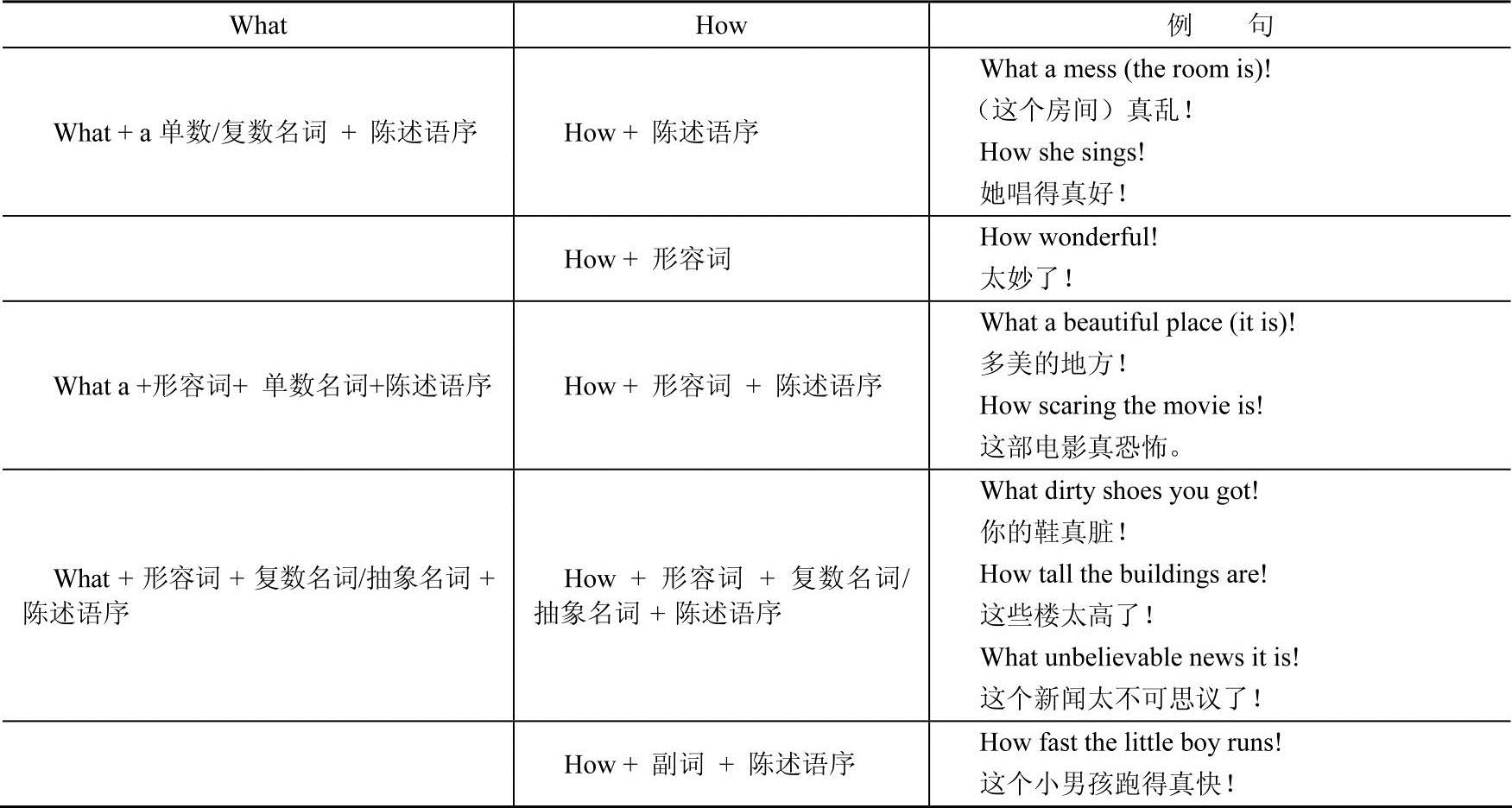
感叹句多由how和what引导。通常,what修饰名词,how修饰动词、副词和形容词,见表2-19。
表 2-19
3.感叹句用单词或短语表示。
例:Look!
看啊!
Well done!
干得好!
(五)简单句
句子中只有一个主谓结构的句子叫做简单句。句子的各个部分均为单词、词组和短语。简单句有五个基本句型。
1.主语+谓语
本句型中谓语动词是不及物动词,后面不需跟宾语,但可跟状语。
例:I just graduated.
我刚毕业。
He slept early last night.
他昨天晚上睡得很早。
2.主语+谓语+宾语
本句型中谓语动词是及物动词,必须有宾语,也可跟状语。
例:He went to work.
他上班去了。
I write my paper at home.
我在家里写文章。
3.主语+谓语+表语
本句型中谓语动词是系动词,必须加上一个表明主语特征、身份、状态的表语。常见的系动词有:be,become,get,turn,grow,look,feel,smell,taste,sound,seem,keep,stay等。可跟状语。
例:It becomes cold these days.
这几天天气变冷了。
The painting looks nice.
这幅画看起来不错。
4.主语+谓语+间接宾语+直接宾语
本句型中谓语动词后跟有两个宾语,这两个宾语都是动作的对象或承受者,其中指人的是间接宾语,指物的是直接宾语。当间接宾语放在直接宾语之后时,通常需要加介词for或to。可跟双宾语的动词有:answer,bring,buy,find,get,give,lend,make,pass,pay,send,show,sing,take,teach,tell,write等。可有状语。
例:Susan showed me the gifts.
苏珊给我展示了她的礼物。
He paid back money to me yesterday.
他昨天把钱还给我了。
5.主语+谓语+宾语+宾语补足语
本句型中构型中宾语补足语对宾语进行补充说明。可以用做宾语补足语的有:名词、形容词、不定式、动名词、分词、介词短语等。
例:We must keep our room clean.
我们必须保持房间整洁。
They forced him to sing.
他们强迫他唱歌。
(六)并列句
并列句是由并列连词将两个或两个以上平等关系的简单句连接在一起构成的句子。其结构是:简单句+并列连词+简单句。并列句中分句之间的关系可大致分为四种。
1.同等关系
这类连词有:and(和),not only...but also(不仅……而且),neither...nor(既不……也不),when(就在什么时候就……),等等。有时也直接使用逗号或者分号连接两个简单句。
例:He teaches me English and I teach him Chinese.
他教我英语,我教他中文。
I was just getting in when he came out.
我正要进去,他就出来了。
2.选择关系
这类连词有:or(或者,否则),or else(否则),either...or(不是……就是)。
例:You’d better hurry up to start,or you’ll stay at home.
你最好快点出发,要不然就待在家里。
It’s your choice!Either she leaves or I will.
你选择吧。要么她走,要么我走。
3.转折关系
这类连词有:but(但是、只是、因为),while(而、却),yet(可是),still(仍然),however(然而),等等。
例:I was sleeping while she was watching TV.
我在睡觉,可她在看电视。
She does not speak English and yet she seems understand what we say.
她不说英语,可她似乎能听懂我们的话。
4.因果关系
这类连词有:for(因为),so(所以、因此),等等。
例:She walks fast,for it is very dark.
她走得很快,因为天太黑了。
No one here knows the problem so he has to turn to someone else for help.
这里没人知道问题所在,所以他不得不另找他人帮忙。
(七)复合句
复合句是由一个主句和一个或一个以上的从句构成的句子。从句是在主句中充当一个成分的分句,如充当主语、表语、宾语、定语、状语等。
1.主语从句
在主句中充当主语的从句叫主语从句。主语从句一般都是做谓语动词的主语,偶尔也可以做分词的主语。这类连词有:what,whatever,whoever,when,that,where,how,whether等。
例:That they were fresh fruits was clear.
显然这些的确是新鲜水果。
Whoever the man is does not have any effect at all.
不管这人是谁都毫无影响。
有些主语从句能用it做形式上的主语。如上述第一个例句可以改成:
It was clear that they were fresh fruits.
2.宾语从句
在主句中起宾语作用的从句叫做宾语从句。其连词有:that,if,whether,why,how,who,whom,whose,what,which,when,where等。宾语从句中谓语动词的时态常常受到主句谓语时态的制约。如果主句谓语是一般现在时或将来时,则从句谓语的时态不受限制;如果主句谓语的时态是一般过去时,则从句通常需要使用相应的过去时态(一般过去时、过去进行时、过去将来时、过去完成时等)。
例:I don’t know how I should contact with her.
我不知道如何与她联系。
Did you see who put the box here?
你看见是谁把箱子放在这儿了吗?
3.表语从句
在主句中起表语作用的从句叫做表语从句。用于表语从句的连词有:that,what,where,why,how,if,whether,that,as,because,as if,as though,lest等。
例:The reason you feel tired is because you did too much.
你感觉疲倦的原因是因为你做得太多了。
The problem is who we can get to replace her.
问题是我们能找到谁去替换她。
4.定语从句
在主句中起定语作用的从句叫做定语从句。可以用来引导定语从句的词有:who,whom,which,when,where,why as,that等。
定语从句的前面都有先行词(被修饰语)。
例:The little girl who is dancing is my daughter.
跳舞的那个小女孩是我女儿。(girl是先行词)
关系词在定语从句中充当某一成分。
例:That is the room where we found the evidence.
那就是我们找到证据的房间。(where表示地点)
that和which在定语从句中使用是有区别的。
1)不能用that的情况
·介词+whom/which的从句中,不能用that。
例:She brought with her three friends,none of whom I had ever met before.
她带了三个朋友来,我以前从来没见过他们。
·当非限制性定语从句与主句之间有逗号隔开时,后面的定语从句中只能用which。
例:One of the boys kept laughing,which annoyed Jane intensely.
有一个男孩不停地笑,立刻激怒了简。
2)不能用which的情况
·先行词是all,much,the little,what little,something,anything,everything,nothing时,只能用that,不能用which。
例:I handed over what little money(that)I had left.
我把我仅剩的一点钱交了出去。
·先行词前有形容词最高级、序数词或only,next,last,all,any,very一类词修饰时,只能用that,不能用which。
例:This is the only problem that we can’t work out.
这是唯一的我们不能解决的问题。
He is the most humorous man that I have ever met.
他是我遇到过的最幽默的人。
5.状语从句
在主句中起状语作用的从句叫做状语从句。状语从句可分为时间状语从句、地点状语从句、原因状语从句、目的状语从句、结果状语从句、条件状语从句、让步状语从句等。
(1)时间状语从句 可引导时间状语从句的词有:before,after,when,while,as,since,till,until,as soon as等。
例:I did not begin to work till he had gone.
他走了后我才开始工作。
As time passed,things seemed to get worse.
随着时间的推移,情况似乎也越来越糟。
(2)条件状语从句 可引导条件状语从句的词有:if,unless,as/so long as,on condition that,in case等。
例:Let’s go out to have dinner together unless you are still angry with me.
咱们一块儿出去吃饭吧,除非你还在生我的气。
In case I forget,please remind me about it.
如果我忘了,请提醒我。
(3)让步状语从句 可引导让步状语的连词有:although,but,though,however,whatever,whoever,however,whenever,wherever,while,no matter how,even if,whether...or等。
例:While we don’t often see each other we still are very close friends.
尽管我们不常见面,我们仍是很亲密的朋友。
Child as he is,he is very self-controlled.
虽然他还是个孩子,自制力却很强。
(4)原因状语从句 可引导原因状语从句的连词有:because,as,since,seeing(that),now(that),as,for等。
例:Now that we are alone,we can speak freely.
现在我们单独在一起,可以随便谈了。
Since the weather is so bad,we have to delay our journey.
天气如此恶劣,我们不得不推迟旅行。
(5)地点状语从句 可引导地点状语从句的词有:where,wherever,everywhere,anywhere等。
例:Wherever you are I am expecting message from you.
不管你在哪儿,我都期盼着你的消息。
Where I live there are so many new apartment buildings.
我住的地方有许多新的住宅大楼。
(6)目的状语从句 可引导目的状语从句的词有:in order that,so that,in case,that,lest,for fear等。
例:He took notes carefully in class so that he could review the lesson after class.
他认真地记笔记,以便课后复习。
She turned away from window lest anyone see her.
她离开了窗户,唯恐有人看见她。
(7)结果状语从句 可引导结果状语从句的词有:so that,so...that,such...that等。
例:He was so excited that he couldn’t sleep for the entire night.
他太激动了以致通宵无眠。
He slowed down his pace so that she could catch up with him.
他放慢了脚步以便她可以跟上他。
(八)强调句
强调句是指用特殊的句型或词和短语的特殊用法来表示情感或意愿的句子。
1.用句型强调
(1)it强调句 这个句型可以分别强调句子的各个部分。其形式为It is/was+被强调的部分+that/who+句子的其他部分。
例:He taught math in high school ten years ago.
10年前他在中学教数学。
It was he/him who taught math in high school ten years ago.
就是他10年前在中学教数学。(强调主语)
It was math that he taught in high school ten year ago.
他10年前在中学教的是数学。(强调宾语)
It was in high school that he taught math ten year ago.
10年前他是在中学教数学。(强调地点)
It was ten years ago that he taught math in high school.
正是10年前他在中学教数学。(强调时间)
(2)what句型 指what引导的名词从句。其形式为What...is/was...。
例:What interested me most in that movie was the quietness of the small town.
那部电影吸引我的地方是小镇的宁静。
(3)not...until...句型 其形式为It is/was not until+被强调部分+that+其他部分。
例:It was not until her husband came back that she began to cook.
直到她丈夫回来她才开始做饭。
其他用于强调的句型还有反义疑问句、倒装句以及一些具有虚拟语气的句型。
2.用短语强调
用来强调的短语有:at all,in the world,on earth。
例:What on earth do you want me to do?
你到底想让我干什么?
3.用单词强调
(1)用形容词very,single强调名词
例:This is the very room my grandma lived.
这就是我祖母住过的房间。
(2)用反身代词强调人物
例:We ourselves will try to solve the problem.
我们将自己解决这个问题。
(3)用助动词do/did强调动词
例:Please do come early,so we will have enough time.
请一定早点来,这样,我们会有足够的时间。
(4)用副词very,only,even,too,just等强调形容词、副词及短语
例:Only in this way can we work it out fast.
只有这样我们才能快速解决问题。
(九)倒装句
在特定的情形下,要将句子的主语和谓语调换位置,称为倒装句。
1.需要倒装的句型
(1)以here,there,now,then等地点或时间副词开头的句子 谓语动词是be,come,go,remain等,而主语又是名词时主谓语倒装。
例:Here comes our monitor.
咱们的班长来了。
Now is your turn.
轮到你了。
(2)if引导的虚拟条件状语从句 连词if省略时主谓要倒装。
例:Were I you,I would be happy.=If I were you,I would be happy.
如果我是你,肯定会很高兴。
(3)as引导的让步状语从句 要把从句中的表语、状语或动词原形放在as之前,意为虽然、即便、尽管。
例:Unlucky as you are,you will not give up.
即便你不走运,你也不会放弃。
Try as he might,Tom could not get out of the difficulties.
不管怎样努力,汤姆还是摆脱不了困境。
Leader as she is,she can not make everyone under controlled.
虽然她是领导,她也不能控制所有的人。
2.需要倒装的短语
(1)only+状语only所修饰的副词、介词短语或状语从句位于句首时,要用倒装语序。这类短语有:only then,only thus,only in this way等。
例:Only then did I realize the importance of the seat belt.
那时我才意识到安全带的重要性。
(2)介词短语 表示地点的介词短语放在句首进行强调时,句子的主谓应倒装。
例:From her room came the sweet music played on the piano by her daughter.
从她的房间飘出了她女儿弹奏的美妙的钢琴音乐。
(3)其他短语 在by no means,in no time,hardly...when/before,no sooner...than,not only...but also等句型中,需要倒装。
例:Hardly he had stood up when he was knocked to the ground.
他还没站稳就被打倒在地。
3.需要倒装的词
具有(半)否定意义的词位于句首时,如seldom,rarely,not,never等,需要倒装。
例:Seldom have I read an article that was so full of lies.
我读过的文章很少有全篇都瞎编的。