五、形容词和副词
形容词修饰名词或代词,表示人或事物的性质、状态和特征。副词修饰动词、形容词、副词以及整个句子,说明时间、方式、地点以及程度等。本部分分析形容词和副词的基本概念及用法,以及两种词性在使用时应注意的情形。
1.形容词的种类
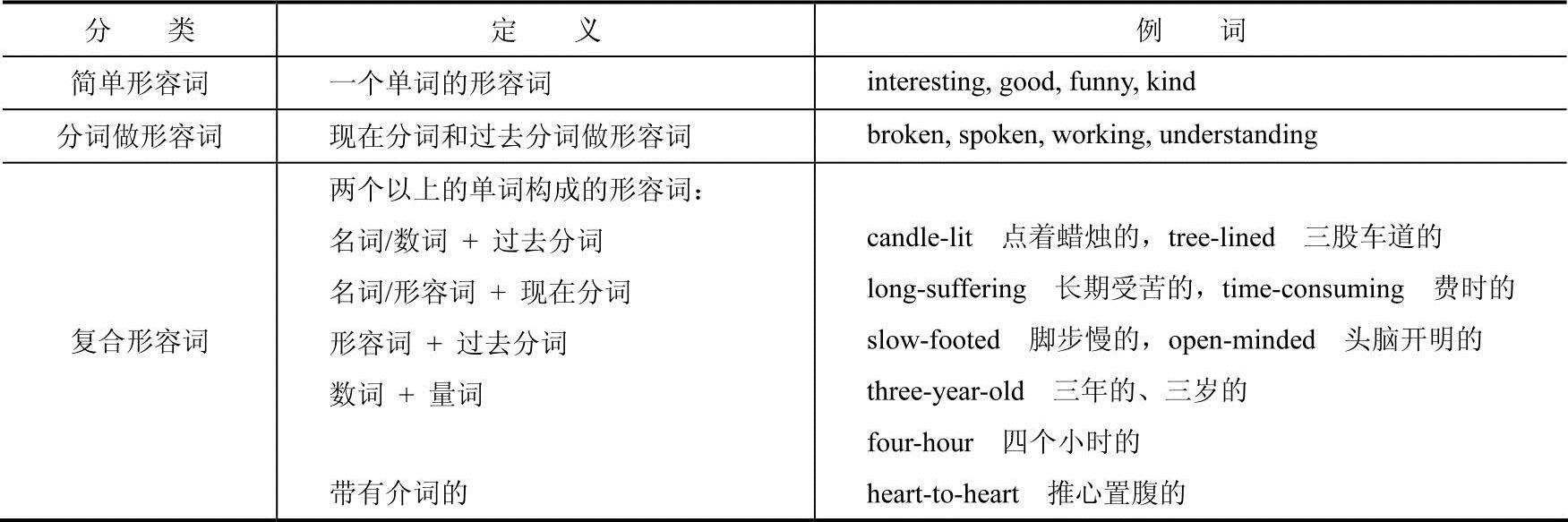
形容词大体分为三种:简单形容词、分词做形容词和复合形容词,见表2-11。
表 2-11

2.形容词的功能
形容词在句中可做定语、表语和补语。
1)做定语 The sunset is a beautiful sight.
日落是一种美丽的景象。
She is a good student,and she works hard.
她是个好学生,学习努力。
2)做表语 He is very busy right now.
他现在特别忙。
The apartment is too expensive for me to afford it.
这套公寓太贵了,我买不起。
3)做补语 You make it hard for me to accept the fact.
你让我很难接受这一事实。
I find it easy to get on with him.
我发现和他相处很容易。
3.形容词在句中的位置及顺序
形容词做定语一般放在被修饰的名词之前。如果有两个或两个以上的形容词修饰一个名词,形容词的顺序由它们和被修饰的名词之间的密切程度决定,越密切的形容词越靠近名词。如果几个形容词的密切程度差不多,则音节少的形容词放在前面,音节多的形容词放在后面。
例:She has a beautiful brown leather jacket.
她有件漂亮的棕色皮夹克。
He has a long red American car.
他有辆加长的红色美国轿车。
注意:单词something,anything,nothing等不定代词被形容词修饰时,形容词放在其后。
例:Is there anything interesting in the film?
电影里有什么有趣的事吗?
4.名词化的形容词
名词化的形容词指的是有些形容词前加定冠词表示一类人或事物,语法上做名词用。常用的有the young,the old,the rich,the poor,the sick,the wounded,the deaf,the blind,the healthy,the living,the dead,the unemployed,等等。还有其他一些说明人的性格和状态的形容词。这类词大都有复数含义,相应的代词用they。这类词做主语时,谓语动词用复数形式。但有些形容词名词化后有单数含义,相应的,其谓语动词用单数。这样的词有:the accused(person)被告人,the unexpected(thing)意外的事,以及一些表示抽象意义的词。
例:The accused was acquitted of the charge.
被告被宣告无罪。
The poor get poorer;the rich get richer.
穷者越穷;富者越富。
The wounded were sent to the hospital immediately.
伤员被立即送往医院。
The true is to be distinguished from the false.
真伪须辨分明。
名词化的形容词在句中可做主语和宾语。
例:The disabled were let in free.
残疾人免费入场。
We should take good care of the old.
我们应当好好地照顾老人。
5.副词的种类
副词大体上可分为如下8种。
(1)时间副词 常见的时间副词有now,then,soon,ago,recently,lately,later,just,before,early,today,tomorrow,yesterday,tonight,suddenly,immediately,already,finally等。
时间副词在句中的位置:
1)表示确定时间的副词(today,yesterday等)通常位于句末,有时也位于句首。
例:He visited the school where he studied for six years yesterday.
Yesterday he visited the school where he studied for six years.
他昨天拜访了他曾经念了6年书的学校。
2)表示非确定时间的副词(soon,recently,suddenly等)可用于句末或句首,还可位于句中(通常位于实意动词之前,动词be、助动词、情态动词之后)。
例:He went to Paris recently.
He recently went to Paris.
Recently he went to Paris.
最近他去了巴黎。
3)几个表示时间的副词(still,already,just等)通常位于句中(实意动词之前,动词be、助动词、情态动词之后)。
例:I have already finished the book.
我已经看完这本书了。
He is just leaving.
他正要离开。
(2)地点副词 常见的地点副词有here,there,up,down,away,nearby,home,ahead,abroad,indoors,overseas,halfway,upstairs,downstairs等。
地点副词在句中的位置:地点副词通常位于句末或句首,但从不位于主语和谓语之间。若有多个副词排列,地点副词通常位于方式副词之后、时间副词之前。
例:Can you help to carry this table upstairs?
你能帮忙把桌子搬到楼上去吗?
(3)方式副词 方式副词常用来表示动词的行为方式。常用的方式副词有carefully,happily,quietly,heavily,warmly,correctly,politely,angrily等。
方式副词在句中的位置:方式副词位于动词(及其宾语)之后,单个的方式副词也可位于主语与动词之间。但要注意,位于动词之前和位于句末会导致句子意思的变化。
例:He walks slowly along the road.
他沿着这条路慢慢地走。
He quickly got dressed.
他赶紧穿好衣服。
They secretly decided to leave the town.
他们秘密决定离开这座城市。
They decided to leave the town secretly.
他们决定秘密地离开这座城市。
(4)频度副词 频度副词常用来表示动作发生的次数。常见的频度副词有ever,never,rarely,seldom,once,often,occasionally,constantly,frequently,usually,continually,always等。
频度副词在句中的位置:频度副词通常位于实意动词之前,动词be、助动词、情态动词之后,也可位于句末(尤其受very,only修饰时),有的频度副词(如sometimes,often,usually,frequently,occasionally等)可位于句首。
例:She is seldom late for work.
她上班很少迟到。
He travels very often.
他经常旅游。
Occasionally he goes shopping.
他偶尔出去买买东西。
(5)程度副词 程度副词是表示程度的副词。常见的程度副词有fairly,pretty,rather,quite,very,much,too,greatly,almost,nearly,half,highly,awfully,deeply,partly,perfectly,really等。
程度副词主要用于修饰形容词和副词。有的还可修饰比较级(much,rather等)和最高级(如quite,much,almost等);有的程度副词(如quite,rather,almost等)可修饰动词;但有的(如fairly,pretty,very等)则不能修饰动词;个别的程度副词(如quite和rather)还可修饰名词。
例:Houses are much more expensive these days.
如今的房价贵多了。
I quite agree with you.
我完全同意你的意见。
It is quite/rather a good idea.
那可真是个好主意。
(6)连接副词 连接副词分为两类,一类用于连接句子或从句,常见的有therefore,besides,otherwise,however,moreover,still,thus,meanwhile等;另一类用于引导从句或不定式,常见的有when,why,where,how等。
连接副词类似于并列连词,使用时其前面通常用分号或句号;若其前面用逗号,则通常带有并列连词and。有的连接副词(如however)后通常有逗号与句子的其他成分隔开。另外,这类副词有的还可位于句中或句末。
例:I don’t like it;besides,it’s too expensive.
我不喜欢它,而且也太贵了。
He may,however,not come at all.
不过,他也许根本不回来。
I don’t know how to do this.
我不知道怎么做。
(7)关系副词 关系副词用于引出定语从句,且在从句中用作状语。关系副词when表示时间,where表示地点,why表示原因。
例:That is the shop where I lost my purse.
那就是我丢钱包的商店。
Do you know the reason why he was fired?
你知道他被解雇的原因吗?
(8)疑问副词 疑问副词用于引导特殊疑问句,常见的有when,where,why,how等。疑问副词通常位于句首,但有时也会有介词短语等在句首。
例:Why do you argue with him?
你为什么要跟他争吵?
Without your help where can we find these books?
没有你的帮助,我们到哪儿能找到这些书呢?
特别注意:表示评估的well,badly,hard等只放在句尾。
例:The boss pays his staff very well/badly.
这个老板给他职员的工资很高/低。
6.副词在句中的作用
(1)副词在句中可做状语、表语和定语
1)做状语 He studies very hard in order to get into the university.
他刻苦学习以便能考上大学。
2)做表语 Can you tell me when he will be back?
你能告诉我他什么时候回来吗?
3)做定语 He loves life here because it is full of joy.
他热爱这里的生活,因为这里的生活充满了快乐。
(2)副词在句中的顺序 副词在句中的基本顺序是:时间和地点副词是小单位在前,大单位在后;方式副词是短的在前,长的在后,并用and或but等连词连接;多个副词的排列顺序是:程度副词、地点副词、方式副词、时间副词。
例:We went shopping in the supermarket at 9 o’clock yesterday.
昨天9点钟我们到超市买东西了。
What were you doing in the classroom at about 8 o’clock yesterday evening?
昨天晚上大约8点钟时你在教室里干什么?
Xiao Li works very hard in the factory every day.
小李在工厂每天都很努力地工作。
注意:①副词very可以修饰形容词,但不能修饰动词。
例:I like this place very much.
我非常喜欢这个地方。
②副词enough永远放在形容词、动词和副词的后面,通常放在名词前面。
例:You can go to school when you are old enough.
你到了年龄就可去上学。
He just hadn’t thought enough about the possible consequences.
他只是没有想好可能产生的后果。
Strangely enough,I didn’t feel at all nervous when I faced the audience.
太奇怪了,当我面对观众时一点儿都不紧张。
We haven’t got enough time.
我们还没有足够的时间。
7.形容词和副词的比较等级
形容词和副词有三个比较等级:原级、比较级和最高级。其中,比较级用于两者之间的比较,最高级用于三者以上(含三者)事物之间的比较。
(1)形容词和副词原级的比较方式 可用修饰词too,very,so,quite等放在形容词或副词原形前表示程度;用“as+原级形容词或副词+as”的结构表示双方相等;表示双方不相等时,用“not so(as)+原级形容词或副词+as”的结构;表示一方是另一方的若干倍时,用“倍数+as+原级形容词或副词+as”的结构。
例:It is too hard for me to finish this book.
这本书对我来说太难了,看不完。
Ms.Sun speaks English as fluently as you.
孙女士说英语跟你一样熟练。
This building looks not so(as)high as that one.
这座楼看起来没有那座楼高。
His house is three times as large as mine.
他的房子是我的三倍大。
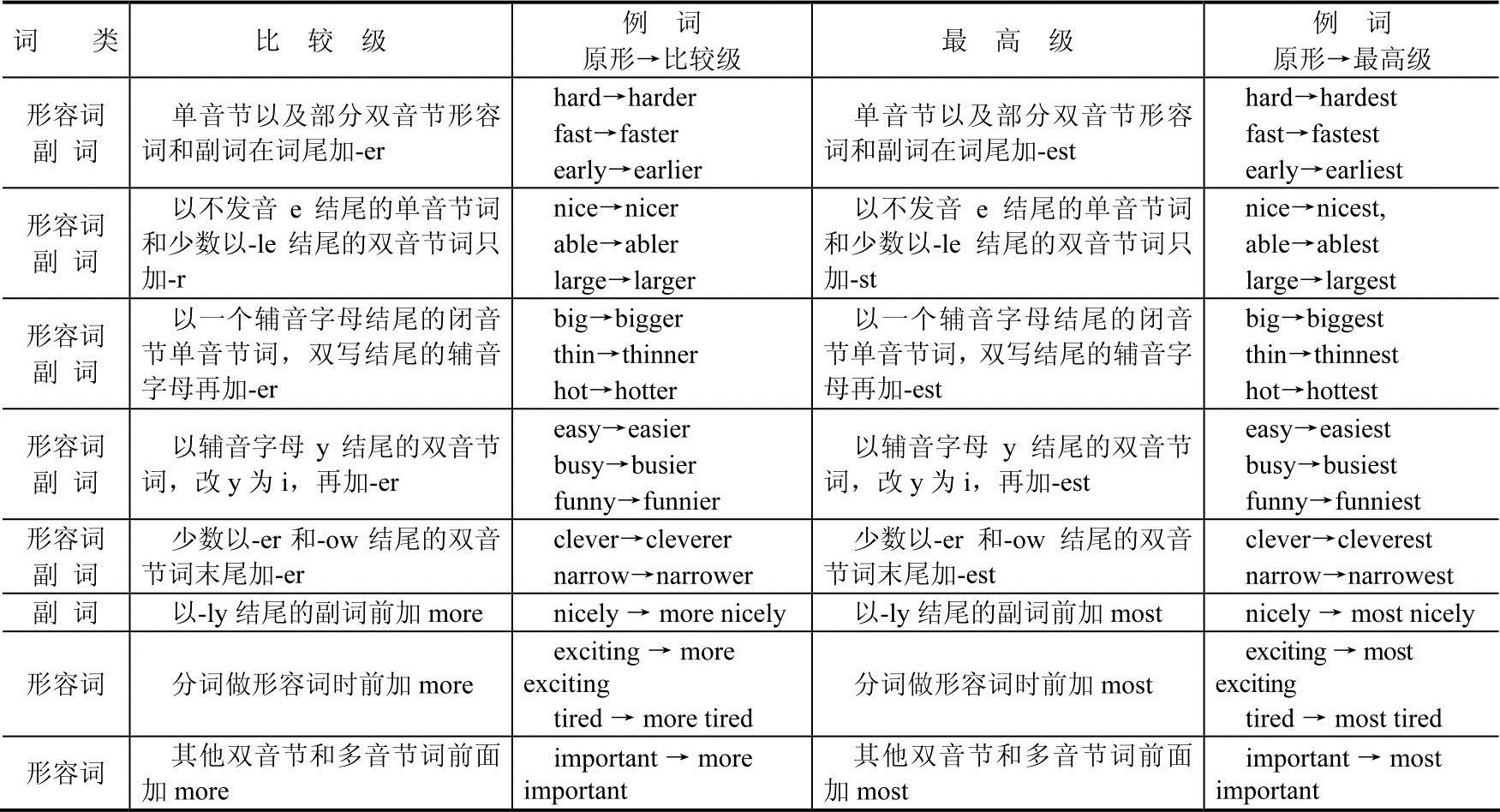
(2)形容词和副词比较级和最高级的构成 见表2-12。
表 2-12

(3)形容词和副词比较级和最高级不规则变化
原级 比较级 最高级
bad worse worst
badly worse worst
far further/farther furthest/farthest
few less least
good better best
ill worse worst
late later/latter latest/last
little less least
many more most
much more most
old older/elder oldest/eldest
well better best
(4)比较级的用法 比较级用于二者的比较,表示其中一个比另一个“更……”,其形式为:比较级+than。than后接比较的对象。但有时,形容词(副词)比较级也可单独使用。
例:There are less people in the hall than I expected.
大厅里的人没有我想象的那么多。
The little baby looks prettier than his sister.
这个小男孩看上去比他的姐姐漂亮。
This box is heavy,but that one is heavier.
这个箱子很重,但那个箱子更重。
比较级前可用下列词修饰:still,quite a bit,even,nearly,rather,much,a lot,a little等。
例:Tom grew still more depressed.
汤姆更沮丧了。
We’ll have to wait a little longer to see what happens.
我们最好再等会儿看看会发生什么。
比较级的常用句型有:
1)more than不只是、非常
例:He is more than kind to us all.
他对我们大家都非常好。
2)more and more越来越……
例:It is getting colder and colder the couple of days.
这几天越来越冷了。
3)the more...the more越……,越……
例:The more you think,the wiser you are.
思考越多就越聪明。
4)no more than只不过、仅仅
例:What he is doing is no more than wasting time.
他所做的不过是浪费时间。
5)no more...than...和……同样不……
例:He can no more play the piano than I can play basketball.
他不会弹钢琴就和我不会打篮球一样。
6)no less than多达、不下于
例:There were no less than two thousand people at the match.
这场比赛有不下2000人到场观看。
7)no less...than和……一样,不逊于
例:This novel is no less interesting than the one he lent me.
这本小说跟他借给我的那本一样有意思。
(5)最高级的用法
1)the+最高级+比较范围。形容词的最高级前必须加定冠词,副词的最高级前可不加。
例:The Sahara is the biggest desert in the world.
撒哈拉沙漠是世界上最大的沙漠。
Of the four of us,I sang(the)worst.
我们四人中我唱得最差。
He likes painting best of all.
他最喜欢绘画。
2)可修饰最高级的词有by far,far,much,mostly,almost,very,nearly等。
例:She is nearly/almost the most beautiful girl in the school.
她几乎是这所学校最漂亮的女孩了。
注意:very和much在修饰最高级时位置不同。
例:This is the very best.
This is much the best.
3)否定词语+比较级。这种形式表达的是最高级含义。同样:“否定词语+so…as”也含有最高级含义。
例:Your story is perfect.I’ve never heard a better one before.
你的故事太棒了。我以前从来没有听过这么好的。
比较:Nothing is so easy as this.
没有如此简单的了。
Nothing is easier than this.
没有比这更简单的了。
This is the easiest thing.
这是最简单的。