二、冠词
冠词是一种虚词,通常本身没有意义,置于名词或名词性单词前,说明名词所表示的人或事物。冠词不能单独存在。这部分将从两个方面讲解冠词:一是冠词基础,包括冠词的分类、冠词的位置以及冠词的用法;二是冠词在实际运用中应注意的问题。
1.冠词的分类
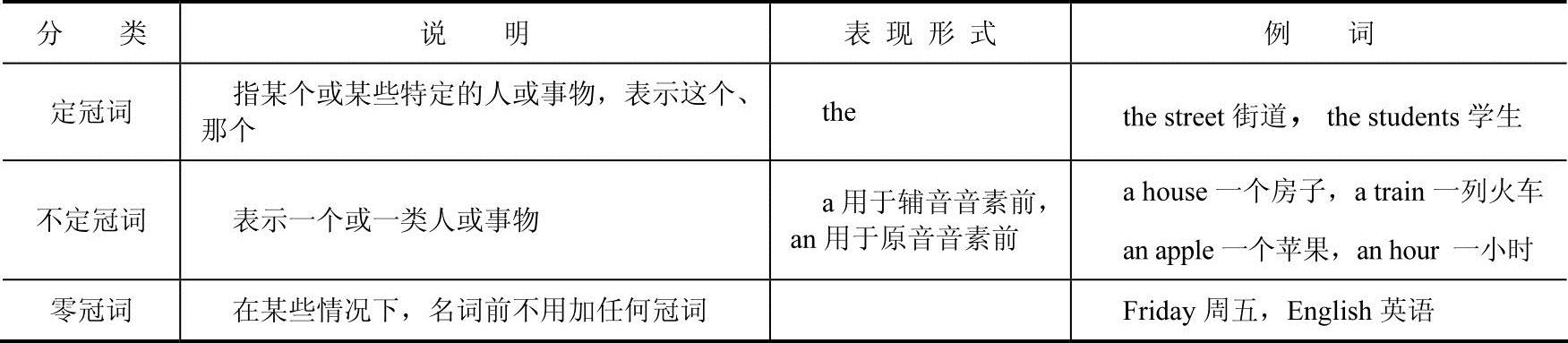
冠词可分为定冠词和不定冠词。还有另外一种情况,即零冠词,见表2-5。
表 2-5

2.冠词的位置
定冠词与不定冠词在修饰名词时的位置通常是相同的,但也有不同的情况,具体见表2-6。
表 2-6

3.冠词的用法
定冠词、不定冠词以及零冠词在不同的情况下会有不同的用法,需要强记。
(1)定冠词的用法
1)指世上唯一的事物。
例:The globe we live on should be preserved by ourselves.
我们居住的地球靠我们自己来保护。
When will we live on the moon?
我们什么时候能居住到月球上?
2)指特定的人或事物。
例:That is the teacher who taught me last term.
那位就是上学期教我的老师。
The event in history once played an important role.
这个事件曾在历史上扮演过重要的角色。
3)指上文提到的人或事物。
例:There is a man over there.The man walks toward me.
那边有个人。他朝我走过来。
He just watched a movie,he said.The movie is Love Is Life.
他说,他刚刚看了一个电影。电影的名字是《爱就是生命》。
4)用在单数名词前指一类人或事物;用在形容词或分词前指一类人,并使其形容词或分词名词化。
例:The forgiving will be the beloved.
宽容的人会成为被爱的人。
The man who is knowledgeable is respected.
有知识的人会受到尊重。
5)用在复数名词前指整体。
例:The books in the reading-room in the small village are from the government.
这个小村庄阅读室里的书都是政府给的。
The students in the university are from all over the world.
这所大学的学生来自世界各地。
6)用在做形容词的序数词前;用在方位词前。
例:That is the second time for him to take the test.
这是他第二次考试。
He was born in the city of the north.
他出生在北方的城市。
7)用在专有名词前(如机关、团体、地名、人名、国名、山川、河流、历史时期、事件、报刊、书籍等)。
例:The Yellow River is the second longest river in China.
黄河是中国的第二长河。
The Smiths have visited China twice this year.
史密斯一家今年已经来中国两次了。
There were many famous poets in the Middle Age.
中世纪有很多著名的诗人。
8)用在带有介词短语或从句做定语的名词前。
例:This is the hospital where you practiced for your medical study.
这就是你学医实习的医院。
The photo of the snow mountain was taken in the summer.
这张雪山的照片是在夏天照的。
9)用于固定词组。
例:in the day 在一天中 in the afternoon 在下午
in the dark在 黑暗中 in the rain 在雨中
the next morning 第二天早晨 by the way 顺便
in the distance 在远处 on the whole 整体
(2)不定冠词的用法
1)指“一个”人或事物。
例:Will you send me an email as soon as you arrive there?
你一到那儿就给我发封电子邮件好吗?
I saw a stranger in our office yesterday.
昨天我看到一个陌生人在咱们的办公室里。
2)指一类人或事物。
例:A book is the symbol of knowledge.
书是知识的象征。
A story means a description of how something happened.
故事是对已发生的事情的描述。
3)用在第一次提到的人或事物前。
例:I just read an article.The idea in the article is very profound.
我刚刚看完一篇文章,文章的观点很深刻。
A new teacher is coming.It is said the teacher is very strict.
要来新老师了。听说这位老师特别严。
4)用在一些时间、速度、价格的单位名词前,意为“每一”。
例:How many words can you read a minute in English?
用英文你每分钟能读多少词?
The publisher forces him to finish two novels a year.
出版商要求他一年完成两本小说。
5)用于固定词组。
例:take a break 休息一会儿 have a rest 休息一会儿
have a dinner 吃饭 all of a sudden 突然
as a matter of fact 事实上
(3)零冠词的用法
1)表示时间的星期、节假日、季节、月份等的名词前不加冠词。
例:Monday is the first day of the week.But some say Sunday is the first.
星期一是一周的第一天。但有人说星期天是一周的第一天。
The best season,for me,is winter.
对我来说,最好的季节是冬天。
2)表示三餐、运动及娱乐的名词前不加冠词。
例:They play basketball together every afternoon.
他们每天下午都一起打篮球。
Have you got something for lunch?
你中午吃饭了么?
3)表示人名、国名、头衔等的名词前不加冠词。
例:North of Canada is too cold to be a place for people to live.
加拿大北部太冷不适合人居住。
I want to ask Professor Wang to write a recommendation letter for me.
我想请王教授给我写推荐信。
4)表示一般概念的抽象名词前通常不加冠词。
例:Love is everywhere.
到处都有爱。
Water in this area is being polluted.
这个区域的水正在被污染。
5)由物主代词修饰的序数词前不用冠词。
例:My first touch to read English written novel is the Scarlet Letter.
我读的第一本英语原文小说是《红字》。
Taking care of her grandson is her second career.
照顾孙子是她的第二事业。
6)序数词做副词时前面不加冠词。
例:They arrived first and I after them.
他们先到,我随后就到。
When they were first married,they lived in Beijing.
他们刚结婚时住在北京。
7)某些固定词组中无冠词。
例:at daybreak 破晓时分at sunrise 太阳初升时
at noon 中午 at school 在学校
by train 乘火车 by day 一整天
from morning till night 从早到晚 from door to door 挨家挨户
go to class 去上课 go to school 去上学
in danger 处于危险之中 in hospital 在医院
in fact 事实上 in bed 躺在床上
4.冠词在使用中应注意的问题
(1)两个名词前分别由冠词修饰时表示两个不同的人或事物
一个名词前的两个形容词分别由冠词修饰时表示两个不同的人或事物。
两个名词前只有一个冠词修饰第一个名词时,表示同一个人或事物。
一个名词前的两个形容词只有一个冠词修饰第一个形容词,表示同一个人或事物。
例:The parent and the teacher have met in the classroom.
老师和家长已经在教室里见过面了。
I want a red and a black T-shirt,please.
请给我拿一件红色和一件黑色的短袖衬衫。
A coffee and milk is what I like.
我喜欢咖啡加牛奶。
(2)在一些固定词组中,有没有冠词会使词组的意义大不相同
1)at table 吃饭时
at the table在 桌子旁边
例:Talking is forbidden at table in my home.
在我们家吃饭时禁止说话。
He sat at the table and began to tell the story.
他坐在桌旁开始讲故事。
2)at play 在玩
at the play 在看戏
例:Children are at play outside the building.
孩子们在楼外面玩耍。
“What is Tom doing?”“He is at the play.”
“汤姆在做什么?”“他在看戏。”
3)behind time 迟到
behind the times 落后于时代
例:She is always behind time.
她总迟到。
We have to try our best to learn new things in order not to be behind the times.
我们要努力学习新东西以便不落后于时代。
4)by sea 乘船
by the sea 在海边
例:He is afraid to travel by sea.
他害怕乘船旅游。
He loves to spend his holiday by the sea.
他喜欢在海边度假。
5)in front of 在……(外)的前面
in the front of 在……(内)的前面
例:A bike suddenly stopped in front of the bus.
一辆自行车突然停在公共汽车前面。
You must give your speech in the front of the classroom and face your classmates.
你必须到教室前面面对你的同学做演讲。
6)in charge of 负责,掌管
in the charge of 在……的负责之下
例:She is in charge of the research project.
她负责这个科研项目。
We are working well on the research project in the charge of her.
在她的领导下,我们的科研项目运作顺利。
7)in words 用语言
in a word 总之
例:It is hard for me to express my feelings in words.
我很难用语言表达我的情感。
In a word,everyone has got his or her achievement during these ten years.
总之,这10年中每个人都有自己的成就。
8)out of question 毫无疑问
out of the question 不可能
例:It is out of question that he will win the first price.
毫无疑问,他会赢得一等奖。
It is out of the question that he will win the first price.
他要赢一等奖是不可能的。
9)take place 发生
take the place of 替代,接替
例:The event took place in 1867 in China.
这个事件发生在1867年的中国。
She is going to retire,so her son will take the place of her job.
她马上要退休了,她的儿子将接替她的工作。