7.2.3 Results
Two indicators of the recognition response were recorded and analyzed:one is the reaction time the participant needed to make the decision,that is,from the time stamp of the start of the slide to the timestamp when he/she pressed the“←”key or the“→”key;and the other is the correctness of the participant's judgment.
7.2.3.1 General descriptive statistics
7.2.3.1.1 Reaction time
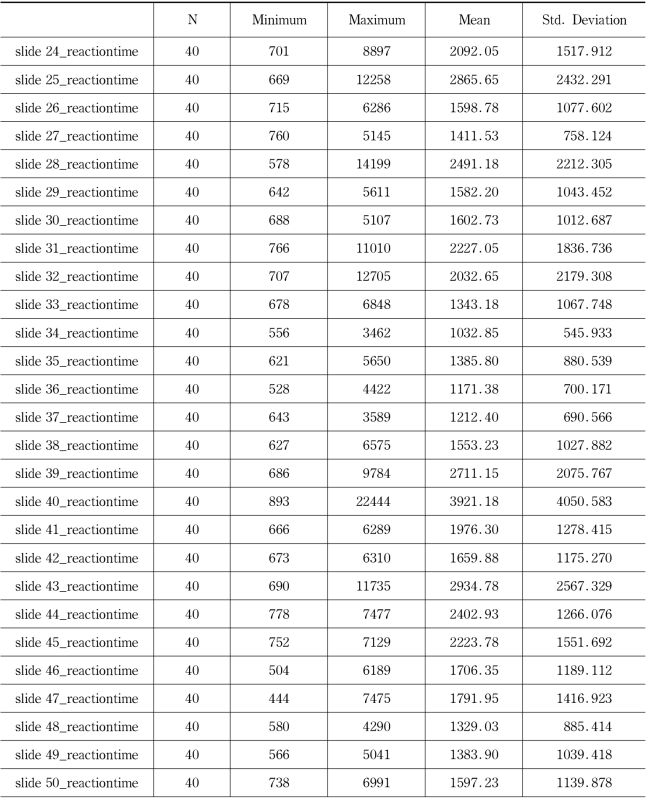
The mean reaction time for each slide was calculated and listed in Table 7.7 below.
Table 7.7 Descriptive statistics of the reaction time for each slide
(to be continued)
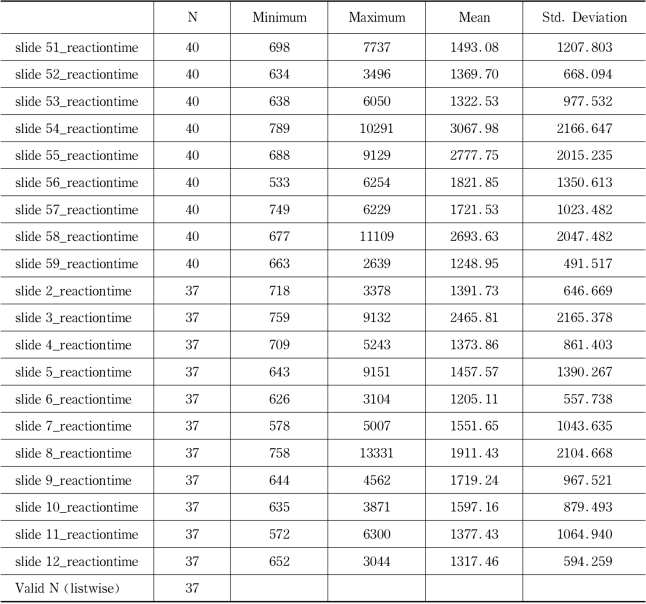
Categorization shows there are great differences among the three types of materials—pictures,diagrams and verbal texts(see Table 7.8).(The data of one slide in the diagram category was excluded because of its poor readability caused by its color reported by participants,that's why there were 5,instead of 6 items in the diagram category.)
Table 7.8 Reaction time for verbal texts,diagrams and pictures in the recognition test

The mean reaction time for pictures is the shortest,1544.67 ms,that for verbal text is the longest,2885.92 ms and that for diagrams is in between,2316.87 ms.
This result accords with the findings of previous studies(See for example,Rayner et al,2001;Pieters and Wedel,2004).It's generally acknowledged that the perception of a picture is quicker than that of a verbal text of similar surface size.The diagram's middle position between the two is in accordance with my prediction since the diagram combines the feature of picture and verbal text.Actually in all the six diagrams(and charts)used in the experiment,both pictorial elements such as embedded small-sized picture,shapes and colors and verbal text elements like phrases are incorporated(see Figure 7.15 for an example).
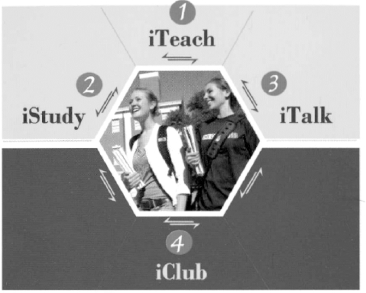
Figure 7.15 An example of diagram in the English learning advertisements
7.2.3.1.2 Correction rate
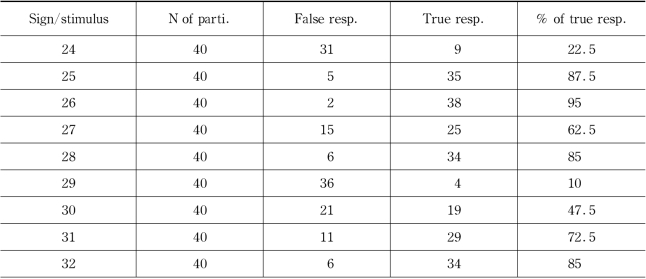
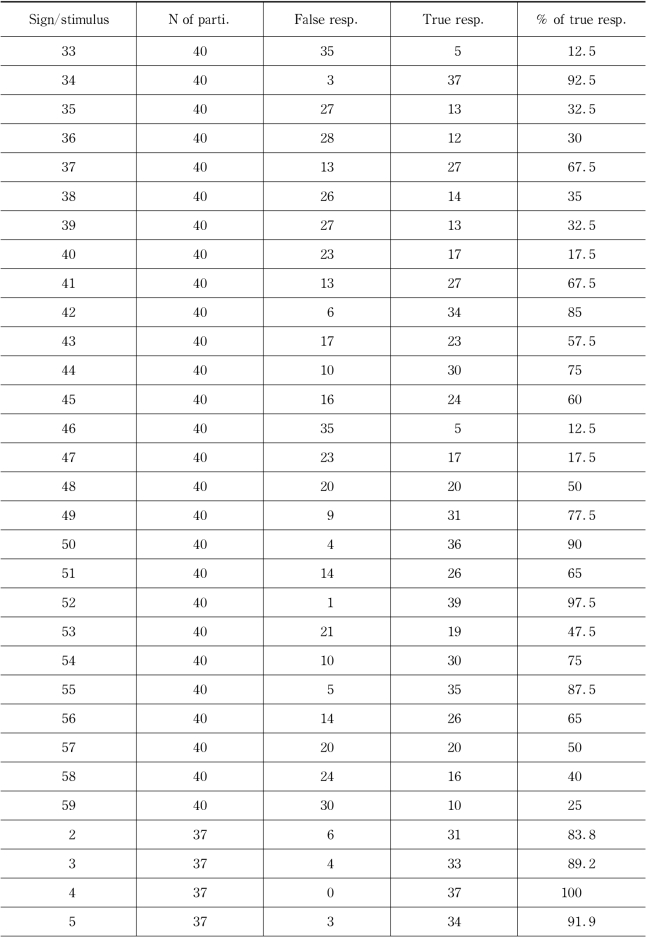
For each sign/stimulus,the numbers of participants that gave false responses and right responses were counted and the correction rate was computed(see Table 7.9 below).
Table 7.9 Correction rate of each of the stimuli
(to be continued)
((to be continued))
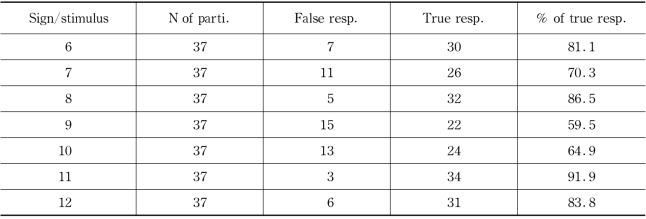
Scrutiny of these stimuli reveals that the stimuli correctly recognized by the largest number of participants are recognition foils.They take up all the 8 highest scores of correct rate and also 13 of the 17 items whose correction rates are higher than 80%.Further examination of these easily recognized foils reveals that all of them but one are pictures.In contrast,the verbal foils and diagram foils are not as easy to detect.
Table 7.10 below shows the mean correction rates of the verbal,diagrams and pictures.The correction rate for the diagram is the highest(71.7%),then the verbal(62.1%),and the picture is the lowest(60.9%).
Table 7.10 Descriptive statistics for correction rate of each category of stimuli

The fact that diagrams are easier to recognize than pictures and the verbal is expected and can be explained by the following reasons:(i)The diagrams in this experiment combine both pictorial elements and verbal elements and thus are more distinguishing.(ii)They have high score of global coherence with a mean score of 3.6,which is significantly higher than that of all test stimuli—3.04.(iii)They have higher local coherence since they function as illustrations of the teaching methods or course levels with which the adjacent verbal texts are concerned.(iv)They are very salient.They are either placed at the upper part near the centre of the page or painted in bright color(s).(v)Moreover,different from picture and verbal texts which always have some similar counterparts on the page,diagram is often the only one of its type on the same page.
7.2.3.2 Correlation test
In order to detect the possible relationship between variables including global coherence,local coherence,salience,and the recognition results data(including reaction time and correction rate)of the experiment,a correlation analysis is needed.Since the data used are interval data,the bivariate Pearson correlation test is appropriate.The results will be reported according to the three variables:Section 7.2.3.2.1 is concerned with global coherence,Section 7.2.3.2.2 with local coherence and Section 7.2.3.2.3 with cohesion(here salience)in layout.In order to find the differences between verbal and visual stimuli,we further distinct the experiment stimuli into two groups:verbal and visual,and did the correlation test again.The results of the correlation test based on differentiated stimuli will be reported in Section 7.2.3.2.4.
7.2.3.2.1 Global coherence
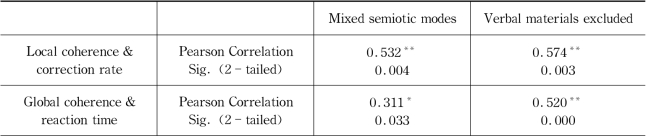
It's shown that the reaction time and global coherence are significantly correlated(r=0.311,p<0.05).Hypothesis 1 is supported.The significant positive correlation between global coherence and reaction time means that the suitability of a sign in the discourse topical structure and context of the whole text is closely related to the difficulty and the effort participants spend on its retrieval.When participants see a picture or a verbal proposition which does not fit into the discourse topic,they spend less time to make initial judgment before going into the specific content of the picture/verbal proposition.Conversely,when the picture/verbal highly matches the discourse topic of English learning,it is more likely to cause some degree of confusion and thus need longer time to judge.
7.2.3.2.2 Local coherence
Correction rate and local coherence are significantly correlated(r=0.532,p<0.01).Hypothesis 2 is supported.It means that the closer the semantic connection between the test stimuli and its adjacent semiotic content,the bigger probability it has to be remembered.This finding suggests that the local coherence or semantic connection of a semiotic unit has substantial influence on people's comprehension of the discourse and thus retrieval of the individual semiotic components in it.
The two pairs of significant correlation and absence of correlation between reaction time and correction rate suggest that there are two phases in the recognition of the test stimuli corresponding to people's reading/viewing behavior.In the first phase,participants give a very brief pre-attentive scan to the picture/verbal to get a tentative impression which is judged against their expectation out of their prior knowledge of the genre—the English learning advertisements.Here global coherence plays the censor's role,that is,when the test stimulus does not fit the genre,it sends a counter-expectation signal to the brain and the brain immediately closes the first phase.Thus the reaction time is shorter.Conversely,if the test stimulus fits well with the genre,the brain will proceed into the next phase.Therefore,its reaction time is longer.In the second phase,the brain needs to make the final decision as to discriminating the seen stimuli and the unseen stimuli.For this end,the participants need to pay focal attention and conscious observation to the stimuli.The local coherence plays the decisive role here.According to the findings in the field of information processing,well-organized texts show better results in comprehension and retrieval than poorly constructed texts.The closely weaved texture through semantic connection among individual semiotic components enhances comprehension of the whole text and lead to better learning results and memory.These findings can explain the result in this recognition experiment that test stimuli with better local coherence show significantly higher correction rate than those stimuli which bear weak semantic connection with adjacent semiotic signs.
7.2.3.2.3 Surface cohesion:Salience
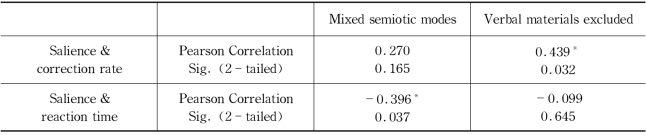
There is a significant negative correlation between the reaction time and salience(r=-0.396,p<0.05).It means that the more salient a sign is,the less time the participants spend in the judging process.No significant correlation was found between salience and correction rate in the recognition test.
7.2.3.2.4 Correlation test based on differentiated stimuli
In order to check the influence of the different semiotic modes of the signs on recognition memory,the textual materials were excluded and a correlation test was performed on the pictorial and graphical materials.This time the results were very different:for local coherence and global coherence,the correlation coefficients were highly increased.Specifically,the correlation between local coherence and correction rate increased from 0.532 to 0.574(p<0.01);the correlation between global coherence and reaction time increased from 0.311(p<0.05)to 0.520(p<0.01).
These changes show that the correlations between the two levels of coherence in content and the recognition memory test were much higher for pictorial and graphical materials than for textual materials.
The changes of correlation are summarized in Table 7.11.In the column of“mixed semiotic modes”,the results represent the condition in which verbal,pictorial and graphical materials were included in the data analysis.In the column of“verbal materials excluded”,only pictorial and graphical materials were included in the data analysis.
Table 7.11 Results of correlation test
(to be continued)
** Correlation is significant at the 0.01 level(2-tailed).
* Correlation is significant at the 0.05 level(2-tailed).
The change is more drastic for the variable of salience.As mentioned above,it was significantly correlated with the measurement of reaction time at the 0.05 level on the basis of all materials including verbal,pictorial and graphical.When the verbal materials were excluded,however,the correlation fell to an insignificant level(r=-0.099,Sig.=0.645,p>0.05)whereas the correlation between salience and another measurement of the recognition memory test—the correction rate—rose to be significant(r=0.439,p<0.05).This result indicates that for the pictorial and graphical materials,there is no significant correlation between salience and reaction time,but a significant correlation between salience and correction rate.The more salient a sign is,the larger the possibility is for people to correctly recognize it.Together with the result in the previous section,this result can lead to the conclusion that salience is significantly correlated with recognition memory,through reaction time or/and correction rate.The hypothesis concerning the effect of salience on recognition memory is supported.
7.2.3.2.5 Discussion
The change of correlation between salience and reaction time might be attributed to the contrast between the substantially lower rating of salience received by verbal materials compared to pictorial materials.As mentioned in the section of“global eye movement data”,verbal texts are more densely compact in a visual field and thus the processing of verbal texts generally requires longer time than pictures.The average reaction time of verbal materials in the current experiment was 2886 ms,which was much higher than that of the pictorial(1545 ms)and graphical materials(2317 ms).Therefore,the numbers of milliseconds obtained in the name of reaction time need to be analyzed with caution.They were not purely the time participants spent on the judging process,but the sum of reading time and the judging time.Due to the great differences in processing speed between verbal and pictorial signs,it's wise to analyze these data in separate groups of semiotic modes rather than in a mixed fashion.In the mean time,the mean values of salience are relatively low for verbal texts(1.4)than pictures(3.05)and graphs(4.4).The reason is that the criterion of salience is the distinctiveness of the sign with reference to its surroundings on the same page.Since the leaflets pages from which the materials were excerpted all include large amount of information in verbal mode,a specific paragraph was not highly distinguishable from other paragraphs in visual appearance.In contrast,the pictures and diagrams stood out easily in the generally verbal texts.The significant correlation between salience and reaction time obtained in the fashion of mixed semiotic modes should be considered with caution,at least not as a definite and unquestionable result.
In the condition of separate semiotic systems,the significant correlation between salience and correction rate sheds light on the cognitive processing of pictorial signs.As found by many researches on visual attention(see for example,Hoffman and Singh,1997;Parkhurst et al 2002),salience has a direct relationship with the allocation of attention.Therefore,the pictures with high salience receive more attention and consequently better comprehension which might account for the better precision in memory.It suggests that attention allocated to a pictorial sign in the original context of advertisement page has a direct relation with the comprehension and retrieval of it.On the other hand,the lack of correlation between salience and reaction time in pictorial materials indicates that the attention allocated to the picture in its original context cannot transform to the ease in identifying it in paradigmatic relations of many other pictorial signs.The reason may lie in the difference in the contexts when the experimental materials were presented to the participants for the first and second time.Specifically,the first time the participants saw the specific signs used in the recognition test was in the eye-tracking experiment with original English learning leaflets.That is,the signs were viewed and comprehended in its natural environment in which the participants knew well the communicative purpose of the leaflets and read the sign in relation to other semiotic signs on the leaflets.But in the recognition memory test when the participants saw the signs for the second time,they saw them as isolated test items sequenced discretely in a large group of other signs.The task which asked them to judge whether a specific sign had been seen before was actually requiring them to view each specific sign with a series of similar,but possibly interfering ones in their mind.Thus in this condition the signs were viewed in a paradigmatic relation to a series of imagined signs with some kind of similar features.The comprehension of the signs in relation to other adjacent signs in their original context was performed in the natural and practical circumstances,whereas the distinction between the test item and other possibly interfering substitutable signs was performed virtually in the participants'mind.Moreover,the distinction process was elusive and impossible to test because of the indefiniteness of the imagined substitutable signs.
Whether the participant can successfully recognize the stimulus depends on the precision of her memory and comprehension of the sign,but not on the distinction between the test item and some other signs since signs in paradigmatic relation,by definition never occur together.Therefore salience which is directly related to attention does not have a significant correction with the difficulty of the task which is embodied in the measurement of reaction time,but with the precision of memory which is embodied in the measurement of correction rate.
7.2.3.3 Comparison group
In order to present a more direct picture of how the variables of coherence,namely global coherence,local coherence and surface cohesion in layout,affect the memory recognition,some stimuli with minimal difference were picked out and compared in a group.
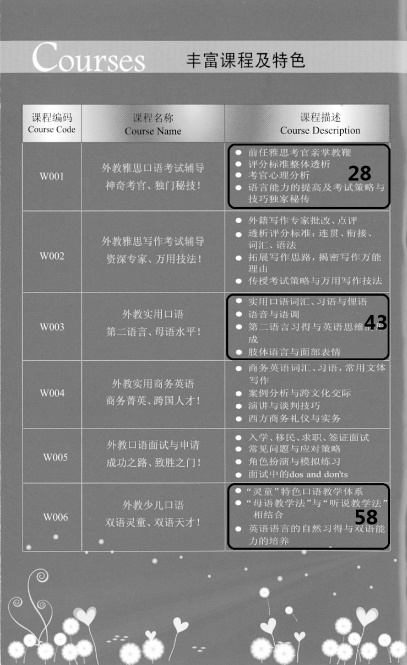
Figure 7.16 Comparison group of spatial location
Stimuli 43,58 and 28 are all verbal and they differ only in the spatial location.They appear originally in a table about course information which occupies a whole page in an English learning leaflet(see Figure 7.16 below).They are located in the different rows of the same column.Slide 28 is the grid at the top,Slide 43 is the one in the middle and Slide 58 is the one in the bottom.In the 3 versions of the memory recognition test which differed only in the presentation order of the stimuli,the three verbal texts were also presented in three different orders,with some other stimuli inserted in between so that participants were expected not to notice the similarity and possible comparison between them.The reaction time and correction rate in the three versions are summarized in Table 7.12.We can see that the correction rate decreases as the location goes from top to bottom.
Table 7.12 Comparison group of location

Stimuli 40 and 54(see the two verbal paragraphs below)are verbal foils.That is,neither of them had been shown to the participants before the recognition test.They differ in the content,or specifically,the relevance of the content with the discourse topic.Stimulus 40 is about the emotional appeal while Stimulus 54 is about teaching method.In terms of global coherence,teaching method is at the heart of the discourse topic—English teaching and learning while the emotional appeal is not so closely related.The recognition test(see Table 7.13)shows that Stimulus 54 has a much higher correction rate and shorter reaction time than Stimulus 40.This result shows that global coherence of a sign with the discourse topic affects people's memory of it.
Stimulus 40
想要留学海外,就读名校吗?
当这些成为你的梦想,你一定在鼓励自己努力再努力,有了学习的决心,你是否也拥有了行之有效的方法?英语成功之路就在你的脚下!
Stimulus 54
彻底颠覆原有的传统的“填鸭式”(Chalk and Talk)教学模式,以戴尔英语独创的“三七教学法”取而代之!在课堂时间分配上达到能使学生潜力得到最大激发的黄金分割,即三分教,七分学;三分学,七分练!大幅度增加学生在课堂上的参与度,迅速提升学生自己动口说、动笔写的能力!
Table 7.13 Comparison group of foils

Stimuli 53,48 and 49 are pictures and they form a comparison pair because they differ only in the respect of global coherence while sharing similar degrees in all other respects,such as local coherence,size and location.They appear on the same page actually in the eye-tracking experiment.As shown in Table 7.14,higher score of global coherence leads to longer reaction time and higher correction rate whereas low global coherence corresponds to shorter reaction time and lower correction rate.
Table 7.14 Comparison group of pictures in the light of global coherence
