6.3.2 Visual salience
Salience is“an item's quality of being visually distinctive relative to its neighboring items”(Humphrey and Underwood,2008).It is not an objective criterion,but a subjective impression which is formed through the balancing of many factors,including color,size,location and degree of distinctiveness.
6.3.2.1 Color
It is relatively easy to recognize the relation between color and visual salience.Bright color helps an element jump out in the visual field and catch reader's attention first.Other things being equal,the more bright and saturated the color is on a certain element,the more eye-catching it will be than others.This is why in the Reader Attraction stage of the English learning advertisements the color of the pictures is usually highly saturated and with high light key.
6.3.2.2 Size
The relation between size and visual salience is also straightforward.Eye-tracking studies(see for example,Pieters and Wedel,2004)have found that increase in the size of an element will directly lead to increase in the attention it draws.Other things being equal,the bigger space an element occupies,the more salient it is and the more attention it will draw.
6.3.2.3 Location
Compared to color and size which are relatively simple,the mapping of salience on location is not a straightforward matter.Kress and van Leeuwen's(1996)use of space(see Figure 6.1)can be of some value,but the salience should in no way be assigned to definite terms such as Given/New and Ideal/Real in the complex multimodal documents like the English learning leaflets in which many variables are at work simultaneously.My proposal is to discard their concepts on information value and consider only the degree of salience.That is,other things being equal,the centre is more salient than the margin;in the vertical dimension the top is more salient than the bottom;in the horizontal dimension,the left is more salient than the right.What needs to be noted is that,in complex composites like the English learning advertisements which include a hierarchy of elements grouped in unit and subunits,the effect of the location principle has to be analyzed with consideration of the balancing and trading-off of all the dimensions including centre/margin,left/right,top/bottom.In relatively simple visual composition,the vertical and horizontal principle is secondary to the centre principle,that is,the centre is the position with the highest degree of salience.
6.3.2.3.1 Centre and margin
The above page in Figure 6.5 could be used as an example for the centre/margin contrast in visual salience.The most important information about the advantages of the advertised course—the four verbal chunks and the graph surrounded by them,are placed on the centre.The picture of a white woman holding books entitled“New Concept English”is placed at the right margin of the page.Through this spatial arrangement,the intended visual effect will be that the readers pay their attention to the diagram first which is placed in the centre,followed by the four surrounding verbal chunks,and finally to the picture of the woman.The picture is here to strengthen the persuasion expressed in the verbal texts.
More examples will be found in the page margins.That is,on the margins of many pages of these English learning advertisements,there will be contact information of the specific language school,or some visual patterns purely for decorative purpose.They will get very little attention from the readers due to their marginal location.
6.3.2.3.2 Left and right
The privilege of the left over the right arises from the visual directionality in modern society.The left-to-right directionality originated in Western cultures,but now spreads to China and has taken over the traditional right-to-left directionality.Since people start from the left,the elements on the left have more chances of being read.This tendency is more obvious in the context of the advertisements because they have to compete hard for attention in the sea of information in the modern society.Therefore,a strategy the designers often use is to put more important information on the left to ensure its largest probability to be read.
As described in the section about the staging of the English learning leaflets as a genre,although the content in these leaflets are highly variable,they tend to include some similar stages,such as Corporate Profile,Statements of Competitiveness which include almost invariably Teachers,Teaching method,Teaching material,
Hardwar e,Course information,among others.The order of the stages and phases in the leaflets is not definite,but they tend to be highly predictable.The Corporate Profile comes first,followed by the Statements of Competitiveness in which the typical order is Teacher—Teaching method—the Hardware section.It means that in the layout on a three-page folder like the one in Figure 6.7,the right page is Corporate Profile,the phases of Teacher and Teaching method are in the middle page and the Hardware is on the right.The layout arrangement indicates the understanding of the importance of individual sections by the adverting company.That is,since their primary purpose of launching the advertising campaign is to boost their brand image,all of them choose to start their leaflets from Corporate Profile and place it on the left page,because they know that's where most people start reading.

Figure 6.7 An example of the location of various stages(LM)
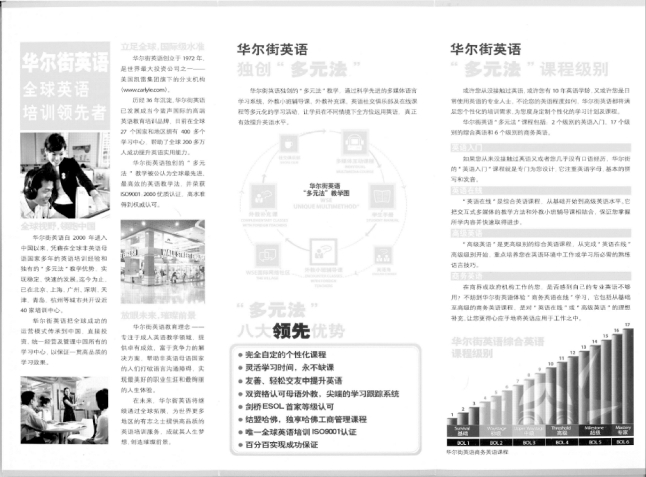
Apart from this example given above,another sample is given below(see Figure 6.8)to illustrate my point.It shows the inside page of a folder of WSE English training company.On its right-side page,there is a verbal text about the Corporate Profile of this company and three pictures of the office building and class scenes.On the middle page is the Statement of Competitiveness in which the learning method is emphasized.On the right page is the Course information.The location of the three stages on the pages cannot be changed because it is related to the relative importance attached to them.Specifically,brand image is more important than the persuasive information which,in turn,takes precedent before course information,because the reader won't read the course information if the persuasion is not effective.

Figure 6.8 A second example for the location of various stages(WSE)
6.3.2.3.3 Top and bottom
Advertisement designers tend to place more important elements on the top of each page and those less important at the bottom.
Take Figure 6.6 for example again,as analyzed earlier,the page is organized visually into six composites each of which is composed of a picture on the top and a verbal paragraph below.The various structure-marking devices discussed in Section 6.3.1 signal that the six composites are parallel rhetorical components of the page as a discourse.The point here is that,although the six composites are completely similar in format and composition,the order of them in spatial positioning is not reversible.The reason is that the location on the page has to do with importance in meaning.Elements on the top usually draw more attention than those at the bottom because the universal directionality of human perception is from top to bottom.Therefore,the designers tend to place more important information on the top and less important information at the bottom.A closer examination of the six composites reveals that the six composites are concerned with topics that have different degrees of connection with the overall discourse topic—English teaching and training services in the specific company.The topics of the three composites in the top row are from left to right:Corporate Profile,teaching/learning method,and foreign tutors.Those in the bottom row are from left to right:promise to the clients,fun activities and employment-oriented services.Observation of these topics finds that those in the top row are more closely related to the discourse topic than those in the bottom row.The matching between the spatial positioning of semiotic elements and their importance in meaning supports my proposal in this section.
What needs to be noted is that complex multimodal discourses like English learning leaflets and brochures usually incorporate all the devices for structural demarcation and semantic importance.Figure 6.8 will be used for illustration again.There are several design features that support my proposal in this chapter.
First of all,in terms of centre/margin spatial arrangement,the middle page is concerned with the so-called“Multi-method”which is alleged to be the special learning method created by this company.This“Multi-method”is also the discourse topic expressed in the cover page of the leaflet which is not reproduced here.Therefore,the central position in the visual space reflects the closest relevance and largest contribution to the discourse topic.
Secondly,my proposal of the top-bottom spatial arrangement can find support in the left-side page of Figure 6.8.It is concerned with the corporate profile of the company.The three component chunks in it demarcated by likeness of form have a descending degree of information value and their order is unchangeable.Specifically,the chunk on the top is about its background,history,achievements and authority in the trade of English training.The chunk in the middle is about its development in China and the chunk at the bottom is about its outlook for future.As analyzed in Chapter 4,the topics concerning the history and achievements are obligatory in the stage of Corporate Profile whereas the outlook for future is optional.Therefore,the order of the three chunks in spatial arrangement is not reversible,because it reflects their order of importance in the contribution to the higher-order topic.
In summary,the spatial positioning of an element reflects its degree of importance in the contribution to the discourse topic.The relationship between spatial placement and importance in communication is not only restricted to the English learning advertisements,but also applies to other multimodal genres such as newspapers.The reason is that layout design is an independent level of discourse which has its own rules and constraints.Support can be found in Brooks and Sissors(2003:276)who find that on each individual page of newspapers,the stories are usually graded in importance from the top down.