1
多模态语篇的连贯构建研究 以中国英语学习广告为例 英文版
1.9.2.1 6.2.1 Existing frameworks on layout analysis
6.2.1 Existing frameworks on layout analysis

The possible similarity between the cohesive devices in the layout which are largely visual and those in the linguistic system can account for the widely-adopted practice of extending linguistic theories to the analysis of layout.The composition analysis in Kress and van Leeuwen's(1996)visual grammar and Bateman's(2008)layout analysis in his GeM Model for analyzing multimodal documents are among the most influential frameworks in this regard.

On the other hand,the unique features in the patterns of cohesion in visual configurations require us to break from the possible constraints posed by the thinking mode originated from linguistics and take into consideration the perspectives of design.Therefore,the above two theory-driven frameworks need to be supplemented by and compared with the theories in the field of document design.In this regard,the framework of Kostelnick and Roberts(1998),which was proposed from the perspective of professional communicators,will be presented and reviewed.

Therefore,in this section three frameworks for analysis of cohesion and layout organization from three different theoretical paradigms will be reviewed.They are compositional framework in the visual grammar of Kress and van Leeuwen(1996),the layout layer analysis in Bateman's(2008)GeM Model for multimodal documents,and the framework from professionals in the design trade proposed in Kostelnick and Roberts(1998).

6.2.1.1 Kress and van Leeuwen(1996)

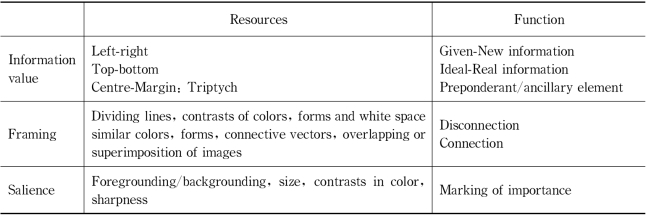
Inspired by Halliday's three meta-functions in language analysis,Kress and van Leeuwen(1996)conceptualize layout as one of the three meta-function or meanings in texture of pictures—textual or compositional meaning,the other two being representational and interactive.Composition relates the representational and interactive meanings of the image to each other through three interrelated systems:information value,framing and salience.

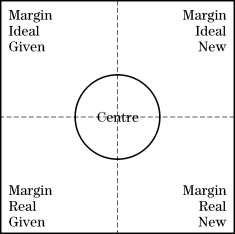
The information value is mostly conveyed through the placement of the elements in the visual space.Specifically,they believe that the placement of a semiotic unit in different pictorial“zones”—left/right,top/bottom and centre/margin gives the unit different weights of information value.Their mapping of the spatial placement and the information values is shown in Figure 6.1.

The manipulation of framing resources can create connection and disconnection in the continuous flow of elements in the visual field.That is,framing devices include not only those on the connection end,such as similar colors,forms,connective vectors,overlapping or superimposition of images,but also those on the disconnection end,such as the presence of framing.Common resources of framing include dividing lines,or actual frame lines,contrasts of colors and forms and white space between the elements which visually signify individuality and differentiation.

Figure 6.1 Use of space and information values(Kress and van Leeuwen,1996:208)

Salience stands for the way some elements in a visual composition are arranged in order to look more eye-catching than others.Common resources include placement in the foreground or background,contrasts in color or tonal value,relative size,differences in sharpness,and placement in the visual field.

Table 6.1 The Composition framework in Kress and van Leeuwen(1996)

The three aspects of composition“all serving to structure the text,to bring the various multimodal elements of the multimodal text together into a coherent and meaningful whole”(van Leeuwen and Kress,1995:26,cited in Peled-Elhanan,2009).

6.2.1.2 Bateman's GeM model(2008)

Bateman's GeM model for analyzing multimodal documents treats the multimodal page as a multilayered semiotic artifact.The major layers of his model include:

the GeM base:the basic elements physically present on a page;

layout base:the layout properties and structure;

rhetorical base:a detailed account of the rhetorical relationships between the content expressed by elements on a page and their communicative purpose;

navigation base:the elements that contribute explicitly to navigation and access in the page,supporting“movement”around the document in various ways;

genre base:a representation of the grouping of elements from other layers into generically recognizable configurations distinctive for particular genres or document types.(Bateman,2008:108)

To analyze the layer of layout base,“we need to capture not only the individual elements but also their layout grouping and spatial proximity,their mutual spatial relationships and their particular layout and formatting properties”(Bateman,2008:115).Bateman also argues that layout analysis should be given a particular priority,because it is through layout that any user of the page necessarily comes into contact with the page's content and organization.His approach is to see configurations of visual elements that are discernibly placed together on the page as clusters of some kind regardless of their functionality or“reader-orientedness”.Visual clustering and rhetorical clustering do not necessarily align,even in well designed documents.

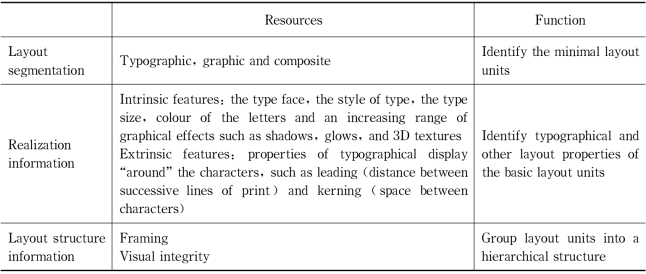
The layout base consists of three main parts:(i)layout segmentation—the identification of the minimal layout units,(ii)realization information—typographical and other layout properties of the basic layout units,and(iii)layout structure information—the grouping of the layout units into more complex layout entities and the determination of spatial relationships.

For each part of layout base,finer classification is made.For layout segmentation,three broad classes of layout elements are identified:typographic,graphic and composite.

For realization information,intrinsic features and extrinsic features are a basic distinction.Intrinsic features include the type face,the style of type,the type size,color of the letters and an increasing range of graphical effects such as shadows,glows,and 3D textures.Extrinsic features include properties of typographical display that come about by manipulating the space“around”the characters,such as leading(distance between successive lines of print)and kerning(space between characters).

The layout structure refers to“how the individually identified layout units are grouped together into larger elements that collectively make up the composition of the page”(ibid:121).“In order to capture this kind of spatial grouping of elements”,the structuring of layout specifies“how larger segments can be constructed and positioned relative to one another”(ibid:122).Several criteria are developed for the identification of the devices of layout structuring,such as considerations of“framing”and“visual integrity”by which layout elements are progressively grouped into larger elements,building up a hierarchical structure with the entire page.

The system of Bateman's layout analysis is summarized in Table 6.2 below.

Table 6.2 System of Bateman's(2008)layout analysis

In summary,layout is regarded as the lowest layer of the GeM model.Specifications here decompose any page-based multimodal document into parts and explicitly state how these parts are organized visually to create a layout structure for the pages of the document.

6.2.1.3 Kostelnick and Roberts(1998)

From the perspective of professionals in design industry,Kostelnick and Roberts'book(1998)Designing visual language proposed an elaborated system of visual language.They hold that“the questions a designer asks when tailoring his design are precisely the same kinds of questions that you ask yourself as you write”(ibid:13).They propose six strategies in design elements that cross over from writing to design.They are:

Arrangement,Emphasis

Clarity,Conciseness

Tone,Ethos

In the list above,the six terms are placed in pairs because of their natural affinities.Arrangement and emphasis strategies pertain primarily to the visual structure and organization of the document.Clarit y and conciseness strategies pertain primarily to functional matters of style,making the design readable and efficient.Tone and ethos strategies relate primarily to readers'subjective responses to the visual language,its voice and credibility.Since the current study is mainly focused on the ideational meaning,or information aspect of the coherence construction,we'll only elaborate on the first pair of terms.

Arrangement means order,the organization of visual elements so that readers can see their structure—how they cohere in groups,how they differ from one another,how they create layers and hierarchies.Visual arrangement also involves spatial orientation within a field,as in left and right,up and down.Emphasis strategies are about controlling what stands out,such as centering,increasing its type size,boldfacing,accenting with bullets,indenting,adding space around them and making it darker.Emphasis at a higher level can be seen in the headers.Guided by the six underlying strategies,the designers deploy various resources to form a well-organized multimodal document.

In the second chapter of their book,they discuss the cognitive basis of design,especially the way human visual perception influences document design,since all documents are designed for people to look at.They hold that the Gestalt principle plays a very important role in the way a document design is perceived and processed by readers and thus is an overall guidance for designers.They identify two most important principles of Gestalt psychology:figure-ground contrast and grouping.Figure-ground contrast can be presented in various degrees and serve to draw more attention to some elements than others and thus mark the importance of them in the visual field.The Gestalt principle of grouping helps make the parts cohere.Visual groups can be created in several ways.Three of the most important are likeness of form,spatial nearness,and division.

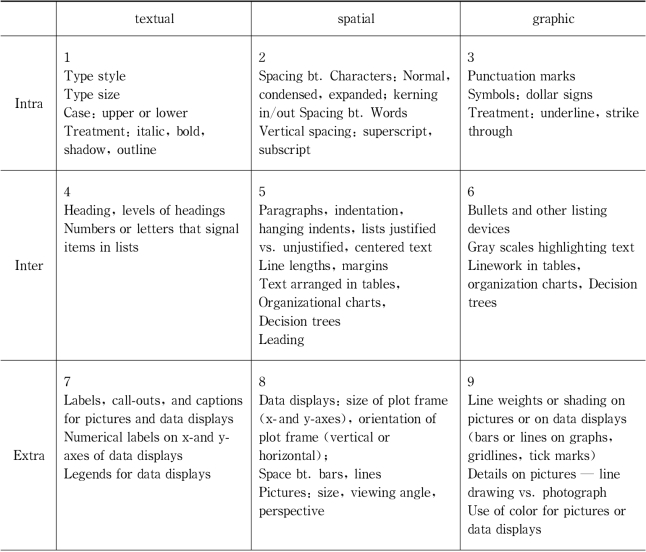
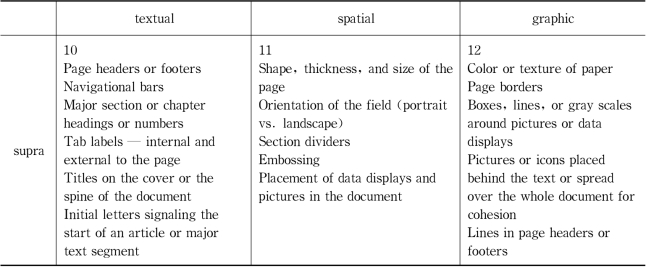
They identify four levels for examining the visual language of a document:Intra,Inter,Extra,and Supra.The first two levels,the intra-and inter-levels,pertain primarily to text design.The extra-level pertains primarily to non-textual elements such as data displays and pictures.The supra-level refers to the large-scale design of the whole document.

Beside the four levels,they also classify the visual cues which enhance our access to information within a visual field into three categories:textual,spatial and graphic.The textual include headings,numbers,letters;the spatial includes paragraph blocks,lists,columns,and the graphic is typically represented by bullets,shading,lines(ibid:163).

Their framework containing four levels and three categories of visual cues is summarized in Table 6.3 below:

Table 6.3 Visual language matrix in Kostelnick and Roberts(1998:86)

(to be continued)

They point out that this rich vocabulary can serve a variety of purposes:signaling boundaries between sections of the document,creating cohesion,and setting the tone.Sometimes a single graphic element can do all three at the same time(ibid:406).