5.3.2 Corporate Profile and Testimonial
This section will analyze the distribution of these categories of visual-verbal relations in the stages except for the Reader Attraction stage in my corpus of English learning advertisements,with the aim to explore how the verbal slogan and picture are combined into a coherent whole in this specific functional stage.A preliminary study of the materials reveals that all these stages,such as Corporate Profile and Testimonial,have similar patterns in visual-verbal relations except the phase of“teaching/learning method”under the stage“Statements of Competitiveness”and the stage“Course Information”.Therefore,I'll first analyze the stage“Corporate Profile”and the stage“Testimonial”first,followed by the analysis of the phase of“teaching/learning method”and the stage“Course information”.The stage“Call for Action”will not be considered in the analysis of the visual-verbal relations since no regular semiotic configurations are found in it,as described in the previous chapter.
5.3.2.1 Patterns of local coherence in Corporate Profile
As described in Section 4.3.2,the Corporate Profile is characterized by long verbal texts and optional use of pictures.If there are pictures in some cases,the pictures are small in size and limited in number compared to the verbal texts.However,the difference in surface level does not necessarily mean difference in status.We need to examine the semantic content expressed in both modes.
Examination of Corporate Profile in my corpus of the English learning advertisements has found that the verbal texts and pictures have the following relationship:
Firstly,the content represented in the picture corresponds to only part of the meaning in the verbal texts.Since the verbal text contains a relatively large amount of information,organized around the various topics such as the material environment of the school,teachers and target clients(children for example),each picture usually focuses on one of the topics in the verbal.In this respect,the information linking principle applies because(i)the two modes have always a connection in information/content and(ii)the degree of information linking between the two semiotic modes varies with different cases.
Secondly,the picture adds new meanings to the topic that it shares with the verbal text.That is,the picture is not something added to,and subordinate to the verbal text;instead,although it departs from one of the topics in the verbal text,it develops it into full detail and carries it forward.
Take Figure 4.11 in Chapter 4 for example,in the verbal text in the stage of Corporate Profile of that leaflet,there is such a sentence:
学校教学环境一流,各教学区均位于高档写字楼内,高雅舒适……
The topic in this sentence is the material environment of the language school.The picture is a photo of the reception place of the language school.In one way,we can say that this picture is about this specific topic of“environment”among many other topics in the verbal text.In another way,a careful examination of the picture reveals that it expresses more than what is said in the corresponding verbal text.That is,besides the“first-class”-ness(一流)of the material environment and their location in good office buildings,the picture also convey many details that are not contained in the verbal text,for example,the big brand name of the corporate on the wall,the bright and clean glasswall offices,the placement of the computer and seats of the receptionist and the green plants decorating the office.These details are not important for the hyper-Topic of the Corporate Profile stage or the overall discourse topic,but they make readers infer the self-consciousness of brand image building of the corporate,and its efficiency,good quality service and a pleasant team who are aware of the modern professional spirit and practices.These positive attitudes inferred from the picture are important for the presentation of the corporate profile.
Figure 5.8 is another example of the visual-verbal relations in the stage of Corporate Profile.The first paragraph in the verbal part concerns the profile of the organization of which the specific language school is subsidiary.The second paragraph is the profile of the language school proper and it is reproduced in the following.
Longman Schools是全球最具影响力的教育机构——培生教育集团(Pearson Education Group)在中国建立的英语培训学校。Longman Schools旨在成为中国最受尊敬的英语培训机构,应用国际认可的教材,由经过专业培训的教师授课,提供优质的服务来帮助学习者提高英语能力。
The pictorial component is a collage of the photos of teachers in the shape of the word“LONGMAN”(this collage is also used in the introduction of the teaching team in other leaflets of this language school).The only crossing point between the verbal and the pictorial part is the information unit“teachers”.The pictorial part,while focusing on the representation of“teachers”,give it more weight through adding new details and symbols which also convey meaning in the image building of the corporate.For example,the large quantity of the photos suggests that the language school has rich resources of good teachers,among which many are native speakers of English.The faces of these teachers wear smiles and look young and lively.Although these features do not represent important information concerning the communicative purpose of the stage or of the whole leaflet,they give the impression that they are an international,effective and happy team.The shape of this collage—LONGMAN—indicates that all these qualified teachers work together with the tenets of the corporate and in this way strengthens the brand image.

Figure 5.8 An example of Corporate Profile
A common pattern in the visual-verbal relations in the above two examples and most of the cases in my corpus is that,in terms of ideational meaning,the picture represents one of the many topics expressed in the verbal text.This relationship is the information link between the two semiotic modes.But the picture is not simply an add-on to this topic in the verbal text.Instead,the picture shows many details due to its largely iconic and indexical nature.These details themselves are unimportant for the overall hyper-Topic of this stage of Corporate Profile,for example,no readers will care exactly how many people there are in the collage in Figure 5.8 in the Longman leaflet.But these details have an overall effect on the attitude and emotion of the readers.
5.3.2.2 Patterns of local coherence in Testimonial
As described in Section 4.3.5,in the stage of Testimonial the key visual elements are the photos of the witnesses whereas the verbal elements include their names and their positive evaluation towards the specific language school.In Section 4.3.5,only the verbal paragraph of evaluation was analyzed for the topical structure.Here in this subsection,the verbal expressions for the names of the witnesses also need to be taken into consideration in order to clarify the verbal-pictorial relations.
The information unit by which the photos and verbal texts are connected is the identity,or the name,of the witness.That is,the ideational meaning the photo expresses is the existence of the witness and has nothing to do with the content in the appraisal.The verbal text starts from the identity,yet develops the communication further to the appraisal the witness gives to the specific language school.
But the photo is not simply an addition to the verbal mode.Instead,it has many details due to the iconicity of the visual genre.As we have analyzed in Section 4.3.5,the photos in this stage show a lot of details which indicate that they show real persons in real environments.These details are not related to what the verbal appraisal is concerned with.They are even not there for the readers to read:readers will not even notice or care whether it is a female or a male shown in the picture if the name shows no obvious clue for sex,or if the verbal information for the witness'identity is“the parent of XXX”which is often the case for the children's programs.For example,Figure 5.9 shows testimonials of four customers.All of their photos are clearly shot in a real background with many details shown.However,these details are not relevant to the appraisal the customers are giving to the specific company.Actually,if examined carefully,some pictorial details are contradictory to the corresponding verbal texts:there are two boys in the rightmost photo while there is only one name shown in the verbal text below!

Figure 5.9 An example of Testimonial
Therefore,what matters is not the exact details that compose the pictures,but the very existence of them which evidences the real existence of the witnesses.In other words,the photos in the Testimonial stage are employed to create a sense of authenticity and thus evoke trust in the readers.This is the essential function of the testimonial.
To summarize,the verbal-pictorial relation in this stage is similar to that in the stage Corporate Profile.That is,the verbal text is usually longer and contains a large amount of information.The picture represents only one unit of information in the verbal text.Through this information unit the verbal and the pictorial are connected.The verbal mode contributes more to the communication of ideational meaning,and the picture contributes more to the interpersonal meaning,that is,to evoke emotions and positive attitudes in readers.
5.3.2.3 Summary:a model with unequal visual-verbal status
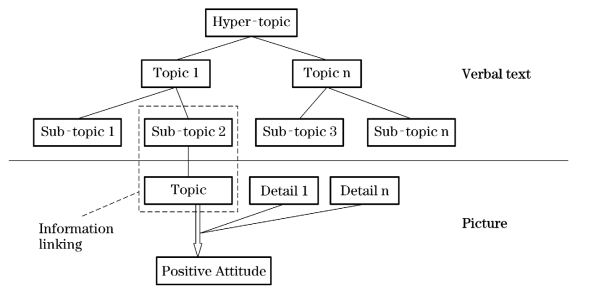
In summary,the typical pattern of visual-verbal relation in the Corporate Profile stage and the Testimonial stage is shown in the following figure(see Figure 5.10).

Figure 5.10 General pattern of the semantic connection between the visual and the verbal in Corporate Profile and Testimonial
This view should not be interpreted in a simplified way as that the verbal mode is in charge of the ideational meaning whereas the picture is in charge of interpersonal meaning.Instead,the verbal text also contains many appraisal resources which aim to elicit positive attitudes and emotions in readers.What I mean by this diagram is that,the development of the ideational meaning concerning the Corporate Profile is mainly completed by the verbal mode whereas the main function of the pictures in this stage lies in their iconic feature which can be somewhat manipulated by the designer to evoke emotions in the readers.
The division of labor between picture and verbal text is,to a large extent,determined by the specific characteristics of the two modes.As Messaris(1997)argues,as far as semantic features are concerned,it is the indexical and iconic properties of visual images that most clearly set them apart from language and other modes of communication.However,symbolic signs are,if anything,even more characteristic of language and the other major modes.What visual syntax lacks,especially in comparison to verbal language,is a set of explicit devices for indicating causality,analogy,or any relationships other than those of space or time.This characteristic of visual communication may appear to be a deficiency on the face of it.However,it can be argued that in certain respects,it is actually an advantage.There are at least two reasons why this might be so.First of all,because a visual argument cannot be entirely explicit,making sense of it may require the viewer a greater degree of mental participation than would otherwise be the case.The viewer's interpretation of a visual argument is more of a product of her or his own mind than it would be if the argument were made explicit in the verbal mode.The implicitness of visual syntax might be part of the reason for the persuasive uses of visual images.Another part of the reason lies in the fact that the verbal claims made in advertisements tend to be held to much stricter standards of accountability than whatever claims in the ads'pictures.This ability to imply something in pictures while avoiding the consequences of saying it in words has been considered an advantage of pictures in advertising.Thus,the pictures showing pleasant-looking models and environments with high key lighting are suitable for the job of evoking emotions in advertising.