5.3.1 Reader Attraction:a model of local coherence based on information unit
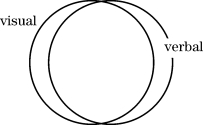
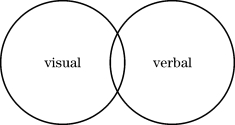
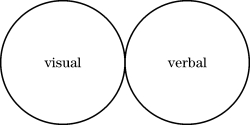
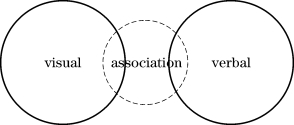
As argued in the previous section,the visual component and verbal component in this stage have somewhat equal status.Therefore,the information linking principle will be the single major criterion for the analysis of the visual-verbal connection.As argued in Section 5.1.2,the degree of information linking is conceptualized as a cline rather than absolute points.The information linking between visual and verbal in every specific case is a point along the cline.But for the convenience of clarification,five types of visualverbal relations which represent typical points along the cline of degree of information linking are identified following the“sememe”model proposed in Meng(2009).Compared to Meng(2009),the terms used for the five types are modified into:isomorphism,cross-cutting,bridging,association and juxtaposition.The list is made in ascending order in terms of the degree of information linking between verbal slogan and the picture in Reader Attraction.
5.3.1.1 A model of verbal-pictorial linking
In the following the five kinds of visual-verbal relationships in the model of intermodal information linking will be elaborated with examples respectively.
Isomorphic
Under this category,the picture component and verbal component are maximally connected through most key information units.If the picture and verbal slogan contain multiple information units,for example,if the picture depicts a transactional action and the verbal part represents the same material process with the same or obviously related participants,it can be said that the visual-verbal relation is maximally overlapping,or they are isomorphic.However,this situation is rare in my corpus of the English learning advertisements,thus no example will be given here.It suggests that complete sameness in content between semiotic systems inside a multimodal discourse is either impossible to realize or not appreciated by users.

Cross-cutting
In this type of advertisements,the visual mode and the verbal mode have a crossing point on one information unit.That is,the two modes of representation share one identical unit of meaning,for example,in the following Figure 5.4 which is the Reader Attraction of an advertisement,the verbal slogan reads“拥抱世界名校的金钥匙”(the gold key that embraces world-famous universities).The picture shows a shiny gold key in a golden-color background.The conceptual meanings expressed in the two modes cross on the information unit—gold key.The internal coherence between the visual and verbal modes in this ad is achieved through their mutual contribution in expressing the key information unit.


Figure 5.4 An example of the“cross-cutting”type of visual-verbal linking
Bridging

In this type of visual-verbal relations,the two modes have no direct overlapping or crossing in ideational meaning.Instead,they contain information units that are closely linked semantically.That is,one information unit in the verbal slogan and one information unit in the picture have close and robust semantic connection;in other words,they are linked by a bridge.Conventional metaphor,metonymy,synecdoche and regular collocation in idiomatic expressions are common instantiations of the bridge.For example,in the following example(see Figure 5.5),the verbal slogan reads“去美国,上大学,请选××
“((if you want to)go to America,enter college,please choose××language school).The picture contains the image of the Statue of Liberty which is universally acknowledged and presented as the symbol of America.Thus the Statue of Liberty can be regarded as a metonymy of America.The information unit“the Statue of Liberty”in the picture and the information unit“America”in the verbal slogan are closely linked by the bridge of metonymy.
Association

Figure 5.5 An example of the“bridging”type of visual-verbal linking

In this type,there is only indirect relevance between the representation in the visual and verbal mode.The key information units in each of the two modes are not coreferential,or overlapping,or linked through metaphor,but are linked through association.That is,one information unit in the visual and one information unit in the verbal are semantically related through some kind of associational relationship,either through collocation,or being in the same semantic field,or in some kind of paradigmatic groups.The association is usually easily understood by the members in the same socio-cultural community where the discourse is used.
In the example in Figure 5.6,the verbal slogan reads“早班托福,领先启航”(TOEFL early program,take the lead of the journey)and the picture shows a ship sailing on the sea in the direction of the sun ahead.There is no direct crossing point in the semantic meaning expressed in the two modes,but the coherence is achieved through the link between the information unit“ship”in the picture and the information unit“journey”in the verbal slogan.Any Chinese readers have the awareness that“journey”and“ship”are often used in the same context or in the same semantic field.The two information units are associated in semantic meaning.With the information linking between the two modes,the readers can comprehend the ad as a coherent whole and understand the intended message in it.

Figure 5.6 An example for the“association”type of visual-verbal linking
Juxtaposition

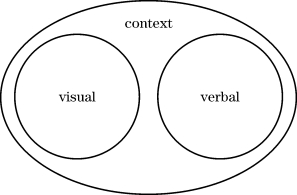
As for this type,there is no direct relevance between what is represented in the visual mode and that in the verbal mode.When two irrelevant meanings are placed together in the same context,in this case,the advertisement,the juxtaposition will generate new meanings through the inferencing process in the reader's mind.The recognition of the communicative goal of the advertisement on the reader's part will exert influence on their interpretation of both semiotic representations.Here the juxtaposition also indicates that the content in the two modes of representation functions as context for each other,influencing the reader's interpretation of the discourse as a whole.
The cognitive reason for this type of visual-verbal relation can be found in the Gestalt principle of perception.It can help us understand how readers see images in context—that is,in relation to a whole visual field.The term Gestalt itself means“form”.According to this principle,our perception of a form depends on its juxtaposition with other forms within a visual field(Kostelnick and Robers,1998:Chapter 2).In other words,the whole form plays an essential role in understanding its parts.In this sense,the juxtaposition of the verbal slogan and the picture forms a new visual field or context which will be used by the reader to create new interpretations of both the verbal and the picture and connections between them.
Figure 5.7 is an example for the juxtaposition type of visual-verbal linking.In it the picture shows the smiling face of a white woman with blonde hair,the verbal slogan reads“来中心体验地道英语!”(Come to our language center to experience real English!).The semantic meanings in the picture and in the verbal slogan have neither direct nor bridged,or even associative connection.A white woman is not necessarily a native speaker of English,nor does she even speak the English language as a second language.However,the juxtaposition of this picture and the verbal slogan in the cover of the leaflet of a certain English training company tends to evoke the inference in the reader's mind that the woman is a native speaker of English and works for the company as a teacher of English language.That is,readers tend to create coherent relations between components of a discourse if there are no obvious cues of connection.According to cognitive science such as the Gestalt theory,people tend to regard things that are placed together as relevant and will actively build the relevance in their mental representation if no cue of coherence is observed in the text.

Figure 5.7 An example of the“juxtaposition”type of visual-verbal linking
5.3.1.2 Summary
What needs to be noted is that the above-mentioned types of visual-verbal relations are not exhaustive categories.Instead,they represent typical smaller ranges in the continuum of degree of visual-verbal information linking from the maximal end to the minimum end.Under each of the category,a range of points are accommodated.Some of these points are closer to the maximum end of the range while some others are closer to the minimum end.Moreover,the boundaries between adjacent categories might not be as clear-cut as they seem to be because the conceptualization is based on semantic meaning which is a fuzzy,blurry area of semiotic studies without clear-cut classification.Each specific case has its special characteristic in semantic connection and occupies a unique point on the cline/continuum.For example,in some cases the exact point may stand between two adjacent categories.Therefore,like all categorization of similar kind,the categorization here has the limitation of uncertainty in determining the exact quantity or measurement.The reason for my categorization here is not in categorization itself,but to find a way to clarify and exemplify my point on the degree of information linking between visual and verbal as the major principle of conceptualizing local coherence between visual and verbal in the Reader attraction stage in the English learning advertisements.
This subjectivity in categorization will not be a serious defect of my conceptualization.In actual operation,the categories are transformed into numbers and more than one coder was asked to code the materials in terms of degree of information linking.The results were gathered and the means of these specific cases were used as their value in the degree of information linking.In this way,a relatively objective measurement of the degree of visual-verbal local coherence can be obtained.In the empirical studies on local coherence,these values will be used in order to check the influence of local coherence on the reader's reading behavior and comprehension process.