1
多模态语篇的连贯构建研究 以中国英语学习广告为例 英文版
1.7.3.3 4.3.3 Statements of competitiveness
4.3.3 Statements of competitiveness

This stage usually takes up the largest percentage of area of the visual space among all the functional stages in the English learning advertisements since it comprises several or even more number of phases such as teaching team,teaching method,and teaching hardware.Given the parallel status of the phases,“list”is a prevailing way of text organization in the stage of Statements of Competitiveness.

List has an inherent internal organization:a list focus on a general category(X)and its members(X1...n).An important characteristic of the environment for reference created by a list is the presence(either stated explicitly or assumed implicitly)of a general category(X)in relation to which other referents(X1...n)are understood.It imposes a category constraint on the list items,that is,the items in the list must be recognized as a sub-category under the list Topic as the general or superordinate category.In the stage of Statements of Competitiveness in English learning leaflets,the constraint means that the Topics of the phases must be recognized as one part of the superordinate Topic of the list,that is,our competitiveness or strengths in English teaching.Inclusion of sub-topics that are not recognized as parts of this overall Topic per se might be regarded by readers as inappropriate and thus will affect the efficacy of the advertisements.This reader reaction will be discussed in greater detail in the empirical studies on the influence of global coherence on appreciation in Chapter 7.

The list in the materials under discussion generally follows the depth-before-breadth structure.In this kind of list structure,references to list-items typically do not cross subcategory boundaries.

X1...(description)

X2...(description)

X3...(description)

Due to the large amount of information included in this stage,the items in the list are proposition-sized,or even paragraph-sized if only verbal texts are taken into consideration.As a matter of fact,not a few cases include pictorial part in the presentation of the topics.The multimodal perspective adopted in this book requires that the unit of measurement be changed to visual chunk.Specifically,each topic takes up a visual chunk which is composed of both verbal and pictorial elements.In materials which have larger visual capacity,the verbal part is usually longer and include its own internal structure further.Likewise,some pictorial part can also be structured with its own internal organization.Therefore,the internal structure of the Statement of Competitiveness stage is an embedded hierarchy.We are now examining the topics one by one,so as to achieve a thorough analysis of the stage as a whole.

4.3.3.1 Phase:Teaching team

This phase is to appraise the teaching team employed by the concerning English language school.This is an obligatory phase in the stage of Statements of Competitiveness,that is,all materials include this section.The reason is obvious:teachers occupy the central role in the class and their qualities have a vital influence on the success(or lack of success)of the learning.The length,or the visual space in a multimodal sense,of this phase can vary greatly in different leaflets or brochures.In the briefest ones,it comprises only a few verbal sentences.In some elaborate ones,it can incorporate a large amount of visual and verbal elements organized in a hierarchical structure.

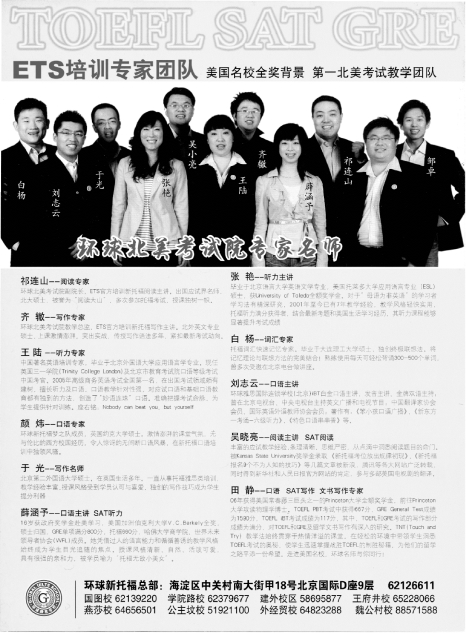
Figure 4.13 An example of the complex“teaching team”phase

Figure 4.13 is an example of the elaborate ones.The top half of the page is a group photo of the teaching team working for the specific English teaching program.They stand in such a way that each of them is given equal status in the picture.Their names are printed beside each of them.They are shown from the front,with direct eye contact with the potential readers.The lower part of the page is occupied by a list-structured verbal text.The items of the list are the introduction of the teachers.Each item comprises a heading and a verbal text.Therefore,the structure of this sample of teacher phase is highly complicated and embedded.

The more general pattern of this phase is not so complicated,that is,the teachers are appraised as a group,not as individuals.It comprises a verbal paragraph claiming the good qualifications of their teaching team and a pictorial part which is often a collage of the teachers'photos.

A closer examination of the content of the phase reveals that the Points in it focus on the following attributes:foreign/international,professional,experienced,and devoted.That is,the teachers are mostly frequently claimed to be native speakers of the English language(thus foreign),have qualification and experience in teaching,and have great enthusiasm in education.These points appeal to many Chinese people's expectations for the ideal teacher of the English language.

4.3.3.2 Phase:Teaching method

This is also an obligatory phase in the Statements of Competitiveness stage.Almost all leaflets and brochures include such a phase.The reason lies in people's increasing consciousness of the importance of teaching method which is closely related to the raised education level of Chinese people and the rapid growth of scientific research on language teaching and learning in recent years.The salient feature of this phase is the prevalent use of graphs and diagrams.The general pattern is the combination of a short verbal paragraph and a graph/diagram.

4.3.3.2.1 The verbal text in the“teaching method”

Examination of the corpus reveals that the verbal texts are mainly centered on three sub-Topics:problem,means and enablement.Problem refers to the fact that in many cases the verbal text begins by identifying some existing problems in the current practices of English teaching and learning.Means refers to the actual means or strategies through which the alleged learning method is implemented.Enablement refers to what the alleged learning method can enable the learner.Problem is optional whereas the other two are obligatory.

The following paragraph is an example of the topical network of the phase excerpted from a leaflet of the EF company.

在中国,人们从小学到大学总共会花上2 000多个小时去学习英语,但仍然是“哑巴英语”。EF英孚的学习方法旨在建立学生说英语的自信与流利。除了帮助孩子们建立英语的基本知识结构(听说读写、语法和词汇),我们的课程更着重于英语的流利、准确、自信、社交技巧和创造性等方面。我们称这个为EF Efekta TM“dualBrain左右脑学习法”。

Translation:In China,people spend over 2,000 hours on their English learning throughout their education,from primary school to college,but the result is still“mute English”.(problem)2.EF's learning method is designed to establish the confidence and fluency of students.(enablement)3.Besides the basic knowledge of the English language(listening,speaking,reading,writing,grammar and vocabulary),our course places more emphasis on the fluency,accuracy,confidence,communication skills and creativity,et cetera.(means)4.We call this“EF Efekta TM dualBrain”method.

The introduction of the learning method by WSE company(see the paragraph below)is very different from that of EF company,though,it shares the same set of Topics.

华尔街英语独创的“多元法”

通过积极、有效的外教小班辅导课、外教补充课和社交俱乐部以及在线学习系统(The Village国际网络社区)的支持,“多元法”帮助您在不同情境下全方位运用和提高英语语言技能,从而显著提升您的英语沟通能力。

WALL STREET ENGLISH UNIQUE MULTIMETHODR

Translation:By the effective use of small group Encounter Classes,Complementary Classes and Social Clubs which are supported by our online learning environment(The Village),(means)2.Multimethod®supports the development of English language skills in a variety of environments and aims to significantly improve your English communication ability.(enablement)

4.3.3.2.2 The Pictorial text in the“teaching method”

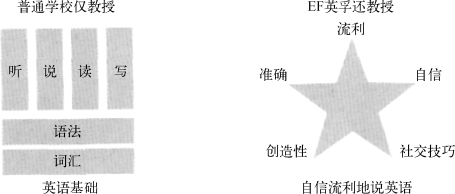
This phase is the one where prevalent use of diagrams and graphs is found.The diagrams and graphs take various forms according to the semantic content expressed in the verbal description of the learning method.For example,the graphical counterpart for the abovementioned verbal text excerpted from the EF company leaflet is shown in Figure 4.14.

The two diagrams on the left and right sides correspond to the two aspects of the means mentioned in the verbal description,that is,“the basic knowledge of the English language(listening,speaking,reading,writing,grammar and vocabulary)”which are taught in all schools on the one hand,and on the other hand,“the fluency,accuracy,confidence,communication skills and creativity”which are claimed to be included only in the courses of this specific language school.

Figure 4.14 An example of diagram in the“teaching method”phase

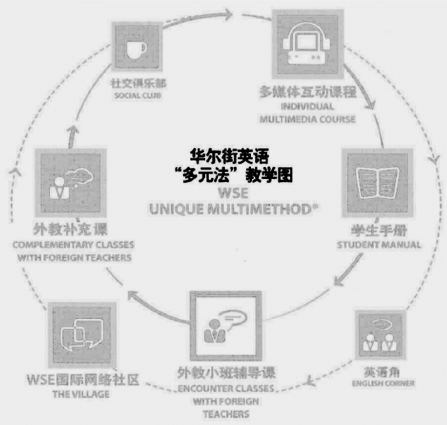
The graphical counterpart(see Figure 4.15)for the above-mentioned verbal text excerpted from the WSE company leaflet is the flow chart in the following.The major means mentioned in the verbal text including“外教小班辅导课”(encounter classes),“外教补充课”(complementary classes),“社交俱乐部”(social clubs),and“The Village”(国际网络社区)are all shown in the flow chart.The elements in the inner circle imply the more essential means in the learning method whereas those in the outer circle imply supplementary means.The arrows indicate that the learning process is a continuous and systematic one.

Figure 4.15 An example of a chart in the“teaching method”phase

The prevalent use of diagrams and graphs are highly motivated because diagrams,as a form of abstract modality,have intextuality with science.Many scholars have explored the reasons of the substantive occurrences of diagrams and graphs in scientific texts.Bertin(1973,cited in Rowley-Jolivet,2002)distinguishes monosemic images(such as graphs,diagrams,maps)which he calls Graphical images,and polysemic images(such as photographs)which he calls Figurative images.In the former,which are conceptual and constructed,each element has a single value or meaning,defined in advance.In polysemic or Figurative images,in contrast,the different visual components are open to several interpretations.Because of the high iconicity of monosemic images,no unambiguous reading is possible.

Kress and van Leeuwen(1996)also study the principle of signification of visuals in a comparative way.They point out that verisimilitude has never been the only criterion for the truth of images.In scientific images and abstract art,images must be truthful,not in the sense that they resemble what they represent,but in the sense that they correspond to the underlying nature,or“essence”of what they represent.This is why in scientific illustrations a simplified diagram might be truer than a highly detailed photograph.In such a context a photograph may be seen as showing only the surface,while diagrams can get underneath that surface by representing the structures common to a range of superficially different phenomena.Another possible validity criterion for images is their emotive resonance.There what matters is neither the truth of verisimilitude,nor the abstract,“essential”truth,but emotive,“sensory”truth.This emotional appeal can be part of the reason for the prevalent use of photos in consumer advertising as a means of eliciting emotion.

Miller(1998)finds that the visuals in scientific articles,such as the diagrams and graphs,have a highly condensed quantity of information.He contests that this allows the expert readers to quickly absorb large amounts of information which they can evaluate for themselves.The visuals are the fast track to the new,which can display information that cannot be explained as effectively in words.

The features of diagrams and graphs that make them significant in scientific texts,as analyzed in the above-mentioned research,include unambiguity in meaning,correspondence to the nature of scientific principles,processes and structures,and privilege and efficiency in representing condensed information over words.They are thus assumed by many people as one significant feature of scientific discourses.When people see diagrams and graphs,their cognitive habit tends to attach to them senses of scientific discourse,such as truth,objectivity,credibility and authority.In addition,the inherent features of diagrams and graphs,such as unambiguity and precise correspondence,are retained even when they are transplanted in the context of promotional discourses.As shown in the above two samples of the phase learning method,the diagrams and graphs do show good correspondence to the semantic content in the verbal text in the visual form.Therefore,the diagrams and graphs in promotional discourses hopefully create strong intertextuality with science in the reader's unconscious level of mind and thus lend weight to the argument in the advertisement as a whole.

As for the spatial organization of the page,it also follows the font of the page of a science book which often takes a vertical composition.The verbal text is on the top and the graph at the bottom.The verbal text explains the alleged learning method or process at the particular English language school.