1
多模态语篇的连贯构建研究 以中国英语学习广告为例 英文版
1.7.3.1 4.3.1 Reader attraction
4.3.1 Reader attraction

Reader Attraction(hereafter RA)is usually the first stage in the advertisements.In leaflets it is the cover page,whereas in flyers it is often the top part of the page.The communicative purpose of this stage is to attract reader's attention and interest to read on.This stage is very important to the efficacy of the whole advertisements since they must compete for attention.Therefore,this stage is the most creative part of the whole advertisements.Highly variable patterns of combinations of verbal and visual elements have been found.In the following the patterns in the verbal and in the visual will be analyzed respectively.

4.3.1.1 The verbal text in RA

Study of the corpus data shows that there are two basic kinds of structure functioning in the verbal text in the RA stage,the problem-solution and the Announcement-Enhancer.The problem-solution structure is an important type of structure in text studies and frequently encountered in various genres of discourses,(see Hoey,1994;Machin&van Leeuwen,2007:Chapter 6).In the English learning advertisements,the problem is almost invariably the troubles and frustrations learners of English often encounter,and the solution is the English teaching and training programs provided by the specific company concerned.A typical pattern found in studies on advertisements is that the problem-solution starts with a series of problems which are typically realized as interrogatives and then proceeds to a solution which is typically realized as a declarative sentence(Hoey,1994).In the RA stage under discussion,the solution is also frequently expressed by exclamatory sentences.There are two reasons for this:one is the need for the expression of strong persuasion required by the promotional nature of the data at issue;the other reason is that,in the syntax of Chinese language the declarative and exclamatory follow the same word order,with the interjections and punctuation mark as the only difference.Thus the desire for a strong impact on the reader,as well as the convenience of conversion from declaratives to exclamations jointly account for the frequent use of exclamatory sentences for the solution part in the problem-solution structure.The following passage is an example of the typical problem-solution structure in the RA stage.

你够优秀吗?

孩子从小就学英语可是仍旧问题重重:

孩子通晓语法,但不善开口

孩子敢说敢秀,但“出口成错”

孩子发音总是不够纯正,不够地道

孩子词汇量狭小,阅读量不足

孩子屡屡在考试中碰壁……

你想变得优秀吗?

江博朗文国际培优英语

——英语交际与英语语法双丰收,

让你更优秀!

Translation:

Are you excellent enough?

Your child has endless problems with English since he started to learn it at an early age:

Your child knows the grammar,but is not good at speaking

Your child dare to speak and show,but his speaking is full of errors

Your child's pronunciation is not pure enough,not standard enough

Your child's vocabulary is small and his reading is inadequate

Your child fails in exams over and over again...

Do you want to become excellent?

Jiangbo Langwen guoji peiyou English

—double harvests of English communication and English grammar

Make you more excellent!

For this problem-solution structure,the Topics are highly predictable and the generic structural potential can be summarized in the following formula:

Problem 1^Problem 2^...Problem n^(question)^solution

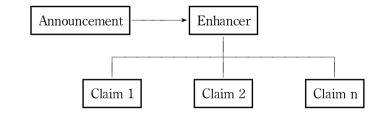
Another important kind of structure often found in the RA stage—the Announcement-Enhancer structure(see Figure 4.7)—can find intertextuality in that of the consumer advertisements.That is,in consumer ads there is usually a short primary Announcement which appraises a certain aspect or attribute of the product,or the significant change it may bring to the consumer,and a longer text—Enhancer—followed to elaborate on and enhance the point made in the Announcement.

Figure 4.7 Announcement-Enhancer structure in the verbal texts in Reader Attraction

In the following an example of such Announcement-Enhancer type of RA is reproduced.

江博激情英语高中英语:扫清英语障碍,高考一身轻松(Announcement)

专业——我们潜心研究新课改的要求,新课改后的英语教与学(Enhancer:Claim 1)

专注——我们关注每一个学生的学习情况、学习情感,让孩子扎实稳健地成长!(Enhancer:Claim 2)

专心——我们专心研究每一节课的教学,力求精益求精!(Enhancer:Claim 3)

Translation:

Jiangbo Passion English senior high school English:(We)remove the English barrier,and make you feel easy and relieved in the college-entrance examination(Announcement)

Professional—we set our heart upon studying the requirements of the new syllabus reform,and also the teaching and learning of English after the reform(Enhancer:Claim 1)

Care—we care for the results and attitude of each student in the learning process,with the aim to help children grow on a solid and steady basis!(Enhancer:Claim 2)

Concentration—we concentrate on every class to make it as perfect as possible!(Enhancer:Claim 3)

Like the case of consumer advertisements,the Announcement is an obligatory part whereas the Enhancer is optional in the English learning advertisements.In a few cases,the verbal text of the RA stage only consists of Announcement,in the form of one or several short phrases.The following passage is an example of such an Announcement-(Enhancer)case.

江博激情英语SAT:美国大学的敲门砖,奖学金的杀手锏,能力和性格培养的通天梯

Jiangbo Passion English SAT:door-knocker of American universities,killer of scholarships,passage-to-heaven of the cultivation of ability and personality

4.3.1.2 The pictorial text of the RA

The Reader Attraction is the most salient part in the whole macro-structure of the English learning advertisements because of its substantial use of pictorial resources.This is understandable since the use of pictures in advertisements,as widely acknowledged,is an effective means of attracting attention and eliciting emotion(see for example,Messaris,1997).Pictures are good at attracting attention because the content they represent might violate reality,for example,surrealism,visual metaphor and visual parodies.Other attention drawing techniques in picture is to use direct eye gaze,manipulated viewing distance and subjective treatment of camera view.The function of emotion eliciting is often achieved through the manipulation of the camera angle which can induce sense of power and status.For example,the upward angle associates with the look of superiority whereas looking down often implies nurturance and subservience.

As far as the English learning advertisements are concerned,the images accompanying the verbal texts in the RA stage are very eye-catching due to their big size,enhanced saturation of color and texture,sensory modality,and the glamorous protagonists in them.In all,the feature of the pictures in this stage resembles that of the consumer advertisements.The protagonists are mostly young attractive females that are smiling at the camera,self-conscious.They do not look the record of a real person in a real environment.They bear the characteristics of what Machin(2004)and Machin&van Leeuwen(2007,Chapter 8)call“generic images”.According to their view which is concluded from their interview with photographers,generic photography is photography which no longer captures specific,unrepeatable moments,and photography which denotes general classes or types of people,places and things rather than specific people,places and things.And it should perhaps be remembered that until recently many key theorists of film and photography have argued that images can never be generic whereas words are always generic and can only become specific in a given context.“The image of a house can never mean‘house’but only ever‘here is a house’”(Metz,1971:118,cited in Machin,2004).However,in the market of consumerist global media,images are made increasingly generic to be less subject to the influence of time,location and other practical limits and thus can be used widely and over and over again.Photographic images are made generic in a number of ways.They will be elaborated one by one in the following.

(1)Decontextualization.It means that the background of the image is either out of focus,or eliminated altogether—many of the images are made in the studio,against a flat background.According to Kress and van Leeuwen(1996:165),“by being decontextualized,shown in a void,represented participants become generic,a‘typical example’,rather than particular,and connected with a particular location and a specific moment in time”.By decontextualization,the image is made timeless and universally applicable,thus the attraction and ideology conveyed in it will hopefully remain longer than those images set in concrete and specific contexts.The RA stage in the English learning advertisements under discussion here also makes frequent use of such decontextualized images.Even if a setting is shown,it tends to be either a meadow,or a generic setting,for example,generic interiors with the style of a showroom or a home decoration magazine,and often with a sense of opulence.For example,in Figure 4.3 the image of the girl in red is placed against an unreal background.

(2)Use of attributes.Photographers often use props to make the image generic.Props are used to connote not only the setting but also the identities of the models and the nature of activities,but in terms of“types”rather than individual identities.A woman in a white coat,wearing glasses,working at a computer tends almost invariably to represent“research,science and technology”.A computer and a telephone indicate an office.Barthes(1977)has found that the objects in photographs constitute excellent elements of signification and form a code of connotation.“They are thus the elements of a veritable lexicon,stable to a degree which allows them to be readily constituted into syntax”(Barthes,1977:22—23).The use of a limited number of props leads to a highly clichéd visual vocabulary.

In the English learning leaflets,a frequently used prop is book:there are numerous instances of a foreigner with a book in his/her hands to indicate a teacher working for the concerning language school.Actually because of the special nature of the services being advertised in these leaflets,the foreign faces or attributes themselves are being used as a kind of prop in many cases.That is,the leaflets include many images in which foreign faces,or parts of a foreigner's body or only the skin color are used,so as to invoke inferences in readers that they can learn and practice English in an international environment.

For example,in the following cover page of a leaflet(see Figure 4.8),a Chinese woman is sitting in the foreground and a black woman is standing in the background.Not only is the image of the black woman somewhat blurry,but her face is also half omitted:only the lower half of her face is shown.The half of a foreign face here is used as a prop for the feeling of foreign-ness which the company attempts to associate with.

(3)Use of models as generic people.The models in the images are often attractive,but its individual features are not easily recognizable because they are overwhelmed and suppressed by the genericity created by their hairstyle,make-up and dress.So they can be re-used in other contexts.The following image(see Figure 4.9)of four young women is excerpted from a flyer of a particular English language school.Their dress,hairstyle,vigorous gesture and the book as a prop,all index their identity as students.The generic identity has suppressed their unique,individual features.Readers see a group of happy and lively students,but do not remember who they are.This speculation is proved by my encounter of the same image in an outdoor poster of another English teaching company,accompanied by several other generic people in the poster this time.

Figure 4.8 Example of use of attributes in RA

Figure 4.9 Use of generic people

The generic images used in these English learning leaflets,as those used in all kinds of advertisements,produce some problems that critical discourse analysts should consider.When discussing about the trend of globalization in visual language,Machin and van Leeuwen(2007,Chapter 8)argue that although the image banks seem to offer an unlimited vocabulary with their several hundred thousand online images,they have serious limitations.The image bank is an ideologically pre-structured world,the categories it uses is a catalogue of clichés and marketing categories.The image bank images provide a world of glamour,health,fun,energy,opulence,control,consumerism,a world without poverty.They quote the Spanish cosmopolitan editor Sarah Glattstein Franco that symbolic images from image banks,can“lift even the most depressing article”.In the pursuit of most-used pictures,and thus maximum revenues,the photographers and image banks produce(and reproduce)highly predictable,easily recognizable and easily digestible images with high key lighting.

In the English learning leaflets,the use of generic models and generic images attaches to English learning many irrelevant but desired features and attributes such as happiness,stylishness,opulence,success and vigor.Learning of the English language is not presented as a systematic,theory-guided,effort-taking and time-consuming process,but more as a fashionable utilitarian commodity for quick and casual consumption.

Another problem is that the inconsistency between the Points in the verbal and in the pictorial.The Points in verbal texts are often concerned with exams,better jobs,going abroad and others,that is,the utilitarian,conscious goal of learning English to get success in life world and they appeal to Chinese learners'conscious and practical goals that are usually made with reason and judgment.In contrast,generic images showing happy young glamorous models in affluent,enjoyable international contexts appeal more to reader's emotions and sensation or the subconscious level of mind.This seemingly contradictory combination of verbal and visual in the English learning advertisements reflects the deep conflict between conscious and subconscious desires of Chinese learners of the English language,which is in turn rooted in the dilemma of the education system and social environment in the transformational China.