1
多模态语篇的连贯构建研究 以中国英语学习广告为例 英文版
1.7.1 4.1 A working definition and model of global coher...
4.1 A working definition and model of global coherence in the English learning advertisements

As the review on global coherence in Section 2.1.3 shows,global coherence is closely related to discourse topic,macro-structure and information organization.Despite the differences in the emphasis and perspectives,these theories share some insights into the fundamental features of global coherence which are summarized as follows:

(1)Global coherence is semantic.As van Dijk and Kintsch(1983)state,global coherence is the semantic representation of the global structure of the text.Other views,such as Reinhart(1980)and Giora(1985),who hold that global coherence is the relevance to the discourse topic,are also based on the semantic content of the text.

(2)Global coherence is not an isolated concept,but a conceptual structure which comprises a network and hierarchy of topics which command the mobilization of resources in the whole text.Van Kupppevelt(1995a)holds that the hierarchical topic-comment structure is the origin of discourse coherence.Van Dijk and Kintsch's(1983)macro-structure also presuppose such a hierarchically organized set of topics.Martin(1992)also believes the sandwich text organization is very important in the formation of texture.

(3)Global coherence is closely related to the external factors of coherence,including the context,communicative purpose and reader's mental knowledge structure.That is,the influence of global coherence is exerted on text processing through the reader expectations derived from the reader's mental schema or script.This mental schema is developed from the knowledge of the related genre and text and the experience with the corresponding situations in the external world represented in the text.With the mental schema or script,the reader can activate knowledge structure concerning the particular discourse topic.The reader expectation of what content will be included in the discourse affects her judgment and interpretation of the coming-in information during reading,and also the construction of a coherent mental representation of the text.

Following these insights,a global discourse topic is believed to command the patterns of semiotic representation in the whole discourse through a set of hierarchically organized topics commanding the various discourse units in the hierarchical structure of the discourse.That is,global coherence is built by a system of discourse topics or themes which govern the discourse units at various levels in the overall representation of macro-structure.Global coherence is defined as the semantic representation of the global topical structure of the text.

Since the English learning advertisements are often multi-page leaflets and brochures which contain many discourse segments,the view of global coherence as a hierarchical network of topics is very suitable.Specifically,global coherence means that all the semiotic units in these advertisements are arranged under the command of a unified discourse topic—English teaching services provided in the specific company.This discourse topic is realized by a hierarchical discourse structure which is represented in a hierarchical order of topics,for example,the teaching team employed by the English training company,the teaching method,courses provided,and so on.The semiotic elements in these advertisements should cohere not only with their adjacent elements,but also with the overall discourse topic/theme and the topic/theme of the discourse segment they belong to.This hierarchical structure of topic-centered disposal of resources is the main internal force that draws the discourse together into a unified and organized whole.

The discourse topics or themes may be represented by the heading,if there is any;or an existing phrase or sentence in the concerning discourse unit;or in other cases,they are abstracted from the content of the discourse unit.In short,they are the semantic abstraction of what the discourse unit is concerned with.The identification of discourse topics at various levels will be elaborated in the next section.

The sandwich text organization in Martin(1992)(see Figure 2.3)is of great value for the elaboration of the definition here.He develops the terms of Theme and New as resources for explaining how information is packaged not just at the level of lexico-grammar,but also at the level of discourse.The Theme of a specific discourse unit is what all the sentences in it contribute to,and the New achieved by all these resources about the theme carries the communication forward.The Themes and News of all the discourse units with the same hierarchical status in the discourse structure are both predicted by,and add up to,a higherlevel Theme,and ultimately,to the overall Theme of the whole discourse.

The great value of Martin's model of texture for the discussion of global coherence in this chapter lies in two aspects:Firstly,it implies a capacity to accommodate multisemiotic means of expression.Following the social semiotic perspective to language,Martin's discussion of information flow and organization implies that the realizational form of the information can be language as well as other semiotic resources like pictures.Therefore,it can be borrowed to analyze the patterns of how information is packaged through a globally operating structure in verbal and visual resources in the English learning advertisements.Secondly,according to Martin,the pattern of information organization created through higher-level Themes and News is a tendency and feature in writing,especially in abstract academic writing,rather than spoken discourse(Martin,1992:456).The reason is that the method of thematic development relies on a degree of consciousness which is more associated with writing than spontaneous spoken monologue.This kind of scaffolding effect created through higher-level Themes and News is also expected to be found in the English learning advertisements as a type of intentionally designed and planned discourse.

Although Martin's(1992)conceptualization is borrowed in this book,the terminology needs to be modified a little.The proposal here is to change“theme”to“topic”and change“new”to“point”.The reasons are stated as follows:

His terminology seems to confound the two pairs of concepts—Theme/Rheme and Given/New.Martin states that:

Halliday is careful to distinguish Theme from Given,assigning distinct Theme^Rheme(realized by constituent sequence)and(Given)^New structures(realized by intonation)to the English clause.This is an essential step in understanding the difference between method of development(this Section 4)and point(Section

6.3.3 below);without this distinction no adequate account of English texture can be provided.(Martin,1992:434)

In the following text in Section 6.3.2 in his book,Martin talks about the Theme selection at various levels of texts,namely macro-Themes,hyper-Themes and clause Themes.Later he talks about the identification of hyper-News in longer texts.This suggests that his method of development means the selection of Themes at various levels and the information around each Theme is summarized in News.Although he states that“Theme and New should interact with discourse semantics in quite different ways”from that at the clause level and“this does turn out to be the case”(Martin,1992:448),this theoretical assumption does not seem to be embodied in his actual analysis.Similar to the treatment of final clause constituent as the New of the clause,he identifies the final sentence of a piece of abstract writing as its macro-New.This practice might lead to the speculation that his identification of News is position-based,thus reader-oriented.This indicates that his view of the two concepts—Rheme and New—is mixed.Halliday claims that Theme^Rheme is speaker-oriented and position-based whereas the(Given)^New is listener-oriented and information-based.Although the two pairs of terms often overlap in actual practices of writing,they should be kept separate in the theories of text analysis.Martin's identification of Themes and News seems that Themes are speaker/writeroriented whereas News are reader-oriented.

The confusion will be avoided in the current working principle of global coherence.Because of the reader-oriented perspective of discourse coherence in this book and the semantic-oriented view of global coherence,the terminology that is reader-oriented and semantic-or information-based will be preferred.Implications will be drawn from van Dijk and Kintsch(1983),that is,the abstract,semantic nature of global coherence and its cognitive influence on reading process.Global coherence,in their sense,does not simply mean macro-structure and superstructure of the discourse,but the semantic representations of the macro-structure and superstructure.It is signaled in the text;at the same time,it is also in the reader's mind.As they argue:

A language user does not normally wait until the end of a full episode or until the end of a complete discourse before deciding about the schematic functions of the local or global information.And,conversely,once some category of a schema has been assigned,knowledge about the canonical structure of the schema allows the language user to anticipate information in the text,which will then facilitate reading and comprehension.(van Dijk and Kintsch,1983:237—238)

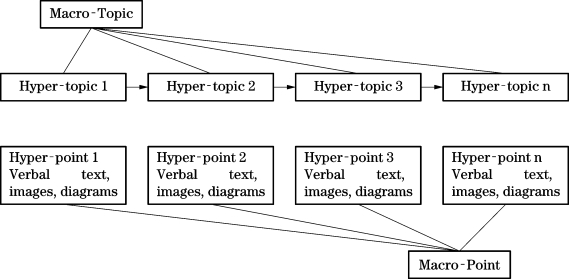
Therefore,in this chapter a terminology of Topic/Point that is more semanticoriented will be adopted to replace Martin's(1992)Theme/New.Topic here refers to the proposition around which the discourse is developed.“Point”refers to the semantic content the discourse tells about the topic.Both topic and point are semantic categories;both involve a multi-layered system in the semantic representations of the global structure of discourse.Specifically,it is assumed that each discourse unit at various levels in the hierarchical macro-structure of the discourse is a relatively independent unit,commanded by its topic and developed and fleshed out by the information inside it.The patterns of semantic representation of the macro-structure of the discourse are in turn commanded and predicted by an overall discourse topic.The system of global coherence in complex multimodal discourses like the English learning advertisements at issue is illustrated in Figure 4.1 below.

Figure 4.1 A working model of global coherence in complex multimodal discourses

The macro-topic refers to the topic of the whole discourse and is the highest-level topic.The definition is not an absolute one;instead,it varies a little with the unit of analysis.If the unit of analysis is a multi-page leaflet,the macro-topic refers to the topic of the leaflet.If the unit of analysis is one page on which a complete advertisement is print,the macro-topic refers to the topic of the whole page.The hyper-topic refers to the topic of the component stages of the discourse,for example,the major obligatory stages in the English learning leaflets such as“Statement of Competitiveness”and“Course Information”.The hyper-topic commands more than one lower-level topic in the stage.The Point of each level means what is talked about the corresponding Topic.That is to say,hyperpoint refers to what is talked about the corresponding hyper-topic,and the macro-point corresponding to the macro-topic,refers to the general idea of the whole discourse.

As acknowledged by numerous discourse studies(see for example,Unger,2006;van Dijk and Kintsch,1983),the patterns of the representation of global discourse structure are cultural-specific and genre-specific.Thus it is assumed that the English learning advertisements as a unique genre will display unique patterns of constructing global coherence.In the next two sections a detailed textual analysis of how global coherence is constructed in these English learning advertisements will be given.