3.2.2 Description of the data
In this section,the terminology of the SFL School of genre theorists will be used.Their definition of genre is“the system of staged,goal-oriented social process”(Martin,1997:13).Its premises are:(i)it usually takes a number of steps to achieve one's purpose(hence“staged”process);(ii)social processes are purposeful/functional(hence“goal-oriented”);(iii)any genre pertains to a particular culture and its social institutions(hence“social process”).
The first premise is embodied in the multiple stages of the English learning advertisements;the“goal”this specific genre is oriented to is to persuade the readers of the superiority of the English teaching services provided by the specific company/school;and the third premise is reflected in its use of verbal and visual resources to appeal to the emotions and desires of Chinese learners of English language and their beliefs about foreign language learning.
In this sub-section the generic structure of the English learning advertisements will be formulated,followed by a summary of the generic features of this specific genre.
3.2.2.1 Generic structure of the English learning advertisement genre
According to Rose(2007),a discourse semantic rank scale is composed of multiple layers of structure,including genre,stage,phase and message.Stage is the“highly predictable segments in each genre”and phase is“more variable segments within each stage,carrying pulses of field and tenor”.Message is a“non-dependent,non-projected clause,together with associated dependent and projected clauses”.The terminology will be followed in the following description of the generic structure of the English learning advertisements.
Following the genre theory of SFL,the staging of the English learning advertisements is summarized in Figure 3.2 as follows.

Figure 3.2 Staging in the English learning advertisements
The stages in bold frames mean obligatory stages.The criterion for the identification of obligatory and optional stages will be given in detail later in this section.The main content of these stages are briefly summarized as follows.
Reader attraction often refers to the cover page of leaflets or the upper part of single-page ads,on which a big-size attractive picture,the brand name of the institution,its logo and slogan are usually printed with salience.
Corporate profile is almost exclusively expressed in verbal text although a few schools also add visual images as justification of their qualification.It is usually composed of several messages,including the history,achievements,guidelines,among others,of the language school/company at issue.
Statements of competitiveness are the most competitive strengths that the language schools claim to own over others.It is usually the most elaborate stage in the English learning advertisement genre.It comprises multiple phases,among which the most frequently seen ones include Learning Method,Teaching team,Environment and Equipment and Teaching materials.The first two phases are almost invariably used in this stage.These phases differ substantially from each other in terms of rhetorical functions and semiotic patterns.
Course information is an introduction of the courses provided by the language school at issue.In this part considerate amount of verbal text is often found.Some ads are designed for only one certain course or program,for example,“spoken English course taught by foreign teachers”,“learning through traveling abroad”,among others.It often takes the form of tables.
Testimonial is a kind of endorsement by the people who or whose children have taken the courses before.It is not an obligatory stage,but a frequently used technique not only in this special sub-genre,but in actually any type of advertising discourse.In this case,the highly positive verbal texts by former learners or parents of young learners are also accompanied by their photos.
Call for action is the last but one stage of the advertisements.It usually employs lexico-grammatical and rhetorical strategies in its verbal and pictorial text to stimulate readers to take action,that is,to pay tuition and enroll in their programs.The frequently occurring phases are promotional incentives and emotional appeal.The former is often represented in price discounts and bonus package,and the latter often takes the form of direct urges or appeals through visual and verbal texts.The most often used verbal strategies include strong persuasive devices,such as second person address forms like“you”and“your”,imperative mood and exclamation mark.
Contact information includes the address,transportation,phone,and website of the language schools.In most cases it is purely verbal,but in a few cases a map illustrating address of the specific language school is included.It is usually put at the bottom part of the page.
The above analysis of the generic structure shows that many of the generic stages,like Statements of Competitiveness,consist of more than one phase.These phases,in turn,comprise more than one message.Therefore,the English learning advertisement genre has a hierarchical structure which is composed of multiple layers of analysis.These stages and phases show substantial differences in communicative goal,persuasive strategy and semiotic patterns.
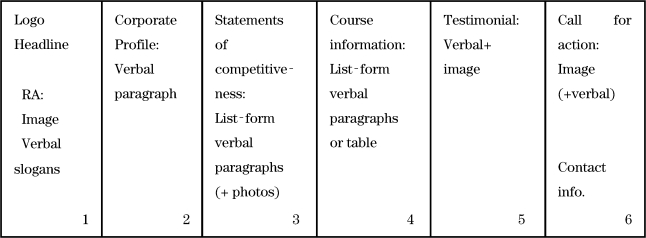
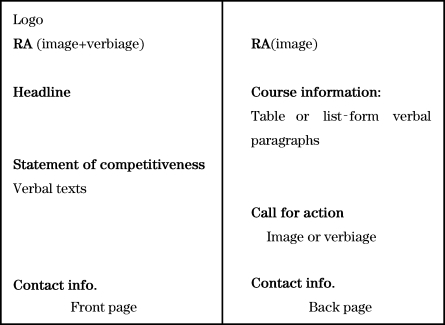
The typical mapping of the functional stages on the actual pages of English learning advertisements is illustrated in the two figures below.Figure 3.3 shows the mapping of the staging on a 6page foldable leaflet.Figure 3.4 shows the typical mapping of the staging on a two-page flyer.

Figure 3.3 Typical mapping of the staging on the leaflets

Figure 3.4 Typical mapping of the staging on the flyers
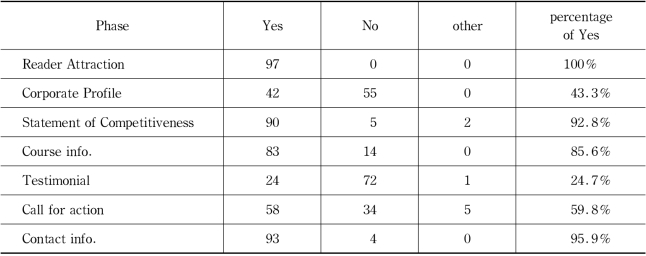
It is observed that the frequency of occurrence of the individual stages in the corpus is highly variable.Therefore,in order to present a more precise description of the staging of these advertisements,their frequency of occurrences is counted and listed in Table 3.4.
Table 3.4 Frequency of occurrences of the stages in the data

As Table 3.4 shows,all advertisements include a Reader Attraction stage,43.3%of them include the Corporate Profile,92.8%include the Statement of Competitiveness,85.6%include the Course Information,24.7%include a Testimonial stage,59.8%include a Call for action stage,and 95.9%include Contact Information.On the basis of the frequency of these stages in the whole corpus,the obligatory and optional stages are decided.The obligatory ones are Reader Attraction,Statement of Competitiveness,Course information and Contact Information whereas the optional ones are Corporate Profile,Testimonial and Call for action.
Following Hasan's notion of Generic Structure Potential,a general generic structure formula is generalized on the basis of the occurrences of the stages.This formula specifies the obligatory and the optional elements within the English learning advertisements as a specific genre,as well as the ordering and recursion of the stages.In a sense,it is a prototype of texts of the same genre since it is representative of the most salient features of its structural realizations.The generic structure formula is as follows:
Reader attraction^(Corporate profile)^Statements of competitiveness^Courses info^(Testimonial)^(Call for action)^Contact information
The stages in boldface are obligatory ones while those in parenthesis are optional ones.The symbol^means“is followed by”.
The sequence of these stages presented above is the most typical one frequently found in these advertisements.But it by no means suggests that the order is fixed;rather,it is relatively flexible and may vary with its individual instantiations in the advertisements.The degree of flexibility and dynamism increases with their multi-modal composition which incorporates signs from multiple semiotic systems.
3.2.2.2 Genre characteristics of the English learning advertisement genre
Two generic features are discussed in this sub-section:dynamism and hybridity,because they are closely related to the analysis and empirical research in this book.
Dynamism
The arrangement of the sequence of the stages is dynamic,especially with the increasing use of multimodality.For example,Reader Attraction may be realized not by one piece of picture,but by separated pieces of pictures on the page or extended large background picture.Incentives like price discounts could be presented in any form,such as drawings,cartoons,figures,and special typographical effects.Therefore,with different forms of representation,it would fit in different places on the ad page.In general,it is the most flexible of all elements.
Another aspect of dynamism lies in the fact that the reading path is in no way fixed.This feature is what all multimodal documents share.Different from linguistic texts which predetermine a linear reading path,multimodal discourses always expect a number of possible reading paths.Although the effects such as salience and framing brought by the use of color,images,organization of the space and other typographical resources have considerate influence on readers'sequence of reading,readers can always choose at will to neglect some parts,skip or linger on some other parts.They can choose freely as to where to start,where to continue or come back and where to quit.This reading path will be examined in the eye-tracking experiment reported in Chapter 7.
A further sense of dynamism lies in the interpretation of images.Although it is often said that“there are a thousand Hamlets in a thousand people's eyes”,language is incontrovertibly the most fully-developed and thus the most capable way of expressing and perceiving human experiences.Compared to language,the visual culture is way behind in that most civilizations don't enable people either to express meanings in visual displays,or to efficiently perceive the meaning conveyed in a visual artifact produced by others.Therefore,the most explicit way of expressing meaning is language.Although today's language in advertising discourses,due to legal considerations,is becoming more and more obscure as a result of the increasing use of subtle and vague wording,it remains the single most explicit and unambiguous way of expression.In contrast,visual images are always open to different interpretations.The readers may see quite different things in the same picture.The number of interpretations has to be restricted by context.
The consequence of the dynamism in multimodal discourses is the subjectivity in the semiotic analysis.Due to the contextuality,fluidity and flexibility of the semiotic resources in the multimodal discourses,the task of describing the meaning-making in a systematic and grounded manner is rather complex.How to prove that the results of the analysis are valid and consistent with the truth becomes a necessary and important issue.For this end,the current book includes an empirical part in which the readers'responses to the coherence construction resources in the English learning advertisements are investigated.
Hybridity
This sub-section deals with the question that these English-learning advertisements as multi-modal discourses often comprise multiple parts which bear generic features of different discourse types.
Martin and Rose(2008:130)argue that“the elasticity of discourse and the attendant facility with which texts adapt to their context means that now and again we'll come across texts which are difficult to categorise as one genre or another(i.e.texts that‘blend’genres)”.Actually,it has been a widely acknowledged concept in discourse studies that many of the longer texts are inevitably composed of more than one simple genre type although the terminology of genre classification used by different discourse analysts may be different as a result of different criteria and perspectives.Martin and Rose discuss this hybrid nature of longer texts under the term macro-genre.They define it as“the nature of texts composed of more than one genre and how they unfold”(Martin and Rose,2008:47).
In this book,the English learning advertisements under examination are also syntheses or a“macro-genre”which incorporates a number of genres.A preliminary rough examination of the data finds that different stages of these English learning leaflets employ different discourse types as part of the strategies to achieve their own roles in the scaffolding of the ultimate goals of communication.For example,in the“learning method”phase under the stage Statements of Competitiveness,the verbal texts and the visual form—diagrams reflect intertextuality with scientific genres.In the Testimonial stage,features of narrative genre are often used.In the Reader Attraction stage and the Call for Action stage,the style of the verbal and the pictorial representation is strongly promotional in order to appeal to the reader's emotions and to sway their judgments.In all,in the English learning advertisements many genres are integrated,mixed and/or blended by way of semiotic representation to realize the generic and idiosyncratic intentions.This hibridity makes our research on the construction of coherence in spite of the diversity and heterogeneity in expressions especially fascinating.
The great diversity across the stages of the genre requires that our analysis of global coherence,local coherence,and surface cohesion in later chapters be all performed in a stage-specific way.That is,the verbal and visual patterns in the various stages of the English learning advertisements will be analyzed respectively.