3.1.1 Global coherence,local coherence and surface cohesion in purely linguistic texts
As discussed in Section 2.1,discourse coherence in verbal texts involves multiple factors,including external ones and text-internal ones.From a perspective of discourse analysis,this book will focus on the text-internal aspect of coherence construction,although the influence from the external factors will also be taken in consideration.
As suggested in Chapter 2,the problems in the existing research of coherence include,(i)the need of a clarification of the relationship between the multiple factors involved in coherence,and(ii)the need of a framework that contains clear,operational guidelines and criteria for the micro-level analysis.To solve these problems,this book proposes to start from the factors in the text and describe the construction of coherence at three levels:the global level,the local level and the surface level.The necessity for the three-level division and the criteria of the three terms will be discussed in Sub-section 3.1.1.1.The relationship between the three levels will be discussed in Sub-section 3.1.1.2.
3.1.1.1 The three-level division:global coherence,local coherence and surface cohesion
As reviewed in Chapter 2,the distinction between local coherence and global coherence and that between semantic coherence relations and formal cohesive devices have been widely acknowledged among linguists.The notions of global coherence and local coherence are semantic in nature in that they are concerned with the logical and semantic relations between elements and parts,and between parts and whole in the discourse.Although both global coherence and local coherence function at the semantic level of texts,the two are fundamentally different in the manner of connection.Specifically,local coherence is a kind of linear relations between adjacent individual elements whereas global coherence is the hierarchical relation network which connects the individual elements to the higher-level discourse units and further up to the discourse topic as the highest node.The notion of cohesion,in contrast,is concerned with the surface level,or the level of expression,and refers to the formal linguistic means marking the connection between elements.Therefore,global coherence,local coherence and surface cohesion represent three different levels of the connectivity that defines a text.
A similar three-way division of textual resources for coherence construction has been proposed in Reinhart(1980):
...I will assume that for a text to be(globally)coherent[1]it has to meet each of the following three(sets of)conditions:connectedness(cohesion),consistency,and relevance.The first is a condition of the linear concatenation of sentences in a text.It requires that the sentences of the text will be formally connected....The second is a semantic condition requiring that each sentence will be consistent with previous sentences...The conditions for relevance...consist of both semantic and pragmatic conditions,and unlike the previous two,they restrict not only the relations between the sentences of the text but also the relations between these sentences and an underlying discourse topic,or theme,as well as their relations with the context of the utterance.(Reinhart,1980:164)
Reinhart's notion of connectedness refers to cohesion and that of consistency refers to the semantic connection between adjacent sentences.His notion of relevance is much more complicated in that at least three kinds of relations are involved,including relations between sentences,relations between sentences and discourse topic,and relations between sentences with the context.These relations are all placed under the semantic and pragmatic relations.In other words,Reinhart's division can be interpreted as follows(see Table 3.1):
Table 3.1 Reinhart's(1980)division of coherence construction resources
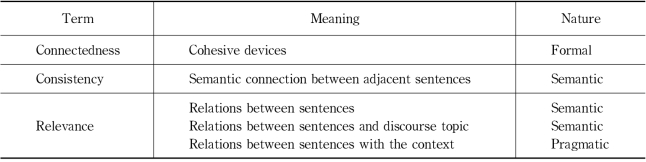
Of the three conditions for text coherence—cohesion,consistency and relevance,“the conditions for relevance are the least understood of the conditions for coherence”(Reinhart,1980:164).In contrast,“consistency is the best defined since it follows from independent semantic conditions”,and“the formal specification of the conditions for cohesion,while not yet fully achieved,is a task in which progress seems feasible,since it has to do with formal(visible)properties of linear concatenation”(ibid:167).
Reinhart's division is largely in accordance with our view in this book that discourse coherence has three levels—global,local and surface,although his view on“relevance”is problematic.The surface level usually refers to the formal cohesive devices that mark the relations between elements at the expression level of the discourse.This is the area in which most studies of text coherence have concentrated,having accumulated a substantial amount of knowledge and hypotheses(Reinhart,1980:167).The Cohesion Theory in Halliday and Hasan(1976)is by far the most influential theory in this regard.The local level of coherence usually refers to the semantic connection between adjacent sentences.The global level of coherence is the one that is the least agreed upon.Although the global coherence has been given highly varied criteria in different studies,its very existence is beyond debate.Therefore,the division of discourse coherence into three levels,namely global,local and surface,allows for systematic description and analysis of the principles and mechanisms of coherence construction.
In order to make the three-level framework an effective one,the three levels must be given clear definitions and criteria.Since cohesion and local coherence have been relatively well defined and studied,the following discussion will mainly focus on global coherence.As suggested in Section 2.1,global coherence is related with a range of factors both in and out of the text.The internal factors which have to do with global coherence,as reviewed in Section 2.1.3,include discourse topic,macro-structure,and information distribution whereas the external factors include the context of situation and reader's mental frame.The various ways of how these text-internal factors reflect global coherence have been discussed in Section 2.1.3.As for the external factors,the context exerts influence on the overall design of the content and structure of the text at the producer's end whereas the reader's mental frame affects his or her comprehension through the top-down guidance at the reader's end.Due to the discourse analysis perspective of this book,the emphasis of the discussion of global coherence here will be placed on the text internal factors.
The proposal here is to conceptualize global coherence as the macro-control on the discourse exerted by a hierarchical discourse topical structure.Specifically,the discourse topic should be conceptualized not as a single,isolated concept locating high above the discourse,but as an abstract proposition or a“conceptual structure”(Chen,Liu and Yang,2004:183)which is contained in the unity of all the information in the text.The discourse topic is composed of a hierarchical semantic network of topics and subtopics.These topics at different levels of the overall discourse topical structure have a global force of connectivity over the corresponding discourse components.Through its hierarchical structure,the discourse topic controls the distribution of content and also the arrangement of semiotic configurations in all units at the various levels of the discourse.
The proposition as the discourse topic should be conveyed by the sum of all other propositions in the text,that is,the topic proposition must have relations with the nontopic propositions.The relations are transcended and maintained in the mental structure of the communicators.All the sequences in the discourse constitute a set of propositions.This set is related to a mental frame which contains all necessary information about the discourse topic,such as the situation,actions,events,conditions,results,and so on.Therefore,although the discourse topical structure is semantic in nature,it operates through the mental frame in the comprehension process.Specifically,the reader's grasp of the discourse topic from textual cues will activate a mental frame or schema concerning the discourse topic if he or she has relevant world knowledge or experiences.As reviewed in Section 2.1.2.2,the mental frame will provide a coherent mental model of the event or situation under discussion in the discourse which greatly affects the comprehension process through constructing inferences for missing links,distinguishing key information from trivial information,and other on-line mental and cognitive activities.If the reader does not have relevant knowledge and experiences concerning the discourse topic,the mental frame of its structure cannot be established and the comprehension will be seriously impaired.For example,Steffensen(1981,cited in Carrell,1982)finds that when there is a mismatch in cultural background knowledge between the reader and that assumed by the text,there will be a loss of textual coherence.In other words,if a reader does not have,or fails to access,the appropriate background schema underlying the text,all the cohesive ties in the world won't help that text cohere for that reader.In a reverse way,a good knowledge of the discourse topic will facilitate the readers in comprehending the discourse,and in some cases might even override the quality of the text's coherence construction.A case in point is McNamara and Kintsch(1996;see also McNamara,Kintsch,Songer,&Kintsch,1996)who find that,after reading a low-coherence text,readers with high topic knowledge perform better in the tasks aimed at tapping deep comprehension which include text inferences,problem solving questions,and sorting tasks.
According to Chen et al(2004:184),the discourse topic should be as concrete and clear as possible.In other words,the proposition or conceptual structure as the discourse topic contained in the text should not be too general.In order for the discourse topic to be possibly clear,two constraints should be met:one being the directness or immediateness of the containment,the other being the integrity of the mental frame.The first constraint requires that the smallest higher-level proposition of the set of all propositions in the text be defined as the discourse topic.The second constraint requires the smallest mental frame,that is,the mental frame should not contain anything,such as situations,actions and events,more than that are necessary for the comprehension of the text.
3.1.1.2 The relationship between the three levels
The relationship between the three levels is another key issue in the establishment of framework for coherence construction.It is held in this book that global coherence has priority over local coherence which in turn has priority over surface cohesion.The justification for this argument will be done with evidences from three perspectives:the text analysis,the production and the processing of the text.
Text analysts hold that the local coherence cannot guarantee the coherence quality of the whole text.Instead,the joint effect of local coherence and global coherence are necessary in realizing the overall coherence or well-formedness of discourses(van Dijk and Kintsch,1983).
Local semantic coherence does not stand alone.We have seen before that linear coherence needs macrocontrol in the form of a theme,topic,or point,as they are theoretically reconstructed as macrostructures.That is,local coherence is to be further defined relative to the global coherence of the discourse.(van Dijk and Kintsch,1983:150151)
The view that local coherence cannot guarantee discourse coherence without global coherence is followed in this book.Global coherence,through the command on the topical structure of the overall discourse,guarantees that all the units inside the discourse are,in their own ways,contribute to an overarching theme—the discourse topic.The smaller units,in their own places in the hierarchical discourse structure,are connected with adjacent units to form the unit higher above them.The micro-level connections are basically semantic in nature,and have an important and indispensable role in weaving the elements into a coherent whole.
Linguists'argument for the importance of global coherence is frequently supported by some texts which show both semantic and formal connection between all adjacent sentences but make no sense at all as a whole(see for example,Unger,2006:27).Although these kinds of well-connected nonsense texts are largely constructed instead of naturally occurring phenomena,they can support the view that global coherence is the prerequisite of text quality,and that semantic connection at local level is a necessary but insufficient condition for the well-formedness of texts.In other words,the coherence of texts can be explained neither by the presence of cohesive devices nor by the appeal to local coherence relations(Giora,1985).Rather,the coherence of texts derives foremost from their relation to a discourse topic.Some evidences for the low status of surface cohesion in discourse coherence can be found in Taboada(2006)who finds that a high number of the relations identified in the Rhetorical Structure Theory(between 60 and 70%of the total,on average)are not signaled.Moreover,she argues that the presence of signaling is not sufficient to identify one particular relation.Frequent signals,such as and,so,and even verbal tense or(non-)finiteness,appear in multiple relations,rendering the signaling ambiguous as to the relation indicated.Therefore,the implication is that the text coherence depends more upon on the semantic aspect of connectivity,including the global connectivity like discourse topic and genre structure,and local connectivity like the rhetorical relations between sentences.
From the perspective of the production,the writer must have set a discourse topic before he or she can plan what information to be included for each component unit,arrange his or her idea into sequences of logically and semantically related sentences and further check whether the adjacent sentences are properly connected formally.In other words,the decision of discourse topic precedes the organization of meaning in individual discourse segments,which in turn commands the polishing of the expression of these meanings.Consequently,constructing the global coherence properly is significantly more difficult than grasping the expository connections which belong to local coherence(Samet and Schank,1984).The priorities of the three levels are more salient in discourse genres in which logic and reasoning play an important role,such as expository and argumentative genres,than in other genres,such as narratives and casual conversations.
From the perspective of discourse processing,the priorities of the different levels of coherence proposed above can find support in many studies by psycholinguistics.The view that cohesion is unnecessary for the establishment of coherence has been claimed and verified in numerous studies.For example,Sanders and Spooren(2009)note that“coherence may,but need not,be signaled explicitly in the text”.They argue that“the connectedness is a characteristic of the mental representation rather than of the discourse itself”(ibid:198).The function of the linguistic signals for cohesion is“processing instructions”to language users,that is,to help readers reconstruct coherence in the text.Chung(2000)investigates the effects of logical connectives and paragraph headings on reading comprehension among 577 Hong Kong students who learn English as a second language.Her finding is that paragraph headings contribute to both macrostructure understanding and microstructure understanding whereas logical connectives do not aid understanding at microstructure level.The combination of paragraph headings and logical connectives is more effective than paragraph headings individually or logical connectives individually in facilitating reading comprehension.The facilitation is much more salient in low-proficiency subjects than in medium and advanced learners.She attributes the facilitative effect of paragraph heading on comprehension to its activation of macrostructure schema which facilitates top-down processing in the first place and guides the processing of the information at a lower level.The results suggest that a clearly signaled macrostructure is very helpful for comprehension whereas the cohesive devices like logical connectives do not have a significant role in comprehension,especially for medium and advanced users of the language.Therefore the findings can support our claim that global coherence is the preemptive condition for the construction of a coherent representation of the text,whereas the cohesion may not be necessary.
However,the lowest status of cohesion in the framework does not mean that cohesion is trivial in the construction of coherence;instead,cohesive devices are also important in that they enhance the semantic relations at the local and global level of the text,and provide formal cues and signals for the readers to reconstruct semantic connections between sentences and sometimes also the logical macro-structure of the whole discourse.The function of cohesive devices to facilitate the reader's comprehension is highly agreed upon among linguists.For example,the finding in Chung(2000)that the best efficacy of comprehension is found when paragraph headings and logical connectives are combined suggests that logical connectives have an enhancing function to the text's coherence quality.These connectives as explicit cues serve as“a scaffolding for the processing of the relationship between the different ideas in the text by signaling whether it is a contrasting relationship,a general-specific relationship and so on”.Therefore,few texts can stand without any use of cohesive devices.Actually,in expository and argumentative genres of texts,and texts whose topics are unfamiliar to the reader,the role of cohesion is especially important.The reason is that,understanding of these texts depends on much mental efforts on the reader's part to correctly decode the logical and semantic relations in the text elements,and the reader's prior knowledge or expectation may have little effect.In this case,the presence of cohesive devices can help a lot in the recognition and reconstruction of the meaning relations in the text.