2.1.3 Global coherence
The discussion in previous sub-sections reveals that the external factors,especially the mental knowledge of the reader,has an overall influence on the top-down processes in discourse comprehension.As is widely acknowledged in discourse studies,the reader's mental representation of texts must be built on the basis of the features and principles in the text as cues.The implication is that the text-internal factors are more fundamental and have primacy in the construction process of discourse coherence.The following three sub-sections(Sub-sections 2.1.3,2.1.4 and 2.1.5)will contribute to the three textual aspects of coherence—global coherence,local coherence and cohesion,respectively.In Sub-section 2.1.3 the definitions of global coherence will be reviewed(2.1.3.1),often in comparison with local coherence,after that the theoretical frameworks of global coherence will be introduced(2.1.3.2).
2.1.3.1 Global coherence vs.local coherence
Coherence is more than connection between individual units like sentences in the text,and there should also be a drawing force operating globally on the text as a whole.Many linguists have made a distinction between these two kinds of connective forces—local and global—in constructing coherent texts.
Besides the proposal in Samet and Schank(1984)which have been briefly introduced earlier in this chapter,van Dijk and Kintsch(1983)also make the distinction between local coherence and global coherence when they discuss semantic coherence.“Under local coherence we understand a property of discourse which is defined in terms of semantic relationships between the successive sentences of the discourse”(van Dijk and Kintsch,1983:150).The global coherence of the discourse is defined as“macrocontrol in the form of a theme,topic,or point,as they are theoretically reconstructed as macrostructures”(van Dijk and Kintsch,1983:150—151).
Giora(1985)placed global coherence at a higher status than that in other researchers'views.She argues that the coherence of texts can be explained neither by the presence of cohesive devices nor by the appeal to local coherence relations.Rather,the coherence of texts derived from their relation to a discourse topic.In her view,the notion of coherence is largely reduced to that of global coherence.
Givón(1995,cited in Kaplan and Grabe,2002)argues that all syntactic and discourse features of a text are a set of processing instructions for how to build a coherent understanding of a text.He proposes two types of coherence:global coherence signaling systems and local coherence signaling systems.The latter includes referent cueing,temporal tracking,locational tracking,event tracking,modality tracking and frame/script tracking.The former includes adverbial transition cues,vocabulary driven processes(specific words that signal discourse continuities and shifts)and cues for new discourse units(marked structures,new paragraphs,new sections,new events).These tracking systems provide continuous low-level signaling,helping to build reader interpretations of coherent segments of texts.
According to Louwerse and Graesser(2005),local cohesion and coherence concern the interrelatedness between adjacent discourse segments.Global cohesion and coherence concern the interrelatedness of larger spans of discourse.For instance,scripted action sequences are globally coherent.
These distinctions between global coherence and local coherence show that the opinion on local coherence is largely agreed upon whereas that on global coherence is highly varied.In Samet and Schank's opinion which is based on discussion of narrative genre,global coherence is the gist of narrative—the story line,plot,or thread of the narrative.Giora regarded global coherence as the relation between text elements and the discourse topic.Louwerse and Graesser equate global coherence with macrostructure of the discourse.The macrostructure in their view is similar with generic structure or schematic structure in the terminology of genre studies.Van Dijk and Kintsch's description of global coherence seem to include attributes of both the two abovementioned opinions,that is,the discourse topic is the controlling force of local coherence within the text and is“reconstructed”or represented in the macrostructure.Unger(2006)proposes that the notion of global coherence can be replaced by that of Relevance.Reinhart(1980,cited in Sanford and Moxey,1995:162)also advances the notion relevance which has a similar connotation to global coherence,that is,each sentence of the discourse must be relevant to an underlying discourse topic,and to the context of the utterance.
Therefore,it can be summarized that,due to the diversity in research perspectives and approaches,there has been no consensus yet as to what global coherence is,or what constitutes global coherence.A range of terms have been involved in the discussion of global coherence,the most frequently occurring ones include discourse topic,theme or gist,macro-structure and context.They will be reviewed in relation to global coherence in the following sub-section.
2.1.3.2 Existing theories on global coherence
As shown in the previous sub-section,the global coherence of a discourse is believed to be related mainly to the following concepts,namely discourse topic(see for example,Giora,1985;Van Kupppevelt,1995;von Stutterheim,1997,cited in Unger,2006),discourse structure(van Dijk and Kintsch,1983),the patterns of information distribution and organization,and the external factors,including context(see for example,Reinhart,1980;Cheng,2003)and reader's mental processes.Since this book takes the perspective of discourse analysis,the emphasis will be placed on the textinternal theories of global coherence.Therefore,the views relating global coherence to discourse topic,discourse structure and information distribution and organization will be reviewed in the following.
2.1.3.2.1 Topic-based theories on global coherence
The topic-based approach to global coherence can find support in Giora(1985)which has been briefly introduced in Section 2.1.3.1.Discourse topic is understood as a proposition,and is independent of sentence topics,though sentence topics can help in recovering the discourse topic.
Von Stutterheim's(1997,cited in Unger,2006)quaestio approach also has implications for the global coherence.Quaestio is an implicit question which the text is designed to answer.Von Stutterheim maintained that coherence was a consequence of the fact that the utterances of a text together answered the quaestio.The quaestio determined what was the topic,what was the main structure and side structure.Seen from the perspective of global coherence in this book,the quaestio can be interpreted as corresponding to what is meant by discourse topic or theme.The quaestio that the whole discourse is designed to answer is the discourse topic whereas the quaestio each discourse segment tries to answer is the topic or theme of that segment and also the secondary topics in comparison with the discourse topic.
2.1.3.2.2 Structure based theories on global coherence
From the perspective of cognitive and psychological perspective,global coherence is more directed towards macro-structure.Kintsch and van Dijk(1978,1983)hold a macro-structure view of global coherence.They distinguish micro-structure and macrostructure of a text.The former correspond to local coherence,that is,semantic representations(propositions)in the sentences.The latter correspond to global coherence,and refers to the semantic representations of the global discourse structure.
Van Dijk(1980,pp.14—15,cited in Cross and Oppenheim,2006)identify two functions of macrostructures:(i)Macrostructures organize complex information.Without them,language users would only be able to formulate information units at the local level and would not be able to group these microstructures together to form the higher-level information units that constitute the main theme of the discourse.This function allows coherence between information units and aids memory and comprehension.(ii)Macrostructures enable the reduction of complex information—they allow the language user to identify the more relevant,abstract or general information from a complex discourse and to disregard the(micro)-information.Together,these functions enable more efficient storage and retrieval of complex information.Clearly,the application of this model is highly relevant to understanding the functions of how global coherence is constructed in the English learning advertisements as a type of multimodal discourse.
More theoretical models on global coherence regard it as a unity of discourse topic and structure.For example,van Kupppevelt(1995a,1995b)argues that discourse coherence is an effect of the internal,hierarchical topic-comment structure of texts.A topic is defined as the set of discourse entities such as persons,objects,places,events(among others)at which the discourse is directed,which are in the focus of attention.It can be defined for sentences,discourse segments and whole discourses.Therefore,the discourse coherence can be explained by the hierarchically defined set of topics commanded by a uniform discourse topic,including topics of discourse segments and the subtopics which are used for smaller units in the discourse.According to Van Kuppevelt,the identification of topics is based on contextually-induced questions in the discourse or discourse segments which may be explicit or implicit and the answers provided subsequently.The question is a topic and the answer is the comment.This theory is mainly based on the discussion of expository monologues and dialogues.Van Kupppevelt's implication is that discourse is hierarchically structured units corresponding to these hierarchically ordered topics.
Halliday and Hasan(1976)argue that a text must cohere with both the context and itself to be a coherent one.The first aspect means that a text must conform to its register the latter means that it must be cohesive.According to Zhu and Yan(2001:85—88),conformity to register means that the text should conform to the generic structure of the genre it belongs to and the discourse topic.The generic structure refers to the component parts or general macro-structure of a specific genre.Specifically,what are the obligatory elements and optional elements of the genre,and their order and frequency of occurrence are also important issues in the analysis of the generic structure of a genre.For a text to be coherent,it should follow the generic structure to a large extent although some texts are designed deliberately with some violations of the generic structure to create certain communicative effects.
2.1.3.2.3 Information-organization approaches to global coherence
Unger(2006)provides a good review of the theories on the relation between global coherence and the patterns of information distribution and organization.According to Unger,they are mainly originated in the field of narrative studies.For example,the distinction between story-line information and non-storyline information,and that between foreground and background,are the important distinctions in these studies.The underlying assumption of this approach is:the overall well-formedness of discourse depends on the way information is distributed over it in terms of varying importance or prominence.As Unger critically observes,the indications of such information grounding are typically sensitive to genre distinctions.
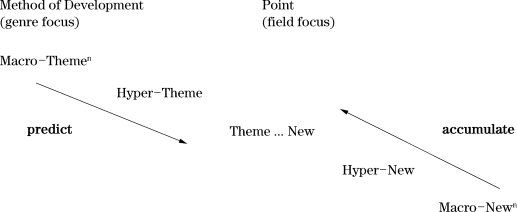
The method of development in systemic functional linguistics is a very different theory of information distribution and organization which provides useful theoretical implications here,although it is not discussed in the light of discourse coherence.Martin(1992)proposes a hierarchical method of thematic development of discourse.One of its apparent difference from other previous reviewed theories is that the term—theme,is used instead of topic.According to Martin(1992:437),there are different levels of themes in the overall organization of discourse.A hyper-Theme functions as what would be termed a Topic Sentence in school rhetoric—as the Theme of the paragraph in other words,rather than as the Theme of a clause.It is an introductory sentence or group of sentences which is established to predict a particular pattern of interaction among strings,chains and Theme selection of a paragraph of sentences.On the basis of this definition of hyper-Theme,the term macro-Theme can be defined as a sentence or a group of sentences(possibly a paragraph)which predicts a set of hyper-Themes;this is the Introductory paragraph of school rhetoric.The proportionalities are set up as follows:
Macro-Theme:text:
Hyper-Theme:paragraph:
Theme:clause
In writing,the use of macro-Themes to predict hyper-Themes,which in turn predict a sequence of clause Themes,is an important aspect of texture;and texts which do not make use of predicted patterns of interaction in this way may be read as less than coherent.(Martin,1992:437)
Macro-Theme,hyper-Themes and clause Themes project forward,scaffolding the text with respect to its rhetorical purpose(i.e.its genre);macro-New,hyper-News and clause News on the other hand look back,gathering up the meanings which have accumulated to elaborate a text's field.The result is a textured sandwich in which texts project both forward and back as they unfold(Martin,1992:456).The method of development is illustrated in Figure 2.1 below.

Figure 2.1 Sandwich texture in abstract written discourse(Martin,1992:456,Fig.6.12)
2.1.3.3 Summary
The review of global coherence reveals the following two points:
First of all,although there has not been a uniform understanding of the term,the great influence of such a globally drawing force on the unity of texts is beyond debate.The different theories all regard global coherence as one of the essential conditions for text coherence.
Secondly,the comparison of the different approaches to global coherence shows that it is difficult to draw a clear line between these approaches.Instead,they share some basic features and principles.Their views actually show different emphases and aspects of the notion global coherence.