2.1.2 External factors of coherence
Although the role of text-external factors in coherence is widely acknowledged,the interpretations of them vary greatly with different researchers.For example,Halliday and Hasan(2001)argue,“the internal and the external aspects of‘texture’are not wholly separable”,the internal“concerns relations within the language,patterns of meaning realized by grammar and vocabulary”;the external“concerns the relations between the language and the relevant features of the speaker's and hearer's(or the writer's and reader's)material,social and ideological environment”(Halliday and Hasan,2001:20—21).Their view is from a social and communicative perspective and the“external”refers to the context in which the discourse is used.In contrast,Unger(2006),taking a pragmatic perspective,proposes that Relevance Theory can serve as an adequate explanation for the recognition of inferred causality relations in narratives.In this sense,the central place in the external factors is occupied by the inferential process in the listener/reader's mind.
The point here is that there are various views concerning the constituents of external factors for coherence.These views can be roughly divided into two groups:those from a social and communicative perspective and those from the individual reader's perspective.The former will be reviewed in Sub-section 2.1.2.1 and the latter in Sub-section 2.1.2.2.
2.1.2.1 Social and communicative perspective
These views mainly focus on context and communicative purpose,which are from a social and communicative perspective toward discourse and the concern is at the production end of discourse.Discourse is,from this perspective,seen as a product of social and material environment,and discourse coherence is accordingly understood as a social phenomenon.
2.1.2.1.1 Context
The significant role of context on discourse coherence is beyond debate.As many linguists acknowledge,language use is very largely prescribed and proscribed by the situation in which it is spoken or written.For example,Coates(1995)argues,coherence in discourse involves far more than lexical and grammatical links between elements on the text.All kinds of features of context—such as the relationship between the participants,the speaker-roles adopted by participants,whether the interaction takes place in the public or private domain—has to be acknowledged in order to assess whether an utterance is coherent.Cheng(2003)also included consistency with context as one important aspect of discourse coherence.
Despite the consensus on the importance of context in discourse meaning and discourse coherence,question remains in the exact definition of context and the actual ways in which it influences discourse.That is,how to pin down context and how big its role is in the interpretation of discourse meaning are a long-standing problem and have induced highly diverse answers.Different levels of context have been found,ranging from the culture as a whole to the face-to-face interaction of human beings,and to the mental construct in people's mind.
Most text linguists hold the view of context as first-order framing of external social reality.According to Galliker and Weimer(2000),the context of a certain utterance is the cultural and social surroundings or circumstances in which the utterance occurs.Halliday and Hasan(2001:20)interpret context as“the relevant features of the speaker's and hearer's(or the writer's and reader's)material,social and ideological environment”.Halliday and Hasan(1976)conceptualize context as a semantic configuration constituted by three variables:field,mode and tenor.Field is the total event,especially the subject-matter,in which the text is functioning.The mode is the function of the text in the event,including therefore both the channel taken by the language—spoken or written,extempore or prepared—and its genre.The tenor refers to social relations among the participants involved.Field,mode and tenor collectively define the context of situation of a text.
Van Dijk's(2008)view of context can be regarded as the second-order framing of one's own mind.From a socio-cognitive perspective,he believes that contexts were“subjective participant constructs”“mental models”“experience model”,and so on(2008:16).He argues that contexts,as mental models,control the processes of discourse production and comprehension,and hence their resulting discourse structures and discourse interpretations.
Givón(2005)attempts to build a bridge through the first-order and second-order framing of context with the third-order framing,that is,framing of other minds.He interprets communicative context as“a systematic on-line construction of mental models of the interlocutor's belief and intention states”(2005:xiv).
In summary,the relation between context and language is hard to pin down.Linguists resort to context for the interpretation of discourse meaning at different junctures and to different extents.
2.1.2.1.2 Communicative purpose
Askehave(1999)reviewed the concept of communicative purpose used in the functional approaches to genre studies.It is often used as a determent of genre classification by scholars in various genre schools.However,as she sharply observes,this practice had some serious problems.The first one is that a clear definition of“communicative purpose”is difficult to find.For example,Swales'main problem is,according to Askehave,that he seems to introduce two types of communicative purpose:the“official”communicative purpose and the“hidden”communicative but never comments on the distinction between them.The problem of Martin's arguments on communicative purpose is,according to Askehave,when he talks about genres/social processes,his account usually restricts itself to a small group of about six or seven different text types.Askehave holds that texts seldom fulfill one function only but a set of purposes and functions at once because the purpose of a text is subjective.
Lentz and Pander Maat(2004)propose that the communicative purpose of a document should be analyzed in terms of four elements:(i)the intended communicative effect as a cognitive result;(ii)the topic(s)of the document;(iii)the target group(s)of the document;and(iv)the organizational goal as a social result.They believe that,documents almost always aim to achieve several purposes at once which are often related to each other.Together,these purposes constitute a functional network that can be represented as a tree with higher-and lower-order purposes.Lowerorder purposes are often a prerequisite for accomplishing higher-order purposes.It follows that these purposes are seen as restrictions on the set of design options for a given document:they restrict the options including content,structure,style,and visuals to be used in a given document.
Lentz and Pander Maat's view of communicative purpose is very comprehensive—it actually subsumes all the key factors of communication:communicative purpose in the conventional sense(reflected in their first element),the content of communication(reflected in their second element),and the communicators including receivers(reflected in their third element)and senders(reflected in their fourth element).Their second element—the topic(s)of the discourse—is actually the internal global coherence,although their argument is based on the communicator's perspective.
What Askehave(1999)and Lentz and Pander Maat(2004)have in common is the subjectivity of communicative purpose which is reflected in the existence of multiple communicative purposes in a discourse.
2.1.2.1.3 Summary
The review of the concepts of context and communicative purpose suggests that the two concepts are not mutually exclusive,rather,they reflect different aspects of discourse and are deeply intertwined.Context reflects the social semiotic aspect of discourse as communication while communicative purpose reflects the intentional aspect.Actually any communicators have both social attributes molded by social conventions and practices and personal intentions/purposes at the same time.Since people's communicative purposes are usually subjected to their social roles and the socio-economic environment they are in,the discussion of communicative purpose can be subsumed into that of context.Additionally,since the communicative purpose is highly subjective and comprises multiple purposes,it is difficult to be used as an operational analytic tool for the discourse coherence.Take the English learning advertisements for instance,the general communicative purpose is to promote their English learning programs,but they also have other more specific purposes,such as to present the company as a reliable and competent partner,to improve the reputation and social recognition of the brand image,to influence public opinion on English learning,and to obtain a larger market share and undermine competitors,among others.
2.1.2.2 Reader's mental knowledge
Since communication is performed by human which is at once a social being and an individual,the understanding of discourse meaning naturally involves individual reader factors,such as reader's knowledge,experience,interest,and involvement in the task.Apart from the reader's interest and involvement in task which are more contextually related,other reader factors,especially those concerning knowledge of the genre and related experiences in lifeworld are believed to have a robust influence on the comprehension of discourses.They are often discussed in the field of discourse processing and psycholinguistics under the category of mental knowledge and mechanisms.
The role of mental knowledge in constructing global coherence has been widely acknowledged in discourse studies(see for example,Li,1990;Cheng,2003;Unger,2006).In the course of reading,readers resort to mental knowledge about the world in order to establish coherence.As Van Dijk and Kintsch(1983)argue,during comprehension readers pull out from their general store of knowledge some particular packet of knowledge and use it to provide a framework for the text they are reading.Knowledge structures are variously called schemata,frames,scripts,or MOPs[2].The knowledge structures about the events and situations in the world serve to guide the interpretation of the discourse,thus are important in constructing global coherence.
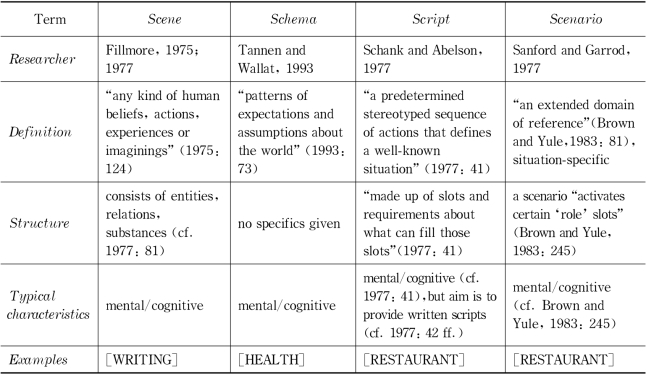
The current problem is that the knowledge structure is discussed in different terminology in linguistics.Script,schema,scenario and frame are the frequently encountered ones among the theories on the mental construction of global coherence.These terms usually differ only in emphasis and cannot easily be distinguished.An excellent overview of these competing terms is offered in Bednarek(2005)(see Table 2.2).
Table 2.2 Overview of linguists'terms related to global coherence(Bednarek,2005)

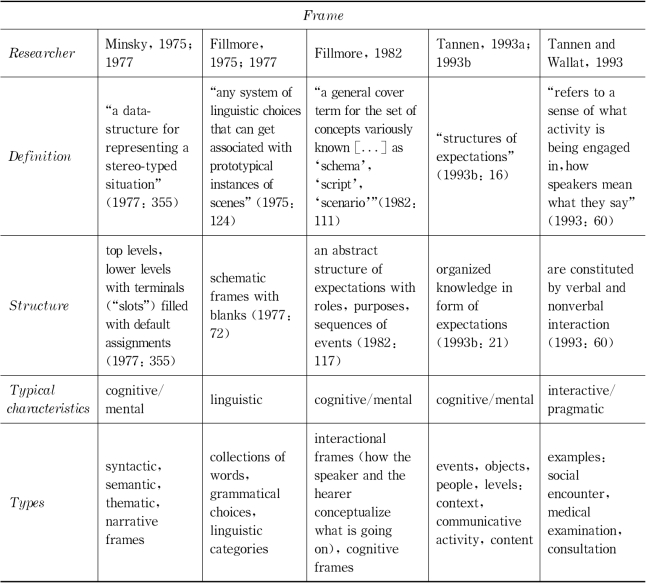
Following Fillmore,Bednarek used the term“frame”as the cover term of all these competing terms.She defined frame as“a mental knowledge structure which captured the‘typical’features of the world”.She believed that frame had become a term associated and linked with different,though related phenomena due to the lack of consistent terminology.The overview of the various connotations of the term by various scholars is presented in Table 2.3.
Table 2.3 Overview of the use of the term“frame”(Bednarek,2005)

Despite the inconsistency in terminology,the basic assumption of all these theories is similar:the impression of coherence is founded on activating the relevant knowledge structure.For example,according to scenario theory(Sanford and Moxey,1995:170-171),the activation means identifying the situation which utterances in language are about—the basic scenario.The more we know about a situation,the more complex and the richer the scenario will be.And a rich scenario constitutes a rich source of knowledge to use in clarifying problems which may arise during interpretation.The identification of a scenario takes place as early as possible during processing.Since scenario identification is to be viewed as a process dependent upon enough information from the message information to satisfactorily content-address a scenario,the coherence of a text should depend upon how readily it makes the appropriate information available.If the information is not readily available,then the text should be hard to understand.Therefore,effective pieces of writing are structured in such ways that they can bring about the right level of interpretation at the right level of detail in the mind of the reader.
To summarize,the comparison of the several terms reveals that they have similar connotation.This similarity can be evidenced by the fact that script,schema and scenario are listed under one entry in The Encyclopedia of Language and Linguistics(Asher and Simpson,1994,Vol.2:602).Apart from the mental/cognitive nature of these terms,what they have in common are:(i)they are all structured in networks;(ii)they influence discourse comprehension through reader expectation.
The first aspect can find support in van Dijk and Kintsch's(1983)argument.In their opinion,basic to all these notions is the intuition that knowledge must be organized in packets,and that it cannot be represented simply as one huge interrelated network of nodes,but that there must be subsets of that network that can function as wholes(van Dijk and Kintsch,1983:46—47).
The second aspect means that this structured knowledge can form the reader's or hearer's expectation of the on-going communication.It's this reader expectation that is important in the construction of discourse coherence at a global level.As van Dijk and Kintsch(1983)point out,schemata provide not only a coherent framework for the semantic units of a text,but also a basis for more active,top-down processes.With this mental model of coherent representation of the text,readers actively build coherence relations between elements within the text,and organize information according to the mental model.Missing information can be assigned default values if it appears insignificant,or it can be actively looked for in the text(van Dijk and Kintsch,1983:48).Bednarek(2005)also believes that“frame”has coherence-inducing function,that is,the hearer's application of frames is of crucial importance in enabling him/her to create coherence.
Therefore,the reader's expectation about the thematic subject and its representation in a hierarchical network in the discourse provides the cognitive drive for the top-down processing of the discourse.It influences the interpretation of the parts according to the mental structure of the whole,so it is the key in the construction of global coherence on the reader's part.