1
多模态语篇的连贯构建研究 以中国英语学习广告为例 英文版
1.5.1.1 2.1.1 Definitions of coherence and cohesion
2.1.1 Definitions of coherence and cohesion

The numerous definitions of coherence generally fall into two groups:those from the textual perspective and those from psychological perspective.In the former group,coherence is often used,either in a comparing way or in a substitutable way,with another term,cohesion.The important opinions concerning these two terms will be discussed in detail in Sub-section 2.1.1.1.The psychological views of coherence will be reviewed in Sub-section 2.1.1.2.Sub-section 2.1.1.3 will summarize the views discussed in previous sections and derive the definition of coherence used in this book.

2.1.1.1 Textual perspective

The most influential theory in this regard is the cohesion theory in Halliday and Hasan(1976).Their key term is cohesion around which they developed a whole set of resources contributing to texture.The cohesive devices,which are generally referred to as cohesion theory,have tremendous influence in the field of discourse studies and ESL teaching.

Halliday and Hasan claimed that cohesion was a semantic concept although their definitions of cohesion are not consistent.They believed that,like other semantic relations,cohesion was expressed through the strata organization of language,that is,the three-strata coding system—semantic(meanings),the lexico-grammatical(forms)and the phonological and orthographic(expressions).Cohesion is expressed partly through the grammar and partly through the vocabulary.There are thus two types of cohesion:grammatical cohesion and lexical cohesion.Reference,substitution and ellipsis belong to the grammatical,reiteration(including repetition of the same word,synonym,superordinate and general word)and collocation belong to the lexical,and conjunction is on the borderline of the two(Halliday and Hasan,1976:6).

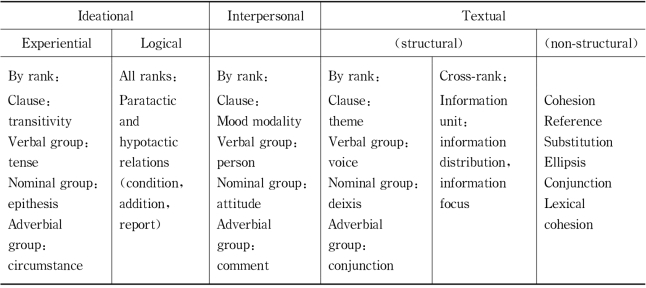
What needs to be noted is that they did not use the word“coherence”,which could be evidenced from the absence of the word in the index.They seemed to use the term texture or textual function in the sense of coherence.For example,textual(component)“comprises the resources that language has for creating text,in the same sense in which we have been using the term all along:for being operationally relevant,and cohering within itself and with the context of situation”(Halliday and Hasan,1976:27).This sentence implies that they believe that a text should meet two conditions to be coherent:to cohere with itself(cohesion)and to cohere with the context of situation(register).Cohesion only partially accounts for the creation of texture of texts.They further clarified the place of cohesion in the linguistic system as one part of textual function,the other parts being theme and information structure(see Table 2.1).Cohesion is“the means whereby elements that are structurally unrelated to one another are linked together,through the dependence of one on the other for its interpretation”(Halliday and Hasan,1976:27).

Table 2.1 The place of cohesion in the description of English(Halliday and Hasan,1976:29)

Although they drew a table illustrating the place of cohesion as one of the three parts of the textual component of text(see Table 2.1),they did not explain the importance of cohesion both in comparison to the other two parts and in the whole system of textual function.The priorities of these structural and non-structural(cohesion)resources of the textual function remain unclear.

In a word,the cohesive devices identified by Halliday and Hasan are only resources which reflect explicit or traceable features in the formal level of language;there are also features of coherence which are implicit or cannot be grasped from a local-level analysis of the text.For example,as Jiang(2005)observes,juxtaposition of sentences without any formal cohesive devices can also help form a coherent text.Zhang(2001)also equated cohesion with the textual meaning that linked clauses and the units above the clause.He argues that cohesion is not only the textual meaning that expresses the semantic relations linking the clauses,but also relations linking the text with the context of situation.In his opinion,the difference between cohesion and coherence is that the former is the concrete semantic relations of the text and the latter is the effect these relations produce.

Apart from the above mentioned views,the widely held view is that coherence is the abstract nature of connectivity and unity of the text while cohesion refers to the explicit formal means that signal the semantic and logical relations.

2.1.1.2 Psychological perspective

In the opinion of psycholinguists,coherence is a mental construct instead of an attribute of the text.For example,Jay(2004)defined coherence as“a person's mental representation of discourse in an organized and meaningful way”(Jay,2004:270).The definition of coherence given by Sanford and Moxey was,“coherence is assumed to be the result of the interpretation and integration of interpreted text elements by the listener(reader)in relation to the intentions of a speaker(writer)”(Sanford and Moxey,1995:181).They claimed that“the idea of coherence in text itself is meaningless”and“the processor has the task of producing a coherent mental representation of the discourse”(ibid:183).Coherence in more general terms consists of being able to interpret events in the world in a non-contradictory way which links novel situations with ones that we already understand.(ibid:181)

The underlying assumption is,“a text is coherent for a reader if and only if the reader has constructed an adequate conceptualization of it”(Samet and Schank,1984:59).Intuitions of textual coherence are a by-product of our comprehension mechanisms.If they work smoothly when presented with a text,then we regard this text as coherent.The comprehension mechanisms work smoothly if the representation of the text is properly formed and its parts are properly connected.

This mental view of coherence is echoed in many other works in the field of discourse processing.For example,van Dijk and Kintsch(1983)believe that discourse coherence was established in the process of strategic comprehension of discourses,and coherence is based on people's knowledge and experiences.When a reader reads a text,an understanding of the text is created in the reader's mind.The process of constructing a situation model is called the comprehension process.In their opinion,text comprehension is a strategic and constructive process whereby the reader uses information in the text as cues to the structure of the events,images and inferences drawn from the text.One of the major issues in discourse comprehension concerns the need for a situational representation,in addition to a representation of the text itself.That is,they assume that discourse understanding involves the representation of a textbase in episodic memory,and a situation model.The textbase is the semantic representation of the input discourse and will be defined in terms of propositions and relations among propositions.Situation model is“the cognitive representation of the events,actions,persons,and in general the situation,a text is about”(van Dijk and Kintsch,1983:11—12).The comprehension of the text depends not only on the mental representation of textbase in episodic memory,but,at the same time,on the activation,updating,and other uses of the situation model in episodic memory.

Focusing on the inferences in discourse comprehension,Shiro(1994)believes that“a text takes shape(or different shapes)in the reader's mind during the reading process”and“a textual world is being built by combining textual information with inferences to form a coherent whole”(Shiro,1994:167).A large amount of textual meaning is constructed by reader's inferencing which implies supplying missing links.The fact that the text is coherent results,to a large extent,from the reader's ability to infer the relations beyond sentence level that keep the text together.The coherence of a text cannot be described independently of the reader(ibid:175).She also raises the question of how to decide how much of coherence is found in the text and how much in the reader's minds.

Gernsbacher and Givón(1995)stated explicitly in their introduction of the book Coherence in Spontaneous Text,“coherence is a mental phenomenon.Coherence is not an inherent property of a written or spoken text”and their definition of coherence is“a property of what emerges during speech production and comprehension—the mentally represented text,and in particular the mental processes that partake in constructing that mental representation”(Gernsbacher and Givón,1995:vii).All syntactic and discourse features of a text are,according to Givón(1995,cited in Kaplan and Grabe,2002),a set of processing instructions for how to build a coherent understanding of a text.Givón noted that grammar must have evolved as a mechanism for speeding up the processing of both local and global aspects of text coherence(ibid:81).These cues work in combination,as parts of a unified connectionist architecture,to assist reader in building a text model of comprehension.

Cornish(2009)claimed that coherence relations were not to be found within the cotext:they were not intrinsically textual at all—even though they were clearly triggered via textual elements(e.g.connectives)as well as via relevant world knowledge.Rather,they are regular cognitive“routines”which are exploited by readers or hearers in order to enrich the texts they are processing,and in order to complete and integrate the propositions which they infer from these texts in terms of an appropriate context,assigning to each of them an appropriate illocution:so they are the“scaffolding”,as it were,that enables the reader or addressee to construct discourse on the basis of text and context.

The reader's role in constructing coherence is also recognized by many text linguists.For example,Tannen's(1989,cited in Kaplan and Grabe,2002)theory of involvement posited that a good part of the discourse coherence derived from various ways in which the reader was involved in the text.Hoey(1991:11)claimed,“coherence is only measurable in terms of a reader's assessment”.Hu(1994:181)stated that discourse coherence referred to the hearer's/reader's attempt to grasp the speaker's/writer's communicative intent using contextual information and pragmatic knowledge.Zhu and Yan(2001:69)agreed that coherence should be at once a linguistic phenomenon and a mental activity,and the ideal research should take both aspects into consideration.Cheng(2003)proposed that a text must be consistent with the reader's expectation,shared knowledge and the principles of cognitive processing,as well as with context,to be coherent.Hu(2007)and Bednarek(2005)also took the stance that it was the hearers(readers)who established coherence,not the texts.

2.1.1.3 Summary

In summary,the acknowledged view is that cohesion refers to the formal features of text which link elements together while coherence is more abstract and refers to the higher-level unity of text(see for example,Djonov,2005;Bednarek,2005).Coherence must be built on the basis of two aspects:the textual resources and the reader's mental construction.

Therefore,the definitions of coherence and cohesion and their distinction can be summarized as follows:

Coherence is the defining feature of a group of stringed sentences or other semiotic elements by which they are recognized as a text,but it is not a property located in the text itself.It also“refers to the extent to which hearers find that this text‘holds together’and constitutes a unified whole”(Bednarek,2005)and is dynamically constructed in the hearers or readers'mind during the process of his or her processing of the text.Therefore,coherence is the result of the interaction between the coherence relations in the text and the reader's active comprehension process.Cohesion,on the other hand,is a text-inherent property;it concerns the explicit textual means by which potential logical connections are signaled.In other words,it refers to the way in which sentences are connected in a text by lexical and structural means.

The current book agrees with this view that,coherence is abstract,semantic and dynamically constructed in the interaction between textual resources and the reader's mental activity.The textual resources for the connectivity of the text provide scaffolding for the readers to construct a coherence mental representation of the text.Cohesion,as the explicit signals of coherence relations,is regarded as signals of the coherence relations at the surface level of texts.