Within a system whose bins are filled according to the binomial distribution(such as Galton's "bean machine", shown here), given a sufficient number of trials (here the rows of pins, each of which causes a dropped "bean" to fall toward the left or right), a shape representing the probability distribution of ksuccesses in n trials (see bottom of Fig. 7) matches approximately the Gaussian distribution with mean np and variance np(1−p), assuming the trials are independent and successes occur with probability p.
Consider tossing a set of n coins a very large number of times and counting the number of "heads" that result each time. The possible number of heads on each toss, k, runs from 0 to n along the horizontal axis, while the vertical axis represents the relative frequency of occurrence of the outcome k heads. The height of each dot is thus the probability of observing k heads when tossing ncoins (a binomial distribution based on ntrials). According to the de Moivre–Laplace theorem, as n grows large, the shape of the discrete distribution converges to the continuous Gaussian curve of the normal distribution.
The theorem appeared in the second edition of The Doctrine of Chances by Abraham de Moivre, published in 1738. Although de Moivre did not use the term "Bernoulli trials", he wrote about the probability distribution of the number of times "heads" appears when a coin is tossed 3600 times.[1]
This is one derivation of the particular Gaussian function used in the normal distribution.
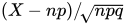
The theorem can be more rigorously stated as follows: , with a binomially distributed random variable, approaches the standard normal as , with the ratio of the probability mass of to the limiting normal density being 1. This can be shown for an arbitrary nonzero and finite point . On the unscaled curve for , this would be a point given by
For example, with at 3, stays 3 standard deviations from the mean in the unscaled curve.
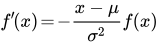
The normal distribution with mean and standard deviation is defined by the differential equation (DE)
with initial condition set by the probability axiom .
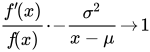
The binomial distribution limit approaches the normal if the binomial satisfies this DE. As the binomial is discrete the equation starts as a difference equation whose limit morphs to a DE. Difference equations use the discrete derivative, , the change for step size 1. As , the discrete derivative becomes the continuous derivative. Hence the proof need show only that, for the unscaled binomial distribution,
as .
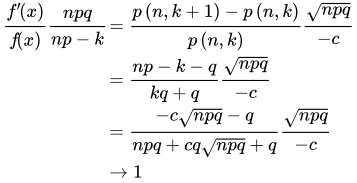
The required result can be shown directly:
The last holds because the term dominates both the denominator and the numerator as .
As takes just integral values, the constant is subject to a rounding error. However, the maximum of this error, , is a vanishing value.[4]
The proof consists of transforming the left-hand side (in the statement of the theorem) to the right-hand side by three approximations.
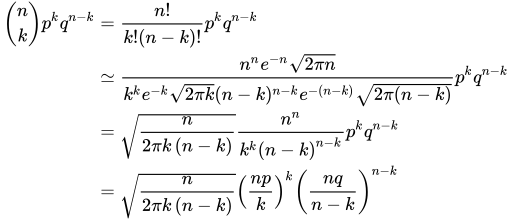
First, according to Stirling's formula, the factorial of a large number n can be replaced with the approximation
Thus
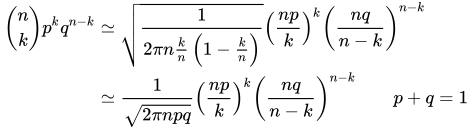
Next, the approximation is used to match the root above to the desired root on the right-hand side.
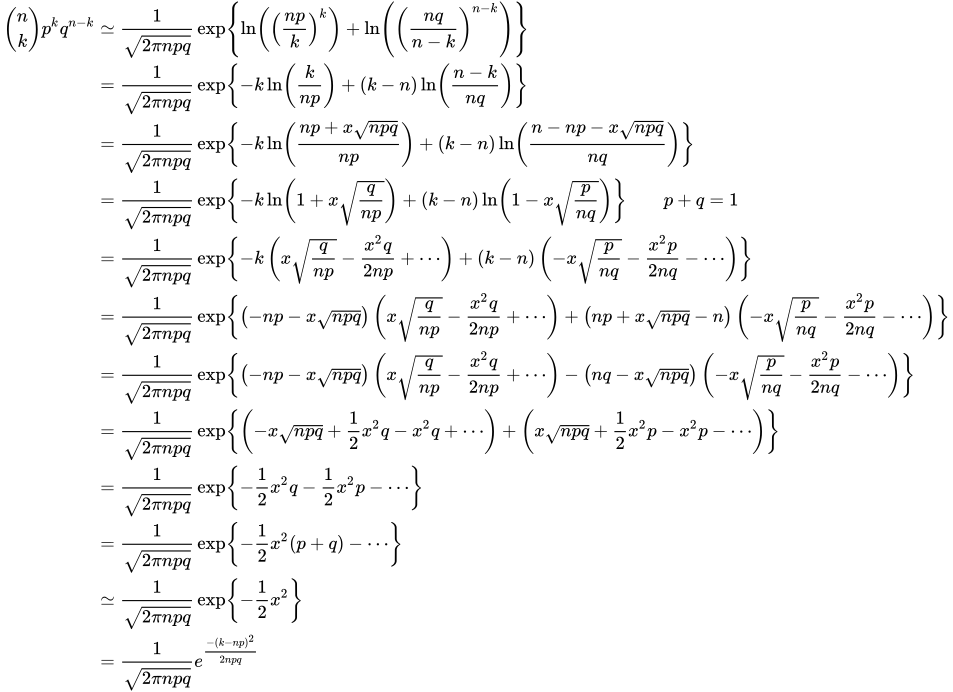
Finally, the expression is rewritten as an exponential and the Taylor Series approximation for ln(1+x) is used:
Then
Each "" in the above argument is a statement that two quantities are asymptotically equivalent as n increases, in the same sense as in the original statement of the theorem—i.e., that the ratio of each pair of quantities approaches 1 as n → ∞.
_-_Galton_1889_diagram.png)