Exploring the success of Korean Wave:A case study of K-POP,focusing on the agency of“SM Entertainment”
Abstract
This research is constructed around one core question:how does Korean popular culture become influential all over Asia and even outside Asia in recent years,what could be considered as the key factor of its success?This question will be explored using a case study of K-POP in terms of idol groups,focusing on a successful agency:the SM Entertainment.How does the Korean Wave make its cultural products appealing?What innovation has been made in the face of global competition?What could be considered as the effective tool of spreading Korean popular culture worldwide?How is the success of Korean Wave evaluated?What attitude do K-POP people hold towards the success?What could be generated from its experience?For these investigations,the study considers that marketing strategy,cultural globalization and cultural leadership could provide a meaningful theoretical context to the research question.To apply the hypothetic theories,the SM Entertainment,as an outstanding record label of KPOP,whose popular singers and popular cultural products are very much welcomed by K-POP audiences around the world,will be examined.An attempt is made to go beyond the management strategy of SM Entertainment and extend to cultural leadership,demonstrating how brilliant leadership facilitates the success of cultural enterprise.Cultural leadership is approved by analyzing and could be applied to the case properly,from an internal perspective.Marketing strategy of Integrated Marketing Communication is discovered as an essential contributing factor of the success,together with assistance of social media.
Key Words:K-POP,SM Entertainment,idol group,cultural globalization,cultural leadership,IMC strategy
Introduction
“Korea wave”,which refers to Korea's own cultural industry output,has become prevalent all over Asia over decades.It covers cultural products mainly including TV drama and movie,later expanded to traditional Korean culture such as food,architecture,dress and so on.Target market of Korean Wave used to be limited within Asia,but now has been broaden world-widely.“K-POP”,as a branch of“Korean Wave”,stands for Korean Popular music especially including idol group,has won popularity especially with younger generations,and stretched Korean Wave's target market from Asia to outside areas including U.S.,Middle East,South America and Europe(Cha and Kim,2011).K-POP has had really huge influence on overseas audiences,and made excellent contribution to the globalization of Korean Wave.The expansion of K-POP in western countries directly relying on world live shows and concerts,besides which also developed by internet and social media.In the sense of the original and physical diffusion method,the live shows and concerts,the SM World Tour Concert is of much significance.In social media,artists in SM Entertainment are also appeared to be the most welcomed and supported.The appeal of K-POP grows in the world's largest and fastest-growing markets,among which most artists and products are from SM Entertainment.SM Entertainment has contributed hugely to the phenomenon of Korean wave and K-POP,in terms of diffusing Korean popular music,making commercial profits,and driving the development of economy and national tourism.Almost half of K-POP fans are the fans of idol groups of SM Entertainment.Therefore,it's meaningful to examine the agency of SM Entertainment specifically as a part of the research.
SM Entertainment has always been regarded as a leading character of Korean idol culture.It owns a sterling reputation of star-making system and has attracted a great number of fans among teenagers.SM Entertainment is an independent record label of Korean pop music,founded by Lee Soo-man in South Korea February 14,1995(Naver,2011).It's called“Star Factory”in Korea,and is one of the“big three”record companies in Korea along with YG Entertainment and JYP Entertainment because of its strong market share and international operations(Naver,2011).However,SM Entertainment towers above the other two companies in terms of global popularity and publicity.SM starts and leads the Korea Wave throughout Asia and internationally.It has made impressive contribution to Korean popular culture which signals the emergence of Korean culture economy with its artists and cultural content(Kim and Sam,2010),in terms of the widely recognized reputation and considerable commercial profits.
Consumers of the cultural products of SM Entertainment have contributednot only enthusiasm but also economic profits to the company.The artists in SM Entertainment have made giant success both artistically and commercially.Just as the French economist Larreche described,talented entrepreneurs do not sell the product to the customer unilaterally,but making the customers appealed by the products and chasing after initiatively(2001).To explore the secret of K-POP's success,finding out the special reason which contribute to the diffusion of Korean pop culture,in terms of culture and business,SM Entertainment will be discussed as a typical example.By discussing the market strategy,business model with the frameworks of business culture,and analyzing the cultural leadership of K-POP and the company of SM Entertainment from cultural entrepreneurship perspective,a better understanding of phenomenon of Korean Wave and K-POP,and inspiring thoughts about development of cultural industry and cultural diffusion would be explored.Since the emergence of the“Korean wave”is a national development strategy of culture and economy essentially,the cultural and economic implications it declaring should be discussed from a global perspective.The countries whose cultural industry is developing could generate insights from the success of K-POP.
Methodology
A research could be a process of gathering data in a strictly organized manner,focusing on structured investigation,exploration or discovery(Davies,2007).Usually,case study refers to research investigating a case in considerable depth,implying the collection of data and analysis(Gomm and Hammersley,2000).This research aims to collect data and information,and structure the findings and discussion in logically organized manner to come to a clear discovery and result.The research intends to be a qualitative research,employing a more exploratory approach.Forms of document analysis and interview will be used,building an element of reflective hypothesis-testing.Conjecture of cultural leadership will be examined in the exploration of K-POP's success.
Case study is employed to figure out a specific form of inquiry(Foster,2000).The research question of this paper is“what is the secret of the success of Korean Wave”,so the paper focuses mainly on“what”question.This type of question is a justifiable rationale for conducting an exploratory study(Yin,1994).Case study is a research strategy requiring detailed investigation(Hartley,2004),data collected will be analyzed and understood.The research design will be explorative and evaluative beginning with cultural business category.Case study is an approach to offer an attractive way of using a variety of methods to produce a rounded portrayal of an identified subject(Davies,2007).Howard Becker argues that case study is interested in process,narrative analysis is appropriate,linking to diverse outcomes from the process(Gomm and Hammersley,2000).
This paper will make a single case study on the phenomenon of K-POP,focusing a representative entertainment agency:the SM Entertainment in South Korea.To pursue an explanatory and exploratory purpose,assumption of cultural leadership will be put forward,and several well-formulated theories will be tested,including cultural globalization,social network,marketing strategy,etc.,attempting to come to a conclusion and making a clear understanding of the reasons why Korean popular culture has became so welcomed within Asia and even the world recent years.The case on the agency of SM Entertainment will attempt to explore the secret which makes Korean popular culture a phenomenon by testing cultural business theories,to specify and confirm the theoretical proposition of the research question.Therefore,this study will be an exploratory case study and the strategy is going to be single-case design.
As to the data analysis,relying on theoretical propositions will be the general strategy to analyzes the case study evidence,“The original objectives and design of the case study presumably were based on such propositions,which in turn reflected a set of research questions,reviews of the literature,and new insights”(Yin,1994).To strengthen the internal validity and to allow the explanations reflecting some theoretically significant propositions(Yin,1994),explanation-building will be used as the dominant mode of analysis.And a case-survey shall be applied as a supplement,for example,to determine“what the existing literature says”about the topic.
Method
To consider the research design comprehensively,the paper will use a combination of primary research and secondary research.The qualitative research methodology based upon theoretical resources collected from a variety of publications will be used in the secondary research.Relevant theories and background will be introduced in the literature review,building framework for the topic,taking a look at the existing comprehensions towards the topic,setting a context for the exploration of this study.Data from academic books and papers,newspaper reports and journals will be collected to make an approach to the background and current situation of the bloom of K-POP from academic perspective.Secondary analysis of data will be undertook by an initial literature review on the following key items including globalization of cultural industry,cultural business model,cultural leadership,“Korean Wave”,“K-POP”and SM Entertainment,critically reflecting the perception and context for the topic.How is the blooming of K-POP is viewed by people and in which way has it been assessed with different criteria will be discussed.The internal cause and the external cause of the success will be analyzed,and notions of different critics and aspects from different considerations will be examined.
In the primary research,besides the long-term observation,three interviews will be conducted.In seeking to understand the phenomenon of K-POP closely,this research will enquire into the first hand experience of experienced people,analyzing the spoken and written word from them.There are three interviewees:Kim Jae Woo,Koh Hyun Soo,and Park Young Min.The first interviewee,Kim,is the co-producer of the live shows and overseas concerts of SM Entertainment,and the producer and director of Korean Broadcasting System at the same time.Kim is in charge of SM Entertainment's live overseas concerts,mostly in China and other Asian countries.Kim has worked in Korean Broadcasting System for decades,knowing the system of K-POP well and deeply.The second interviewee,Koh,is the music video director of most K-POP artists,who has much working experience within K-POP field,and knows K-POP entertainment agencies and idols very well.The third interviewee,Park,is a director and producer of K-pop overseas concerts,also a long-term partner of SM Entertainment,and an experienced professional of K-POP.Questions such as how do the professional in Korean entertainment industry see the success of K-POP in the global context,what do they consider to be key elements of K-POP's success in terms of culture and business,and what attitudes do they hold towards the successful and failed experiences of K-POP will be core items to explore,among which,opinions of cultural leadership will be especially emphasized on.The observation and practice-based understanding of the interviewees will be taken as important arguments to find out the answer of the research question.In addition,a written piece from Koh after the interview will also be taken as a supplement to make the findings more persuasive.
After the interview,this study intends to summarize the findings found from the interviews,comparing them with relevant existing literatures,trying to get uniformity and new discovery from the comparison.The precedent studies about Korean Wave and K-POP seem not quite sufficient in terms of internal reasons of success,mostly focusing on phenomenon aspect.This research aims to explore something inside which has not been mentioned in relevant literature before.By interviewing the experienced personages of K-POP culture,concentrating on the example of SM Entertainment,it would be possible to get access to some unknown facts hidden under the surface more deeply and specifically.Combing with existing literatures and supportive theories,hypothesis would be able to be proved,and answer for the research question would be revealed more clearly.
Literature Review and Theoretical Perspectives
Cultural Globalization
The globalization of cultural industry has become a phenomenon.Nowadays,cultural products and services such as music,books,films,move across international boarder frequently.UNESCO made an analysis of the trade flows worldwide of cultural products and services between 1994 and 2003,reporting that over 7%of the world's Gross Domestic Product are cultural and creative industries(2005).Although highincome economies are still the largest producers and consumers of cultural products in the first half,developing countries and areas such as China and Eastern Asia rise up afterwards,increasing the share and improving the market a lot(UNESCO,2005).The heart of global trade has been gradually shifting from western countries to eastern areas.Individual and collective cultural identities are shared in the process of cultural globalization,together with the improvement of interconnectedness among different population and cultures(Jonathan,Renato,2002).
According to Lampel,Shamsie and Lant,there are two sides to globalization in cultural industries:“one positive and the other negative”,both for producers and consumers(2011,p240).To producers,the positive view towards this issue regards the globalization of large entertainment and media companies as a progressive coming together of distant creative communities,from which could cultural industries break the national boundaries and get brand new chances to develop(Lampel,Shamsie and Lant,2011).On the contrary,the pessimistic assessment of the issue indicates that the globalization in cultural industries sacrificing benefit of local communities especially when crushed under the flood of technological revolution.To consumers,the pessimistic view argues the globalization commercializes the world's cultural heritage and supplant cultural diversity with cultural homogeneous products,while the optimistic perspectives describe globalization as stimulating innovation,promoting cultural crossfertilization and increasing the diversity of products and experiences available to everyone worldwide.Whether to encourage or constrain the globalization in cultural industries remains to be an argument,however,new forms of strategies and new styles of organizations do have been affected by the ongoing process of cultural globalization.
“As nations emerge from under repressive or dysfunctional economic structures and then see discretionary incomes rise rapidly,one of the first areas to benefit is music”(Vogel,2011).Music industry has become an essential participant of cultural industries in the process of globalization.It not only has benefited a lot from globalization,but also has contributed a lot for it.Understanding of the evolution of cultural industries from an organizational perspective should be applied to the impact of globalization on the business of culture,since the organizations producing market cultural products operate at the cutting edge of globalization.According to Lample and Shamsie,the impact of the pull of globalization on the organizations in cultural industries includes two issues:the first deals with the influence on the development of competitive advantages in cultural industries,and the second concerns the impact on the cultural space in which cultural industries operate(2006).The process of globalization should be seen as human integration an hybridization,consisting of capitalism as well as modernity facilitated through technological advances(Pieterse,2003).Updated tools of communication should also be concerned as an essential factor of global communication.
Cultural Business
In the field of marketing study,the concept of“Integrated Marketing Communication”,short for“IMC”,was brought up in 20th century.Opinions towards this issue ranges from academic to entrepreneur,there is no universally and authoritatively acknowledged definition so far.Generally speaking,“IMC”is a communication process which entails the planning,creation,integration,and implementation of diverse forms of marcom,delivering to a brand's targeted customers and prospects(Shimp,2007).
It aims to affect the target audience directly,requiring all of a brand's communication media deliver a constant message.The goal of IMC is to unify the enterprise by combining the production and marketing,integrating all resources and taking full advantage of positive factors.From a philosophical perspective of management,consumer is particularly stressed in the process,as well as the brand.According to Brannan,IMC emphasizes on ambushing audience,consistency across audience and products,and integration(1998).To a single brand,“everything associated with that brand must be fully integrated in support of the brand's positioning and personality”(Brannan,1998).Effective communication comes from structured thinking combined with insight into the needs,aspirations and attitudes of the target customers.Positioning makes the needs of the market clear,making the company being more aware of its brand personality,to deliver the proper products with good management of the process.
In terms of the advertising management,the internet works multiply in marketing,building demand,conducting transactions,filling orders,providing customer service,and serving as a versatile advertising medium(Schultz,1993).Internet advertising varies in different formats,among which social media has played an essential role recently.In terms of promotion management,and marketing oriented public relations,consumer-oriented promotions is especially concerned.
Business means economically or money motivated purposive social organizations traditionally(Ansoff,1965).Profit has been regarded as the success of such an organization.According to Peter Drucker,“The end product of managers'work are decisions and actions”(1959).To make effective decisions on the production of a business company in order to make profits could be seen as the responsibility of the manager.Business planning means to make decisions systematically,to prepare programs for their implementation,and to measure actual performance against the programs(Peter Drucker,1959).To make profits,diverse ideas have been brought up.
Ansoff brought out the concept of“diversification”(1957),referring to a change in the features of the company's product line or market,in contrast to market penetration,market development,and product development,which represent other types of change in product-market structure.Each of these is defined as a special kind of product-market strategy.Basic items consist of the product line,product mission,market strategy,market penetration,market development,product development and diversification(Ansoff,1957).Each of the above strategies describes a distinct path which a business can take toward future growth when most actual situations a business following several of these paths at the same time.To the strategy makers and the leaders of firms and companies,pursuing these developments helps to build a progressive,well-run business,and may be essential for survival in the face of economic competition.The product-market alternatives are suitable for music industry as well.
In the industry of music,concerts have been a significant term to make profits as well as expand influence.Concerts by popular performers may be profitable for their organizers if they are skillfully budgeted and planned.The purpose of a concert tour is to provide artists with exposure that can leverage sales of records and other licensed merchandise,to be brief,making commercial profit.With such performances,artists can burnish their brand,generating substantial income that is largely not shared with recording companies without risk(Vogel,2011).Holding tour concerts is an important way to achieve a company's goal commercially,socially and artistically.
From a company perspective,record agencies maintain a sophisticated infrastructure that provides relatively efficient financing,marketing,artist development,and distribution services.In return for providing such services,the companies benefit from pockets of potential profit at many different levels,including mark-ups in the form of production fees,recoupment of recording costs out of royalties,charges for equipment rental and packaging,and interest on royalty payment holdbacks.Analyzing a table based on Bryne(2008)and similar to Avalon(2002),among the estimated cost of a major record label CD,retail overhead occupies the largest proportion as 24 percentage of total,then comes label overhead,accounting for 18 percent.Marketing and promotion of the product constitute 15 percent,likely remaining the same with other costs for overhead.However,the musicians'unions make up only 1 percent,which indicates that more than half of the costs of a CD are related to overhead and marketing(Vogel,2011).Appropriate business model is the practical secret of the success cultural business.
Cultural Leadership
Cultural leader is regarded as the genius behind the system(Lampel,Shamsie,Lant,2006).According to the Cultural Leadership Programme(CLP),cultural leaders needed the following skills:management,financial accounting,people management and teamwork,strategic planning,media skills,fundraising and so on(Leicester 2007).“It's not what we do,but who we are that matters most...Most of the analyses of leadership emphasise such qualities as courage,vision,decisiveness,humility,tenacity,compassion,etc.,none of which can be learned as skills”(Leicester 2007,p.15).Cultural leader is“Somebody who creates and/or provides products(tangible or intangible),which have the primary purpose of influencing the emotional state of consumers,often through sensory stimulation”(Moss,2011).
Cultural entrepreneurs arecultural change agents and resourceful visionaries,mainly refers to people who organize cultural,financial,social and human capital,to generate revenue from a cultural activity(Leicester 2007).Innovations of cultural leaders result in economically sustainable cultural enterprises,creating cultural value and wealth for both creative producers and consumers of cultural services and products(Isar & Anheir 2008).According to O'Hara,good cultural entrepreneurs have the characteristics such as innovation,conservation,empathy,embrace spirituality,multiple truths lightly held,holistically and systemically thinking,locally and globally acting,tolerance of ambiguity and difference,responsibility and accountability,collaborate and compete in service of the whole,respecting rational & non-rational ways of knowing(2001).
Leadership styles can be classified into 3 broad categories,including Autocratic,Democratic and Laissez faire.Autocratic means to centralize power under a dictatorial leader.Democratic means power splitting between the leaders and the staff.Laissez faire means power is devolved to staff.The three are all people related.Successful cultural leaders adopt a developmental response to new challenges;they present as“different,more capable people as a result,better able to cope with subsequent stresses and challenges in their lives”(Leicester 2007,p.10).
Although entertainment and media products inundate lives,the business of culture can never simply be a business.It,s a business that as old as human society,and as new as the latest technology,bringing intensely private experiences,delivering collectively exhilarating events.It produces perishable commodities,and creates works that are truly immortal.It may be a business,but it is not ordinary business.As the product of ongoing symbolic human activity that is as old and as pervasive as human society itself,culture is intrinsic to the existence of human.Industry,by contrast,is as system of production,distribution and marketing that delivers products to consumers.The system is created by specialist organizations and sustained by consumer demand.Intrinsic nature of cultural products is stressed.Although there are varieties of definitions of cultural industry from different areas and countries,the basic and intrinsic feature of spirituality of culture exists all along the way(Lampel,Shamsie,Lant,2006).Cultural leaders should be aware of the nature of cultural business and culture itself,balancing economic profits and intrinsic cultural value at the same time.
Successful arts and cultural organizations embrace the opportunity to work with their audiences on whatever level they want to and offer different and varied points of engagement,in order to engage with the market deeper,walking in the audiences'shoes.There is a changing role and mission of arts and entertainment organizations from privileged gatekeepers to facilitators.The role and relationship that audiences have with culture,arts and entertainment will continue to involve.Entertainment organizations need to think not just about developing their audiences,but about listening,engaging,and opening up a variety of avenues to their audiences,so that everyone involved has an unforgettable experience(Ben Walmsely,2011).Audience strategy should also be considered as an important feature of cultural leaders.
“HALLYU”—Korean Wave
The term of“Korean wave”,which means South Korean trend literally,was first put forward by the Chinese media(Ravina,2009),originally coined in mid-1999 by journalists from Beijing.China showed a surprising appetite for importing cultural goods originating from South Korea,it is this phenomenon which literally means“Flow of Korea”(Kim,2007).Then the term has been widely used by South Korean media and academia,referring to Korean cultural industry output.The phenomenon of successful diffusion of Korean popular culture appears to be a proper example of the globalization in cultural industries.The images of Korea used to be negative,because the country experienced change from an independent land to a marginal part of the world as a colony.However the export of its cultural goods has made the country proud in recent modern times.Products of Korea's popular culture including TV dramas,films,animation and music appeal a large number of consumers not only in Korea but also outside Asia(Kim,2005).In March,the Ministry of Culture and Tourism released“Analysis of Import and Export of Broadcast Programs 2004”,which documented the substance of“Korean Wave”(Lara,2010).
“Korean Wave”began in East Asia in the 1990s,recently spreading from Asia to the United States,Latin America,the Middle East,and parts of Europe(Ravina,2009).It consists of two forms:TV drama serials and popular music.It is also assessed as a marketing and business phenomenon,involving the commercial profits earned by K-pop concerts and live shows,the musical products and cultural efforts from promoters,publicists,and corporate agents(Cho and Kang,2005;Han and Lee,2008).Rather than physical commodity,it's more the Korean culture which is sold to the world by K-pop.The Korean government has promoted the Korean Wave as an export industry,making various efforts including creating Korean pop stars in tourism materials and the direct support of Korean media companies(Lin and Hwang,2008),among which,the idol groups are especially highlighted.Meanwhile,the Korean government has offered subsidies for“cultural industries”(Chua,2008),and industry representatives have called for low-interest loans in order to support the continued success of the Korean Wave(Kang,2009).Korean Wave could be considered as a successful case of cultural industry development in Asia.
K-POP
K-POP,short for Korean Pop,is a musical genre originating in South Korea,which is characterized by a wide variety of audiovisual elements,more often used to refer to songs produced by idol groups(Naver,2012).The hallmarks of K-POP includes diversity of audiovisual content and the support of government agencies(Jennifer,2013),systematic training of singers(The Chosunilbo,2013),bands with numerous members and sub-units(Zoe,2012),rapid distribution via the Internet,and dedicated fanbase(Evan,2013).Benjamin regards K-POP as genre fusion with both singing and rap,focusing on performances and visuals(2012).
In the late 2010s,the Korean Wave was represented by the performances of Korean idol group,becoming clearly different from the existing characters(Cha and Kim,2011).Korean idol group is seen as a distinguished cultural icon of Korean Wave.The recent news of Korean idol groups occupies headlines not only in Korea but also in areas such as Europe and the US,sending new hopes and energy through the K-POP industry after the surge of pride when it firstly gained popularity in Japan and China(Choi,2011).
The BBC describes the K-POP group singers Super Junior and the Wonder Girls as“highly produced,sugary boy-and girl-bands with slick dance routines and catchy tunes”(Williamson,2011).The spread of Korean music and the increasing popularity of its singers is mainly due to the three major entertainment companies that dominate the K-POP market:SM Entertainment(SM),YG Entertainment(YG)and JYP Entertainment(JYPE)(Korea Herald,2009),among which,SM is the oldest and largest entertainment company in the Korean music scene.YG Entertainment and JYP Entertainment are also famous of idol groups.The big three of K-POP agencies are incorporating experienced foreign talent for both music and choreography in order to make K-POP more appealing abroad.A survey conducted by the Chicago Council on Global Affairs in 2008 shows that 80%of respondents from China,Japan and Vietnam look to South Korean culture with high respect(The economics,2010).Korean news media reported that a Korean idol group concert in Paris was sold out within 15 minutes and a demonstration asking for another concert was staged in front of the Louvre museum by ardent fans that could not get tickets(KBS News,2011).KPOP is recognized by Time magazine as“South Korea's Greatest Export”(Mahr,2012).
The debate over K-POP is big.The new debate is identifying how the genre penetrated the masses and how to treat the loss of“Korean-ness”.As Choi said,the global pop music scene is dominated by the US market,yet no one calls it US-Pop or A-Pop(2011).Therefore it is argued whether the overbearing“K”of K-pop should be rejected.However,since K-POP has decided to embrace globalization,by absorbing influence and elements overseas into the Korean productions rather than unilaterally propelling“Korean”music onto the world,unique characteristic of Korean has been sacrificed somehow.Although the popularity has been increased,there is still some distance to get worldwide recognition for K-POP(Choi,2011).Question of how to maintain characteristic of Korean culture as well as keeping the tolerance of diversity should be an essential issue taken into cultural leaders'consideration.
SM Entertainment
The founder of SM Entertainment,Lee Soo Man,hascontributed considerably to K-pop by creating some biggest celebrities,as well as the unique system of creating.It makes K-POP waves internationally(Chandler,2011).Idol groups from SM Entertainment possess bigger and better reputation than peers from other companies.Famous groups such as H.O.T,TVXQ,Girls Generation,SHINEE and others receive much attention from fans worldwide.
An outstanding example would be boy group TVXQ.TVXQ is regarded as one of Asia's most successful acts and have been labeled as“Kings of K-pop”and“Asia's Stars”for their immense success and contributions to Korean pop(Korean Times,2011).TVXQ is the best-selling K-POP group in the world with over 12 million copies sold,triple the amount of second,described the group as“K-POP royalty”by Billboard(Jeff,2012).They also made it in the Guinness World Records for having the world's largest official fan club and for being the Most Photographed Celebrities in the World(KBS World,2009).SM also saw success with its girl unit,S.E.S,in the late 90s,and Girls'Generation in 2007,who has been working with world's top producer and gained global recognition(Kim,2012).Not only groups,but also solo singer like BoA,has also caused waves throughout Asia and topped the Japanese version of the Billboard singles chart several times,becoming the first singer from outside Japan to reach number one on the album chart(Lee Yong-sung,2003),debuted in the US later after succeed in Asia.Artists in SM Entertainment have been a mainstay in Korean Wave,and the course of Korean music and culture has already been changed by their influence,which is the reason making SM Entertainment more outstanding than other K-pop entertainment agencies,making it worthy of discussion.
SM Entertainment was founded in 1989,opening a new era of planning company in Korea.In 1998,popular idol groups of SM Entertainment including boy group HOT and girl group SES caused the“Korean wave”in China and Japan.Since then idols from SM Entertainment have rapidly built an Asia-wide awareness and reputation within a short period of time,and there is even an increasingly number of Asian teenagers who have star dream going to South Korea and training themselves in SM Entertainment,hoping to become a member of the giant SM artists'family.
SM Entertainmentbranches out into different fields to develop.It co-created a network entertainment company named“FANDANGO KOREA”together with the joint venture FANDANGO JAPAN,YOSHIMOTO Group and AVEX(SM TOWN,2011),aiming to develop digital information resources for public in the era of rapid development of the network and mobile communications.SM Entertainment has succeeded both locally and internationally.The annual SM Town world tour concert has been held in different countries all over the world,attracting hundred thousand international audiences,making a considerable profit as well.After several successful collaborations with foreign talent,SM sought more famous musicians and bigger names.This phenomenon of drawing in foreign talent may lead either to the growing appeal of K-POP,or the transformation of K-POP itself.Globalization effort has always been an insistence of SM Entertainment.
Findings
Optimism and Pessimism of“New Hallyu”after Korean Wave
“Hallyu”means Korean wave,mainly representing Korean TV drama products,exporting mainly within Asian countries.However,a new concept of“New Hallyu”has been brought up in recent years,and there are different sounds towards this concept,the optimism,and the pessimism.
“To be brief,the so-called‘New Hallyu,actually equals to K-pop,referring to music products.The core of‘Hallyu,is the Korean TV drama content,while the‘New Hallyu,is predominate by the Korean idol culture,relating to music.”said director Koh,an experienced producer and music video director of K-POP.“K-pop is not a joint name of Korean music generally,it actually refers to dance music of Korean idol singers,especially idol groups.”
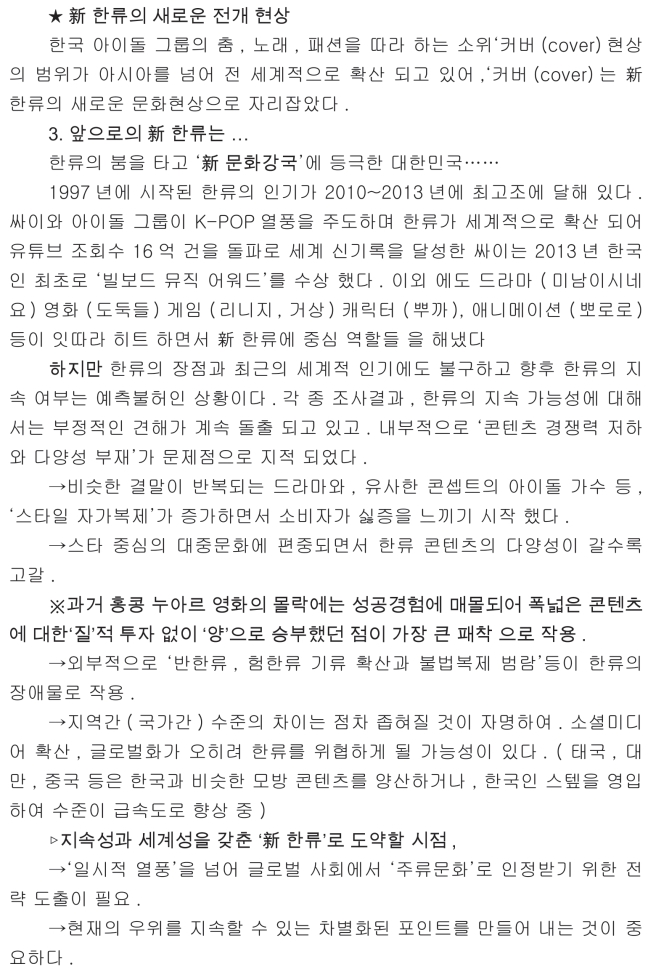
According to Koh,“New Hallyu”has becoming a representative heat discussion which draws attention worldwide much more than traditional Korean Wave.It is not transforming popularity from Korea to overseas,but come into being worldwide simultaneously,forming a multiple consumption situation.The past Korean wave which is mainly dominated by TV dramas now has shifted to new situation,where idol groups are the main force.The core consumer class of new Korean wave is female from 10 to 20 years old in general,which is also of big significance,reflecting its high popularity among young generation.A phenomenon called“cover”,which means to imitate the dance,the song and the fashion of Korean idol groups,has spread from Asia to western countries.“Cover”has become a new cultural representative of the New Korean Wave(Koh,2013).Korean people look forward to make their country a“new cultural giant”in the future.
“Inthe history of exporting Korean cultural products,our country has already occupied the priority position of Asia,from central Asia and the surrounding areas,all the way through the silk road to the middle East,approaching to South America and Africa.The area is still expanding.”said Koh.“Korean people who live in Korea start to praise the high popularity that K-pop artists create overseas,which has made Korean tourism more attractive.Without any purposed business planning,the sudden hot wind of K-pop has made Korean people get back the sense of pride again,and make believe their pop culture is possible to step onto world's stage by effort.
Nevertheless,Koh points out that Korean Wave is not as powerful as it used to be at the early stage.Regardless of the current advantage and the popularity of Korean Wave,whether it will last long and how long it will continue still remain unknown and unpredictable.About 2-3 years ago,Korean Wave appeared to be on the decline,the K-pop products started to sell less than before.Debates towards the pessimistic views of“how long may the Korean wave last”have been heated,but the core issue of the debate should not only to explore how long will it last,but to find out“how to make it last long”deep inside.
“Low competitiveness of the content of cultural works and lacking of diversity are seen as the crux of the matter.”said Park,another locally and globally experienced director of K-pop concerts.Similarity appears to be a problem.TV dramas with endings very alike are produced repeatedly,idol singers with same concept and style get debuted time after time.Style reproduction has been increased severely,customers start to get bored.The New Korean Wave especially lays particular stress on the starcentred mass culture,resulting to the reduction of diversity of Korean cultural contents.Park compares Korean Wave with Hongkong noir film,raising the example of the decline of Hongkong movie,illustrating that disregarding experience of success,ignoring investment on quality but try to win with quantity,is the essential reason of its final failure.Now the Korean Wave encounters similar situation as Hongkong noir movie did,and may also get trapped in a bottle neck.Meanwhile,even in the globalization era,it's also going to be very difficult to keep the success of Korean Wave simply relying on imitating western culture.Simply adding western cultural elements can't guarantee the vitality.“Cultural leaders should create unique Korean culture genes and integrate them into global contents,improving the rare cultural value of Korean culture.Re-creating intrinsic Korean culture prototype in the global context may get bigger success”,said Koh.
Korean government realized the crisis soon,and the Department of Cultural Industry started to make effort towards this situation.Occasionally,Psy makes the“Gangnam Style”phenomenon,which is actually the result of the effort of Korean government in some degree,together with Korean IT industry.“Psy Phenomenon”is subsidized by Korean government 280 billion Korean Won,spending on the helicopter,the dressing,the make-up and other teams of Psy(Koh,2013).The investment on Psy could be understood as the attempt on revitalizing Korean Wave.
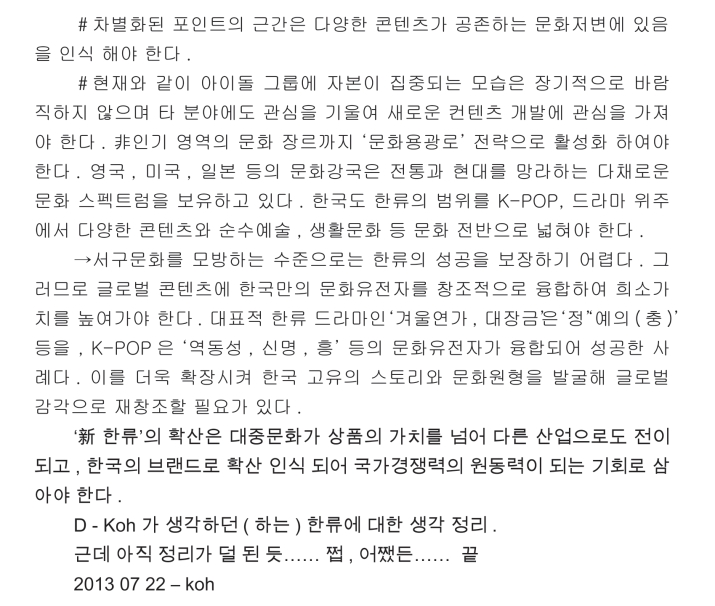
Since it's been predicted that Korean Wave will be declined in 3-5 years in the future,to revitalize Korean Wave,there will be a new Psy afterwards,but now is not the appropriate timing.Former president Lee Myung Bak was the president of Korea who support the development of Korean cultural and entertainment industry most,but he cut the financial support later,due to which Korean Wave has been affected and slightly declined(Koh,2013).The entertainment enterprise is conducted by Korean government and Korean cultural industry.Finance and policy support plays an important role in the development of Korean Wave.
National sprit of“Love,Hate and God”
“To show the produced TV content(TV drama,music programme)to foreign audiences,is like the irony of serving the customer in restaurant with the ready-touse food.If you intend to run the restaurant successfully,you must make the strategy of‘being able to create delicious feast,the jumping-off point,make sure that you have the ability to make a competitive flavour,then spread by word of mouth and conduct extensive publicity.Similarly,in television content production,attractive and interesting content must be created first,then marketing or promotional activities could get opportunity and space.Emotional products such as TV drama and music need to be touching and moving,then its ultimate value will be realized”,said Koh.
This point of view indicates that,to develop heart-moving and content works is the departure of TV content production.To achieve the goal of“touching”and“heartmoving”,cultural and spiritual features have been appropriately added to the work,which is basically formed in Korean history.“What make us proud,is the‘love,,the‘hate,,and the‘god,,which are the basic competitive power in cultural wars.”By which Koh suggests that history and belief has been an essential reason of the thinking pattern of Korean.
The inherent talent of sensibility of Korean people which formed in their unique history has been appropriately applied to their cultural creation,including acting,singing,directing and so on.Korea is an Asian country which has been deeply influenced by Confucianism from China.Confucian beliefs consider the influences of spiritual matters including“harmony”and“the nature of heaven”.“Harmony,which represents coordination,and deities,which represents archaeus and vigour,are the intrinsic temperament and sentiment of Korean”(Koh,2013).Korean religion includes Buddhism,Catholicism and Protestant.Deities occupies an important position in the mind of Korean people.According to Koh,the coordinate and various“harmony”and the free and unrestrained spirit of“deities”complex,come down in one continuous line with the powerful and luxury dancing and singing of K-pop.
Korean is a nation good at singing and dancing,supplied Park.It's because Korean people had gone through tough times in history,their talent and nature of performance had been oppressed.Until entering peace time,economy upturn,the artistic nature of Korean started to relieve.That's the reason why Korean hold local live shows and music festivals quite frequently and numerously.
Trainee System:the magic weapon of K-pop’s success
Korean idol groups are recognized highly in the field of dance,singing,performance and so on.They have been trained before debut for several years,getting systematic training of singing,dancing,language,self-management,etc.Koh introduces the basic condition of the trainee system.“Although this unique trainee system is built as a long term investment of the company,due to the high popularity and influence of idols,backed by thousands of idol publicity organizations called as‘pool,,a complete system finally established in entertainment field.On the other hand,the experience of‘localization strategy,over 10 years has also contributed to the popularity of Korean idols all over the world.”Added Kim,an experienced producer and director in Korean Broadcasting System,also the co-producer of SM Entertainment's live shows overseas,explains the origin and development history of the system.
“The trainee system was firstly originated in Japan.”said Kim.“In the station of the US Army,there were a lot of mixed children,who are beautiful and lovely.The entertainment agencies went select good looking teenagers in these areas,giving them training courses to get ready for debut.Gradually,an organized system has been established,having been spread and learnt by other areas.”Korea has done very good job on developing and improving the system,finally making it their special kill weapon of their own cultural recreation.
In Korea,almost every entertainment agency has its own trainee system.The mode of star-making operation has a very mature process.The big three entertainment agencies in Korea have their own method of talent selection respectively:SM Entertainment holds open audition on Saturday weekly in Korea,and global audition annually including areas such as China,Canada,Japan,Thailand,USA;YG Entertainment receives post demo videos;JYP hold open audition half-monthly and receives emails.The average selection rate is 1∶500(Kim,2013).SM is the first Entertainment agency which adopts the model of trainee system.
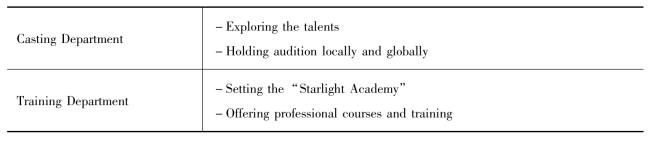
SM Entertainment set 4 departments in the star-making process:casting-training-producing-promotion,among which the trainee system is a key link of big significance.It was until 90s that SM Entertainment separates casting from training.“In the past,the casting stuff seeks for talent on street,now it has been replaced by global audition.Teenagers take part in the audition spontaneously.And there has been an explosive increase in recent years,which reflect the popularity and influence of Kpop idols”(Kim,2013).
Singing and dancing are the basic test items in casting,but for SM Entertainment,not like the other entertainment agencies,beautiful face is even more important than other practical conditions.Good looking appearance contributes very much to the huge popularity of SM's idols,it is like a distinguished characteristic of SM idol style.“This could be attributed to the special idea of founder Lee Soo Man.He always believes that abilities like singing and dancing could be acquired by education and practice,but a pretty looks come with born and cannot be changed afterwards.Under the same condition,compared with one who has singing and dancing strength but ordinary looking,one who has better looking would be more likely to be selected.“This thinking sometimes seems to be paradoxical and a little weird,but it's also interesting.”said Kim.The principle indeed matches the original purpose of trainee system,and it also have drawn much more attention and attracted more fans than other companies'idols.
However,true power and extraordinary strength of idols in SM are still the special kill of its success.The strength not only refers to the stage performance,but also the quality and spirit of the idols.SM requires the artists not only to be talented,but also to be well and fully trained.Before debut,trainees will be trained for years,shorter could be 1 year while longer could be over 8 years,for example Xiah Junsoo,exmember of boy group TVXQ,had been a trainee for 8 years.Suho,leader of boy group EXO,had been trained for 7 years,who trained the longest in the team.
Quantity and quality of training are both extremely high.For example,boy group H.O.T which lead Korean Wave in China,the members receive training from12-16 hours every day before debut.Sometimes,the training could be too much pressure and overload,even cruel.Members of TVXQ used to exercise singing from noon till midnight without break,and as long as the teacher is still not satisfied,they must keep practicing,and other relevant stuff are also accompanied.Trainees also receive training in terms of lingual expression and facial expression to speak with unruffled calm in front of camera no matter when and where.They need to go through various examinations from cruel competition.According to Kim,during the process,trainees lives in company totally.They will be offered free dormitories and catering,as well as some monthly allowance.But they are forbidden to be occupied by anything else except training,and they will be separate from their families,even when they get ill.Trainees are required to train a strong heart by overcoming the difficulties,preparing for the future debut.Extreme strict rules,high pressure and tough training far exceeds perseverance and tolerance of ordinary people,have made many teenagers drop out halfway every round.Those who insist to stay usually are elites and may get the opportunity of getting debut.
Kim discloses that“Separation and Reunion”is the secret of making excellent idol groups with solid strength.“Every man has his hobby-horse”,one of the advantages of group is the number and diversity of the group members.To maximize audience and to ensure the repay of investment,strategy of separation and reunion are used to optimize different group member allocation.At first,there was no personnel change in the prep-debut group.It was until TVXQ have SM started this strategy.Before debut,the chosen trainees are not confirmed to enter any prep-group.They have to pass through experimentations of diversity on the basis of concept,exploring the best candidate for different characteristic group.During the process,members will be gathered together,getting training as a collective for a period,but may be dismissed and replaced to other groups at any time.How to live in an environment of uncertainty and abrupt change is a compulsory module of every trainee.Even getting debut in a group,certain members may get the chance to solo based on their personal features,or join in diverse units with members from other teams,even exchange to other groups.There are a variety of possibilities of joining and parting.The strategy benefits diversity of idol groups,but also has unsatisfied results.Boy group Shinhwa job-hop to GOOD company because of dissension on the issue of going or staying of members.H.O.T was even dismissed forcibly by SM.This strategy is a touchstone of entertainment market.
Market orientation and Globalization effort
K-POP has spread worldwide now.In terms of K-POP globalization,SM Entertainment is very worthy to be mentioned.SM adopts strategy as naming groups in foreign language,taking in foreign members,releasing albums in foreign languages,etc.Not only SM,but also almost every entertainment agency in Korea starts to produce“mixed”idol groups,which contains foreign members cast from overseas,but SM has done efficient and brilliant job on this issue.Boy group“Super Junior”and girl group“F(X)”both have Chinese members.Recent new boy group“EXO”comprises twelve members,four of which are Canadian and Chinese members.It's separated into two subgroups Exo-K and Exo-M,debuting in Korea and China on the same day with the same album,performing in Korean and Mandarin respectively.The new and original form has doubled influence and popularity of the group,attracting a great deal of fans from not only in the two countries but also overseas areas.
Apart from idols,overseas shows and concerts are also a huge effort SM has made.SM Entertainment started to hold world tour concert“SM Town Tour”annually since 2002 in China.All artists in SM company are attended in the concert.The tour has been expanded from Asian areas including China,Taiwan,Japan,Indonesia,Thailand,etc,all the way to western countries such as America and France.The tour concert has spread Korean Wave wider and developed K-POP further.
Diffusion by Social Media and“Global Korean network”
According to Kim,social media represented by Youtube is the hero for spreading K-pop works to the world.Videos recording the trainees'life and performance especially get the chance to prove idols'strength in social media.On the other hand,the“Korean network”established by overseas Korean and increasing foreign students have made big contribution to the spread of Korean Wave.
Including the completed MV,diverse performance contents are now accessible worldwide through social media.Contents which are concerned by customers being uploaded and shared in forums,twitter,blogs,Facebook,etc.,speeding up the diffusion.Korean idol contents on social media make exposure directly on the internationally recognized media industry,taking a giant effect on networking.Social media helps Korean artists to get attention from overseas producers,choreographers,singers and influential practitioners,carving out their way to enter overseas market.
Discussion
As Koh said:“The success of Korean wave comes more from its subjectivity and initiative rather than factors such as times,environment,or market stimulating”(2013).The unique cultural drive and innovation of cultural leaders have contributed a lot.Although cultural leadership is mainly referred to cultural organizations of art,the theory could also be expanded into entertainment field in the case of Korean Wave to a certain degree.
The creativity of cultural leaders is a distinguished feature embodied in the success of K-POP.“Creativity is not the product of single individuals,but of social systems making judgements about individuals products”(Czikszentmihalyi,cited in Pope 2005,p.67).This statement could also be applied to the case of K-POP.If the cultural product of K-POP is treated as an individual product of the K-POP producers,then the sprit of“Love”,”Hate”and”God”,the insistence of“harmony”could be the national cultural product of Korean social system.The theme in Korean TV dramas,or the principle of personal quality training of trainees,has both shown the ethos of Korean culture linked to history and politics.Taking SM Entertainment as an example,the“SMP”style could be a distinguished feature of its stage performance.The“SMP”style refers to the music and dance style of SM's artists.It's a stage-centred art form,mostly used in group performance,emphasizing the mix of singing and dancing in a powerful way.It is the fusion of different styles.To embrace the difference and diversity of different styles,the soul of“harmony”must be insisted.Similarly,the spirit of harmony has been taken into consideration in the process of cultural globalization.
As culture is used in two senses:the common meaning of a whole way of life,and the special process of discovery and creative effort,embodying in art and learning(William,2000),K-POP culture could be seen as the discovery and creative effort of Korean from their way of life,consisting of history and politics.Looking back to history,South Korea has undergone colonial domination,war,division,and rapid economic growth in the process of modernization(Cho,2005).In the ancient era of Korea,from 2nd century BC to around 668 AD,the land had been in warring states until unification by Silla in 676.Then it had experienced the division of Later Three Kingdoms(892-936),invasion by the Khitan Liao Dynasty and the refugees(Kim,1451),and foreign invasion on the late 16th century.In the ancient times,due to geographical and political reasons,Korea had been deeply affected by Confucianism from China,which plays an essential role in the intellectual history of Korea.Different religions had influenced Korean as well,among which Buddhism and protestant occupying a dominating position(Choi,2006).From 1910-1945,Korea had been under Japanese rule.After 1045,along with the Soviet invasion of Manchuria and the Chinese civil war,Korea had poverty division during 1945-1949(Stuek,2004).Korean has gone through war and poverty in ancient history,political division and economic crisis in modern history,in which the ethnic psychology and ethnic culture of Korean nation are gradually formed.The value orientation is directly affected by common experiences constantly accumulated in history.Since cultural industry has been called as‘creative industry,,the success depends on ideas and creativity.All the creative cultural products are based on people's creativity,and it will come back to the essence of humanity itself finally.Cultural leaders of Korean Wave embrace the spirituality and humanity from historical heritage,cleverly injecting them into cultural products to market,adding unique charm to the cultural products of Korean Wave,no matter TV drama or idol singer.
Inspiring fromother cultures has also been mixed in the cultural products of Korean Wave.Cultural leaders have always made efforts to assimilate the elite of western music,adding eastern cultural elements into the work in order to step over the lingual baffle.There are many producer of main trend Korean music content who also has American pop music experience,which can not be ignored.The impact of the fusion falls in aspects below:
-Diversity of content and beats in same song,keeping fresh charm
-Members of group have superior ability of dancing,singing,different and diverse fascination
-Not only dance and hip-hop,but also band and ballad idol groups start to bloom.
-Big companies start to be increasingly distinguished from others in terms of music style,fashion style,management style,by which offering more options for audience,and improving their competitiveness respectively.
Beside creativity,cultural leaders are also required to have the following skills:management,financial accounting,people management & teamwork,strategic planning,media & presentation skills,governance,mostly focusing on courage,vision,decisiveness,humility,compassion,etc.(Leicester 2007,p.15).Cultural leaders of Korean Wave understand the role they play,taking full advantage of their skills to improve the career.They have the awareness of the optimistic and pessimistic terms of the prospect,and the courage to change.They discharge the responsibility of introducing and spreading their culture conscientiously.They believe that to get more benefits in the global market,shortsightedness must be avoided.They have the crisis consciousness and willingness to face challenges.“Crisis equals opportunity.If it's armed with our creativity and ideas,the current cultural war is probably a new chance for us to build a new Genghis Khan's empire”,said Koh(2013).Although it might be absurd to expand territory in reality in terms of geography and politics,it does have the possibility to realize the dream by working hard in cultural field.The vision and ambition could be seen as an essential characteristic of Korean Wave.
To keep the vitality and influence of Korean Wave,cultural leaders believe that cultural communication and communication of“common cultural bond construction”should be continued.As Koh points out that“The basic problem is that there are hardly any more developable space for cultural products,in our national market less than 50 million population.”Based on the Korean national condition,from the cultural industry characteristic perspective,if Korea steps into the circle of“propaganda our own culture”unilaterally,or regard opponents as target to attack only,giant resistance would appear,laying a retroaction on the development of Korean culture.The insight and outsight could be seen as a brilliant feature of the cultural leaders of Korean Wave.
“If you want to build a higher tower than architecture,however eager you are,however long the process is,you can not succeed only by the enthusiasm of organizing mud and bricks,but also need to have great concept and suitable tools,and put in effort on frame structure”(Koh,2013).This metaphor indicates the importance of the practical business strategy to be used.To make the final success in cultural industry,cultural leaders of Korean wave adopt proper business model and conduct strategic management to make benefit.“Quality over quantity”strategy has been realized to guarantee its competitive power.“Being a‘world major,,we fully understand the basic fact of the characteristic of content producing industry,that only a few individual works could finally swept the market”(Koh,2013).Korean wave planned to empolder“killer content”strategy.To break temporary popularity and get recognition as mainstream culture,creating advantage which could be inherent is very important.The pessimism attitude towards the future of Korean Wave indicates that“Distinguished point”must be created,upon the basis of common cognition of diverse culture classes.Even in the era of“New Hallyu”,capital should not be focused on idol groups only,but should transferred to other fields and create new contents.Broaden cultural themes and making it a part of the“culture melting pot”strategy.The UK,USA,Japan and other culture power all have rich and colorful cultural projects both traditional and modern.Korea should learn from it,expand the category of Korean Wave from K-pop and TV drama to diverse contents,including pure art,daily life,native culture and so on.
In the case of SM Entertainment,the skills of strategic planning and entrepreneurship of K-POP cultural leaders embody in the business model the company uses,which could be described by the theory of Integrated Marketing Communications,short for IMC.
IMC(Integrated Marketing Communications)means integrating all the promotional tools so that they work together in harmony.IMC should be focused on the process of business,which will become an enclosed loop system(Schultz,1993).IMC analyze the sensing state of customers deeply,target audience and market orientation are especially stressed,building relationships and brand values.It is the expression of marketing planning and the way to build powerful brand.In the process of integrated marketing,the most important factor should be the human(Brannan,1998).
In the entire system of star-making of SM Entertainment,the producing chain from casting to promotion appears to be a brilliant process,and the quality of the trainee system does contribute a lot to the reputation of SM Entertainment,enhancing the brand value.SM Entertainment especially focuses on the concept of“integrating”.The division of labour of the four departments:casting-training-producing-promotion,is clear cut,and coordinating with each other effectively.
续表
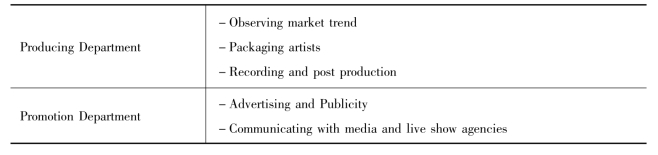
One of the golden rules of IMC is to think customers first.From this perspective,SM has done detailed and fully preparation in terms of globalization attempt.To enter overseas market,local cultural elements have been added into their product,such as music and dance,and artists would be trained to speak local language(Kim,2013).SM has got foreign group members speaking foreign language,and artists would perform the same song in different language versions in different places.When performing overseas,songs could be covered,reproduced,re-composed to suit overseas audience.SM makes detailed planning of every artist before debut,including idol groups and solo singer.For example,BoA is planned to enter Japanese market,so the whole process of training involves Japanese elements.Kangta is planned to enter Chinese market after the dismissing of H.O.T,because H.O.T had already accumulated much popularity in China.Boy group EXO is oriented in both Korean and Chinese market,splitting into two groups with almost half Chinese members,and debuting in the two countries at the same time with a same album in two versions(Kim,2013).The target market and customer is clearly oriented.Different styles of idol groups are oriented with different audience varies from gender and age to nationality and culture.
Due to the concern of target market and audience,K-POP products establish distinguished styles and features.Different styles of the big three Korean entertainment companies are as below:
-SM:dance,Europe Pop,perfect and sincere image
-JYP:dance,rap,lyrics,sexy image
-YG:Hip-hop,free and unrestrained image
(Koh,2013)
Artists differ from others by forming their own style as a mark,to attract certain crowd of audience.Except for the type of performance,appearance plays another important role as well,especially for idols.That's why SM Entertainment thinks highly of facial looks more than other companies.Beautiful faces and appearance have always been a signboard of artists in SM Entertainment.In contrast,YG Entertainment has a number of singers owning excellent singing strength,but the appearance seems to be general.Those singers are also very much welcomed in Korea,but not as famous as SM artists in foreign countries(Kim,2013).The style of good-looking could also be seen as an essential factor of the success of SM,which leads Korean fashion and improves the notability,being extremely welcomed by the audiences who are fond of good-looking appearance.Based on knowing the needs of customers,the information of strategic orientation has gone directly into the heart of audience.Meanwhile,it's also a good opportunity to achieve the goal of globalization.
In terms of the advertising management of IMC,the internet performs a multifaceted marketing function,serving as a mechanism for building demand,conducting transactions,filling orders,providing customer service,and serving as a versatile advertising medium(Schultz,1993).Formats of internet advertising including web sites,display or banner ads,rich media formats such as pop-ups,interstitials,video ads,etc,web logs,e-mail,search engine advertising and advertising via behavioral targeting.SM mainly uses three methods:advertising,sale promotion,public relationship.
In the aspect of advertising,SM singers attend different TV and radio programs in the big three TV stations in Korea:KBS,SBS,MBC to improve the notability(Koh,2013).Artists also have their websites or blog on internet,introducing their new released teasers and music videos,communicating with fans.In the link of internet promotion,social media need to be paid special attention.Social media is the new online media which offers space to participate for users.It has features including participating,openness,communication,dialogue,communization,connectivity.“Social media refers to the means of interactions among people in which they create,share,and exchange information and ideas in virtual communities and networks”(Toni,2008).It has been a main force in diffusing culture in modern time.In the diffusion of Korean Wave,social network has contributed a lot.
The most frequently used social network includes Facebook,Twitter,YouTube,etc.Facebook was founded in 2004(Nicholas,2010).Twitter was born in 2006(Alex Internet,2013).Other social medias such as Tumblr and Instagram come to public as well in the following years.People are getting closer through social networks.Likewise,these social networking platforms make it easier for K-pop artists to reach larger,more global audiences.SM Entertainment has adopted these social networking services to diffuse its cultural products.Facebook's mission is“to give people the power to share and make the world more open and connected”(Facebook,2004).SM sets exclusive Facebook homepage for the artists,sharing the updated news and products of artists with fans.Since Facebook has ushered in the new era of exhibitionism and voyeurism together with YouTube in 2011(Lee,2013),SM has also set the“SM TOWN Official YouTube Channel”as well,publishing music videos,record of live shows,variety shows,and other kinds of video works of artists at first time.A survey shows that one-third of the online population is on both YouTube and Facebook(Interactive Advertising Bureau,2010),indicating the huge impact of broadcasting of these two social networks.By sharing information by these forms of social network,diffusion of K-POP has been speeded up.SM has also registered official account of the artists on the mobile communication tools such as“Line”and“Kakao Talk”,broadening spaces of communication and interaction with audience and customer.Marketing activities based on social media develops the expansion of Korean Wave.Without the parallel rise of social media,simply relying on the business strategy and creativity,K-POP can not come to success so quickly and widely.The success of K-pop could be attributed to technology pushed.Cultural leaders need to keep up with the pace of the times.Taking advantage of the social network as an efficient tool to spread Korean Wave,could be seen as a good effort to meet the challenge of 21st century.
In the sale promotion,signing promotion could be seen as a good attempt.Although the price of the records doesn't fall,to meet the idol in person could appeal more fans than a real sale.To maximize the profit,the well-made limited version or repackage version of CDs is also an allure,many unpublished surprise will be packaged within to meet the desire of fans.In the public relationship,conference of new releasing album or mini fan-meeting on the birthday of the artists will been adopted.Sometimes the artists will also be hyped by media,but under control of the company.Commercial promotion is complex and various,improving the attention for the artists and their works.
Business means economically or money motivated purposive social organizations traditionally.Profit has been regarded as the success of such an organization(Ansoff,1956).By using the suitable business model and establishing a complete system,SM company has made big profit.H.O.T sell 12 million albums of“I YAH”in 1999,TVXQ earned 3.5 hundred million for advertising,BoA and Girls Generation have also made distinctive profit in overseas markets,always dominating Korean music product sale chart(Kim,2013).Apart from the singers themselves,the accessories products of idols become another huge source of income.A chain of stores named“Everysing”selling various music peripheral goods opened by SM have made a great deal of extra profit.It is also a must-go place for tourists from all over the world.Integrated business strategy is creatively used to make benefits.
To keep the freshness and longevity of the music products,SM has always invited foreign top musicians and producers for the work of SM artists,and cooperated with elites in different fields,in order to increase the diversity of music product,and to improve the value of the work.The art of business entertainment could be understood as the popularity and admiration of the products in any form,no matter it is a singer or an album.Cultural leaders of SM Entertainment has done good job on the balance of commercial profit and the“popularity art”.
Conclusion
It had been talking about Korean TV content only to discuss Korean Wave before,but now the focus of Korean Wave has shifted to K-POP.By exploring a successful representative of K-POP,the SM Entertainment,the secret of the success of Korean Wave could be attributed to two reasons:the cultural leadership,and the business model.This research aims to test whether the theory of cultural leadership could be broadened and applied to entertainment field.The hypothesis of cultural leadership has been examined in the case study of Korean Wave and K-POP,and has been proved by facts collected from existing literatures and interviews after the analysis.
Cultural leadership has been reflected in the innovation of the mature trainee system,the creativity of producing attractive products,the consciousness of potential crisis in current situation,the vision and ambition of the future,the openmindedness and capacity of new things from outside world,the management and marketing skills of planning and communication.
In the case of Korean Wave and K-POP,the core element of success is the artists,to be specific,the idol singers.Lots of research of Korean Wave has been emphasizing the external factors such as local policy,international environment,influence of globalization,developing trend of cultural industry,etc.But the internal reason of the people and Korean own creativity has been barely mentioned.Cultural goods differ from general merchandise.Like television content,when they come into being and be able to be traded in the market,not like general merchandise winning on price,cultural goods appeal customers by the intrinsic value hidden in the spiritual content.As long as the content is good,it can win.K-POP of the New Korean Wave works in the similar way.In the context of cultural industry and creative economy,the creativity of people is like a cell nucleus,the industrial management is like a cell membrane.They depend on each other for existence,and should be equally treated.
The other reason of the success could be the business strategy of K-POP,among which the trainee system is the core and key element.In the case of SM Entertainment,adoption of the IMC(Integrated Marketing Communications)business model helps to build a complete professional management system,producing many singers and artists who are famous in Asia and worldwide.
In terms of promotion management,and marketing oriented public relations,consumer-oriented promotions is especially concerned.“Everything associated with that brand must be fully integrated in support of the brand's positioning and personality”(Brannan,1998).SM Entertainment builds brand value with the systematic management and marketing-oriented promotion,conquering the hearts of audience as well as their pocket.
The ideas and activities of the two factors have been overlapped and paralleled carried in the process of K-POP development,all the way along with the attempt of globalization.The diffusion of the“New Hallyu”means the value of mass culture,which is beyond general merchandise transforming into other industry,and spreading as a brand of Korea.The“New Hallyu”is supposed to be seen as the opportunity and motivation of national soft power.For those countries whose cultural industry is developing,especially the Asian developing countries,valuable experience could be learned from Korean Wave and K-POP.
Nevertheless,although K-POP is successful,it also needs to be treated critically.Just as the pessimistic views of relevant people,development of K-POP has also led to negative results,and has laid negative impact on K-POP itself in return.For K-POP itself,its development has reacted upon the process and expanding space of K-POP.Along with the gradually reduction of regional differences,and the diffusion of social media and globalization,China,Taiwan,Thailand and other Asian areas start to produce similar cultural products,increasing the similarity invisibly.A great deal of high-level Korean talent in this field has been introduced to foreign countries,which could be a double-edged sword to Korean.
In terms of the negative caused by K-POP development,due to the overpropaganda of K-POP Korean government,a large number of teenagers both inside and outside Korea have been deeply encouraged to become idol.Young boys and girls are lured by the shining surface of stars,neglecting their studies(Kim,2013).Atmosphere of becoming a trainee has been formed among many teenagers in the areas including China,Hongkong,Taiwan,Thailand,etc.,especially severe in Korea.The features of the certain audience should have been considered,such as the age,mentality,sense and value of the juveniles.The awareness could be linked to the sense of responsibility and the long-term vision of the cultural leaders of K-POP.
In addition,the unique fan culture of K-POP idols has also become a disturbing problem for both fans and the idols.There are certain group of fans known as“Sasaenpan”in Korean,which means the extremely crazy fans who chasing after the idols anytime anywhere,even into their personal lives.The extent of the enthusiasm is far beyond imagination,and some of the activities they did could even be judged as illegal,if seriously investigate.A special business chain has been shaped only to serve the irrational fans.Although the phenomenon has not become a common concern of the mainstream,it is still worthy of discussing in the entertainment field.
Not only for the audience and fans,to the artists and idols themselves,slave contract has been a thorny issue and unpleasant pressure.Based on the cruel trainee system,after debut,idols are obligated to sign a long-term and unfair agreement with their management agencies(Williamson,2012).Trainees who agree to sign on a slave contract are often put into a“factory-styled grooming process”,and will be exploited without defense.Contact with friends and family members was also restricted.The slave contract usually resulting in the leaving of artists,some artists even take their agency to court,JYJ,the former members of TVXQ produced by SM Entertainment is a typical example(Jazeera,2012).A growing number of legal disputes over such alleged mistreatment has made negative influence on K-POP.These problems of Korean Wave remain to be solved,shall be discussed in further analysis.
Bibliography
Ahlqvist,T.et al.2010.Road-mapping the societal transformation potential of social media.foresight,12(5),3-26.
Alexa Internet.2013.“Twitter.com Site Info”.Retrieved 2013-08-21.Available from:http://www.alexa.com/siteinfo/twitter.com
Anheier,H.K.,and Isar,Y.R.(Eds.).2008.Cultures and globalization:The cultural economy.Sage.
Anon.2012.“King of K-pop is back”.Koreatimes.Retrieved 2013-02-23.
Ansoff,H.I.1965.Corporate Strategy:An Analytic Approach to Business Policy for Growth and Expansion.Carnegie institute of Technology.
Asiaholics.net.2010.“Which Group Has Left Their Mark On The K-pop For This Generation?Asia-Holics Forever”.Retrieved 2011-09-04.
Benjamin,J.2012.“The10 K-pop Groups Most Likely to Break in America”.Rolling Stone.Retrieved 2012-06-29.
Benjamin,J.2012.“TVXQ!Q & A:On America,Favorite Artists,Future Touring Plans”.Billboard.Retrieved 14 December 2012.Available from:http://www.billboard.com/articles/news/1481405/tvxq-qa-on-america-favorite-artists-future-touring-plans
Brannan,T.1998.A Practical Guide to Integrated Marketing Communications.Kogan Page Limited.
Byun,J.2007.The consumer Internet in South Korea:an American's perspective(Doctoral dissertation,Massachusetts Institute of Technology).
Capon,C.2008.Understanding Strategic Management.Harlow:Pearson.
Cha,H.H.and Kim,S.M.2011.ACase Study on Korean Wave:Focused on K-POP Concert by Korean Idol Group in Paris.Department of Broadcasting,Visual and Performing Arts.
Chandler,M.2011.Korean Entertainment Agency Taking Its Acts Globally.Graduate school of Stanford business.
Cho,H.J.2005.Reading the“Korean Wave”as a sign of global shift.Korea Journal,45(4),147-182.
Choi,Y.G.2011.The Globalization of K-pop:Is K-pop Losing its Korean-ness?Situations Vol.5(Winter 2011),Yonsei University.
Choi,Y.J.2006.Dialogue and antithesis 2.Hermit Kingdom Press.
Chosun Ilbo.2012.“NYT Draws Attention to K-pop Idol-Making Factories”.Retrieved 28 De-cember 2012.
Davies,M.B.2007.Doing a successful research project:Using qualitative or quantitative methods.New York:Palgrave Macmillan.
Doosan Encyclopedia.2012.“K-pop”.Naver.Retrieved 11 March 2012.
Drucker,P.F.1959.Long-Range Planning—Challenge to Management Science.Management Science,5(3),238-249.
Facebook.2004.About Facebook.Available from:https://www.facebook.com/facebook/info
Farrar,L.2010.“Korean Wave'of pop culture sweeps across Asia”.CNN.Turner Broadcasting System,Inc.Retrieved March 16,2010.
Gomm,R.,Hammersley,M.,& Foster,P.(Eds.).2000.Case study method:Key issues,key texts.Sage.
Hartley,J.2004.Case study research.Essential guide to qualitative methods in organizational research,323-333.
Inda,J.X.and Rosaldo,R.2002.Introduction:a world in motion.The anthropology of globalization:A reader,1-34.
Interactive Advertising Bureau,2010.Social:A closer look at behavior on YouTube & Facebook.
Jennifer,R.2012.“K-pop:the story of the well-oiled industry of standardized catchy tunes”.Institut national de l'audiovisuel.
KBSWorld.2009.“TVXQ in Guinness World Record”.Retrieved August 14,2009.
Kim,J.S.et al.1451.“Goryeosa(The History of Goryeo)”.Article for July 934,17th year in the Reign of Taejo.
Kim,J.Y.2007.“Rethinking media flow under globalisation:rising Korean wave and Korean TV and film policy since1980s”.University of Warwick Publications.
Kim,M.S.2012. (High Expectations on“Genie”of Goddesses SNSD)”.Hankyung.com.Available from:http://www.hankyung.com/news/app/newsview.php?aid=2009061751277
Lampel,J.et al.2005.The business of culture:strategic perspectives on entertainment and media.Psychology Press.
Lampel,J.et al.2006.Toward a Deeper Understanding of Cultural Industries.
Lawlietta.2012.“JYPE's Rainstone dishes details regarding Wonder Girls album,Rodney Jerkins & Claude Kelly.”Available from:http://www.allkpop.com/2011/01/jypes-rainstone-dishesdetails-regarding-wonder-girlsalbum-rodney-jerkins-claude-kelly
Lee,N.2009.“BoA's1st USAlbum to Release March 17”.Retrieved February 7,2009.
Lee,N.2013.Facebook Nation:Total Information Awareness.Springer.
Lee,Y.S.2003.16-Year-Old Rules Asian Pop Market.The Korean Times.
Leicester,G.2007.Rising to the occasion:Cultural leadership in powerful times.St Andrews:International Futures Forum.
Lim,A.2008.“Korea Fair Trade Commission Clamps Down on Entertainment Companies“Slavery”Contract Terms”.Retrieved 2013.Available from:http://coolsmurf.wordpress.com/2008/11/21/korea-fair-trade-commission-orders-10-entertainment-companies-to-modifyslavery-contract-terms/
Mahr,K.2012.“South Korea's Greatest Export:How K-pop's Rocking the World”.Time(magazine).Retrieved 28 April 2013.
MFRASCOG.2012.The Real Reason Behind K-pop's Success-Music Globalization.(n.d.).Retrieved from http://musicglobalization.com/2012/11/27/the-real-reason-behind-K-popssuccess/
Moss,S.2011.Cultural entrepreneurship.In:Walmsley,B.,ed.Key Issuesin the Arts and Entertainment Industry.Oxford,Goodfellow.
Nicholas,C.2010.“At Last-The Full Story Of How Facebook Was Founded”.Business Insider.
Available from:http://www.businessinsider.com/how-facebook-was-founded-2010-3#wecan-talk-about-that-after-i-get-all-the-basic-functionality-up-tomorrow-night-1
O'Hara,M.2001.Alternative psychological scenarios for the coming global age.Washington DC:American Psychological Association.
Oh,J.2011.“Behind the scenes of East-West collaborations.”Korea Herald.Available from:http://www.koreaherald.com/entertainment/Detail.jsp?newsMLId=20110302000914
Oh,J.2011.“Western artists,producers turn to K-pop.”Korea Herald.Available from:http://www.koreaherald.com/entertainment/Detail.jsp?newsMLId=20110301000135
Park,M.Y.2011.“Funky U.S.designer pursues distinctive style.”Korea Herald.Available from:http://www.koreaherald.com/lifestyle/Detail.jsp?newsMLId=20110707000702
Pieterse,J.N.2003.Globalization and Culture.Rowman & Littlefield.
Ramstad,Evan.2012.“Behind K-pop's Pop:The work of Fans”.The Wall Street Journal.Retrieved 26 January 2013.
Ravina,M.2009.“Introduction:Conceptualizing the Korean Wave”.Southeast Review of Asian Studies.Volume 31,pp.3-9.Emory University.
Schnabel,J.F.1972.Policy and Direction:The First Year.United States Army in the Korean War 3.Washington,DC:Center of Military History,United States Army.pp.3,18.
Schultz,D.E.1993.“Integrated Marketing Communications:Maybe definition is in the point of view”.Marketing News.1/18/93,Vol.27 Issue 2,p17.
Shimp,T.A.2007.Integrated Marketing Communication in Advertising and Promotion.Thomson Higher Education.
S.M.Entertainment.[no date].“STOWN J-POP ZONE”.Available from:http://www.smtown.com/link/jpop
SM TOWN.2011.S.M.Entertainment:the future of culture technology.
Stacy,H.2011.“Exclusive Will.i.am interview:‘America has the flu,and science is the vitamin c that our economy needs”.Available from:http://www.cambio.com/2011/08/12/exclusivewill-i-am-interview-livechat-america-has-the-flu
Stake,R.E.1995.The art of case study research.
Stueck,W.2010.The Korean war in world history.University Press of Kentucky.
The economists.2010.South Korea's pop-cultural exports:A“Korean wave”washes warmly over Asia.Seoul and Phnom Penh.
UNESCO Institute for Statistics,UNESCO Sector for Culture.2005.INTERNATIONAL FLOWS OF SELECTED CULTURAL GOODSAND SERVICES,1994-2003,Defining and capturing the flows of global cultural trade.Montreal.
U.S.Bureau of Democracy,Human Rights,and Labor.2009.“International Religious Freedom Report 2008-Korea,Republic of”.Retrieved January 31,2010.
Vogel,H.L.2001.Entertainment industry economics:A guide for financial analysis.Cambridge University Press.
Walmsley,B.2011.Key Issues in the Arts and Entertainment Industry.Goodfellow Publishers.
Williamson,L.2011.The dark side of South Korean pop music.BBC.Retrieved 19 December 2012.Available from:http://www.bbc.co.uk/news/world-asia-pacific-13760064
Williams,R.2000.Culture is ordinary.From:Bradford,Gigi et al,The politics of culture:policy perspectives for individuals,institutions,and communities.pp.16-19.New York:New Press.[4]
Yin,R.K.2009.Case study research:Design and methods(Vol.5).Sage.
Yoon,L.2010.K-pop Online:Korean Stars Go Global with Social Media.TIME.Retrieved on 2011-02-20.
Zoe,C.2012.“Gangnam Style:Three Reasons K-pop Is Taking Over The World”.National Public Radio.Retrieved 26 December 2012.
Appendix
Written work toward s interview questions from Director Koh Hyun Soo
2013 07 19-koh