PI3K/AKT/mTOR通路中的AKT及MTOR等的磷酸化水平高低与非小细胞肺癌的生物学特征关系密切。有研究5371 纳入了79例晚期肺鳞癌患者,通过二代测序技术进行分析发现,含PI3K突变的患者与不含PI3K突变的患者相比,中位生存期更差(8.6mvs 19.1m, P<0.001), 更易发生远处转移(18% vs 3%,P<0.05),更易发生脑转移(27% vs 0%,P<0.01)。 通过进-一步的全外显子测序发现,有脑转移的患者有着更高的PTEN缺失率。除此之外,PIK3CA 的突变和扩增作为不同的基因遗传学变异,对于肺鱗癌的生物学特性及靶向治疗反应,有着不同的临床意义。有学者发现PEBP4 ( Phosphatidylethanolamnine binding protein 4)作为PI3K的下游信号分子,其过表达可以激活AKT和MTOR的磷酸化,促进非小细胞肺癌的生长和侵袭。另外,目前发现的与肿瘤生长和侵袭关系密切的ILT4 (Immunoglobulin like transcription factor 4), WSTF (Willianssyndrome transcription factor) 以及miRNA ( 如miRNA-107 等),可以通过PI3K/AKT/mTOR信号通路发挥其生物学功能。

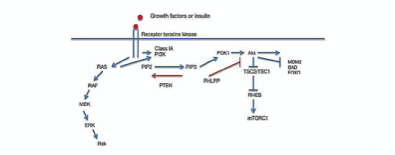
图3-3 PI3K/AKT/mTOR通路。受体与配体结合后,激活的IA型PI3K在细胞膜上将PIP2转化为PIP3。与此同时,通过PI3K的交互作用,RAS/RAF/MAPK通路也被激活。PIP3 作为第2信使结合AKT的PH结构域,促使PDK1磷酸化AKT蛋白,导致AKT活化。活化的AKT导致TSC2/TSC1 复合物磷酸化和失活,进一步引起RHEB的聚集并抑制,最终导致mTORC1的活化。mTORC1活化后可以增强蛋白翻译,抑制细胞自噬。磷酸化的AKT除了活化mTOR信号外,也可以活化MDM2和FOXO。FOXO的活化导致细胞周期抑制。PI3K= 胞内磷脂腺肌醇激酶; PIP2= 4,5-二磷酸脂酰肌醇; 磷脂酰肌醇-3, 4, 5-三磷酸; PTEN=人第10号染色体缺失的磷酸酶; PDK1= phosphoinositide dependent kinase-1; TSC=结节性硬化症相关蛋白; RHEB=Ras homologenriched in brain; mTORC1= 雷帕霉素机能靶标蛋白复合物1; MDM2=murine double minute 2; BAD=Bcl2 相关细胞死亡激动剂; FOXO=forkhead box O; PHLPP=PH domain leucine-rich repeat protein phosphatase。
参考文献
1. Ferguson K M. A structure-based view of Epidermal Growth Factor Receptor regulation. Annu Rev Biophys, 2008, 37:353-373.
2. Wieduwilt M J, et al. The epidermal growth factor receptor family: Biology driving targeted therapeutics. Cell Mol Life Sci, 2008, 65:1566-1584.
3. Wee P, Wang Z. Epidermal Growth Factor Receptor Cell Proliferation Signaling Pathways. Cancers(Basel), 2017, 9:pii: E52.
4. Sigismund S, et al. Emerging functions of the EGFR in cancer. Mol Oncol, 2018, 12:3-20.
5. Jorge A A, et al. Noonan Syndrome and Related Disorders: A Review of Clinical Features and Mutations in Genes of the RAS/MAPK Pathway. Horm Res, 2009, 71:185-193.
6. Normanno N, et al. Epidermal growth factor receptor(EGFR) signaling in cancer. Gene, 2006, 366:2-16.
7. Najafi M, et al. Extracellular-signal-regulated kinase/mitogen-activated protein kinase signaling as a target for cancer therapy: an updated review. Cell Biol Int, 2019 , 43:1206-1222.
8. Panda M, Biswal B K. Cell signaling and cancer: a mechanistic insight into drug resistance. Mol Biol Rep, 2019, 46:5645-5659.
9. Solomon B, Pearson R B. Class IA phosphatidylinositol 3-kinase signaling in non-small cell lung cancer. J Thorac Oncol, 2009, 4:787-791.
10. Vivanco I, Sawyers C L. The phosphatidylinositol 3-Kinase AKT pathway in human cancer. Nat Rev Cancer, 2002, 2:489-501.
11. Zhu C Q, et al. Role of KRAS and EGFR as biomarkers of response to erlotinib in National Cancer Institute of Canada Clinical Trials Group Study BR.21. J Clin Oncol, 2008, 26:4268-4275.
12. Ishida N, et al. A novel PI3K inhibitor iMDK suppresses non-small celllung cancer cooper actively with A MEK inhibitor. Exp Cell Res, 2015, 335: 197-206.