七下 Unit 6 Outdoor fun Integrated skills
Background:Outdoor activities
Everyone likes outdoor activities because they are much fun.
Key words:ourdoor activities,the history of kites
Ⅰ Background information
There are a lot of outdoor activities people do.But children will be more interested in swimming,going on picnics,especially flying kites.
The students in Grade 7 still like flying kites and will be more interested in the history of kites.
Ⅱ Type of the lesson
Integrated skills training
Ⅲ Teaching aims and learning objectives
By the end of the lesson,the students will be able to:
1.Understand the meanings of the new words.Use them in proper situations.
2.Catch necessary information from the listening materials.
3.Know the history of kites well.
4.Talk about outdoor activities with the useful expressions correctly.
5.Cooperate with partners and experience the feeling of success.
Ⅳ Teaching content
1.New words
2.The history of kites
3.Different listening skills
Ⅴ Focus of the lesson and predicted area of difficulty
1.New words and the history of the kites
2.Different listening skills
3.How to lead students to talk about the different outdoor activities
Ⅵ Teaching aids
1.Four pictures of historical people 2.Blackboard 3.Chalk
4.Computer 5.Multimedia
Ⅶ Teaching procedures
Step 1 Warm-up and lead-in
Play a video about outdoor activities and have a free talk before class.
T:Just how I noticed some of you studied after class.I think you can go out to relax between classes.More relaxation will make you more energetic.Let's enjoy a short video.And see what is one of you doing.
Yes,he is cycling,flying a kite,swimming,playing basketball,skating,riding,jogging…so many outdoor activities.Then among these outdoor activities which one do you like best?And why?(找三到四个同学回答)
【设计理念:1.导入户外活动话题。2.用师生对话活跃课堂气氛,调动学生参与积极性。】
Step 2 Think
Listen and answer.
T:Everyone has his own favourite outdoor activities.Can you guess what is my favourite?…Yes,you are so clever.I like flying kites for fun.But when I go out for fun,I don't know what I can do and I can't do and what I should take.Our old friend Amy and her cousin Shirley are going out for a picnic.And let's listen and fill in the table.
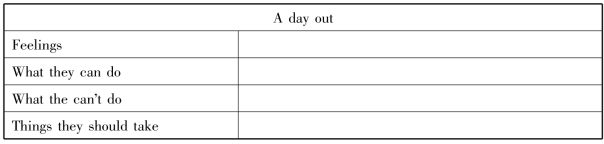
【设计理念:1.操练导入部分的活动。2.训练学生听的能力。】
Step 3 Discuss
T:In this conversation,Amy tells us what to do and what not to do for a picnic.But there are many more things we need to think about and pay attention to in our lives.Please think about:What can you do?What can't you do?And why?What can you take?Now work in groups and write down the list.Try to write down as many as you can.
OK,let's check.
First,what can we do?We can fly kites,go jogging and enjoy the view…
Second,what can't we do?We can't climb the trees,swim in the river,walk on the grass,throw rubbish(垃圾)…
Last,what can we take?Food,drinks,mattress,umbrella…
【设计理念:1.锻炼学生思考问题的能力。2.培养学生合作解决问题的能力。】Step 4 Present(Pair work)
Go out for a picnic
T:Tomorrow is Saturday.And it will be very sunny.
A:We are having a picnic today.I'm so…Maybe it's a good time for you to have a picnic.Now talk with your partner about it.(找三组同学回答)
B:Me too.It'll be a great day.
A:What can we do there?
B:We can…
A:Good.Can we…too?
B:No,I'm afraid not.It's dangerous/…to…Yes,Of course.It's exciting/…to…
A:I see.
Remember to take/bring…
B:OK…
【设计理念:1.锻炼学生说的能力。2.鼓励学生应用刚刚所用的知识。】
Step 5 Lead-in
T:Some students like flying kites,but do you know something about kites?
T:If you don't,it does not matter.One of my friends in Weifang,Shangdong Province told me something about kites.Now let's listen to the material and try to answer the two questions:
When did people in Weifang begin to make kites?
When was the first International Kites Festival held in Weifang?
T:People in Weifang designed their own beautiful kites.If you design your own kite,what will it look like?
T:I also design many beautiful kites.Look at them.Tell me what it looks like.
T:You are so great.Some other students also design their own kites.What do they look like?Look at Part A1.Listen to the conversation and write down the students'names under their kites.
【设计理念:通过自制听力内容增加学生对潍坊风筝节的了解从而对处理之后的听力部分做好铺垫。】
Step 6 Think
T:Flying kites is interesting and many people like it.But how much do you know about the history of kites?
Look at the five questions:
Q1:Which country were kites born?
Q2:Who made the first kite in China?
Q3:What did the first kite look like?
Q4:What did people use to make the first kite?
Q5:How did kites become famous all over the world?
T:It does not matter.I would like to introduce another four people to you,and then you will learn better about it.
Now let us play a guessing game.I will show you some pictures or some words.Can you tell me who the person is?Here are the rules:The first one to give us the correct answer,your group will get one star.Let us see which group will be the winner.
T:You are so clever.We know the four people are closely related but do you know what did they do to help kites become famous all over the world?
T:It does not matter.Now let us listen to the material and finish Part A2:Write the correct letters in the boxes.
T:They helped a lot to make Chinese kites famous.But when did the Chinese people begin to make kites?Now let us listen again and fill in the blanks with correct words.
【设计理念:以一个猜的游戏介绍四位历史人物及其对风筝产生和推广做出的贡献来增加学生对风筝历史的了解,并且为下面的听力部分做好铺垫。】
Step 7 Discuss and retell the history of kites
T:After learning so much about the history of kites,how much do you remember it?Now close your books.Works in groups and try to retell the history of kites from three aspects:when/who or what place/what happened.
discuss Review the history of kites!
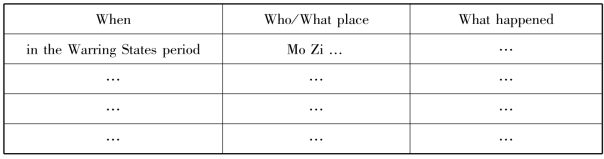
【设计理念:以复述听力内容和填充表格的方式来帮助学生复习、巩固上述听力材料文本,加强学生对风筝历史的掌握。】
Step 8 Group work
T:The next International Kites Festival in Weifang is coming.Many foreigners will come to see it.Your group will be invited(被邀请)to give a talk about Chinese kites.It includes:
*history of kites(4 periods)
*beautiful kites(material,shape…)
*your hope
You can report like this:Good morning,ladies and gentlemen:
Welcome to Weifang,China.We are very glad to give you a talk about Chinese kites here.
First,we'd like to introduce the history of Chinese kites…
Then we will show you some beautiful kites.
We use…to make kites.They have different shapes.Some look like…Some look like…You are sure to like them.
At last,we hope…
【设计理念:通过要求学生小组合作,准备一个关于中国风筝的讲座来操练以上所学内容并且在合作的过程中培养合作精神。】
Step 9 Summarize
T:Today we learn that kites are also an important part of Chinese culture.When we have free time,do not always watch TV or play computer games.You had better go out to do something such as flying kites and go near the nature.
【设计理念:老师简明扼要地总结本堂课所学内容,并且进行主题升华:让中国的风筝文化走向世界。】
Ⅷ Blackboard design
Words:wood period century
excited mobile phone
Phrases:make a bird out of wood
use bamboo to make kites
in the 13th century
from then on
become famous for
Sentence structures:
It is dangerous to do…
Remember to take your mobile phone.
Now everything is ready.
Shall we go?
Ⅸ Teaching reflection
本节课以6个微视频来导入课外活动,既提供了相关的背景知识,又激发了学生的学习兴趣,然后通过师生对话活跃课堂气氛,调动学生参与积极性,再通过小组间的讨论,锻炼学生用英语思维的能力,同时培养学生合作解决问题的能力。之后以自制听力来介绍中国潍坊的风筝,为学生提供背景信息,从而为下面的听力内容的处理做好了铺垫。再以一个猜的游戏介绍四位历史人物及其对风筝产生和推广做出的贡献来增加学生对风筝历史的了解。并通过填表格练习帮助学生梳理听力内容,为复述做好准备,但听完立刻让学生复述还是有难度的,可以进行一个过渡环节,例如,安排一个小组对话,让学生对文本较为熟悉之后再复述。
点评:
在本节课的教学中,老师能通过Discuss(Step 3)部分的开展,不仅锻炼学生思考问题的能力和培养学生合作解决问题的能力,还通过讨论,渗透德育,如We can't walk on the grass/climb the trees/throw rubbish;还对学生进行了安全教育,如We can't swim in the river等。在Pair work(Step 4)中,设计周末去野餐的情境,锻炼学生说的能力,鼓励学生及时应用所学的知识,教师还通过自制听力内容(Step 5),增加学生对潍坊风筝节的了解,既扩大了学生的知识面,也为接下来的听力部分做好了铺垫。但是在Step 2和Step 3之间,可以让学生读一读Speak up的对话,确保学生能顺利完成Step 4中pair work的任务。