八下 Unit 7 International charities Comic strip and welcome to the unit
Background
Key words:charities around the world
Ⅰ Background information
At present,there are lots of people who are in need,such as people with serious diseases,blind and deaf people,children without families,people in poor areas,the elderly,earthquake survivors and so on.There are some international charities in the world and they do something to help people in need.It is important for students to cultivate some mental qualities by learning this lesson,such as kindness,be willing to help others and so on.
Ⅱ Type of the lesson
Welcome to the unit
Ⅲ Teaching aims and learning objectives
By the end of the lesson,the students will be able to:
1.Memorize the new words and phrases.
2.Learn some famous international charities.
3.Think about how to help the people in poor areas better.
4.Learn about the passive voice in the simple present tense.
5.Arouse students'interest in this unit.
6.Cooperate with partners and experience the feeling of success.
Ⅳ Teaching content
1.New words and phrases
2.Some famous international charities
Ⅴ Focus of the lesson and predicted area of difficulty
1.New words and phrases
2.Four international charities
3.Passive voice in the simple present tense
4.How to improve students'involvement in class
Ⅵ Teaching aids
1.Video 2.Pictures 3.Blackboard 4.Chalk
5.Computer 6.Multimedia 7.Projector
Ⅶ Teaching procedures
Before class,students listen to a song called“Tell me why”.
【设计理念:课前播放英语歌曲“Tell me why”,表达了一个小男孩想要帮助世界上需要帮助的人们的心声,为本节课做了一个很好的铺垫,即及时为需要帮助的人们伸出援助之手。】
Step 1 Warm-up and lead-in(about 5 mins.)
【设计理念:从歌曲导入,师生自由对话,激发学生帮助他人的意识。通过一张世界地图向学生呈现世界上最富有的十大国家和最贫穷的十大国家来激发学生学习本课的兴趣,让学生思考如何帮助贫穷地区的人们,导入本课的话题international charities。】
T:Do you like the song?Did you understand the song?What does the boy want to know?
S:…
T:In the world,lots of people are in need.Look at the world map.What are the ten poorest countries?
S:They are…
T:People in poor areas/countries don't have…?What do they need?
S:…
T:How can we help them?
S:We must do something to help.We can donate money to them.
T:Have you ever done anything for charities?Were you happy to help charities?
S:…
T:It's our duty to help them.There are many international charities in the world.What international charities do you know?
Step 2 Presentation
【设计理念:通过呈现四大国际慈善组织,让学生对它们的缩写、全称、标志、作用等有更加深入的了解。】
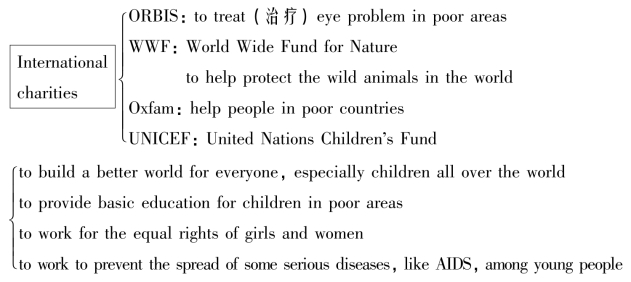
1)ORBIS
T:What does the signal look like?What kind of people does it help?
(Read a table to learn more about ORBIS.In the signal,we can see there is a plane.ORBIS uses a plane to visit poor areas.So it is called“Flying Eye Hospital”.ORBIShelps blind people and people with eye problems.)
2)WWF
T:Its full name is World Wide Fund for Nature.Look at pictures.How does it help?
(It is an international charity to help protect the wild animals in the world.)
3)Oxfam
T:It helps people in poor countries.
Read a passage and learn about what Oxfam works for.
Look at pictures and learn about other Oxfam events.
4)UNICEF
T:It stands for United Nations Children's Fund.How does this charity work?Read Part B and answer the question.(It helps build a better world for everyone,especially children all over the world.It provides basic education for children in poor areas.It works for the equal rights of girls and women too.It also works to prevent the spread of some serious diseases,like AIDS,among young people.)
Step 3 Guessing game
【设计理念:通过这个活动来检查学生对四大慈善组织的记忆情况以及他们灵活运用所学知识的能力。在这个活动过后提出一个问题,问学生想为哪个慈善机构效力,既很好地承接了上文,又很自然地导入了下文,即B部分的对话。】
T:We have learnt four international charities.Now let's play a guessing game.
Look at part of the pictures and guess what kind of international charities it is.
Which charity can help them?
Problem 1:_________________________________________
Some restaurants sell dishes made in rare animals which are protected by laws(法律).
Problem 2:_________________________________________
Children in poor areas in Africa don't have enough food to eat or enough houses to be their shelters.They are ill,but they can't go to hospital.They are old enough,but they can't go to school.
Problem 3:_________________________________________(Listen and fill in the blank)
Problem 4:_________________________________________
Catherine has been blind since she was sixteen years old.Now ten years has passed,but she still can't see anything because she is very poor and hasn't got enough money to go to hospital.
T:Which charity would you like to work for?Why?
S:…
Step 4 Presentation
【设计理念:接上面的问题,如果有学生谈论到UNICEF,那么将进一步阐释该慈善机构并板书带读equal rights,basic education和especially,为B部分的对话做了很好的铺垫。同时将B部分的对话作为听力材料,很好地锻炼了学生的听力。】
T:(If the student says he would like to work for a charity called UNICEF.)Everyone has the equal rights to receive education.However,some children,especially those from poor areas,can't go to school like us.We should try to help them go back to school.(板书并带读equal rights,basic education和especially)
Mr Wu is asking the students about international charities.Listen to the tape and tell me how UNICEF helps people.
S:…
T:Read the conversation after the tape.Pay attention to your pronunciation and intonation.
Step 5 Comic strip
【设计理念:通过回答问题让学生对漫画的内容有更深刻的理解;通过背诵并表演对话,让学生在忠于原文的基础上适当地加入自己的想象力从而丰富漫画的内容,让学生能在具体的情境中灵活运用英语;通过讲解知识点,让学生了解一般现在时的被动语态。】
T:Hobo wants to do something for charity.
Activity 1:Answer the questions:1.What is needed for charity?
2.What does Hobo want Eddie to do?
3.What does Eddie want to do first?
Why?
4.How far will they go?
Activity 2:Recite and act the dialogue out.
Activity 3:Language points
Step 6 Group work
【设计理念:通过这样一个大活动来创设真实的语境,旨在让学生之间用英语谈论如何帮助贫困地区的人们。】
Choose our chairperson
T:As we all know,helping others is helping ourselves.Do you want to do something to help others?
T:Here is an activity:Choose our chairperson.
Do you want to be a chairperson of one of the international charities?If you do,please make a speech in the class.Here are some tips for you:
Good morning,ladies and gentlemen,
·My name is…I want to be a chairperson of the Oxfam/UNICEF/OBRIS…
·If I can be the chairperson.I will try my best to…,and…
·So if you like me,please support me.At last,I want to thank…for your help.Thank you very much.
T:We need more charities.We need more people to take part in charity work.
Step 7 Homework
【设计理念:1.在小组合作的基础上,开始查阅资料,巩固课堂所学。2.结合导航单,先学ReadingⅠ。】
T:Now please remember your homework:
1)Remember the new words and phrases.
2)Recite the dialogues.
3)Search more information about international charities on the Internet.
4)Preview reading.
Ⅷ Blackboard design
8B Unit 7 International charities
Ⅸ Teaching reflection
这节课先从一首歌曲“Tell me why”导入,为引入话题做了很好的铺垫。接着free talk,拉近师生距离,唤起学生的善良意识,让他们觉得加入国际慈善组织是件很有意义的事。然后详细地介绍了四大国际慈善组织并且对此做了相关的guessing game,形式丰富,既锻炼了学生解决实际问题的能力,也很好地考查了学生的掌握情况。然后通过B部分的对话,让学生听对话回答相关话题,锻炼了学生的听力。接着让学生回答漫画部分的对话,充分发挥想象力来表演漫画,培养了学生对英语学科的兴趣,通过讲解知识点,加深了学生对文本的理解,并且对被动语态有了一定的了解,为语法学习做了铺垫。最后通过一个大活动,让学生参与到帮助他人的队列,以演讲的形式就本节课的学习进行输出。这样就升华了本课的主题,让学生意识到帮助别人就是帮助自己,送人玫瑰,手有余香。
这节课优点在于整节课流程清晰,结构紧凑。缺点在于:1.操练不够充分,如果能在大活动过后设计一些题目会使本课更加充实。2.个别环节的串词不够流畅。3.整节课稍显沉闷,可以多设计一些有趣的环节,增加课堂的趣味性。4.板书待优化,增强设计性。
点评:
Welcome课型旨在为学生简略介绍本单元所学内容,通过各环节的精心设计与活动的安排,激发学生的学习兴趣,提高学习的主观能动性,同时,也从单词、词汇和语法层面,让学生对于本单元有基本的认识与了解。
本节课环节设计紧凑,合理地体现了教学目标,能够帮助学生系统并详细地了解国际慈善组织的名称及各自的职能,并通过guessing game进行反馈,巩固学生的记忆。课堂任务的安排明确有效,层层递进,既能融入听、说、读、写等语言技能的训练,又能帮助学生更好地理解文本,更能培养学生解决实际问题的能力。课堂活动的安排则体现了教师“教”与学生“学”的统一。任务的抛出,给了学生提示,通过一个个活动的完成,教师最大限度地调动了学生的语言输出能力,让学生在不知不觉中学会了语言技能与知识。
Welcome课型注重趣味性和实用性,国际慈善组织通过不同的方式帮助各种所需人群,通过相关视频的使用,并结合一些直观的图片,不仅能激发学生的兴趣,还能够在情感上引起学生的共鸣,并且学生情感上的认同能促使他们更多地了解四大慈善组织,从而提升学生的自主学习能力。group work的设计让学生开动脑筋,集思广益,并利用课堂所学组织自己的语言,真正做到学以致用,本课的主旨也得到了升华。
当然,本节课在知识点操练方面还有待加强,板书的设计略显烦冗,需要改进。课堂活动可再做深度思考,让学生学会合作,加强讨论,取长补短,共同学习。