Text Importance of Influenza Vaccination for Health Care Personnel
With the annual influenza season under way, the Food and Drug Administration (FDA)is urging health care organizations to ensure that influenza vaccination programs are available for health care personnel (HCP).
Because unvaccinated HCP can be a primary cause of outbreaks in health care settings, annual workplace immunization programs decrease the likelihood of contracting influenza and the chance of infecting others.Therefore, the mission to ensure patient safety in each health care setting should include influenza vaccination of personnel.
Despite the benefits of immunization, CDC estimates that only 40% of the nation’s HCP are vaccinated each year.Studies have shown that low vaccination rates among HCP contribute to influenza outbreaks in hospitals and other health care settings, needlessly putting patients at an increased risk of contracting influenza and suffering from its potential major complications.Annual immunization of caregivers protects employees, their families and patients, and may reduce influenza-related deaths among persons at high risk for complications from influenza.
HCP refers to all paid and unpaid persons working in health care settings who have the potential for exposure to patients and/or to infectious materials, including body substances, contaminated medical supplies and equipment, contaminated environmental surfaces, or contaminated air.
HCP might include (but are not limited to)physicians, nurses, nursing assistants, therapists, technicians, emergency medical service personnel, dental personnel, pharmacists, laboratory personnel, autopsy personnel, students and trainees, contractual staff not employed by the healthcare facility, and persons (e.g., clerical, dietary, house-keeping, laundry, security, maintenance, billing and volunteers)not directly involved in patient care but potentially exposed to infectious agents that can be transmitted to and from HCP and patients.
These recommendations apply to HCP in acute care hospitals, nursing homes, skilled nursing facilities, physician’s offices, urgent care centers and outpatient clinics, and to persons who provide home health care and emergency medical services.
One hospital evaluated the impact of vaccination on HCP and hospitalized patients and saw an increase in immunization coverage from 4% to 67% over 12 flu seasons.During that timeframe, laboratory-confirmed influenza cases among HCP decreased from 42% to 9%.In addition, nosocomial (hospital-acquired)influenza cases among patients decreased from 32% to 0%.
Studies have shown that some of the primary deterrents to immunization are concerns related to the safety and efficacy of the influenza vaccine.But, each year the vaccine undergoes a review by FDA to assure its safety and potency before it is approved for immunization of the public.The misconception that the vaccine causes influenza, and the mistaken belief that they are not at risk is also another reason why many HCP don’t get vaccinated.
The fact is that healthy adults can pass the influenza virus to someone else one day before symptoms begin, and they can continue to infect others up to five days after getting sick.Therefore, it is possible for a healthy adult to unknowingly spread the virus to patients at high risk for serious complications from influenza.
This risk has been one of the primary factors in motivating many major professional medical societies to endorse and publish recommendations requiring HCP with direct patient care to be immunized.In fact, some states and health agencies have adopted mandatory immunization programs to help decrease the likelihood of contracting influenza and the chance of infecting others.
The initiative to improve influenza vaccination for HCP is supported by the Department of Health and Human Services (HHS), the National Foundation for Infectious Diseases (NFID), the Infectious Disease Society of America (IDSA), the American College of Physicians (ACP), and the Joint Commission on Accreditation of Health Care Organizations (JCAHCO).
FDA urges health care facilities to educate their HCP regarding the benefits of influenza vaccination and potential health consequences of influenza illness for themselves and their patients.Health care systems are encouraged to implement or expand immunization programs for patients and staff.In an effort to improve vaccinations rates among HCP, HHS has developed the Health Care Personnel Initiative to Improve Influenza Vaccination Toolkit.This kit offers health care systems a comprehensive educational packet designed to help implement, or enhance existing, annual influenza vaccination programs.
注:本课选自FDA官方网站:http://www.fda.gov/BiologicsBloodVaccines/GuidanceComplianc eRegulatoryInformation/Post-MarketActivities/LotReleases/ucm063035.htm
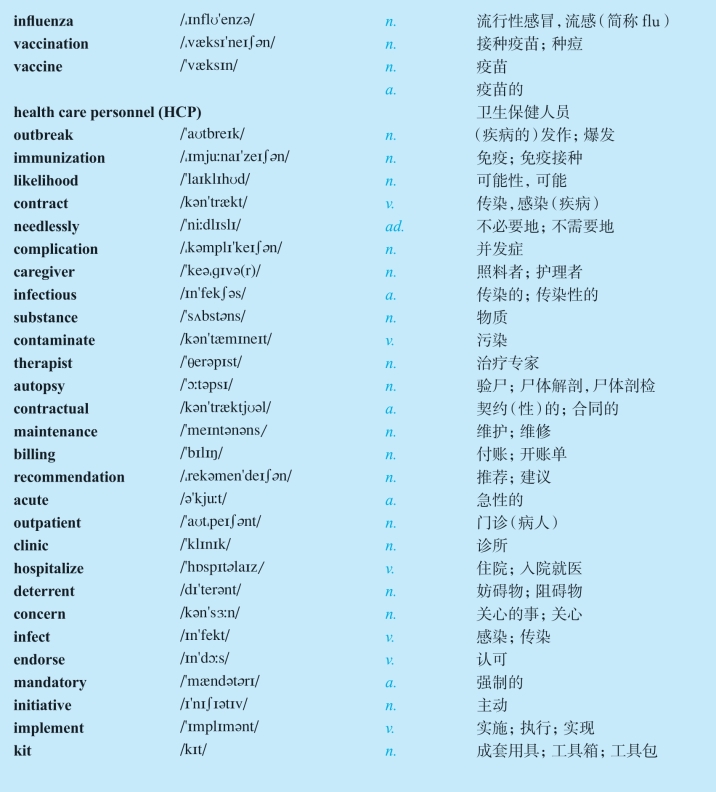
NEW WORDS AND EXPRESSIONS
NOTES
1.health care setting:卫生保健院所,医疗机构
2.Studies have shown that low vaccination rates among HCP contribute to influenza outbreaks in hospitals and other health care settings, needlessly putting patients at an increased risk of contracting influenza and suffering from its potential major complications.
本句中的contribute to 后跟两个宾语:influenza outbreaks in hospitals and other health care settings 和putting patients at an increased risk of contracting influenza and suffering from its potential major complications
全句可译为:研究表明在卫生保健人员中,过低的疫苗注射率在医院和其他医疗机构会造成重大流感疾病的爆发;不必要地使病人处在不断增加的传染到流感的危险并遭受大多数潜在流感并发症的风险之中。
3.HCP refers to all paid and unpaid persons working in health care settings who have the potential for exposure to patients and/or to infectious materials, including body substances, contaminated medical supplies and equipment, contaminated environmental surfaces, or contaminated air.
其中working in health care settings和who have the potential for exposure to patients and/or to infectious materials分别是现在分词和定语从句做定语同时修饰persons。
全句可译为:卫生保健人员是指所有有偿或无偿在医疗机构工作的人,他们有可能接触到病人和/或传染性的材料,包括身体的物质、被污染的医疗用品和设备、污染环境的表面,或受其污染空气。
4.laboratory-confirmed influenza cases:实验室确诊的流感病例
nosocomial (hospital-acquired)influenza cases:院内(医院内获得的)流感病例
5.The misconception that the vaccine causes influenza, and the mistaken belief that they are not at risk is also another reason why many HCP don’t get vaccinated.
该句中的第一个that the vaccine causes influenza从句是misconception的同位语;
第二个that they are not at risk从句是belief的同位语。
全句可译为:对疫苗导致流感的误解,并且错误的认为他们没有处在风险中也是为什么许多卫生保健人员不接种疫苗的另一个原因。
6.This risk has been one of the primary factors in motivating many major professional medical societies to endorse and publish recommendations requiring HCP with direct patient care to be immunized.
本句主干:This risk has been one of the primary factors 这种风险已经成为主要因素之一。
requiring HCP with direct patient care to be immunized 为现在分词作后置定语修饰recommendations,意思为:要求直接护理病人的卫生保健人员注射疫苗的建议。
many major professional medical societies:许多主要的专业医学会
全句可译为:这种风险已经成为激励许多主要的专业医学会赞同并公布关于要求直接护理病人的卫生保健人员应注射疫苗的建议的主要因素之一。
7.the Department of Health and Human Services (HHS):医疗与公共服务部
the National Foundation for Infectious Diseases (NFID):国家传染病基金会
the Infectious Disease Society of America (IDSA):美国传染病学会
the American College of Physicians (ACP):美国医师学会
8.FDA urges health care facilities to educate their HCP regarding the benefits of influenza vaccination and potential health consequences of influenza illness for themselves and their patients.
其中regarding the benefits of influenza vaccination and potential health consequences of influenza illness for themselves and their patients 为介词短语作动词educate的宾语,译为:教育卫生保健人员关于他们和他们的患者注射流感疫苗的益处及流感疾病对健康的潜在影响。
9.In an effort to improve vaccinations rates among HCP, HHS has developed the Health Care Personnel Initiative to Improve Influenza Vaccination Toolkit.
全句可译为:为了努力提高卫生保健人员疫苗接种率,医疗与公共服务部门已经提高卫生保健人员的主动性,改进流感疫苗接种工具包。
Exercises
Task 1 Answer the following questions.
1.In annual influenza season, what programs should be implemented for HCP?
2.Are HCP easier to be infected influenza than average persons?
3.In Paragraph 5, what might HCP include?
4.How many rates increased in immunization according to one hospital’s evaluation on the impact of vaccination?
5.Why have the results of influenza cases been decreasing over 12 flu seasons in one hospital?
6.What are the two reasons why many HCP don’t get vaccinated?
7.Can a healthy adult spread the virus to patients at high risk for serious complications from influenza unknowingly?
8.What have some states and health agencies done to help decrease the likelihood of contracting influenza and the chance of infecting others?
Task 2 Translate the following into Chinese.
Vaccines, as with all products regulated by FDA, undergo a rigorous1review of laboratory and clinical data to ensure the safety, efficacy, purity and potency of these products.Vaccines approved for marketing may also be required to undergo additional studies to further evaluate the vaccine and often to address specific questions about the vaccine’s safety, effectiveness or possible side effects.
According to the Centers for Disease Control and Prevention, vaccines have reduced preventable2infectious diseases to an all-time low and now few people experience the devastating3effects of measles4, pertussis5and other illnesses.
The Center for Biologics Evaluation and Research (CBER)regulates vaccine products.Many of these are childhood vaccines that have contributed to a significant reduction of vaccine-preventable diseases.
Notes:1.rigorous 严格的 2.preventable 可预防的 3.devastating 毁灭性的
4.measles 麻疹 5.pertussis 百日咳
疫苗及其相关知识问答
1.什么是疫苗?
答:疫苗是将病原微生物(如细菌、立克次氏体、病毒等)及其代谢产物,经过人工减毒、灭活或利用基因工程等方法制成的用于预防传染病的自动免疫制剂。疫苗保留了病原体刺激机体免疫系统的特性。当机体接触到这种不具伤害力的病原体后,免疫系统便会产生一定的保护物质,如免疫激素、活性生理物质、特殊抗体等;当机体再次接触到这种病原体时,机体的免疫系统便会依循其原有的记忆,制造更多的保护物质来阻止病原体的伤害。目前用于人类疾病防治的疫苗有几十种,根据技术特点分为传统疫苗和新型疫苗。传统疫苗主要包括减毒活疫苗和灭活疫苗,新型疫苗则以基因疫苗为主。
2.什么是第一类疫苗?
答:第一类疫苗是指政府免费向公民提供,公民应当依照政府的规定接种的疫苗。包括:(1) 国家免疫规划规定的疫苗,省、自治区、直辖市人民政府在执行国家免疫规划时增加的疫苗; (2) 县级以上人民政府或者其卫生主管部门组织的应急接种所使用的疫苗; (3) 县级以上人民政府或者其卫生主管部门组织的群体性预防接种所使用的疫苗。主要有:乙肝疫苗、卡介苗、脊髓灰质炎疫苗、百白破疫苗、麻腮风疫苗、白破疫苗、甲肝疫苗、流脑疫苗、乙脑疫苗,以及在重点地区对重点人群接种的出血热疫苗、炭疽疫苗和钩端螺旋体疫苗。
3.什么是第二类疫苗?
答:第二类疫苗是指由公民自费并且自愿接种的其他疫苗。目前常用的第二类疫苗有流感疫苗、水痘疫苗、B型流感嗜血杆菌疫苗、口服轮状病毒疫苗、肺炎疫苗、狂犬病疫苗等。
4.为什么要接种疫苗?
答:接种疫苗是预防和控制传染病的手段之一。通过接种疫苗可以使人群免疫力提高,筑起一道天然的防病屏障,使传染病不易发生,从而降低发病率,减少死亡,以达到控制传染病的流行,最终达到消除或消灭的目的。
5.对季节性流感疫苗过敏,是否能接种甲型H1N1流感疫苗?
答:不能。普通的季节性流感疫苗和甲型H1N1流感疫苗的制作工艺基本相同,因此对普通季节性流感疫苗过敏的人不能接种甲型H1N1流感疫苗。由于制备季节性流感疫苗和甲型H1N1流感疫苗的过程,均需鸡胚培养、灭活、裂解、纯化等工艺,疫苗中不可避免的会残留微量的卵清蛋白、甲醛、裂解剂等物质,因此对疫苗任何成分过敏的人应禁止接种甲型H1N1流感疫苗。
6.发生疫苗不良反应/事件后向哪里报告?
答:医疗机构、接种单位、疾病预防控制机构、药品不良反应监测机构、疫苗生产企业、疫苗批发企业及其执行职务的人员为责任报告单位和报告人,在发现疫苗接种不良反应/事件后(包括接到受种者或其监护人的报告),应当填写《疑似预防接种异常反应个案报告卡》,并提交给受种者所在地的县级疾病预防控制中心。
7.如果打算接种季节性流感疫苗、甲型H1N1流感疫苗和肺炎疫苗,应该如何进行接种?
答:目前市场上的季节性流感疫苗、甲型H1N1流感疫苗和肺炎疫苗均是灭活疫苗,相互间不会干扰免疫应答或增加副反应发生率,但不建议三种疫苗同时接种。如同时接种其中任何两种疫苗时应选择在不同的部位。如两种疫苗不能同时接种,应间隔至少14天。
8.甲型H1N1流感疫苗和狂犬病疫苗接种应间隔多久?有先后顺序吗?
答:被犬、猫等动物咬伤后,应立即接种狂犬病疫苗。如需接种甲型H1N1流感疫苗,应在狂犬病疫苗全程接种完成后,至少间隔14天。如接种甲型H1N1流感疫苗后被犬、猫等动物咬伤,也应立即接种狂犬病疫苗。
9.甲型H1N1流感疫苗注射的部位和方法与季节性流感疫苗有什么不同?
答:接种甲型H1N1流感疫苗的注射部位和方法与接种季节性流感疫苗相同,都是上臂外侧三角肌,肌肉注射。详细情况参照各生产企业的甲型H1N1流感疫苗和季节性流感疫苗使用说明书。
10.甲型H1N1流感疫苗与季节性流感疫苗能否同时接种?
答:WHO与美国免疫咨询委员会 (ACIP)认为,甲型H1N1流感疫苗与季节性流感疫苗可以同时接种,要在不同部位接种。但由于目前国内外尚无两种疫苗同时接种后的临床试验数据,专家建议,如果需要接种两种疫苗,应至少间隔14天。
11.疫苗与预防接种:接种疫苗后出现不良事件,其原因可能有哪些?
答:除由于疫苗本身固有特性所引起的疫苗不良反应外,其他可能因素还包括:由于疫苗质量原因引起的疫苗质量事故;接种过程中由于违反操作规程引起的接种事故;由于受种者在接种时正处于某种疾病的潜伏期或者前驱期,接种后巧合发病的偶合症;因受种者心理因素发生的心因性反应等。
12.我国甲型H1N1流感疫苗的种类有哪些?
答:我国是全球首个批准甲型H1N1流感疫苗上市的国家。目前,经过国家食品药品监督管理局批准并上市的甲型H1N1流感疫苗为15微克无佐剂裂解疫苗,注射剂型。截至目前,批准上市的疫苗由以下8家企业生产:北京科兴生物制品有限公司、华兰生物疫苗有限公司、长春长生生物科技股份有限公司、上海生物制品研究所、北京天坛生物制品股份有限公司、江苏延申生物科技股份有限公司、浙江天元生物药业股份有限公司、长春生物制品研究所等。国产的甲型H1N1流感疫苗采用世界卫生组织推荐的甲型H1N1流感病毒株,疫苗的生产工艺与往年的季节性流感疫苗基本相同,均需经过鸡胚培养、灭活病毒、纯化、裂解等工艺后制成。
13.我国的甲型H1N1流感疫苗怎么接种?
答:接种甲型H1N1疫苗后,可刺激机体产生针对甲型H1N1流感病毒的抗体,用于此型病毒所致流感流行的免疫预防。接种剂量/剂次:15 μg/0.5 ml,1剂次。接种部位:上臂外侧三角肌。接种途径:肌肉注射。甲型H1N1流感疫苗要求于2—8℃避光保存和运输,严防冻结。接种甲型H1N1疫苗对其他流感没有预防作用。接种季节性流感疫苗对甲型H1N1流感也没有预防作用。卫生部要求在确保安全的前提下,按照知情同意、自愿免费接种的原则,积极稳妥、有序地开展疫苗接种工作。接种前,接种人员要认真查验儿童预防接种证、卡,核对受种者姓名、性别、出生日期及接种记录,确认是否为本次接种对象、接种疫苗的品种,如发现原始记录中受种者姓名、出生日期有误,应及时更正;对不属于本次的受种者,应向儿童家长或其监护人做好说服解释工作。同时还应告知受种者或其监护人所接种疫苗的品种、作用、禁忌、不良反应以及注意事项,询问受种者的健康状况以及是否有接种禁忌等情况,并如实记录、告知和询问情况。各级疾病预防控制机构负责组织疫苗的接种实施,接种单位要严格按照《疫苗储存和运输管理规范》的要求,在甲型H1N1流感疫苗储存、运输、使用的各个环节做到冷链储运,并做好温度监测工作。
14.在哪里能够接种甲型H1N1流感疫苗?
答:甲型H1N1流感疫苗接种工作实行属地化管理,请咨询当地卫生行政部门和疾病预防控制机构,并密切关注当地卫生行政部门发布的甲型H1N1流感疫苗接种重点人群、接种地点等相关信息。
15.哪些人群不能接种甲型H1N1流感疫苗?
答:以下人群不能接种甲型H1N1流感疫苗:对鸡蛋或疫苗中任何其他成分(包括辅料、甲醛、裂解液等),特别是卵清蛋白过敏者;患急性疾病、严重慢性疾病、慢性疾病的急性发病期、感冒和发热者;格林巴利综合征患者;未控制的癫痫和患其他进行性神经系统疾病者;严重过敏体质者,对硫酸庆大霉素过敏者;年龄小于3岁者;医生认为不适合接种的其他人员。