Supplementary Reading Acupuncture
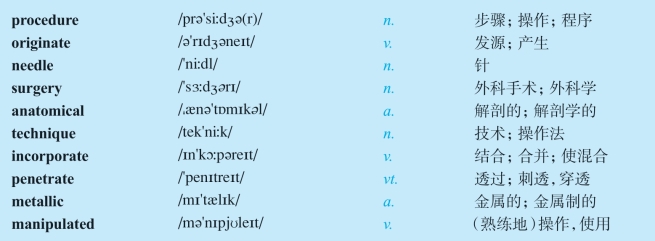
Acupuncture is one of the oldest, most commonly used medical procedures in the world.Originating in China more than 2,000 years ago, acupuncture began to become better known in the United States in 1971, when New York Times reporter James Reston wrote about how doctors in China used needles to ease his pain after surgery.
The term acupuncture describes a family of procedures involving stimulation of anatomical points on the body by a variety of techniques.American practices of acupuncture incorporate medical traditions from China, Japan, Korea and other countries.The acupuncture technique that has been most studied scientifically involves penetrating the skin with thin, solid, metallic needles that are manipulated by the hands or by electrical stimulation.
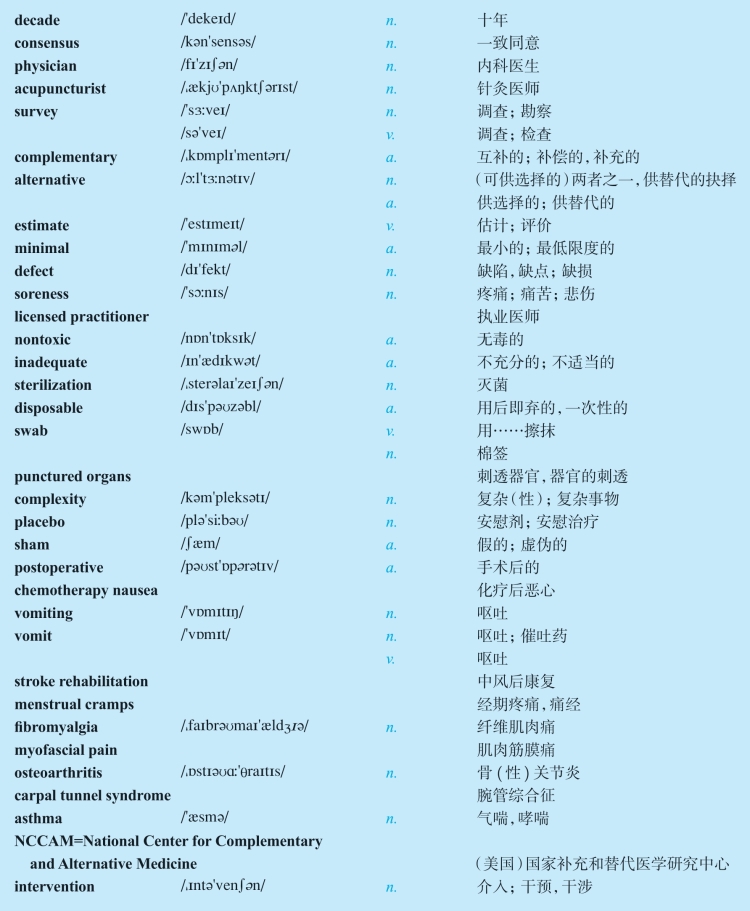
In the past two decades, acupuncture has grown in popularity in the United States.The report from a Consensus Development Conference on Acupuncture held at the National Institutes of Health (NIH)in 1997 stated that acupuncture is being “widely” practiced by thousands of physicians, dentists, acupuncturists and other practitioners for relief or prevention of pain and for various other health conditions.According to the 2002 National Health Interview Survey—the largest and most comprehensive survey of complementary and alternative medicine (CAM)use by American adults to date—an estimated 8.2 million U.S.adults had ever used acupuncture, and an estimated 2.1 million U.S.adults had used acupuncture in the previous year.
Acupuncture needles are metallic, solid and hair-thin.People experience acupuncture differently, but most feel no or minimal pains as the needles are inserted.Some people are energized by treatment, while others feel relaxed.Improper needle placement, movement of the patient, or a defect in the needle can cause soreness and pain during treatment.This is why it is important to seek treatment from a qualified acupuncture practitioner.
The U.S.Food and Drug Administration (FDA)approved acupuncture needles for use by licensed practitioners in 1996.The FDA requires that sterile, nontoxic needles be used and that they be labeled for single use by qualified practitioners only.
Relatively few complications from the use of acupuncture have been reported to the FDA in light of the millions of people treated each year and the number of acupuncture needles used.Still, complications have resulted from inadequate sterilization of needles and from improper delivery of treatments.Practitioners should use a new set of disposable needles taken from a sealed package for each patient and should swab treatment sites with alcohol or another disinfectant before inserting needles.When not delivered properly, acupuncture can cause serious adverse effects, including infections and punctured organs.
According to the NIH Consensus Statement on Acupuncture, there have been many studies on acupuncture’s potential usefulness, but results have been mixed because of complexities with study design and size, as well as difficulties with choosing and using placebos or sham acupuncture.However, promising results have emerged, showing efficacy of acupuncture, for example, in adult postoperative and chemotherapy nausea and vomiting and in postoperative dental pain.There are other situations—such as addiction, stroke rehabilitation, headache, menstrual cramps, tennis elbow, fibromyalgia, myofascial pain, osteoarthritis, low-back pain, carpal tunnel syndrome, and asthma—in which acupuncture may be useful as an adjunct treatment or an acceptable alternative or be included in a comprehensive management program.An NCCAM-funded study recently showed that acupuncture provides pain relief, improves function for people with osteoarthritis of the knee, and serves as an effective complement to standard care.Further research is likely to uncover additional areas where acupuncture interventions will be useful.
注: 本文选自美国国家补充和替代医学研究中心National Center for Complementary and Alternative Medicine网站,网址:http://nccam.nih.gov/health/acupuncture/
NEW WORDS AND EXPRESSIONS


COMPREHENSION QUESTIONS
1.When was acupuncture known to Americans?
2.What does the term acupuncture describe?
3.What has been most studied in acupuncture?
4.How many adults in the U.S.are estimated to have used acupuncture each year?
5.What does an acupuncture needle look like?
6.What are felt when receiving acupuncture?
7.What is required by FDA about the acupuncture needles?
8.Does acupuncture cause many complications? Why?
9.What are the procedures a practitioner should follow when giving acupuncture?
10.Why have the results of acupuncture studies been mixed?