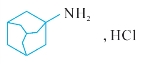
Supplementary Reading BP 2007 Amantadine Hydrochloride(Ph Eur monograph 0463)

C10H18ClN 187.7 665-67-7
Action and Use
Anticonvulsant; antiviral.
Preparations
Amantadine Capsules
Amantadine Oral Solution

Definition
Amantadine hydrochloride contains not less than 98.5 per cent and not more than the equivalent of 101.0 per cent of tricyclo[3.3.1.13,7]decan-1-amine, calculated with reference to the anhydrous substance.
Characters
A white or almost white, crystalline powder, freely soluble in water and in alcohol, practically insoluble in ether.It sublimes on being heated.
Identification
First identification A, D.
Second identification B, C, D.
A.Examine by infrared absorption spectrophotometry (2.2.24), comparing with the spectrum obtained with amantadine hydrochloride CRS.Examine the substances prepared as discs.
B.To 0.1 g add 1 ml of pyridine R, mix and add 0.1 ml of acetic anhydride R.Heat to boiling for about 10 s.Pour the hot solution into 10 ml of dilute hydrochloric acid R, cool to 5℃ and filter.The precipitate, washed with water R and dried in vacuo at 60℃ for 1 h, melts (2.2.14)at 147℃ to 151℃.
C.Dissolve 0.2 g in 1 ml of 0.1M hydrochloric acid.Add 1 ml of a 500 g/l solution of sodium nitrite R.A white precipitate is formed.
D.1 ml of solution S (see Tests)gives reaction (a)of chlorides (2.3.1).
Tests
Solution S
Dissolve 2.5 g in carbon dioxide-free water R and dilute to 25 ml with the same solvent.
Appearance of solution
Solution S is clear (2.2.1)and not more intensely coloured than reference solution Y7(2.2.2, Method II).
Acidity or alkalinity
Dilute 2 ml of solution S to 10 ml with carbon dioxide-free water R.Add 0.1 ml of methyl red solution R and 0.2 ml of 0.01M sodium hydroxide.The solution is yellow.Add 0.4 ml of 0.01M hydrochloric acid.The solution is red.
Related substances
Examine by gas chromatography (2.2.28).
Test solution
Dissolve 0.10 g of the substance to be examined in 2 ml of water R.Add 2 ml of a 200 g/l solution of sodium hydroxide R and 2 ml of chloroform R.Shake for 10 min.Separate the chloroform layer, dry over anhydrous sodium sulphate R and filter.
The chromatographic procedure may be carried out using:
— a glass column 1.8 m long and 2 mm in internal diameter with a packing prepared as follows:mix 19.5 g of silanised diatomaceous earth for gas chromatography R with 60 ml of a 3.3 g/l solution of potassium hydroxide R in methanol R and evaporate the solvent under reduced pressure while rotating the mixture slowly (support); dissolve 0.4 g of low-vapour-pressure hydrocarbons (type L)R in 60 ml of toluene R (dissolution requires up to 5 h), add this solution to the support and evaporate the solvent under reduced pressure while rotating the mixture slowly,
— nitrogen for chromatography R as the carrier gas at a flow rate of 30 ml/min,
— a flame-ionisation detector.
Programme the temperature of the column linearly at a rate of 6℃ per minute from 100℃ to 200℃.Maintain the temperature of the injection port at 220℃ and that of the detector at 300℃.Inject 1 μl or the chosen volume of the test solution.Continue the chromatography for a period at least 2.5 times the retention time of the principal peak.In the chromatogram the sum of the area of any peaks apart from that corresponding to amantadine does not exceed 1 per-cent of the total area of the peaks; no peak, apart from that corresponding to amantadine, has an area exceeding 0.3 per-cent of the total area.Disregard the peak corresponding to the solvent during the evaluation.
Heavy metals (2.4.8)
12 ml of solution S complies with limit test A for heavy metals (20 ppm).Prepare the standard using lead standard solution (2 ppm Pb)R.
Water (2.5.12)
Not more than 0.5 percent, determined on 2.000 g by the semi-micro determination of water.
Sulphated ash (2.4.14)
Not more than 0.1 percent, determined on 1.0 g.
Assay
Dissolve 0.150 g in a mixture of 5.0 ml of 0.01M hydrochloric acid and 50 ml of alcohol R.Carry out a potentiometric titration (2.2.20), using 0.1M sodium hydroxide.Read the volume added between the two points of inflexion.
1 ml of 0.1 M sodium hydroxide is equivalent to 18.77 mg of C10H18ClN.

注:文中计算单位因引用原文,未作规范化处理。编者
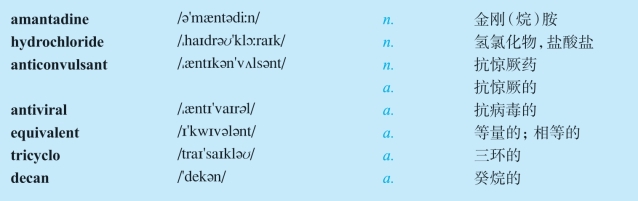
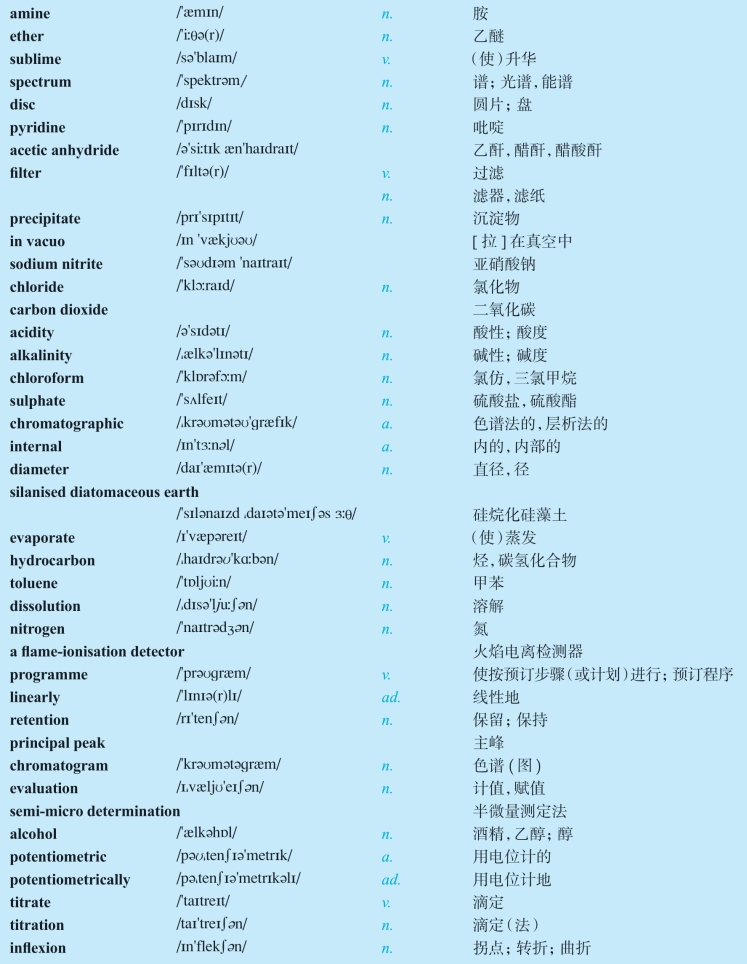
NEW WORDS AND EXPRESSIONS


COMPREHENSION QUESTIONS
1.What is the character of Amantadine?
2.How to carry out test B in Identification?
3.How to prepare solution S?
4.What does solution S look like?
5.What are the procedures when determining Acidity or Alkalinity?
6.How is the test solution prepared?
7.What may the chromatographic procedures be carried out using?
8.How to programme the temperature in the duration of chromatography?
9.What are the results in the chromatograph?
10.How to carry out Assay according to the text?