Text A General Introduction to OTC Drugs
American medicine cabinets contain a growing choice of nonprescription, over-the-counter (OTC)medicines to treat an expanding range of ailments.OTC medicines often do more than relieve aches, pains and itches.Some can prevent diseases like tooth decay, cure diseases like athlete’s foot and, with a doctor’s guidance, help manage recurring conditions like vaginal yeast infection, migraine and minor pain in arthritis.In addition to the substances such as aspirin and acetaminophen that people typically think of as OTC drugs, many other commonly available products are considered OTC drugs by the Federal Food and Drug Administration (FDA).Some toothpastes, some mouthwashes, some types of eye drops, wart removers, first aid creams and ointments that contain antibiotics, and even dandruff shampoos are considered OTC drugs.
The U.S.Food and Drug Administration determines whether medicines are prescription or nonprescription.The term prescription (Rx)refers to medicines that are safe and effective when used under a doctor’s care.Nonprescription or OTC drugs are medicines FDA decides are safe and effective for use without a doctor’s prescription.
Some OTC drugs were originally available only by prescription.After many years of use under prescription regulation, drugs with excellent safety records may be approved by the FDA for overthe-counter sale.FDA also has the authority to decide when a prescription drug is safe enough to be sold directly to consumers over the counter.This regulatory process, the New Drug Application (NDA)process allowing Americans to take a more active role in their health care is known as Rxto-OTC switch.As a result of this process, more than 700 products sold over the counter today use ingredients or dosage strengths available only by prescription 30 years ago.
Increased access to OTC medicines is especially important for our maturing population.Two out of three older Americans rate their health as excellent to good, but four out of five report at least one chronic condition.
Fact is, today’s OTC medicines offer greater opportunity to treat more of the aches and illnesses most likely to appear in our later years.As we live longer, work longer, and take a more active role in our own health care, the need grows to become better informed about self-care.
The best way to become better informed—for young and old alike—is to read and understand the information on OTC labels.Next to the medicine itself, label comprehension is the most important part of self-care with OTC medicines.
注:本文内容选自FDA,MERCK网站,网址:http://www.fda.gov/cder/consumerinfo/WhatsRightForYou.htm, http://www.merck.com/mmhe/sec02/ch018/ch018a.html
NEW WORDS AND EXPRESSIONS
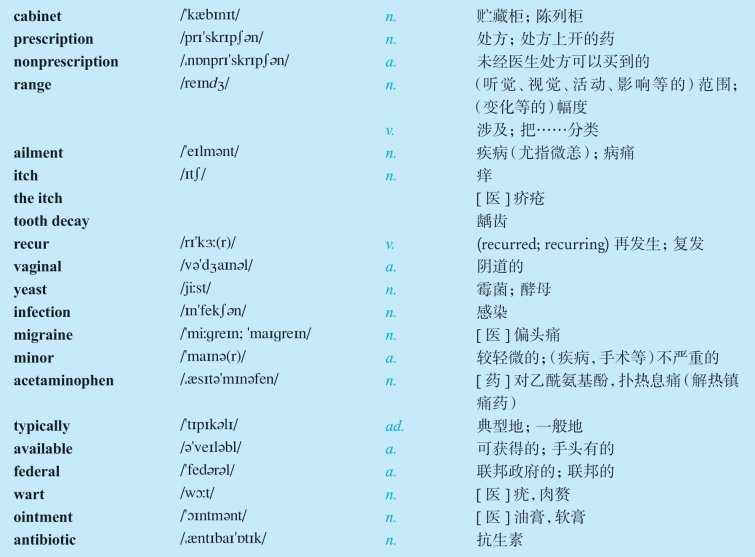
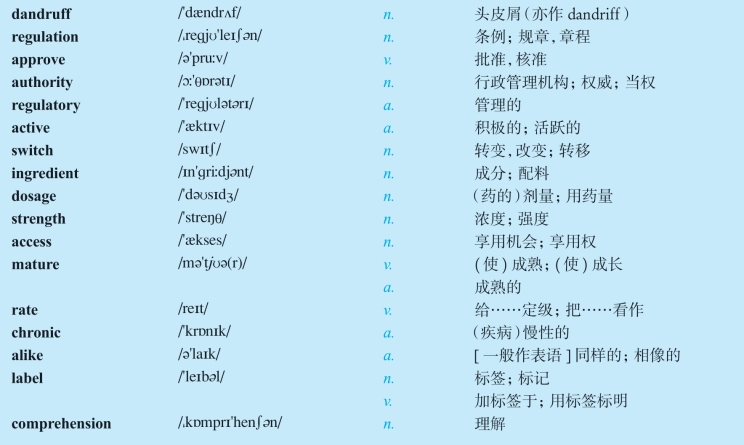
NOTES
1.非处方药和处方药的定义分别为:
Over-the-Counter (OTC)Medicine:Medicine you can buy without a doctor’s prescription.
Prescription Medicine:Your doctor writes a prescription that tells the pharmacist what you need.You pick up the medicine at a pharmacy.
2.Some can prevent diseases like tooth decay, cure diseases like athlete’s foot and, with a doctor’s guidance, help manage recurring conditions like vaginal yeast infection, migraine and minor pain in arthritis.
该句中的主语some(指OTC drugs)后面的谓语分别为:can prevent, cure和help。
因此,本句的主要成分是Some can prevent diseases, cure diseases and help manage recurring conditions.可译为:某些非处方药能够预防疾病、治疗疾病,并且有助于控制复发性疾病。
3.In addition to the substances such as aspirin and acetaminophen that people typically think of as OTC drugs, many other commonly available products are considered OTC drugs by the Federal Food and Drug Administration (FDA).
in addition to 引导介词短语。In addition to the substances such as aspirin and acetaminophen that people typically think of as OTC drugs 可译为:除了人们一向认为是非处方药的阿司匹林和扑热息痛的药物外,其中that people typically think of as OTC drugs 是一个定语从句,修饰先行词aspirin and acetaminophen。
该句的主干为:many other commonly available products are considered OTC drugs by the Federal Food and Drug Administration (FDA).可译为:许多其他常用药由联邦FDA认定为非处方药。
FDA:The Food and Drug Administration(美国食品药品管理局) is an agency of the U.S.Department of Health and Human Services that makes sure that medicines for diabetes and other illnesses work and are safe.
4.This regulatory process, the New Drug Application (NDA)process allowing Americans to take a more active role in their health care is known as Rx-to-OTC switch.
this regulatory process 和the New Drug Application (NDA)process )(新药申请过程)是同位语。
该句的主要成分为:This regulatory process is known as Rx-to-OTC switch.可译为:这种调整过程被认为是由处方药向非处方药转变(的过程)。
allowing Americans to take a more active role in their health care 为现在分词短语做后置定语,代替定语从句 which allows Americans to take a more active role in their health care,修饰process。
全句可译为:这种使美国人能在他们卫生保健中发挥更积极作用的新药申请,即调整过程,被认为是由处方药向非处方药转变(的过程)。
5.As a result of this process, more than 700 products sold over the counter today use ingredients or dosage strengths available only by prescription 30 years ago.
as a result of this process 由于这个(转变)过程,即上句中所说的由处方药向非处方药转变过程。
sold over the counter today 为过去分词短语做后置定语,代替定语从句 which are sold over the counter today,修饰products,即非处方药。
全句可译为:由于这个(转变)过程,今天700多种的非处方药所使用的是30年前只能凭处方才能买到的成分和剂量浓度。
6.Increased access to OTC medicines is especially important for our maturing population.
该句的主语是access to OTC medicines:对非处方药的获得权。maturing population 指中年人。
全句可译为:非处方药获得权的增加对我们中年人特别重要。
7.Fact is, today’s OTC medicines offer greater opportunity to treat more of the aches and illnesses most likely to appear in our later years.
today’s OTC medicines offer greater opportunity to treat more of the aches and illnesses most likely to appear in our later years 为表语从句,可译为:今天的非处方药为以后我们生活中很可能出现的疼痛和疾病提供了更多的治愈机会。
8.As we live longer, work longer, and take a more active role in our own health care, the need grows to become better informed about self-care.
as 引导时间状语从句,意思为“当……时候”;从句中的3个谓语并列为:live longer, work longer和and take a more active role。
主句的主干为:the need grows。 to become better informed about self-care 为目的 状语。
全句可译为:当我们的寿命延长,工作得更久,在自我卫生保健中发挥更重要作用(自我卫生保健意识增强)时,能更好地了解自身健康的需求就随之增加。
Exercises
Task 1 Answer the following questions.
1.What are OTC drugs according to the text?
2.What is the definition of prescription medicine?
3.Can you give some examples of OTC drug in our daily lives?
4.Which agency could determine whether medicines are prescription or nonprescription?
5.What is the another function of FDA?
6.How can prescription drugs switch to OTC drugs?
7.How many OTC drugs use ingredients or dosage strengths available only by prescription 30 years ago?
8.What is especially important for maturing people?
9.What’s the proportion of older Americans who regard their health as excellent to good?
10.What do we need badly when we live longer, work longer, and take a more active role in our own health care?
Task 2 Translate the following into Chinese.
Safety is a major concern1when the FDA considers reclassifying2a prescription drug as OTC.Most OTC drugs—unlike health foods, dietary supplements3(including medicinal herbs4)and complementary therapies5— have been studied scientifically and extensively.However, all drugs have benefits and risks, and some degree of risk has to be tolerated if people are to receive a drug’s benefits.Defining an acceptable degree of risk is a judgement call6.
Notes:1.concern 关心的事 2.reclassify 重新分类 3.supplement 膳食补充品
4.herb 草药 5.therapy 疗法,治疗 6.judgement call 需要有判断力
非处方(OTC)药品简介
非处方药是指为方便公众用药,在保证用药安全的前提下,经国家卫生行政部门规定或审定后,不需要医师或其他医疗专业人员开写处方即可购买的药品。一般公众凭自我判断,按照药品标签及使用说明就可自行使用。非处方药在美国又称为柜台发售药品(over-thecounter drug),简称OTC药。这些药物大都用于多发病、常见病的自行诊治,如感冒、咳嗽、消化不良、头痛、发热等。为了保证公众健康,我国在非处方药的包装标签、使用说明书中标注了警示语,明确规定药物的使用时间、疗程,并强调指出“如症状未缓解或消失应向医师咨询”。
非处方药由处方药转变而来,是经过长期应用、确认有疗效、质量稳定、非医疗专业人员也能安全使用的药物。不过在非处方药中,还有更细的分类,红底白字的是甲类,绿底白字的是乙类。甲、乙两类非处方药虽然都可以在药店购买,但乙类非处方药安全性更高。乙类非处方药除了可以在药店出售外,还可以在超市、宾馆、百货商店等处销售。不过,由于我国建立药品分类管理制度不久,故乙类非处方药暂不实行,根据国家规定目前全部按甲类非处方药管理。
美国对非处方药与处方药的主要评价依据是:药物的毒性和潜在的危险性, 药物服用的方法及辅助手段。就新药而言,经由新药审批程序以确定新药属于处方药或非处方药;对于已上市的处方药物而言,作为FDA非处方药评价工作的一部分,也根据1984年药品价格竞争和专利条款回复法案的规定,可按照增补的新药审批程序(supplemental NDA)转变为非处方药。从1938年到1962年,FDA大约受理了420个非处方药的新药申请。当时审批程序十分简单,相当多的申请只是希望通过成为非处方药以获得更大的市场收益。作为1962年食品、药品和化妆品法案修正案的一部分,FDA要求对这420个非处方药的安全性和有效性进行再评价。同时,FDA扩大了非处方药物评价范围,包括对当时市场上所有非处方药的活性组分,及这些药品的标签加以评价。1972年,FDA开始了巨大的非处方药评价工程,这是有史以来对非处方药的安全性、有效性及标签的正确性进行的最为全面系统的一次评价。FDA的专家小组对各类非处方药分别加以评价,提出结论和建议,并完成专题报告。到20世纪80年代早期,所有FDA的专家小组都已完成有关探讨,出版了有关各类非处方药的专题报告。非处方药专题报告规定了在哪些情况下,非处方药被认为总体上安全有效(GRAS & GRAE),且标签正确。今天任何人都可以遵照某个非处方药专题报告的要求,将非处方药投入市场,而不需经新药审批程序或任何形式的FDA审批。但当投入市场的非处方药与专题报告有所偏离时,必须进行某种形式的新药审批以获得FDA的批准。简而言之,全面遵守非处方药专题报告可以保证非处方药直接迅速上市,而不需任何形式的上市许可。不过所有非处方药都应遵守食品、药品和化妆品法案中关于掺假和标签错误行为的一般条款,包括药品生产质量管理规范(GMP)、药厂注册及产品注册的条款。
非处方药具有安全、有效、使用剂量受到严格控制的优点,但并不意味着这类药物使用绝对不会发生不良反应。随着普通消费者实施自我药疗选择范围的增大,发生药物不良反应和药物相互作用危害的机会也会增多。如果消费者自我诊断错误、选用非处方药失当、误用或滥用非处方药可能产生以下危害:
1.掩盖其他疾病或加重病情
如退热药或止痛药的使用为药品消费者实施自我药疗提供了极大的方便,但使用不当会掩盖潜在的感染性及其他病患,延误或加重病情。
2.造成严重药物不良反应
许多活性成分与病人正在服用的处方药发生药物相互作用,也可能引起不良反应的发生。如抗组胺药会引起镇静和嗜睡,若合并使用镇静-催眠药或其他中枢神经系统抑制剂时,其不良反应会增加。
非处方药若使用不当,会引起过量,如退热药或感冒药的非处方药往往都含有乙酰氨基酚(扑热息痛),重复给药可使该药剂量过大而损害肝脏,严重者可致肝昏迷死亡,特别是3岁以下小儿及新生儿因肝、肾功能发育不全,如不慎过量使用了含该成分的非处方药,后果将十分严重。
3.增加病人和社会的经济负担
由于非处方药的费用往往由病人自己支付,不合理用药会造成病人直接的经济损失,若误用或滥用非处方药造成不良后果,会造成个人与家庭不必要的经济损失,对人类有限的医药资源也是有形的浪费。
4.导致身体或精神对药物的依赖性
少数复方制剂处方由于治疗或处方组成需要,含有需要特殊管理的精神药品。虽然单位制剂中含量有限,但若大剂量、长期滥用,也可能引起药物成瘾。
因此在使用时同样要十分谨慎,切实注意下述几点:
(1)通过各种渠道,充实、提高个人的用药知识,作为自我药疗的基础,便于小病的自我判断。
(2)正确选用有国家统一标识的非处方药。
(3)仔细阅读标签说明书,了解其适应证、注意事项及不良反应。
(4)认真检查所选药品有无批准文号及非处方药“登记证书编号”。
(5)注意药品的内外包装是否有破损,是否标注有效期。
(6)严格按说明书用药,不得擅自超量、超时使用,若有疑问要向医师或药师咨询。
(7)按要求储藏药品,放置于小儿不可触及处。