Unit Eight Go Dutch
In this unit, students will
1. Talk about going Dutch.
2. Learn nonverbal social-communication skills: Understand Others’ Feelings.
3. Learn verbal social-communication skills: Persuade Others.
Ⅰ.Warm-up Activities
1. Read the following passage, and answer the following questions.
“Go Dutch” ?
To “go Dutch,” also known as a “Dutch treat” or a “Dutch date,” implies an informalagreement for each person to pay for his or her own expenses during a planned date or outing. The decision to “go Dutch” is usually made in advance in order to avoid any confusion when the bill arrives or the tickets are purchased. Under certain social and financial circumstances, the idea to “go Dutch” allows larger groups of friends or co-workers to enjoy a night on the town without the worry of one host footing the entire bill. During a romantic dating situation, however, the suggestion to “go Dutch” may not be as well received.
Many people agree to “go Dutch” as a tactful way to level the financial playing field. One friend may feel uncomfortable with the idea of another friend in better financial shape always footing the bill. When two or more people agree to “go Dutch,” each is free to spend within his or her personal entertainment budget. Even if one person can afford to order the most expensive item on the menu, the rest of the group is not obligated to spend outside their own limits.
When it comes to social dating, however, the idea to “go Dutch” is not universally accepted. Traditionally, the person who invites a companion for dinner or other entertainment is obligated to pick up the entire tab. Modern dating etiquette now allows women to assume the same role as men when it comes to financing a date, but there is still a clear division between the inviter and the invited. Some couples, however, are very comfortable with the decision to “go Dutch,” especially during early casual dates. By agreeing on a Dutch date, neither party feels obligated or indebted romantically to the other party for picking up the entire bill.
The origin of the phrase “go Dutch” or “Dutch treat” can be traced back to a time when England and the Netherlands fought constantly over trade routes and political boundaries during the 17th century. The British used the term “Dutch” in a number or derogatory or demeaning ways, including “Dutch courage” (bravery through alcohol) and “Dutch treat”, which was actually no treat at all. The Dutch were said to be very stingy with their wealth, almost miserly, so the British used the word “Dutch” informally to imply all sorts of negative behaviors.
While many of these derogatory Dutch references fell out of common usage, Americans did retain the idea of a “Dutch treat” when a number of German (Deutsch) immigrants arrived. A corruption of Deutsch led to the designation of German immigrants living in Pennsylvania as “Pennsylvanian Dutch”. Even though the original British slur was against the actual Dutch, some Americans perpetuated the negative connotation of “Dutch treat” to include the German“Dutch” as well.
The modern idea to “go Dutch” no longer carries the stigma of the term’s original intentions. It is simply a recognized bit of social jargon which allows each party to know the financial arrangements of a date or social outing.
from http://www.wisegeek.com/what-does-it-mean-when-you-go-dutch.htm
Questions:
1) Why do some people choose to “go Dutch”?
2) Under what kind of situation “Dutch treat” is not accepted?
3) What is the origin of “Dutch treat”?
2. Pair work: At a Restaurant
Role A: You invited your friend to dinner in a restaurant, but you left your wallet at home.
Role B: You took the money that was only enough to pay the bill. Role A starts the conversation.
3. Learn from movies
You will watch an episode of “Family Album U.S.A.”. Please fill the following blanks with the words you hear, and then, discuss with your partners on who shall pay for the meal in such a case.
Somsak: Rose-petal salad. And there’s a 1) ________ call for you, Mr. Bennett.
Harry: Excuse me, Susan.
Susan: I hope 2) ________ is wrong.
Somsak: I’ll get the rest of the dinner. Excuse me.
Harry: Please 3) _________ me, Susan, but. . . I have to leave. I feel terrible, but . . .
Susan: What’s the matter?
Harry: My daughter isn’t 3) ________well.
Susan: Oh no! Is it serious?
Harry: I don’t know. The baby-sitter says she has a 4) ________ and she’s crying. I’ll have to go home. Will you forgive me?
Susan: Of course. I’m so sorry for Michelle. And you didn’t have a 5) ________ to eat.
Harry: Oh, it’s OK. Let me 6) ________ you home first.
Susan: No, no. Please, go ahead.
Harry: It’s our first date.
Susan: We’ll make 7) ________. Please don’t worry.
Harry: I’ll phone you.
Susan: I hope your 8) ________ is all right. Good-bye.
Harry: Good-bye.
Ⅱ.Focused Topic
Go Dutch
A.Dialogues
Please read the following dialogues and note the italic expressions.
Dialogue 1 It’s Really a Great Decision
A: That was quite enjoyable!
B: Yeah! Great decision. I like this place a lot.
B: I’m so full!
A: That was great. It was worth every penny.
B: I’m glad we got dessert.
A: Everything else is going good?
B: Yeah! Just…just getting tired of the way things get changed up at work a little bit, but…what are you going to do.
A: Yeah. So, what’s the damage? That’s not bad. I was thinking we’d go Dutch on this?
B: What… what’s that?
A: Split it down the middle?
B: Perhaps…
A: Are you fine with that?
B: Yeah… super chill.
A: What’s chill for you is chill for me!
B: Yeah… totally.
A: Oh yeah. We’re going Dutch tonight.
B: Yay, Dutch…
A: Perfect!
B: Hello? Hey, oh my gosh. So, I’m still on my date here, and we had to go Dutch. You know, like, split down the middle? Yeah! What the heck? He’s a lawyer! Is he cheap, or something? I don’t understand. Like, with Mason, I never had to pay for anything. He, like, paid for my student loans, like, there was no question. Like, what’s the deal here? What’s going on? Oh God, he’s coming back. Gotta go.
A: Alright! What’s up? What do you say?
B: Oh, all good! Yeah!
Dialogue 2 Qualities Appreciated in Friends
A: There is a newly shot movie called Serendipity.
B: What kind of subject is it about?
A: Of course love—the eternal theme. Some of my friends have seen this movie and they said it’s very lovely.
B: Fine, let’s go and see it.
A: Great! But I have a suggestion.
B: For what?
A: How about going Dutch when we go on a date?
B: Why? I can afford to buy you a ticket for a movie.
A: Yes, I know. But…
B: But what?
A: You’re still an undergraduate. It would be a burden for you if every time you pay the bill.
B: I can do some part-time jobs to afford our dating bills.
A: You should focus on your thesis and job-hunting.
B: I know that.
A: Nowadays it’s not necessary for men to pay all the bills.
B: Yes, but I just feel uncomfortable if I ask you to pay your own bill.
Other Useful Expressions
Dutch treat be on somebody
to take care of the bill let me settle the bill
to stuck in the lunch rush to eat like a bird
credit card to stop snacking
have a drink to make it Dutch
to treat somebody to let me pay
to separate the check
Practice:
1. Please answer the following questions by making a conversation with your partner:
1) Who will pay the bill when you go out eating with your friends?
2) When you get married, will you split the bill with your wife (or husband)?
3) Who will pay the bill when you and your parents go out eating?
4) If your boyfriend proposes Dutch treat, will you get angry? If your girl friend proposes to go Dutch, will you feel hurt?
2. Role-play: Student A will interview student B about two of the following topics:
1) Do you go out eating often? Which one do you prefer, Dutch treat or paying by turn?
2) How do you talk about paying bills with your friends after you finish eating?
3) What will you do if someone always doesn’t pay when you eat together?
4) What will you do if your friend suggests going Dutch, and you don’t take any money with you?
B.Socio-Communicative Skills
Verbal communication refers to the communication which is carried out in either oral or written form with the use of words. Nonverbal communication refers to the communication through one’s voice quality, facial expressions, gestures, bodily movement, attitudes towards space and time, and so on.
To achieve successful conversations, it is necessary to learn the skills of both the verbal and nonverbal communication.
Non -verbal Skill
Understanding Others’ Feelings
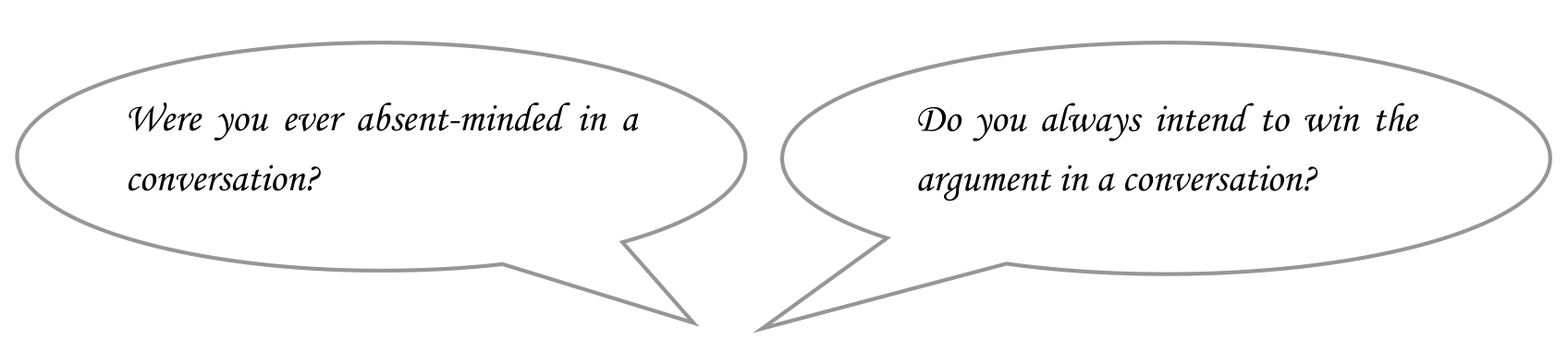
Poor communication skills, disagreements and misunderstandings can be a source of anger and distance, or a springboard to a stronger relationship and happier future. Here are some suggestions for you to understand the others’ feeling.
? Stay Focused. Sometimes it’s tempting to bring up past seemingly related conflicts when dealing with current ones. Unfortunately, this often clouds the issue and makes finding mutual understanding and a solution to the current issue less likely, and makes the whole discussion more taxing and even confusing. Try not to bring up past hurts or other topics. Stay focused on the present, your feelings, understanding one another and finding a solution.
? Listen Carefully. People often think they’re listening, but are really thinking about whatthey’re going to say next when the other person stops talking. Truly effective communication goes both ways.
? Try To See Their Point of View. We talk a lot about our point of view to get the other person to see things our way. Ironically, if we all do this all the time, there’s little focus on the other person’s point of view, and nobody feels understood. Try to really see the other side, and then you can better explain yours.
? Look for Compromise Instead of trying to ‘win’ the argument, look for solutions that meet everybody’s needs. Either through compromise or a new solution that gives you both what you want most, this focus is much more effective than one person getting what they want at the other’s expense. Healthy communication involves finding a resolution that both sides can be happy with.
? Don’t Give Up. While taking a break from the discussion is sometimes a good idea, always come back to it. If you both approach the situation with a constructive attitude, mutual respect, and a willingness to see the other’s point of view or at least find a solution, you can make progress toward the goal of a resolution to the conflict. Unless it’s time to give up on the relationship, don’t give up on communication.
Practice:
Make a conversation with your partners on the following topics and try to understand the others’ feelings.
1) Your friend borrowed your car, but didn’t return on time. You are talking with him or her about it.
2) You were late for class, and now you are talking with your teacher on it.
3) What your friend said hurt you and you are talking about it with your friend.
4) Your friend didn’t keep his or her promise, and you are talking about it with your friend.
Verbal Skill
Persuading Others
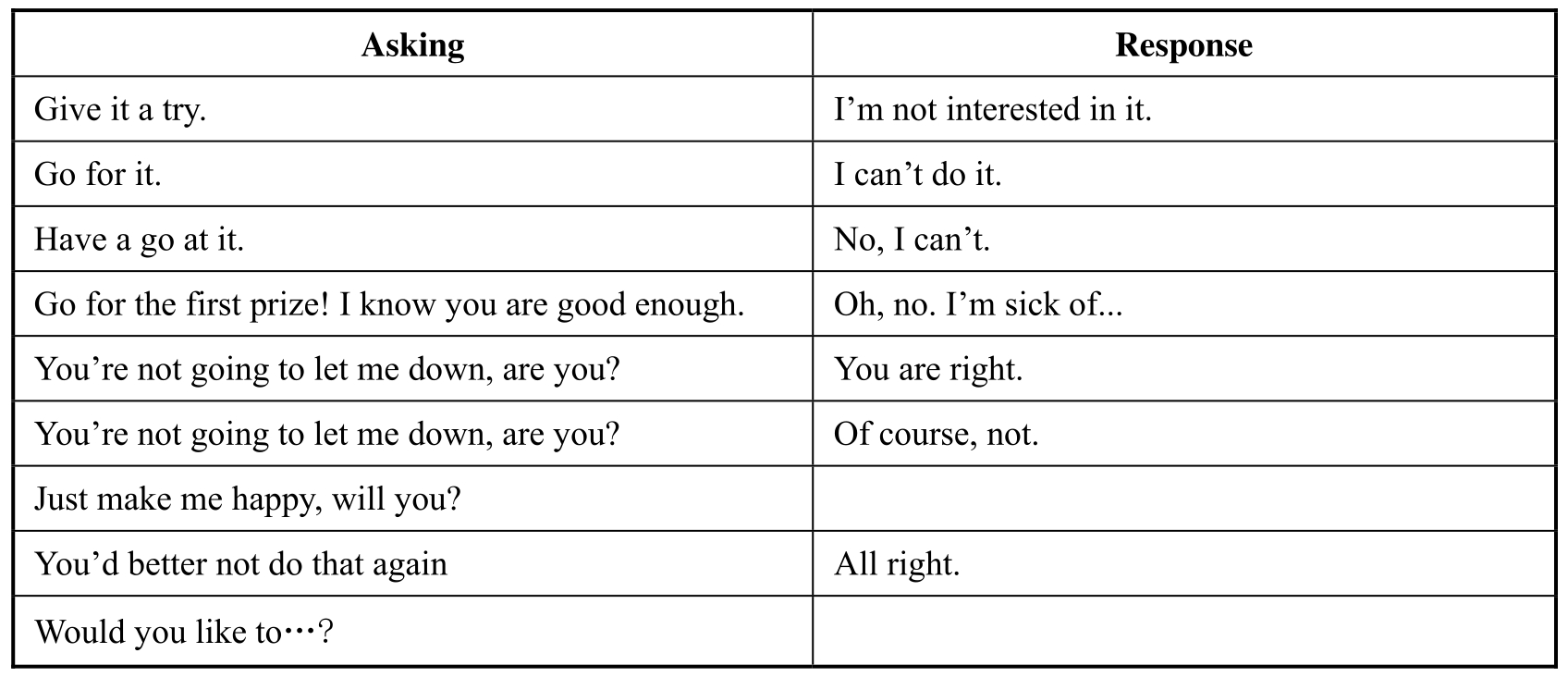
Learn the following conversations and make conversations with your partners based on the situations given below.
1) A: Would you give me a hand repairing the machine?
B: Don’t you see I’m busy now?
A: But I really need your help.
B: Why didn’t you ask Mike for help?
A: He is short of practical experience. You know it.
B: I’m extremely busy recently, so I’m afraid I can’t spare time on you.
A: I’ve never asked you for anything, so please.
B: If I go to help you, most probably, I can not finish my work on time.
A: If you can help me, I will help you. I will get my machine repaired, and you will get your job done.
B: OK, that’s a deal.
2) A: How are you getting on with your English studies?
B: Not very good.
A: What’s the matter?
B: I really can not memorize these words.
A: Rome is not built in a day. You should be patient.
B: I find it boring!
A: Nobody is born interested in something. And English has become an international language.
B: Yes, it is useful. But I just find it too hard for me.
A: All things are difficult before they are easy.
B: You are right. I should work harder on it.
Now, make conversations of persuasion based on the following situations by using the expressions above:
1) There is a party on Saturday. You want to go with your friend together, but he or she hesitates.
2) Your friend is smoking while driving, and you persuade him not to do it.
3) Your friend worried about his or her weight, you are trying to comfort him or her.
4) You want to go swimming, and you persuade your friend to go with you.
C.Activities
1. Discussion: form into two groups and discuss on the following topics: Dutch Treat Helps to Improve Relationships with Friends.
Here are some points for your reference:
Dutch treat is fair.
Paying by turns is old schoolish.
Dutch treat shows respect.
Paying for your friend shows your care.
Paying for others adds the burden.
2. Pair work: Read the following passage, and work with your deskmate to make a list of rules for the first date.
First Date Rules
First date with the girl you’ve had a crush on for ages? What everyone thought was the‘gentlemanly’ thing to do over the years, might just not be acceptable to young girls anymore. Many young girls are refusing to let the guy foot the bill alone, and believe in going Dutch, even on the first date.
“The guy paying the bill while the girl does nothing is too old schoolish,” says Ankita Suman from Amity University. “That used to happen in the olden days when men were considered superior and women weak. That’s definitely not true today, and I can take care of myself perfectly well. If I need to like him, I need to know he respects my views,” she says. When Keerthi K., a college student from Chennai, went on her first date with a boy who she really liked, she told him beforehand that they would share the bill. “The plan was to go for a movie, and then dinner. So he paid for the movie tickets while I shelled out for the food. I don’t think we would have gotten along if he hadn’t agreed to that arrangement,” she says.
The boys aren’t averse to such an arrangement either, since it tells them a lot about the girl they are dating. “If on my first date, I know that she’s not needy and doesn’t want me to take care of her, I would be overjoyed. I definitely believe in an equal relationship, and frankly, it’s not like either of us is earning or anything,” says Rahul Kumar, an engineering student from Delhi.
Yet others have different reasons for going Dutch. “My first date with a friend of many years went very, very badly. We went to a fancy restaurant, and if I had to foot the bill myself, I would have been broke for a long time after that. If I didn’t get the girl, at least I didn’t have to pay for a bad date,” says Mohit Malhotra, a junior college student from Delhi.
There are still those who believe that the person who asks the other person out should be the one to pay. Ashima Shenoy, from Jain Junior College in Bangalore, says, “I’d like my date to be chivalrous, and I think the guy paying for the first date is an old tradition. Once we start going out, there is no question of him paying all the time, but a first date is a different question altogether.”
from http://www.deccanchronicle.com/tabloids/first-date-rulesgo-dutch-or-take-hike-668
3. Read the following passage and answer questions.
Who Will Pay at a Posh Restaurant?
Most of us won’t mind handing out some cash now and then even though economic times are tough. However many of us need a break occasionally from the relentless financial pressures we face. So when you book a posh restaurant for your first date, make sure you are both aware of how the tab will be split.
The anticipation leading up to the night has set the scene for a memorable occasion. You both show up separately but on time at a prearranged restaurant that has an exceptional reputation. It goes without saying that any restaurant with a fine reputation will usually charge accordingly. You and your date have both come prepared with plenty to talk about to avoid those uncomfortable silences that can be all too familiar on a first date. Everything is going great, what could possibly go wrong?
The restaurant certainly lived up to its reputation, but they certainly know how to charge if the menu is anything to go by, and when the bill turns up at the end of the third course, you guessed right—$380 for a three course meal and two bottles of wine!!
With such a romantic environment, and you and your date seemingly forming a chemical connection, it’s pretty easy to see how you lost track of the escalating and ensuing cost.
After you and your date discuss the enormous dinner tab sitting on the table in front of you, are you both thinking the same thing (who’s paying)? As tradition goes, the man usually pays, but these days, tradition stands for little in the land of love. Or did she ask you out for dinner, so you expect that she will automatically pick up the bill? And anyway, whose idea was it to go to such a ridiculously expensive restaurant? It’s amazing how the bill at the end of dinner can sour the mood.
All the same, you can see where this is heading, so you make the noble gesture and fix up the bill, but still, that almost sour taste in your mouth has turned slightly bitter. And before you know it that all too familiar uncomfortable silence is all over the pair of you, and instead of a good night kiss, you both make a hurried exit in opposite directions.
Even though it sounds trivial at the time, it’s important to get a handle on who is payingthe bill before the night starts. No longer is it automatically assumed the man pays. Times have changed and we live in a society of equality. And if you are in doubt or are worried about offending your date, you can always go Dutch!!
You are not necessarily a cheapskate, but times are tough, so sharing the burden is something that we should all consider from time to time in order to maintain the lifestyles we are accustomed to.
from http://ezinearticles.com/?Going-Dutch-on-Your-First-Date&id=4268406
Questions:
1) How to avoid a sour feeling after an expensive dinner?
2) If you are a girl, can you accept going Dutch on the first date? Why?
3) If you are a boy, can you accept going Dutch on the first date? Why?
Ⅲ.More Practice
1. Read the passage in the appendix, make a list of suggestions for going Dutch, and then work in groups to discuss which ones are important. You may also give your suggestions in discussion.
Suggestions for Women and Men on Going Dutch
2. Read the following extracted part of a passage and list some differences between Occidental and Chinese ways of paying the bill. Do you agree with these differences? Why or why not?
Occidental Go Dutch vs
Chinese Pay the Bill
A friend asks me “Why Chinese don’t go Dutch?” So I want to regard this question as the topic and write an article. As everyone knows, Occidental will go Dutch while having a meal in the restaurant. But Chinese don’t go Dutch. Chinese will pay the bill and check out generously. Occidental don’t often entertain guests; but Chinese often invite friend to dinner. A lot of Occidentals feel puzzled to this question.
Why does such a difference exist? Because of the East and West culture and custom are different on the surface. I will analyze this question concretely.
First of all, food systems between China and Occident are different. Chinese put into practice Gather Dining System; Occidentals put into practice Individual Dining System. Everybody can share the delicious food of all over the table when eating Chinese food. Please note it is sharing; but Occidentals just eat the food in one’s own plate, if you eat beef, he eats chicken. It is impossible that you taste the flavor of his chicken. The result of the Individual Dining System is that you can only eat the food in your plate. It is unable to share. Ha-ha! What I said is right! So to eat Chinese food is happier than to eat Western-style food. And I want to ask you a question. Do you like the free thing? I think nobody don’t like the free thing. Ok! Suppose I invite you to eat the delicious Chinese food, then I pay the bill. This is equivalent to that you have enjoyed a delicious Chinese food free. So you will be very glad.
Secondly, Occidentals eat for the health; Chinese eat for the friendship. Occidental advocate individualism and independence is strong. So Occidental express that respect for each other’s independence through the way go Dutch. Chinese like making friends and solidarity. Chinese value the interpersonal relationships and friendship very much. There are a lot of folk adages in China, for example “Depend on parents at home, leave home and depend on the friend!”, “Handle affairs is easy if you have many friends!” another sentence is the more violent: “Insert the knife into both sides of the rib for friend!!!” Therefore, friend’s position is important in Chinese’s mind. The purpose that Chinese don’t go Dutch is that they don’t want to destroy the friendship between the friends. Dutch treatment is the stingy behavior in China, is unfavorable to the friends’ solidarity and is unfavorable to keeping the harmonious interpersonal relationship.
Third, it is only simple “Have a meal!” that Occidental entertain guests. It is not purpose that Chinese entertain guests, but it is the means. In Americans’ idea, “Have a meal” definition is to add fuel to the body for keeping health and normal life activity. Thus resist the attack of disease. That is to say, there is no any additional value. In the Chinese idea, “Have a meal” not only is for maintaining the health of the body, but also is a kind of life enjoyment, even is the means to promote friendship between the friends. After enjoying the sumptuous delicious food, you are glad, I am glad too, everybody is glad. The friendship between the friends has been strengthened in this kind of atmosphere.
Chinese are a nation liking treat very much. Generally speaking, one party who propose treat will pay the bill in China. But purposes are different. For example you help me to do a thing, I will invite you to dinner in order to express thankfulness to you, certainly, and I will pay the bill. Suppose I am a company manager, you are another company manager. I talk about the business with you, and I will say: “Let’s have a meal together!” Certainly, I will pay the bill. My purpose is to congratulate business’ success, promote the friendship between us, even the friendship and cooperation between two companies.
In fact, Chinese are very complicated. So I say that Chinese don’t go Dutch is not merely a kind of folkway and custom, but a means, a method, a repayment way, a way to express emotion, even is probably a kind of stratagem.
from http://www.mysteriouschina.com/occidental-go-dutch-vs-chinese-pay-the-bill/
3. Group work. Join in a group of 4 or 5 and talk with each other when you will not go Dutch and report your group work to the whole class.
Ⅳ.Assignment
Make a Speech on Olympics
The Olympic Games are a major international event featuring summer and winter sports, in which thousands of athletes participate in a variety of competitions. The Games are currently held every two years, with Summer and Winter Olympic Games alternating, although they occur every four years within their respective seasonal games. Since 2008, host cities are contracted to manage both the Olympic and the Paralympic Games, where athletes who have a physical disability compete. The Paralympics are held immediately following their respective Olympic Games.
The 2008 Summer Olympic Games took place in Beijing, China, from August 8 to August 24, 2008. Make a speech on what impressed you most during the 2008 Summer Olympic Games.